

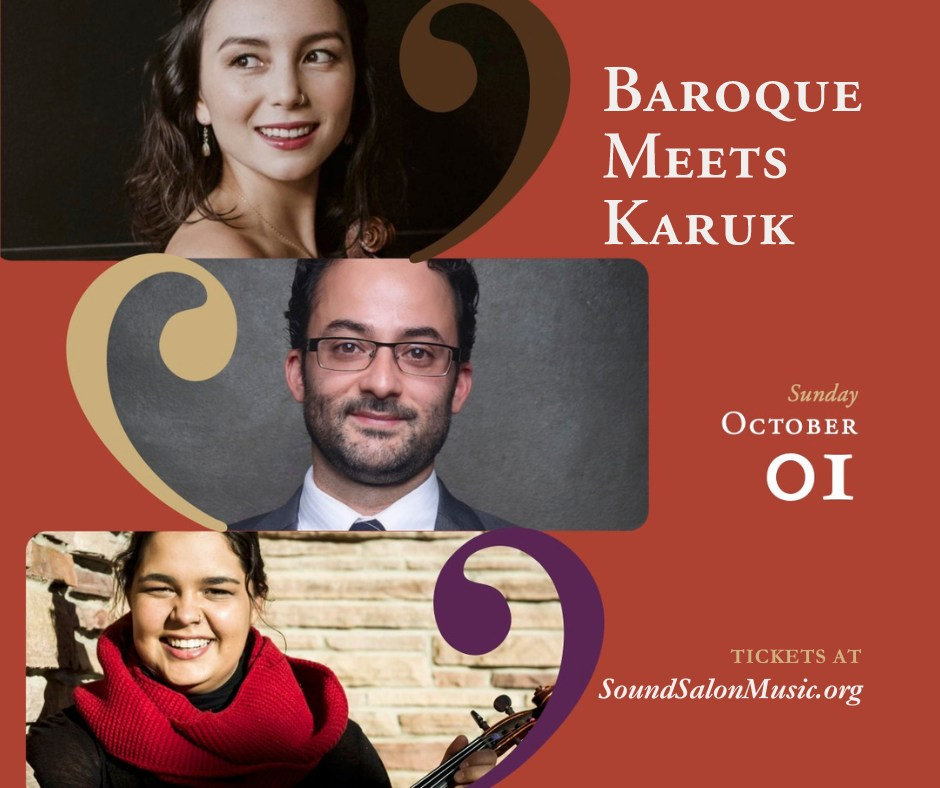
Sound Salon, formerly known as Byron Schenkman & Friends, launches a new season — and a new decade — Sunday evening with a program titled Baroque Meets Karuk. One of my fall picks for The Seattle Times, the concert begins at 7pm on 1 October at Benaroya Hall.
The chamber series has rebranded itself but remains committed to engaging and thought-provoking programs that encourage re-examining assumptions and, even more, making welcome discoveries.
This opening program, for example, will juxtapose pieces by 17th-century European composers with music from the Karuk tradition of the North American Pacific Coast, exploring connections between Spain, Italy, Austria, and the colonization of Turtle Island (now known as the North American continent).
Notes on the Program
By Byron Schenkman
We open our season with festive music from 17th-century Europe and from the Karuk tradition of what is currently known as northern California. Baroque composers of the 17th century learned from the music of diverse nations and cultures, whether by traveling themselves or by exposure to travelers.
Johann Heinrich Schmelzer likely studied in Italy before settling in Vienna where he was employed for many years as a violinist at the Habsburg court. The Spanish bassoonist Bartolomé de Selma y Salaverde was employed in Innsbruck and published music in Venice. Andrea Falconieri led the music at the Spanish court in Naples. The violinist Biagio Marini was born in Brescia and died in Venice, but also worked in Brussels and in various German and Italian cities.
Salamone Rossi was a Jewish violinist employed as concertmaster at the court in Mantua. He published many volumes of secular Italian vocal and instrumental music including the first trio-sonatas for two violins and continuo, a genre which would become standard for composers all over Europe for about 150 years. He also published a rare collection of Jewish polyphonic sacred music, starting a potential tradition which was wiped out by the destruction of the Jewish ghetto in 1630.
Like many of the women who published music in 17th-century Italy, Claudia Rusca and Isabella Leonarda were both nuns. Rusca published just one volume of sacred vocal music which also contains two short instrumental works. Leonarda was an exceptionally prolific composer who published hundreds of works including twelve instrumental sonatas.
Henry Purcell never left his native England yet his music was influenced by various international styles. Purcell’s royal employer Charles II spent his years of exile in France and much of Purcell’s theater music, including the Chaconne from “King Arthur,” is closely modeled on French music of the time. The French chaconne had its origins in an indigenous dance brought to Spain from what is now South America.
Duwamish Land Acknowledgement
Sound Salon would like to acknowledge that we are on the traditional land of the first people of Seattle, the Duwamish People past and present, and honor with gratitude the land itself and the Duwamish Tribe which has stewarded the land throughout the generations.
Filed under: Byron Schenkman, early music
 MEMETERIA by Thomas May