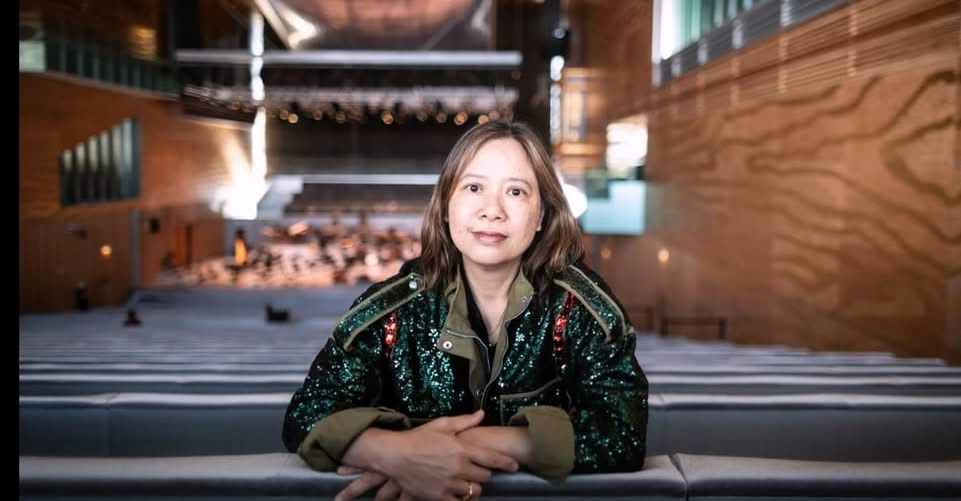
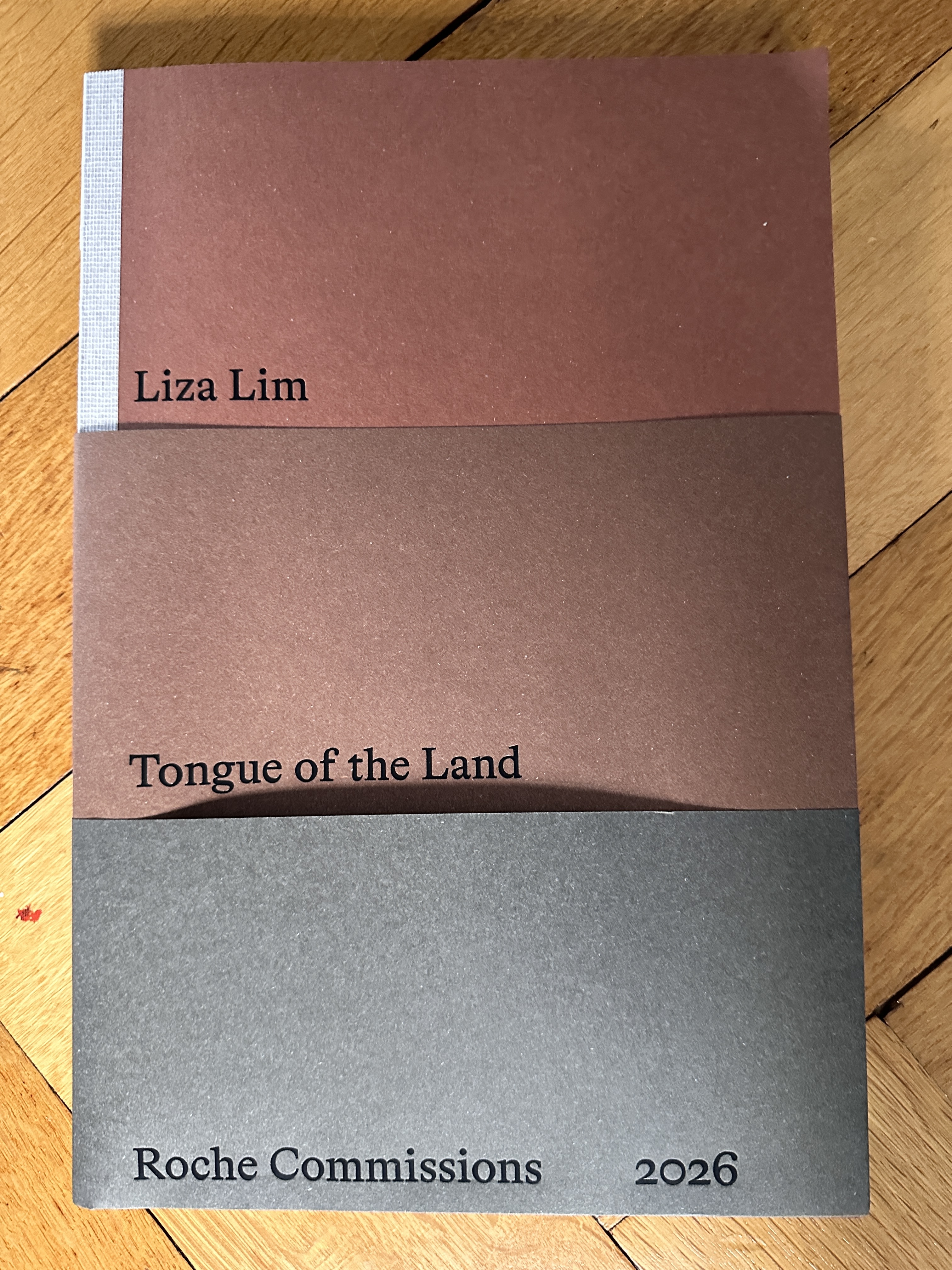
Happy birthday toLiza Lim – the day after an extraordinary world premiere at Lucerne Festival by the Lucerne Festival Contemporary Orchestra of her Roche Commissions composition Tongue of the Land. It’s a thrillingly original and powerful new work that brings a reconstructed 2,000-year-old Celtic bronze trumpet – aka the carnyx – into a modern orchestra. Lim wrote it for the trailblazing Dutch trumpeter Marco Blaauw as soloist.
Tonight – Sunday 30 August at 10pm–Midnight PDT (UTC−7) – Seattle-based composer, writer, and broadcaster Michael Schell will broadcast a new interview with Liza on Flotation Device on 91.3 KBCS, a long-running program devoted to contemporary, experimental, and improvised music. It will be available afterwards in podcast format at https://www.mixcloud.com/flotationdevice/
SRF 2 Kultur Swiss Radio has made last night’s complete Lucerne Festival concert available to listen to on demand here. The program also features Jörg Widmann as soloist in Mark Andre’s über for clarinet, orchestra, and live electronics, as well as John Adams’s Doctor Atomic Symphony. Peter Rundel’s conducting was superb – precise but passionate while navigating three entirely different sound worlds. Tongue of the Land comes at the beginning of the second half, starting just after 1:11:00. (A VPN is required to listen from outside Switzerland.)
I also had the privilege of editing the accompanying book published by Roche, which commissioned Tongue of the Land through the biennial Roche Commissions series. Brilliantly designed by award-winning designer Alexey Murashko, it traces Liza’s creative process and the remarkable journey of the carnyx into this new work. I’ll share a link as soon as it becomes available:
I had discussed the process in depth with both composers over the past spring while compiling Roche’s publication documenting and introducing their new compositions, so it was especially thrilling to be present for this moment, with such palpable creative energy emanating from the immensely talented LFCO players.
A native of Cuenca, Spain, David Moliner was born in 1991 and also performs as a percussionist — a background that has clearly left its mark on Dämonischer Iris, which begins with attention-grabbing thwacks. This is the fourth and last part of his Estructuras cycle of orchestral works that trace his evolution as a composer. Inspired by images and insights from Dante, Goethe, the Symbolist poets, and an epiphany while visiting the illusory Rakotzbrücke near Dresden, Moliner’s piece embraces the contradictions of human experience, including our latent demonic side, mostly hidden away beyond conscious awareness.
Dämonischer Iris made a very strong impression, the audience bringing the excellent conductor Jack Sheen back for another curtain call with their applause. Moliner is a gripping storyteller, creating a sense of suspense at the beginning and then moving in several unexpected directions, swerving from Ligeti-like whimsy (musicians doubling on harmonicas feature among the sound world, along with whistles and birdcalls) to dead-serious intensity as if in a stream of consciousness. After hearing Klaus Mäkelä conduct the Oslo Philharmonic in Scriabin’s Poème de l’extase the previous day, I couldn’t help but think of Dämonischer Iris as a kind of 21st-century counterpart depicting the intensely contradictory character of human nature.
Whistles and harmonicas to defamiliarize the sound, the instrumentalists. Overall thought of an essay on the idea of emotional/tone transitions in a work: where does it “go” from being a parody or ironic to dead serious? Compare this to transitions in use of musical material, the Strauss waltz, the rowdy football song. How much of the violence and terrifying music here is a sort of Freudian ID that we are trying to repress? What is the Reason here? He provokes interesting questions. Prominent descending scale figure. Big Mahlerian trombone solo (or horn?). Imaginative use of the orchestra and of creating suspense. March gestures to get the music moving, on a track. A counterpart to Poeme of Ecstasy — here the intoxication of dark impulses. Anti-ecstasy.
Hovik Sardaryan comes from Sevan, Armenia, where he was born in 1993; he and Moliner are both now based in Berlin. Ikone similarly explores what lies beyond the surface of everyday appearances — yet the two sound worlds invented by these composers could hardly be different. Sardaryan found inspiration in the work of Armenian filmmaker Sergei Parajanov as well as the theory of icons developed by the early-20th-century polymath Pavel Florensky, a Russian Orthodox theologian, engineer, mathematician, and inventor.
Florensky focused on icons as a challenge to the concept of pictorial space developed by Renaissance painters that has prevailed in the West: he explored how the spatial organization of icons from Byzantine and Russian culture negates the linear perspective the West has come to rely on to depict the “real” world. An icon, by contrast, becomes a portal between the viewer’s present reality and transcendence.
Conductor Rita Castro Blanco showed deep sympathy with Sardaryan’s complex score and confidence in how to shape its dense texture of microtonal layers and subtly, constantly shifting tempi — quite an accomplishment, as Ikone clearly showed itself to be the more challenging piece overall for the orchestra. With his astonishingly original tone colors and intriguing musical dramaturgy, Sardaryan invites us to imagine the transcendent perspective from the “other side” of an icon: unlike Wagnerian “time become space,” it suggests a moment of terrifying beauty sub specie aeternitatis.
As if all this weren’t a wonderfully full meal, Enno Poppe, this summer’s composer-in-residence, took the stage after intermission to lead the Swiss premiere of Mathias Spahlinger‘s passage/paysage, a massive orchestral opus from 1989/90 whose rarity in the concert hall is obvious in light of the immense challenges it poses. Poppe offered an elegant and engaging overview of the work and then led the LFCO in a deeply committed performance.
Spahlinger has described the Hegelian “theme” of passage/paysage as “the suspension, decomposition of order through its own regularity.” This idea manifests itself above all through the radical use of contrasts — or static non-contrasts. But the real tour de force comes in the long final section, a prolonged insistence on sonorities organized around the note B, which — as Poppe pointed out — Alban Berg famously used in the murder scene in Wozzeck as a figure for death. Poppe said he finds this among the most gripping finales in the orchestral literature, even comparing it to the dying gestures at the end of Mahler’s Ninth Symphony. The strings’ violent pizzicatos seemed to evoke incessant attempts at stoppage, at finding an ending — or perhaps a broken lyre string.
Radio SRF 2 Kultur will rebroadcast the concert on 20 September 2023 at 21:00 (CET) here.
Interview with Moliner on Dämonischer Irishere (in German)
Interview with conductor Jack Sheen on Dämonischer Irishere (in English)
The British-born, Berlin-residing Rebecca Saunders is this summer’s composer-in-residence at Lucerne Festival. Tonight brings the culminating event of her residency: the world premiere of her piano concerto to an utterance. She wrote it while working closely with the soloist Nicholas Hodges, in her signature fashion, to explore aspects of the instrument’s sound potential.
The premiere was originally to have taken place last summer and had to be postponed because of the pandemic. In another twist, Ivan Volkov, who was originally scheduled to conduct, had to bow out just last week for reasons of health. Composer-conductor Enno Poppe will lead the newly named Lucerne Festival Contemporary Orchestra. They will then take the work to Musicfest Berlin.
“The solo piano within this concerto was conceived as a disembodied voice,” explains Saunders. “It seeks to tell its own story, wavering, almost painfully, inevitably failing to sustain its uncertain striving. It seeks to attain the silence of its end through its own excessive speaking: an incessant, compulsive soliloquy on the precipice of non-being.”
The clip above is from a piece titled “Study,” based on the solo part, that Saunders presented last year at the Musikfest Berlin.
toan utterance is the tenth in the series of Roche Commissions sponsored by the pharmaceutical giant Roche. The latest composer to be commissioned has also been announced: Thomas Adés, who will write a violin concerto for Anne-Sophie Mutter to be unveiled in the summer of 2022.