Osmo Vänskä led the Seattle Symphony in a breathtaking account of Mahler’s Symphony No. 2. (Photos by Carlin Ma)
I reviewed the final concert of the Seattle Symphony season — an excellent performance of Mahler’s “Resurrection” Symphony No. 2 with guest conductor Osmo Vänskä:
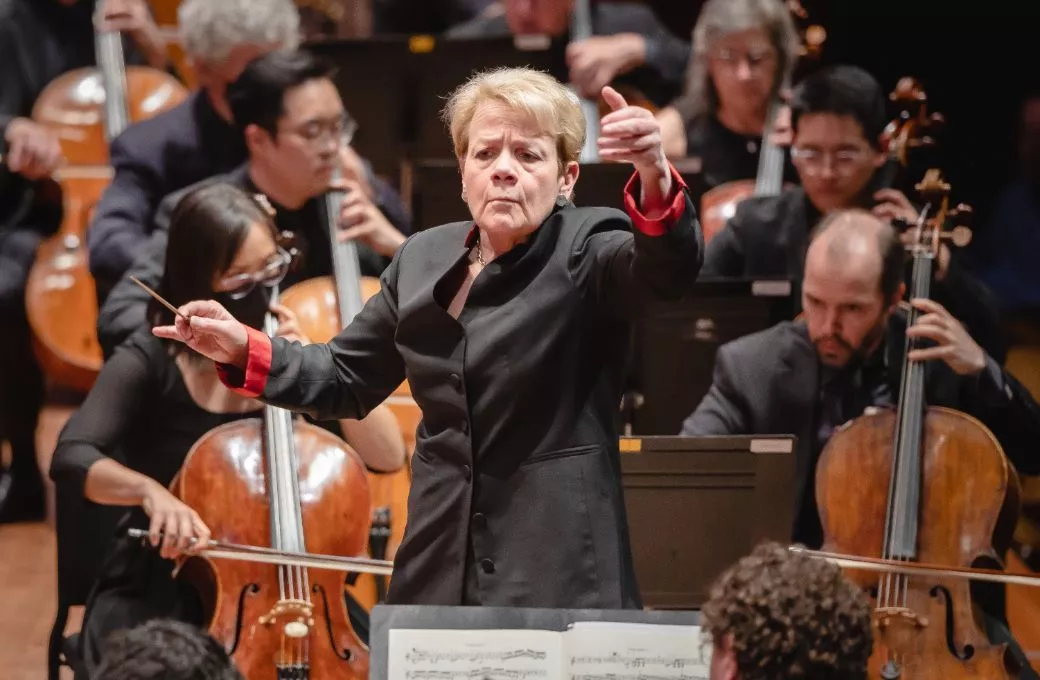
SEATTLE — The Seattle Symphony’s season of guest conductors concluded with a visit by Osmo Vänskä. On June 24, he led a breathtaking, meticulous performance of Mahler’s Symphony No. 2. Conventional program structure offers a chance to experience each visiting conductor’s skills with a variety of pieces and styles. But with the entire concert devoted to this single work, Vänskä took on the additional test of sustaining the musical narrative over the length of a feature film.
Three leaders of Pacific MusicWorks, from left, Henry Lebedinsky, Tekla Cunningham, Stephen Stubbs. ‘A healthy ecosystem needs to have an educational aspect that cultivates the next generation.’ (Photo by Elizabeth Ellis)
My feature story for Early Music America Magazine’s latest issue is now available online:
The vulnerability of our natural ecosystems makes us more aware of the fragile state of our artistic ecosystems—and how profoundly interconnected these issues are.
What happens when a city known for its early-music scene becomes too expensive for musicians?
‘Can one person save the planet? No. But you can right your own individual actions that are ethical and point you in a certain direction.’
Igor Levit takes a break rehearsing Busoni’s one-of-a-kind Piano Concerto with San Francisco Symphony
“Because it’s there” might not provide sufficient motivation to motivate the rewiring and firing of countless synapses necessary to tackle the wild behemoth that is Ferruccio Busoni’s Piano Concerto. Nor to organize the expanded orchestra plus choir of low voices that adds to the expense for a program decidedly unfamiliar to most audiences.
But it’s exactly the sort of challenge to appeal to Igor Levit and Esa-Pekka Salonen, who are both avowed fans of Busoni’s anomalous contribution to the piano concerto repertoire. Because of schedule conflicts, I was able only to experience their interpretation in the dress rehearsal on Thursday morning before the first performance that evening of this week’s subscription concerts. (Additional performances are on Saturday evening (24 June) and Sunday afternoon (25 June) — if you happen to be in the Bay Area, I can’t recommend this rarity highly enough. Do not miss!
Because of Busoni’s idiosyncratic fusion of German and Italian influences, I tend to think of Busoni as a character invented by Thomas Mann. His work suggests a Faustian striving to synthesize the contrapuntal complexity of Bach with classical grace, the stern discipline of the North with the fantasy and insatiable curiosity of Da Vinci — like Bach, one of his key inspirations. (Did the music-obsessed Thomas Mann in fact actually encounter Busoni in concert in his guise as a powerhouse pianist? What did he think of Busoni’s own treatment of Faust in his remarkable opera — for which the composer penned his own libretto — which premiered in Dresden in 1925?)
There’s even a Faustian aspect to the Piano Concerto — not only (and most obviously) in its choral apotheosis, but in its bold motley of crazy contrasts. The piece plays with Romantic clichés of diabolical, indeed possessed, virtuosity but also draws from the poetic tenderness of Chopin, the rigor of Brahms, the mysteries of Bayreuth, the kaleidoscopic soundscapes of Busoni’s contemporary, Mahler (who led the world premiere of his gorgeous Berceuse élégiaque on his final concert in New York in 1911) — only to veer into cartoonish Rossini-land, with some seasonings from Italian folk song.
Busoni composed his Piano Concerto from 1901 to 1904 and played the solo part in the world premiere on 10 November 1904 with the Berlin Philharmonic under Karl Muck (Busoni had settled in Berlin a decade before. –earlier in 1904, incidentally, he had undertaken a concert tour of the US). As James Keller points out in his program note, the composer described the work-in-progress in a letter to his wife with this commentary, accompanied by a sketch:
The enclosed drawing is crude and clumsy, but not ridiculous. . . . It is the idea of my piano concerto in one picture and it is represented by architecture, landscape, and symbolism. The three buildings are the first, third, and fifth movements. In between come the two “lively” ones, Scherzo and Tarantella: the first represented by a miraculous flower and birds, freaks of nature; the second by Vesuvius and cypress trees. The sun rises over the entrance; a seal is fastened to the door of the building. The winged being right at the end is taken from Oehlenschläger’s chorus and represents mysticism in nature.
One of the big challenges for a conductor is how to make all these elements cohere. But Salonen is clearly not only at home with Busoni’s overarching architectural concept of the 75-minute, five-movement score, but understands how to make the transitions between episodes that on the surface seem almost arbitrary — while at the same time relishing the delight and astonishment they bring. Even with a requisite intermission interpolated before the choral finale during the dress rehearsal, the Piano Concerto’s ability to draw us into a world of its own was apparent.
As for the piano soloist, Busoni has created a genuinely Shakespeare-sized role. Levit has made it his own. I was surprised to learn that he actually first took it on at the age of 18. At Davies Hall, he occasionally flexed and sipped from his water bottles and seemed surprisingly at ease — this was, after all, just hours before opening night — but remained intensely focused on the minutest detail.
The opening movement was magisterial, the stuff of great oratory, but Levit could tame his gigantic sound on a dime to produce wondrously hushed arpeggios that seemed a portal to another universe. The enormous, complex, multi-movement central movement fascinated me the most — above all, Busoni’s ability to transform the simplest, most mundane of gestures into a solemn utopia of lofty poetry. It inspired Levit’s signature depth of thoughtful concentration (the dagger-eyes he shot as some careless cell phone noise intruded were beyond deadly), which comes across on his recordings but really needs to be experienced live.
The piece frequently brought to mind a compact opera filled with interludes and comic relief, particularly in the madcap frenzy of the fourth-movement tarantella — really, an immense satire of the idea of the tarantella that approaches postmodern irony. Busoni in fact conceived writing a music drama based on the Danish poet and playwright Adam Oehlenschläger’s play Aladdin, or the Wonderful Lamp from 1805 but decided to set an extract titled “Hymn to Allah” as the choral movement that concludes the Piano Concerto.
Summing up his admiration of Busoni, Levit remarked in a recent interview with the New York Times: “Busoni has always been one of those role models I never met, in a way like an idol figure, regarding the way he thought and especially wrote about music, his utopian idea about what free music actually is, his idea about what the creator’s job is, which is to set up your own rules and not follow the rules of others. As a composer, as a pianist, as a thinker, teacher, we are speaking here of one of the most incredible minds of at least the 20th century. He was this larger-than-life figure, and I think it’s a larger-than-life piano concerto.”
To quote Busoni’s credo as formulated in his Sketch of a New Aesthetic of Music from 1907: “Music was born free and to win freedom is its destiny.”
Text from Adam Oehlenschläger’s Aladdin
V. Cantico
Die Felsensäulen fangen an tief und leise zu ertönen
Hebt zu der ewigen Kraft eure Herzen; Fühlet euch Allah nah’, schaut seine Tat! Wechseln im Erdenlicht Freuden und Schmerzen; Ruhig hier stehen die Pfeiler der Welt. Tausend und Tausend und abermals tausende Jahre so ruhig wie jetzt in der Kraft, Blitzen gediegen mit Glanz und mit Festigkeit, Die Unverwüstlichkeit stellen sie dar.
Herzen erglüheten, Herzen erkalteten, Spielend umwechselten Leben und Tod. Aber in ruhigen Harren sie dehnten sich Herrlich, kräftiglich, früh so wie spät. Hebt zu der ewigen Kraft eure Herzen Fühlet euch Allah nah’, schaut seine Tat! Vollends belebet ist jetzo die tote Welt. Preisend die Göttlichkeit, schweigt das Gedicht!
Translation by Noam Cook:
Low and Soft the Stone Columns Begin to Resound
Raise up your hearts to the eternal force; sense the closeness of Allah, behold his deeds! Joy and grief alternate in earthly light; while the pillars of the world stand in repose. Thousands upon thousands upon thousands of years, as calm in their force as now, flash sedately by with radiance and steadiness, representing the irrepressible.
Hearts glowed, hearts grew cold, playfully life and death alternate. Yet waiting quietly they persist blissfully, forcefully, both early and late. Raise up your hearts to the eternal force sense the closeness of Allah, behold his deeds! Now the inanimate world is enlivened fully. Praising the divine, the poem is silent!
Christina Scheppelmann, General Director of Seattle Opera. Photo by Philip Newton
Seattle Opera announced today that its general director, Christine Scheppelmann, will take on the reins at La Monnaie/De Munt in Brussels, Belgium, in 2025, after her five-year contract in Seattle concludes.
“I love being here,” Scheppelmann toldSeattle Times‘ Janet I. Tu. “But they made me an offer I couldn’t refuse.”
Scheppelmann is the fourth general director in the company’s history. Her final season will therefore be the already announced 2023-24 season, which begins in August.
Regarding the search for Scheppelmann’s successor, Seattle Opera indicated only this: “Seattle Opera’s Board of Trustees is committed to continuing to produce the highest-quality artistic experiences and programming with artists from around the world. The board invites the community to celebrate the achievements of Scheppelmann’s tenure and looks forward to new artistic and programming opportunities that will grow opera audiences for the future.” Meanwhile, Seattle Symphony continues to lack a music director — that search is still under way, with no update on its progress.
“Under Scheppelmann’s leadership, the company produced a world premiere, launched cornerstone programs, expanded its community partnerships, and brought over 100 new artists to Seattle for company debuts, with nearly 50 coming from abroad,” according to Seattle Opera’s press release.
“Leading Seattle Opera is a tremendous opportunity,” said Scheppelmann, who came to Seattle from the Gran Teatre del Liceu in Barcelona. “The company boasts an incredible staff, orchestra, chorus, and crew, as well as a wonderful, supportive audience, all of whom I will miss greatly. I love this city and the opera community in this region, which has welcomed me wholeheartedly. I could not pass up the opportunity to lead one of the great European opera companies while also being closer to my family. But for now, there is much work to do and more opera to come in the year ahead, and I look forward to sharing what we have in store.”
“Seattle Opera has been fortunate to collaborate with a general director of Christina’s caliber, and thanks to her leadership, the company is well positioned to build on its successes,” said Board President Lesley Chapin Wyckoff. “That Christina has accepted an offer to head one of Europe’s most important opera companies is a testament to her abilities and her excellent work in Seattle, which has ensured a bright, promising future for Seattle Opera. We could not be more proud of what she has accomplished here and we wish her the best in this exciting new opportunity.”
On 9 June 1921, Prague’s State Opera hosted the Czech premiere of Arnold Schoenberg’s early masterpiece Gurre-Lieder, based on a 14th-century Danish legend. For the first time in 102 years, the State Opera will again present the work on Tuesday, 20 June 2023 at 19:00 Prague time. Details here.
Schoenberg’s mammoth score calls for a small army: almost 250 singers and instrumentalists will be on hand, including the Prague Radio Symphony Orchestra and the Norwegian Radio Orchestra, with Petr Popelka conducting.
This is a co-production between the National Theatre Opera and the State Opera, Musica non grata, Prague Radio Symphony Orchestra and Norwegian Radio Orchestra. Performed in the German original, with Czech surtitles. Part of the Musica non grata project, the program will contribute to the celebrations marking the centenary of Czech Radio.
“The inclusion of the Gurre-Lieder in the Musica non grata cycle and its return to the State Opera is entirely logical, as it was at this very venue, formerly the Neues deutsches Theater, where, on 9 June 1921, the masterpiece received its Czech premiere, conducted by Alexander Zemlinsky, one of Musica non grata’s central figures,“ said Per Boye Hansen, Artistic Director of the National Theatre Opera and the State Opera. Arnold Schoenberg worked on the monumental cantata on and off for 11 years, starting in 1900 and finishing in 1911. The Gurre-Lieder was first performed on 23 February 1913 in Vienna under the baton of Franz Schreker. It is based on Jens Peter Jacobsen’s 1868 poem cycle Gurresange, inspired by the medieval Danish legend, set at the Gurre Castle, telling the tragic love story of King Waldemar and his mistress Tove Lille (Little Tove), murdered by Queen Helvig. The grief-stricken King curses God and is consequently condemned to fly for ever with his dead minions through the night sky, seeking his beloved Tove, who has transfigured through the magnificence of Nature. Schoenberg’s cantata features some 35 leading motifs depicting not only the main characters but also natural phenomena (sunset, sunrise, galloping horses, etc.) and a variety of emotional states (desire, affection, fear, mourning, etc.). Noteworthy too is the fact that in the Gurre-Lieder Schoenberg employed for the very first time the Sprechgesang, a “spoken singing” technique. “I find it immensely exciting that at the time when Schoenberg shocked the world with Pierrot lunaire, ushering in a brand-new musical-aesthetic style, in the Gurre-Lieder he brought to bear to great acclaim for the last time the Late-Romantic idiom of the early 20th century,” Per Boye Hansen added.
Stellar Czech and foreign singers will appear at the State Opera. The solo parts in the Gurre-Lieder have been assigned to artists of such renown as Michael Weinius, a regular guest at the Wiener and Bayerische Staatopers; the Grammy Award winner Dietrich Henschel; the German soprano Susanne Bernhard; the Norwegian baritone Yngve Søberg, a finalist of the prestigious International Hans Gabor Belvedere Competition; and the Czech mezzo-soprano Štěpánka Pučálková. Schönberg’s gigantic cantata will be performed by a formidable body of almost 250 vocal and instrumental forces, including the Prague Radio Symphony Orchestra (SOČR), the Norwegian Radio Orchestra (KORK), the Czech Philharmonic ChoirBrno and the Slovak Philharmonic Choir, conducted by Petr Popelka, Music Director of the SOČR and the KORK. “I deem the Gurre-Lieder one of the most marvellous compositions in the history of music, the crowning glory of the entire evolution of tonality, hence I feel greatly honoured to have been afforded the opportunity to conduct a performance of it. I also cherish the fact that, after more than a hundred years, we will bring the Gurre-Lieder back to the venue where it was presented under Alexander Zemlinsky. The SOČR and the KORK are top-notch European orchestras, and I believe that binding together their singular energies will enrich their players musically and personally, giving rise to a truly remarkable experience,” Petr Popelka pointed out.
The performance in Prague of the Gurre-Lieder is a co-production between the National Theatre Opera and the State Opera, the Prague Radio Symphony Orchestra, the Norwegian Radio Orchestra and the Musica non grata cycle, funded by the Embassy on the Federal Republic of Germany to the Czech Republic. The concert on 20 June at the State Opera will be broadcast live from 7 pm on Czech Radio Vltava and the Norwegian radio channel NRK P2. The evening will be recorded by Czech Television. “Rarely indeed is a work of this magnitude performed in Prague, or anywhere else for that matter. We are talking decades. For the members of the orchestras it may even be a once-in-a-lifetime opportunity. Fortune dealt us a kind hand and, owing to many favourable circumstances, we can perform the famous opus within the celebrations of the centenary of Czech Radio. I believe that the radio and television recordings, as well as the audio document of the concert, will offer music lovers the possibility to acquaint themselves with this extraordinary piece,” Jakub Čížek, Director of the SOČR, added.
Gurre-Lieder 20 June 2023, State Opera, 7 pm Music: Arnold Schoenberg (1874–1951) Text: Robert Franz Arnold (1872–1938), based on a poem cycle by Jens Peter Jacobsen (1847–1885)
Conductor: Petr Popelka Prague Radio Symphony Orchestra Norwegian Radio Orchestra Czech Philharmonic Choir Brno Chorus master: Petr Fiala Slovak Philharmonic Choir Chorus master: Jozef ChabroňWaldemar: Michael Weinius Tove: Susanne Bernhard Wood Dove: Štěpánka Pučálková Peasant: Yngve Søberg Klaus the Jester: Kevin Conners Speaker: Dietrich Henschel
I reviewed this past weekend’s Seattle Symphony program with guest conductor Marin Alsop:
There was nothing star-crossed about Marin Alsop’s guest appearance with the Seattle Symphony. Fortune turned its wheel to allow for a happy, if long-overdue, collaboration following an absence of almost two decades from Benaroya Hall….
Happy 100th birthday, San Francisco Opera! Friday night’s big celebration concert, writes Joshua Kosman was “an aptly celebratory evening — warm, communal and full of sparkling music to help observe the landmark. It also augured well for the company’s future in an uncertain environment.”
San Francisco Opera’s “100th Anniversary Concert” bows with Karita Mattila, Brandon Jovanovich, Daniela Mack, Lawrence Brownlee, Ailyn Pérez, Michael Fabiano, Susan Graham, Lucas Meachem, Nina Stemme, Brian Mulligan, Patricia Racette, Russell Thomas, Heidi Stober, Christian Van Horn, and Adela Zaharia with the San Francisco Opera Chorus. Photo: Drew Altizer Photography
Thursday is opening day of the 2023 Ojai Music Festival. This year’s edition is curated by Music Director Rhiannon Giddens together with Artistic Director Ara Guzelimian. Links:complete lineup of performances and2023 program book, which include my notes and commentary, along with an introduction to the themes of the festival.
You can watch the Libbey Bowl concerts via livestream on the OMF homepage: To watch the 2023 Festival’s free Live Stream of Libbey Bowl concerts, please visit our homepage at concert time beginning on Thursday, June 8. The live stream video will appear at the top of the page for viewing.
Composer Wang Lu, whose “The Nothing Man and Other Tales” will have its premiere with Seattle Modern Orchestra June 3. (Matt Zugale)
This weekend, Seattle Modern Orchestra gives the world premiere of Wang Lu’s The Nothing Man and Other Tales. I wrote about this wonderful composer for TheSeattle Times:
“I’ve always been interested in storytelling,” says composer and pianist Wang Lu. “We all crave stories.”
Wang’s latest composition, “The Nothing Man and Other Tales,” taps into this human hunger by recounting a series of stories she discovered in a children’s book that her daughter has been enjoying. Her musical treatment transforms these tales into adventures for adult ears.





 MEMETERIA by Thomas May