
Here’s my review for Musical America of the American premiere of Kaija Saariaho’s final opera, Innocence, which was presented by San Francisco Opera this month:
Filed under: Musical America, review, Saariaho, San Francisco Opera

June 24, 2024 • 11:29 am Comments Off on The Pain and Insight of Saariaho’s “Innocence”
Here’s my review for Musical America of the American premiere of Kaija Saariaho’s final opera, Innocence, which was presented by San Francisco Opera this month:
Filed under: Musical America, review, Saariaho, San Francisco Opera
June 17, 2024 • 3:47 am Comments Off on Adams’s Early Masterwork “Harmonium” Strikes a Chord in Seattle
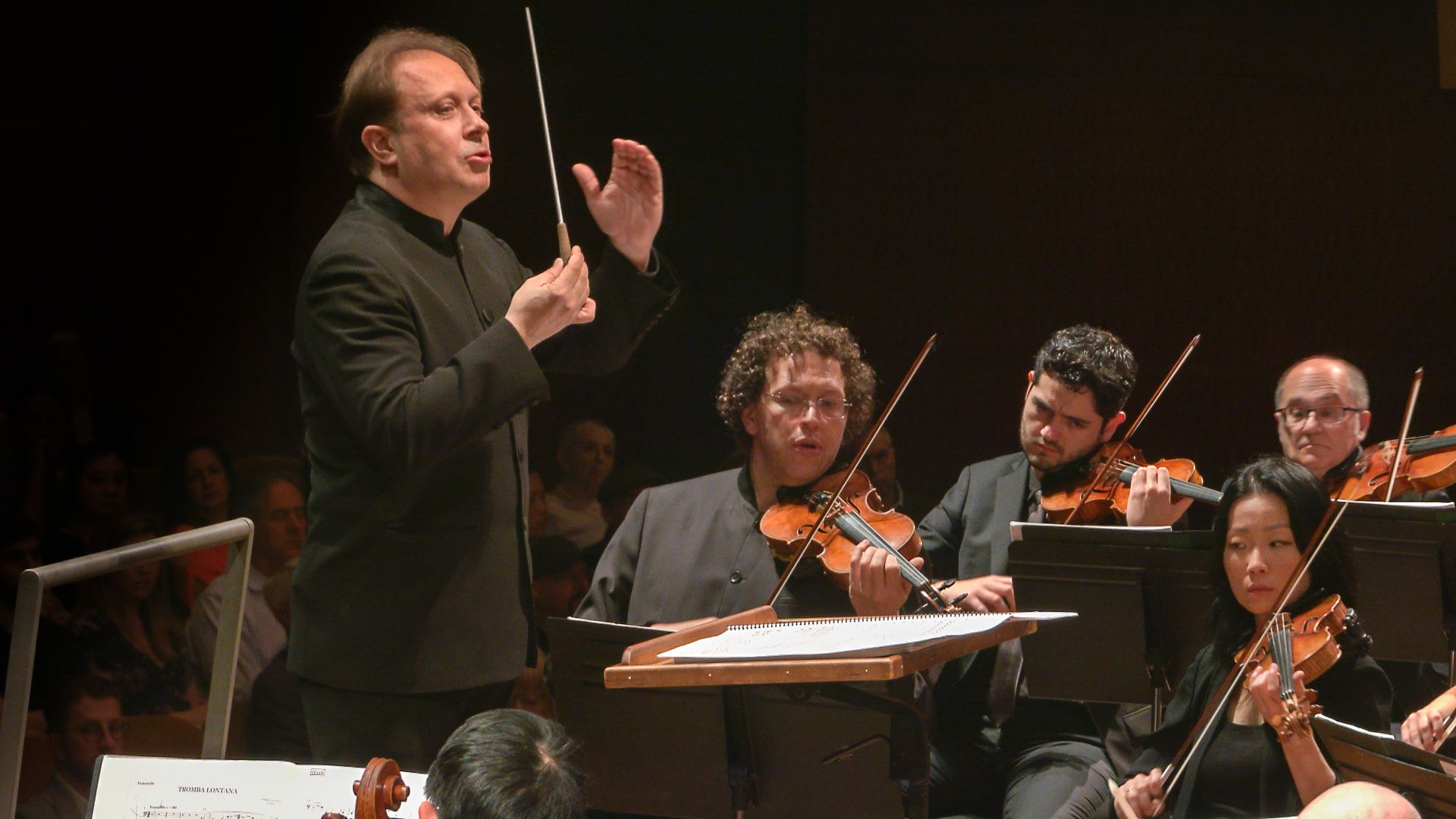
For their second-to-last program of the season, the Seattle Symphony added John Adams’s early breakthrough Harmonium to its repertory with a breathtaking performance led by Conductor Emeritus Ludovic Morlot. During the 1970s, Adams had been building a reputation as an experimental composer doing his own thing in the Bay Area. He had become an advisor on contemporary music to the San Francisco Symphony’s then-music director Edo de Waart and received a commission to write a big choral-orchestral piece to help the orchestra celebrate its first season in Davies Hall, SFO’s new home across the street from the War Memorial Opera House. The premiere in April 1981 was a sensation that launched Adams on his path toward international stardom.
In his guise as a conductor, Adams has paid multiple visits to Seattle to lead the musicians in various of his own compositions and regards the SSO as “an excellent orchestra.” So it was especially satisfying to finally hear the collective forces of the SSO and its Chorale perform this pivotal work from more than four decades ago for the first time.
As it happened, I’d just come from hearing the original septet version of Adams’s 1978 piece Shaker Loops the week before at the Ojai Music Festival (performed by members of the visiting Mahler Chamber Orchestra, with fresh birdsong obbligato from the trees surrounding the outdoor Libbey Bowl). Adams had adopted the idioms of Minimalism in his distinctive, “impure” way in Shaker Loops and does something similar in Harmonium, but working for the first time with the much larger canvas of symphony orchestra and chorus. It was interesting to notice that some of the DNA of Shaker Loops is still present in varied form in Harmonium. At the same time, aspects of the signature language Adams would go on to develop (mostly orchestral, but in some respects choral as well) also appear in this score — certain timbral gestures from the tuned percussion, a shine that anticipates Grand Pianola Music (1982), or the stirring choral “pillars” found in the operas.
But the very fine performance led by Morlot kept me from falling into the trap of viewing a great artist’s early work merely contextually, as a launching pad toward future greatness. Harmonium proved completely compelling on its own terms, a splendidly structured choral triptych that conveys states of transcendence, serene contemplation, and unbridled joy.
Adams initially considered setting texts from the Wallace Stevens collection called Harmonium and then thought of writing for a wordless chorus, relying on their pure sounds, before he found a basis for what he imagined — “human voices — many of them — riding upon waves of rippling sound in John Donne’s “Negative Love” and two poems by Emily Dickinson: “Because I Could Not Stop for Death” and “Wild Nights.”
Morlot showed his sensitive understanding of Adams’s dramatic use of sudden harmonic modulations — at this stage in his career, the composer had been likening it to the process of “gating” in electronic music — and shaped the sense of progressive revelation via negation in the opening Donne section with a tenacious clarity.
The Chorale, excellently prepared by Joseph Crnko, encompassed an enormous sonic spectrum, from mystic whispers to ecstatic, Whitmanesque yawping that sent shockwaves crashing through Benaroya Hall. (Fittingly, the concert had begun with Tromba lontana, an “anti-fanfare” from 1986 in which the composer uses a pair of trumpets to sound an elegiac rather than military mood, calling to mind Whitman’s poem “The Mystic Trumpeter.”) Adams’s guiding image of surging waves of sound came to life most thrillingly in the final “section”Wild Nights” movement, a drastically contrasting juxtaposition with Dickinson’s death meditation preceding it.

One of the most unforgettable moments in Harmonium is the seamless transition between the polar Dickinson poems, in which Adams builds up an irresistible, orgiastic flow of momentum. Beethoven’s Fifth Symphony, which occupied the second half of the program, happens to offer a plausible parallel in the musical “tunnel” that interlinks its last two movements.
Curiously, the program on which Harmonium was given its world premiere in San Francisco also involved a Beethoven pairing: in that case, with the Emperor Piano Concerto No. 5 — a work whose aura Adams confronted the next year in his wonderfully over-the-top Grand Pianola Music. On this occasion, Morlot — in his first reunion with the SSO since the sadly under-attended opening night of the season last September — approached the Beethoven with a clear sense of proportions and architecture. And with a bigger, more-rounded sound overall than in his Beethoven interpretations of several years ago, when he was music director.
Morlot held back from imposing an “interesting” perspective on the score, following Beethoven’s command of a single eighth-note rest between the first two statements, for example. He followed all of the repetitions — including, a bit surprisingly, even in the Scherzo. Still, the vision that emerged was more finale-centric, it seemed to me, with the terseness of the opening movement as a mere station on the way forward rather than an existential state. Despite brisk tempi, Morlot shaped the eccentrically long-spun melody of the Andante’s main theme with style and drew a magnificent dark sheen from the strings in particular, with bold strokes in the finale.
If aspects of the Scherzo felt understated, Morlot steered clear of the feeling of anti-climax that deflates so many renditions of the finale. The return of the ominous Scherzo music actually felt surprising, and the insistent paragraphs of C major brought to mind something of the French Revolutionary era music that was a clear inspiration for the young Beethoven.
review (c) 2024; all rights reserved Thomas May
Filed under: Beethoven, John Adams, Ludovic Morlot, review, Seattle Symphony
June 5, 2024 • 8:01 am Comments Off on 2024 Ojai Music Festival
With Mitsuko Uchida as Music Director, this year’s Ojai Music Festival from 6-9 June promises an intriguing mix of Mozart piano concertos, early Modernist masterpieces (with a focus on Arnold Schoenberg), and pieces by contemporary composers who hold special significance for her. I had the privilege once again of writing the program notes, which are available here.
Visit OMF’s homepage for livestreams and replays of the concerts here.
Filed under: Mozart, Ojai Festival, program notes, Schoenberg
 Arts & Culture Stories from NPR
 MEMETERIA by Thomas May