You know that chilling moment when you try to introduce a friend to a piece of music you love — a piece of music that contains a little bit of the world’s meaning for you — and … nothing? That moment when it doesn’t just fail to register, but the other party has no interest in trying to figure out what turned you on in the first place?
This phenomenon can be shocking when you’re dealing with someone who normally does have some sort of musical response but who remains immune to the piece in question. I vividly recall trying to introduce an acquaintance years ago to the Heiliger Dankgesang from Beethoven’s Op. 132 — which is about as transcendent as music gets, as far as I know it — and being appalled by the evident reaction of boredom. For a moment, it felt like some sort of variant on the uncanny valley phenomenon.
I think we’ve all been there, but what I find truly unfathomable is an existence without music. Yet it turns out a new study whose results were just published in Current Biology suggests that music simply may not be as “universal” as we like to believe it is. A team of psychologists at the University of Barcelona found that possibly up to 5% (!) of the population cannot take pleasure in music — any music. Some people are simply, or rather, biologically, incapable of enjoying it, no matter how accessible we try to make the experience.
This is distinct from the well-known phenomenon of amusia and similar dysfunctions Oliver Sacks has described in Musicophilia. The Barcelona study also points out that the 30 student volunteers who participated — “healthy people with specific musical anhedonia” — “do not find music pleasurable, but enjoy other rewarding stimuli.”
From the abstract of the article (“Dissociation between Musical and Monetary Reward Responses in Specific Musical Anhedonia”):
Music has been present in all human cultures since prehistory, although it is not associated with any apparent biological advantages (such as food, sex, etc.) or utility value (such as money). Nevertheless, music is ranked among the highest sources of pleasure, and its important role in our society and culture has led to the assumption that the ability of music to induce pleasure is universal. However, this assumption has never been empirically tested.
In the present report, we identified a group of healthy individuals without depression or generalized anhedonia who showed reduced behavioral pleasure ratings and no autonomic responses to pleasurable music, despite having normal musical perception capacities. These persons showed preserved behavioral and physiological responses to monetary reward, indicating that the low sensitivity to music was not due to a global hypofunction of the reward network. These results point to the existence of specific musical anhedonia and suggest that there may be individual differences in access to the reward system.
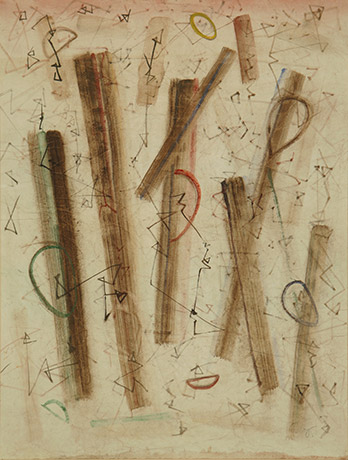
Currently on view as a counterpart to the Frye Museum’s Noguchi exhibit is Mark Tobey and Teng Baiye: Seattle/Shanghai. The latter, more modest in scope, also attempts to break new ground in considering cross-cultural connections and impulses shared between artists.
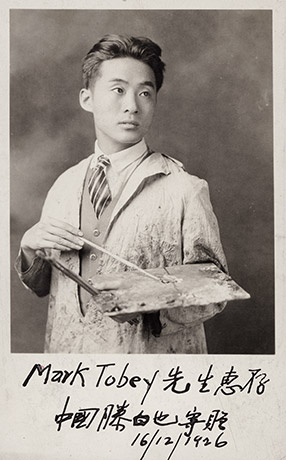
The American painter Mark Tobey (1890-1976) found himself at a turning point in his career when he discovered inspiration from the East. And, as with the Noguchi on display in the companion exhibition, a component of that inspiration was mediated early on by friendship with a Chinese artist. The friend in Tobey’s case, Teng Baiye (1900-1980), had moved to Seattle to study art at the University of Washington and met Tobey in the early 1920s.
Seattle was the city where Tobey had chosen to move in order to reboot his life and art after a disastrous attempt at marriage. (He eventually met his life partner, the Sweden-born Pehr Hallsten, in Ballard, according to one account.) Around three decades later, Life Magazine published its famous article hailing four “mystic painters of the Northwest,” which cemented Tobey’s image as a leading figure of the so-called “Northwest School.”
Portrait of Teng Baiye with dedication to Mark Tobey, 1926. Photograph. University of Washington Libraries.
Tobey’s early friendship with Teng gives this glimpse into his mature work its focus. The younger Teng taught Chinese calligraphy to Tobey, who later visited his friend in Shanghai in 1934. But with the onset of the world war looming, Tobey lost contact with his friend and never heard from him again. Some very intriguing questions emerge from this juxtaposition: what interpretation of a complex traditional aesthetic did Teng mediate, and what role did this play in Tobey’s evolution of his characteristic “white writing” style?
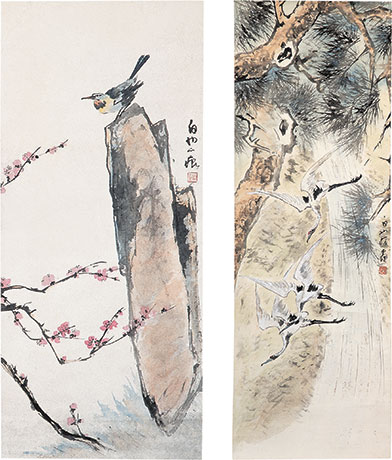
The exhibit is also about mirroring, and the same should be asked in the other direction as well: what did Teng take away from his time in Seattle, what did he gain from his friendship with Tobey? The shocking fact is that we apparently have so little to work with. The two ink-and-paper scrolls on display represent the only works by Teng on display.
left: Teng Baiye, Bird on Rock, before 1949. Ink and paper mounted on scroll. Collection Bao Mingxin right: Teng Baiye, Cranes and Pine Tree, before 1949. Ink and paper mounted on scroll. Collection Bao Mingxin.
Teng’s absorption of Western influences made him suspect back home as China struggled toward its postwar identity as a nation. Teng became a victim of Mao’s Cultural Revolution and was released from forced manual labor just a few years before his death. The vast majority of his artwork appears to have been destroyed — perhaps other works have survived in private hands, but the sparse knowledge we have is one of the points here. (Even the transliteration of Teng’s name has been maddeningly inconsistent among books in English, adding to the confusion over his legacy.)
Meanwhile, as Life elevated Tobey to a new level of fame, questions about the identity of American artists in the postwar years were also taking on new urgency. But from today’s post-Cold War, global perspective, are we able to discover mutual influences beyond the mutual stereotypes of “East” and “West” that prevailed in the past century? As Tobey himself wrote:
Man today is challenged to extend his mental and spiritual horizons. Geographical barriers have given way before the light of science, invention and psychology. The great inventions that have demolished the former sense of special difference must await a new man who will use them positively. But this new will have seen a great light which burns away the barriers of prejudice and religious antagonism. The art of the future cannot germinate in antagonism and national rivalry but will spring forth with a renewed growth if man in general will grow to the stature of universal citizenship.
David Wallis explores the psychology and cultural implications of hoarding in a recent essay for Nautilus. He points out that for the first time, the Diagnostic and Statistical Manual of Mental Disorders (DSM) has listed hoarding as a clearly defined disorder. (And the topic fueled six whole seasons of A&E’s series about the havoc wrought by compulsive hoarding.) Wallis cites figures from the American Psychiatric Association claiming that “2 to 5 percent of the United States population suffers from” this disorder.
This point especially caught my attention: “Those with hoarding disorders, then, have an amplified sense of something that all of us cherish: Our deepest feelings for our families and close friends, and our artistic sensibilities.”
But apparently hoarders suffer from a weakening of capacity alongside this tendency to amplify positive qualities. This weakness involves problems with wiring in the part of the brain responsible for “motivation, executive control, and response to conflict.” Those suffering from a hoarding complex often “avoid the anxiety of throwing something away” simply by deferring the decision indefinitely. Wallis consulted with Monika Eckfield, a professor of physiological nursing at California State University, San Francisco:
“This is common to all of us,” Eckfield says. Like the neuroscientists, she believes hoarding becomes abnormal as a result of “mis-wiring” in the brain’s executive functions. Chronic hoarders “have a much harder time following through,” she says. “They get distracted. They get disorganized. They end up adding to the pile, and the idea of sorting through those piles is very overwhelming.”
Wallis concludes:
Modern science has clearly revealed why hoarding deserves the designation of “disorder”: It is reflected in physical differences in how the brain is wired. At the same time, it is something that reflects to us some of the qualities and decisions with which we all struggle: Consumerism, attachment, decision-making, time management — and, at some level, survival. I’m left wondering if it is any coincidence that it was in 2013, when society demands so much from us in each of these capacities, that hoarding has taken on full-fledged disorder status in the DSM-V handbook.
Admittedly this may seem like an odd leap to make, but it occurred to me that the phenomenon of “holding on” — of wanting to preserve a sense of the musical past — started becoming a serious factor in Western music during another period of intense social and political change: after the French Revolution and during the upheavals of the early 19th century. Within a few decades, a dramatically new paradigm had become the prevailing attitude.
Mendelssohn’s famous performance of Bach’s St. Matthew Passion is just one example of this shift toward the concept of timeless masterpieces that should be handed down to the future. The old habit of allowing music to recede into oblivion with past generations — a consumable object that quickly went out of fashion — gave way to the permanent “canon” and an entirely new model of music history that continues to influence the way we think about composers today and even how composers think of themselves.
The dawn of recording enabled an exponential expansion of this tendency. Even more, it allowed for endless sifting through the past to make the claim for composers who had fallen through the cracks but who deserve rediscovery. If the “anxiety of influence” demands a kind of creative mutilation of the looming giants of the past, could it be that the canon — not so much who belongs to it but the rationale behind it — provokes an anxiety not unlike that found with hoarding?
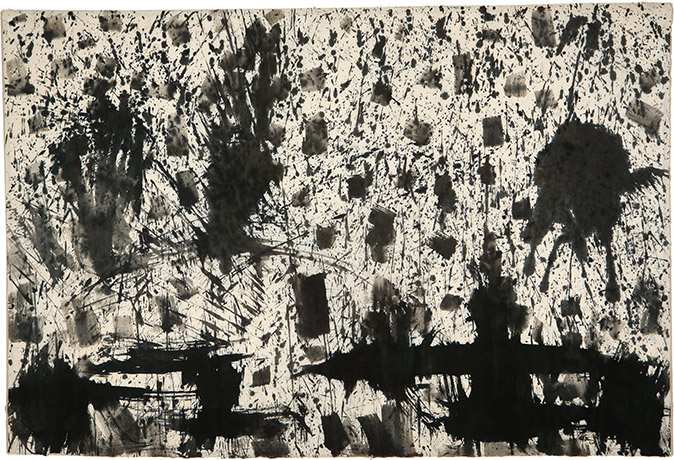
Isamu Noguchi. Peking Drawing (man reclining), 1930. Ink on paper. The Noguchi Museum.
Variations on the East-meets-West meme are certainly familiar in art history, but the details really do matter. Take the case of Los Angeles-born Isamu Noguchi, the son of an “East weds West” union.
Noguchi’s hugely influential career as a sculptor, landscape architect, and furniture designer is usually examined with reference to the inspiration he found in Japan during his initial sojourn there in 1931. But the exhibition Isamu Noguchi and Qi Baishi: Beijing 1930, which just opened at Seattle’s Frye Museum, brings us fascinating insights about the impact of a very different Asian source: the fruit of Noguchi’s six-month-long visit to Beijing (then known as Peking) from July 1930 to January 1931.
Having spent some time in Paris thanks to a Guggenheim grant — where he worked as Brâncuși’s assistant — Noguchi was already developing a reputation with his abstract sculptures (and celebrity portrait busts to bring in cash). After returning to Paris for a show, he headed East but decided to make a lengthy detour from his intended destination of Japan and stopped in Beijing.
It was during this period of intense personal introspection that Noguchi was introduced to the master ink painter Qi Baishi (1864–1957). As had been the case with Brâncuși, they shared no mutual language in the conventional sense — Noguchi spoke no Mandarin, Qi no English — yet the young artist, in search of a father figure, discovered a remarkable affinity for Qi’s work. (During his deferred trip to Japan, he hoped to make a connection with his estranged real father, the writer Yone Noguchi.) They became friends, and Qi mentored Noguchi in the medium of brush ink paintings.
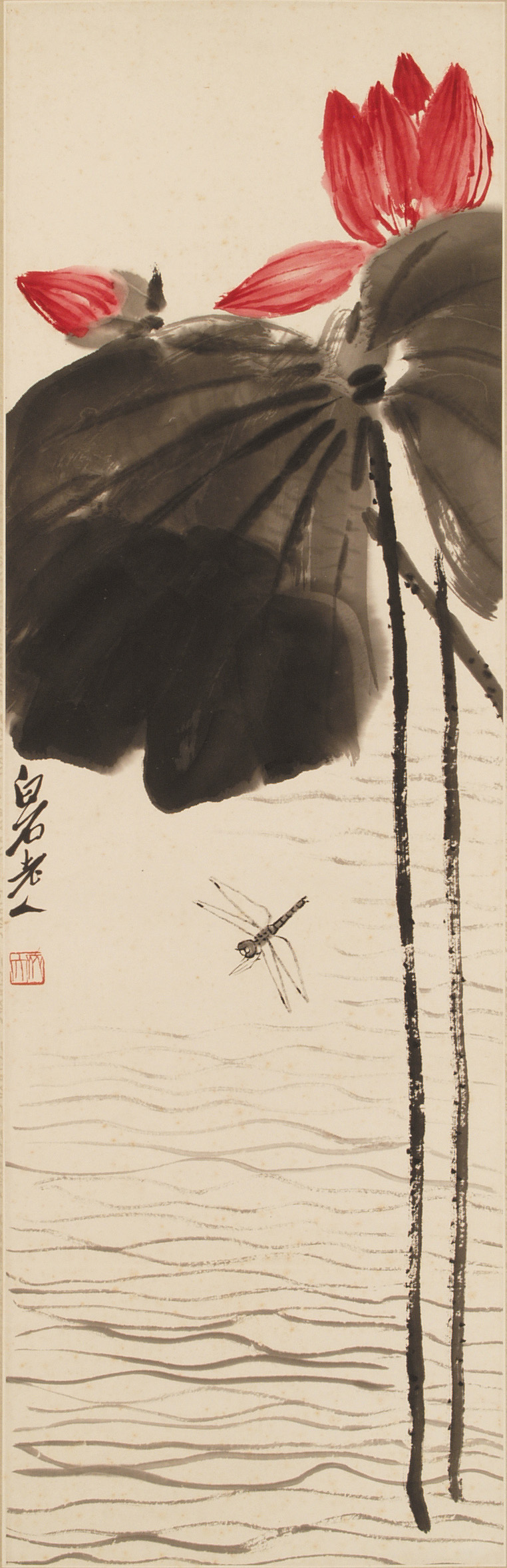
Qi Baishi. Lotus and Dragonfly, 20th century. Hanging scroll, ink and color on paper. Michael Gallis Collection. Photo: Dennis Nodine
The result was more than 100 ink paintings known as the Peking Drawings. This exhibit, curated by Natsu Oyobe, is the first time a substantial number of these have been displayed alongside the work of Qi Baishi. “I did figure drawings, because that was what I knew how to do,” wrote Noguchi. “How ashamed I was of my limitations when I visited the painter Qi Baishi, whom I adopted as a teacher.” A selection of drawings created just before this life-changing trip is also on view, allowing us to assess the impact of Qi and other Chinese artists.
Especially striking is the difference in subject matter Noguchi chose, in contrast to the traditional themes of nature in Qi’s exquisite paintings: the human body, frequently nude, and mothers nursing or cradling babies in particular. In terms of scale, with their elongated dimensions, we can already see Noguchi’s later aesthetic foreshadowed.
In an essay in the fine accompanying catalogue, Lang Shaojun observes that “the basis of Noguchi’s painting remained essentially Western… His sketches are free and uninhibited, not subject to the constraints of a plastic realism associated with fine lines. Heavy ink sketching is superimposed on precise, delicate, realistic images. A layer of abstraction deconstructs and destroys the original sketch. The conscious intertwining of these two different methods creates a form-like body and its shadow, a shapeless non-shadow, an isomorph of a tangled national identity.”
Isamu Noguchi. Mother and Child, 1930. Ink on paper. Collection Samuel and Alexandra May.
Museum director Jo-Anne Birnie Danzker pointed out during the press preview that Chinese scholars and art historians are keenly interested in this topic at present — and in the similar cultural cross-connections explored in the Frye’s adjoining new exhibit, Mark Tobey and Teng Baiye: Seattle/Shanghai (to be discussed in a separate post).
“When you come upon your own culture mirrored in art through these sorts of connections, from another culture, it makes you see things you didn’t realize were there,” she remarked. Because of the disruptions of history and political developments over the last century, “what we are learning about these relationships now is on the cutting edge of scholarship.”
Birnie Danzker’s own essay in the catalogue, “Grabbism: 1930s,” underlines the larger implications of the young Noguchi’s confident borrowings and the productive line of questioning these open up:
The debate about the true nature of Noguchi’s drawings and sculpture from the 1930s and whether his work is closer in spirit to that of his teacher Qi Baishi or to that of the Chinese modernist Lin Fengmian is a fascinating study in how, after a century of cultural exchange between modern China and the West, the phenomenon of mutual “misreadings” of Western and Western art…now constitutes an integral part of the history of art.
Seattle Chamber Players (SCP) just concluded Icebreaker, its biennial two-day festival of new music. This year’s edition, the seventh in their history, was titled open source, with a focus on high-tech music-making.
Artistic director Elena Dubinets — a key figure responsible for the Seattle Symphony’s smart programming — organized a stimulating and provocative program of five compositions spread over two evenings at Seattle’s terrific On the Boards space. SCP’s core members consist of Laura DeLuca (clarinet), David Sabee (cello), Mikhail Shmidt (violin) — all members of the Seattle Symphony — and Paul Taub (flute).
Their ranks were supplemented by a chamber orchestra of fine colleagues, with Alastair Willis conducting for the majority of the two concerts. (The requirements for some of these pieces should count as training for a certification in air traffic control — that’s how nerve-wrackingly intricate they are.)
open source ranged far and wide in terms of ambition, scope, and attitude. There was room for pieces featuring cheeky allusions and playful “rewiring” of musical codes as well as epic-scale updatings of the Gesamtkunstwerk meme and its goal of a total-immersion experience.
Pieces like Spam! by the Portuguese composer Luís Tinoco (on hand as this year’s guest composer) offered a sardonically comic take on the flotsam and jetsam of spam email in our procrastination-information culture. Another type of saturation provided the impetus for a music-and-video piece by the German composer Michael Beil, the title of which did double duty as the name for the festival itself.
The ideal of “open source” culture touches on utopian attitudes of sharing and pooled creativity. In Beil’s retooling of the hypnotic barcarolle from Jacques Offenbach’s Tales of Hoffmann, it also suggested a new angle on Walter Benjamin’s notion of the “aura” for this era of hyper-reproducible artifacts. In practice, though, open source turned out to be rather less fascinating than in the abstract, on paper.
The Greek composer Yannis Kyriakides also started with a promising concept in his recent Karaoke Etudes, to which this observation by Douglas Coupland serves as an epigraph: “21st-century life is karaoke — a never-ending attempt to maintain dignity while a jumble of data uncontrollably blips across a screen.” And this time, in practice, the interplay of pop-culture artifact, memory, improvisation, and oblique visual cues — with its mix of beguiling innocence and bemusement — cast a charming spell.
The two highlights of open source — a concerto-with-film by Michel van der Aa and a psychedelically tinged “video-opera” by Fausto Romitell — were substantial, visionary pieces featuring extremely complex and sophisticated media synchronizations. (The once-ubiquitous “multi-media” really has started to sound like a quaintly old-fashioned term — something like “mimeograph” or “xerox.”)
And both of these therefore represent one-of-a-kind works. It was a real coup for Elena Dubinets and SCP to score the Northwest premiere of the Dutch composer Michel van der Aa’s Up-close, which had its West Coast premiere in the Los Angeles Philharmonic’s Green Umbrella series just last month. I’ve recently written aboutUp-close — scored for solo cello, string ensemble, and electronic soundtrack — and its radical reimagining of the concerto format as a hybrid of film and live theater.
Simply put, it was thrilling to experience this significant new composition in live performance. As the solo cellist, Julie Albers also had to perform a scripted part in tandem with the images from van der Aa’s filmic counterpoint — a mysteriously never-explained narrative involving an older woman and her traumatic memories (having to do with coded messages, communication, and an implicit backdrop of the Dutch Resistance in the Second World War).
I found Albers’s stern, grainy, edgy sound extremely effective and dramatically compelling. Her phrasing captured the desperation of her “character” with a deeply felt immediacy. I also admired how alert she was to the amazing spectrum of nuances van der Aa has written into the part.
To be able to present a contemporary composition as significant, as cutting edge, and as emotionally engaging as van der Aa’s Up-close underscores the value of SCP’s Icebreaker festivals. Seattle audiences would benefit from more of this kind of boldly planned and executed new work — an undeniable peak of this edition of the festival.
So, too, was the big work on the first night: An Index of Metals by the Italian composer Fausto Romitelli, who died a decade ago (only in his early 40s). Romitelli’s video-opera for soprano and ensemble turned out to be case in which what’s “on paper” pales by comparison to the live experience in real time.
Fausto Romitelli in 2001
Dubinets neatly summarizes Romitelli’s part-sculptural, part-industrial preoccupation with sound, which he thought of as “material to be forged”:
Anything but a formalist composer, Romitelli did not shy away from hybridization, breaking down the barrier between art music and popular music. Distortion, saturation, psychedelic rock-inspired compositions and “dirty” harmonies were part of his musical universe…”
Romitelli’s final work, An Index of Metals, has been characterized as an artistic final testament that synthesizes everything he had developed in his process of treating sound as malleable matter. Remarking on the starting point for his compositions in general, Romitelli wrote: “The grain, thickness, porosity, density, brilliance, and elasticity are the main aspects of these sound sculptures resulting from amplification and electroacoustic treatment as well as simple instrumental writing.” He explained the guiding idea behind An Index of Metals as follows:
The aim … is to turn the secular form of opera into an experience of total perception, plunging the spectator into an incandescent matter that is both luminous and sonorous, a magma of flowing sounds, shapes, and colors, with no narrative but that of hypnosis, possession, and trance. It is a lay ritual, rather like the light shows of the the 1960s or today’s [i.e., at the millennium] rave parties in which space, having assumed a solid form through the volume of sound and visual saturation, appears to twist into a thousand anamorphoses. Rather than calling on our analytical ability, like most contemporary music, “An Index of Metals” aims to take possession of the body with its over-exposition of senses and pleasure.
Granted, that could merely amount to a lot of gobbledegook signifying nothing. But the incredibly meticulous planning that went into this realization paid off: the SCP and their collaborators succeeded in conveying the re-enchanted performance dynamic that has to be there for Romitelli’s magic to work.
In one sense, you could say Romitelli’s rejection of the “analytical” in favor of Dionysian immersion and sensory overload — what the composer calls “the fusion of perception” and “the henceforth limitless body in the furnace of a ritual mass of sound” –makes for a contemporary reincarnation of Romanticism.
Certainly Index recalls the psychedelic Romanticism of groups like Pink Floyd (whose “Welcome to the Machine” from their 1975 album Wish You Were Here gets sampled at the start), but aspects of early-20th-century modernist fusions enter the mix as well. On top of all that, Romitelli uses high tech to fuse sound, image, and spatial perception into a delirious feedback loop of continual “translation.”
The video elements comprise three separate films (created by Paolo Pacchini and Leonardo Romoli), while a solo soprano, accompanied by 11 amplified instruments, sings a text by the Solvenian writer Kenka Lekovich (translated into English).
As the soloist, the Polish soprano Agata Zubel was mesmerizing and indeed “elemental.” (Zubel and SCP have recorded an album together — Cascando — which took a prize in the Polish equivalent of the Grammies in 2011.)
And what an assignment the soprano is given — to project musical-emotional sense from the foggy, twilit timbres of Romitelli’s soundscape. To the fluid stream of video images she sings Lekovich’s texts of “Hellucination.” It all induced a state of awe — an awe both majestically terrifying and ecstatic.
As Romitelli writes, he wanted Index to present “a violent, abstract narrative, denuded of all operatic artifice, providing an intiaiton rite of immersion and a trance of light and sound.”
Pages from one of Emily Dickinson’s small poetry booklet “fascicles”
So just how many of the dear, withering Muses are supposed to be on death row? Of course the meme of The Death of Classical Music (TM) gets periodic play.
And poetry? The art that is inseparable from language itself, the very signature of our humanity? There’s no lack of doomsayers claiming with a straight face — and hoping to boost hits in the process — that poetry “is about as useful as the clavichord.”
One common denominator in this litany of obits: the relentlessly short-sighted, quick-fix worldview of contemporary capitalism.
“Poetry is dead by capitalism’s standards – it is not an obvious moneymaking venture, despite traceable employment and readings’ payoffs via the academy – and that emboldens some folks limited by capitalist blinders to herald poetry’s last breath,” writes Amy King, co-editor of the PEN Poetry Series, in a worthwhile new essay for the Boston Review: “Threat Level: Poetry.”
And talk about blinders: “The naysayers of poetry’s vastness seem to be primarily fueled by declaring poetry’s defeat or impotence instead of engaging in the more difficult work of creating beyond what they know.” King continues:
“The limits of my language are the limits of my world” is not Wittgenstein’s defeatist end; it is his challenge to set out boldly and with curiosity to expand and explore through the language we think through. He didn’t stop with the “Tractatus Logico-Philosophicus” where that statement appeared; it was his first of many books, such as the “Philosophical Investigations,”that explicated his theory of “language-games” and complexly broadened his considerations of language use overall.
What a lazy, pretentious approach to think we’ve located our limits and can now only recycle and shuffle what’s been said before as cut-and-paste, as the Conceptual poets would have it, or by squeezing words into forms without any sense of language’s expansiveness or trust in the person using it, as traditional formalists would claim.
[…]
Further, the writers of poetry’s obituaries are aligning themselves with a capitalism that is patriarchal by default: it is more beneficial to divide and conquer or imperialistically claim, in sound-byte fashion, than to identify and envision beyond perceived limitations or some institutionalized formulaic trend.
I especially admire Amy King’s eloquent manifesto for what poetry can do:
Poetry is as large as language. Just as language pushes its limits, poets can make connections where connections are frowned upon. We might engage with our intuition or emotion or even that mysterious and popularly denounced “spiritual” part of ourselves. We can juxtapose the arbitrary with the arbitrary and invoke a maddening sense of the reality we’ve inherited. We can move from our depression or fleece a corrupt order with a vision of existence that incites responses varying from the call to question to the responsive insurrectionary. We can also highlight the beautiful-ugly among us that everyday language would insist is either one or the other.
Hearing a super-charged performance of Béla Bartók’s Third String Quartet by the Ehnes Quartet on Sunday – a condensed cosmos of formal and tonal experimentation – reminded me of why this composer’s quartets are genuinely comparable to what Beethoven achieved with the medium.
By happy coincidence, my friend Philip Kennicott, one of the most brilliant critics writing today, had just been immersed in the entire Bartók cycle on the other coast, back in my old hometown. The performers were the Takács Quartet. (I’d heard their two-evening Bartók cycle in D.C. back in the ’90s.)
In his reflections on the experience, Kennicott makes a very important point about the much-misunderstood presence of “folk elements” in Bartók’s music: “The turn to folk music was not, for Bartók, nostalgic, but rather a way forward. What he found there wasn’t simplicity, but density, and in that density was a modernity as vital as anything hatched in the musical systems of Paris and Vienna.”
And on Bartók’s sense of an ending:
So the music is always anxious, always driving forward, which is both exhausting and exhilarating, and perhaps that’s why Bartók’s endings—ironically anticlimactic, humorously flippant, pompously emphatic—are so appealing. By the time Bartók ends something, no honest listener could claim to want to hear more. The idea, the gesture, the mood has been wrung out, used up, finished off. And then it’s on to the next thing, with renewed energy and relentlessness.
Kennicott then works George Steiner’s interpretation of the door metaphor in Bartók’s Bluebeard’s Castle into his discussion:
We open successive doors in Bluebeard’s castle because “they are there,” because each leads to the next by a logic of intensification which is that of the mind’s own awareness of being. To leave one door closed would be not only cowardice but a betrayal—radical, self-mutilating—of the inquisitive, probing, forward-tensed stance of our species.
This was Steiner’s best hope for hope, after the brutality of World War I, the obscenity of Hitler, ages of anti-Semitism, and the terrors of the post-war age, especially its predation on what was once called, without embarrassment, Culture. It is also a perfect description of the powerful, dutiful, heroic denial of self in Bartók’s string quartets, which also proceed by a logic of intensification, and which leave the listener grasping at “the mind’s awareness of being.”
Like modern physicists, practitioners of contemporary literary theory of the post-structuralist persuasion trade in ideas that can seem uncannily reminiscent of the ancient insights of Buddhism: ideas like the slippery elusiveness of language, the self/author as an illusion.
But even without the filter of once-fashionable theory, certain artists themselves trigger comparison with aspects of the Buddhist quest. Beethoven’s final piano sonata, the Opus 111, replaces the conventional design with a two-movement dialectic that is frequently likened to a transition from Samsara (the stormy world of struggle of the C minor first movement) to Nirvana (the serene variations of the Arietta). “The farewell of the sonata form,” as Thomas Mann’s character Kretschmar in Doktor Faustus puts it.
According to the writer Pico Iyer, Marcel Proust is another artist who brings Buddhism to mind. Proust “ventures into the farthest reaches of self-investigation and reflection on subjectivity, but brings his understandings back into language and archetypal episodes that anyone can follow.”
The Buddha, as I understand it, ultimately devoted himself to the simple exercise of sitting still and resolving not to get up until he had looked beyond his many delusions and projections to the truth of what he was (or wasn’t) and how to make his peace with that.
A recreation of Proust’s cork-lined bedroom (Musée Carnavalet in Paris)
Am I the only one who thinks that this sounds very much like someone in a cork-lined room, almost alone for years on end and turning a fierce and uncompromising light on all his experiences and memories so as to see how much of them might be wishful thinking, and what they owe to illusion and the falsifications of the mind? Marcel Proust never formally meditated, so far as I know, and he never officially quit his gilded palace to wander around the world, practicing extremes of austerity and cross-questioning wise men. But if I want to understand the tricks the mind plays upon itself—the ways we substitute our notions of reality for the way things are and need to dismantle the suffering false thoughts can create—I can’t think of a better guide and friend than the author of “À la recherche.”
[…]
Proust’s genius, like that of his compatriot Cartier-Bresson (who called himself “an accidental Buddhist”), is to register every detail of the surface and yet never get caught up in the superficial. Here is the rare master who saw that surface was merely the way depth often expressed itself, the trifle in which truth was hidden thanks to mischievous circumstance (or, others would say, the logic of the universe). It takes stamina, bloody-mindedness, concentration, and a fanatic’s devotion to stare the mind down and see how rarely it sees the present, for all the alternative realities it can conjure out of memory or hope. Proust had the sense to belabor us with little theology, academic philosophy or overt epistemology; yet nearly every sentence in his epic work takes us into the complications, the false fronts, the self-betrayals of the heart and mind and so becomes what could almost be called an anatomy of the soul. I’m not sure sitting under a tree in Asia 2,500 years ago would have produced anything different.
There’s a trend of classic film scores being played live by orchestras around the U.S., and they’re proving to be a successful programming strategy for attracting audiences. Which film composers currently writing are producing future classics? Alan Zilberman argues that there’s been “a sea change in film scores from complexity toward simplicity.” Why?
[B]ecause composers trust canny audiences to feel an emotional response when abstracted melodies contain an aural space for significance (or what feels like significance).
I talked about the power of simplicity with composer Nicholas Britell, who composed all the musical arrangements performed by Solomon Northup (Chiwetel Ejiofor) in “12 Years a Slave” (The rest of the score of the film is by Hans Zimmer). After studying neuromusicology at Harvard, Britell became deeply aware of, “patterns that trigger cascades of feeling.” The ability to invoke such feeling is instrumental to a composer’s work (pun intended): the best ones do not manipulate, exactly, and instead want their work to reflect what happens on screen.
Still, a conversation about feelings and patterns [does] not explain what it is about the notes that provokes a strong reaction, so I asked Britell to give an illustrative example of powerful music. He thought for a moment and suggested François Couperin’s “Les Barricades Mysterieuses,” a baroque piece for the solo piano Terrence Malick used in “The Tree of Life.” According to Britell, the key to the piece’s power is the dissonance.
“Throughout the piece, there are certain times where the lines continue a little longer (i.e. “suspensions”). The harmony changes yet they’re still holding an old harmony and then they quickly resolve. This process is something I always find very beautiful. It’s the main technique of a lot of music, where something overstays its welcome by a millisecond then resolves.”
[…]
Zimmer’s [“Time” from the 2010 film “Inception”] is full of lengthy suspensions that have time to resolve. But right at the very end, there’s one final note has no opportunity to decay. It’s cut off short. Do you want more? That’ll be one ticket.
My first trip back to the Hirshhorn after an absurdly long hiatus was well rewarded: I could have easily spent many more hours exploring the exhibition Damage Control: Art and Destruction Since 1950.
Harold Edgerton’s landmark films of the U.S. government’s nuclear tests in the 1950s launch the show. They set its underlying tone of dizzying terror mixed with a paradoxical beauty. The aftertaste this leaves – uniquely disturbing yet fascinating – is comparable to the old-fashioned aesthetic rubric of “the sublime,” as the critic Philip Kennicott aptly points out in his excellent Washington Post review:
Most visitors, conventionally secure in the magical belief that these weapons will never again be used, will find them beautiful in a limited, purely visual way. And that isn’t particularly strange: Since the 18th century, we have had an aesthetic category for this — the sublime — into which we place and contain things that are awesome, boundless, incomprehensible and beyond imagining. There is even a measure of old-fashioned pride in our love of the sublime: Look what man has wrought.
The end of the Second World War was seen to mark the “zero hour” – and the start of something ominously new after so much destruction and nihilism – yet no doubt in the coming year we’ll encounter many reminders of how consciousness was radically changed by the earlier cataclysm that erupted in 1914. And many of the exhibit’s works provoke comparisons with the recurrent theme of revolution and overthrow that has shaped modernity itself.
One of Raphael Montañez Ortiz’s notorious piano destructions appears in the vicinity of the films of nuclear detonation. The aftermath evidenced by these ruins of twisted wire and axed wood encourages the viewer to try to make sense of the rubble – perhaps even to imagine the sounds that could now be elicited from it. It’s ultimately a romantic gesture, an echo of the rock gods of the ’60s and the sacrificial offering of their instruments at the climax of a performance: as if to signify a point of extreme expression and release, after which …only noise or silence can rule.
One of the most profoundly unsettling uses of musical imagery occurs in Christian Marclay’s Guitar Drag from 2000, a video piece viewed within a narrow gallery space. It shows the artist roping a Stratocaster guitar to the back of his pickup truck and dragging it mercilessly across a rural Texas landscape. The soundtrack consists of the instrument’s tormented screams, amplified from speakers strapped to the back of the truck. Marclay’s reference to the horrendous contemporary lynching of James Byrd is beyond chilling.
The natural life cycle of music – the birth and death of sounds – is distorted in ways that underline how utopian is the illusion of the artist’s control of material. I also found myself repeatedly thinking of the principle of entropy and the natural decay of order. Here and in many of the other installations, videos, photographs, and concept pieces, the glorification of violence from earlier in the twentieth century is turned on its head, forcing us to rethink the facile acceptance of destruction as part of the pattern of “progress.”
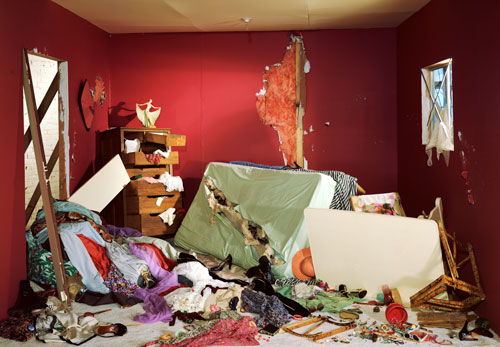
Jeff Wall, The Destroyed Room (1978)
Kennicott reflects on the ambivalence of destruction as metaphor and the political claims of art:
There is no readily agreed upon contract for when it is okay to destroy things in the name of art, but there are degrees of transgression and limits to the acceptability of consequences. There is a big difference between Rauschenberg’s asking for and receiving permission to erase a drawing by de Kooning and the vandalism of the brothers Jake and Dinos Chapman, who painted cartoon clown and animal faces onto an original set of Goya’s 1810-1820 “The Disasters of War” etchings. In no conceivable universe is the loss of these Goyas compensated for by the trivial graffiti the Chapmans have added, which not only defaces them but further victimizes the victims of war Goya originally depicted.
One can generate elaborate justifications for vandalism to put it into seemingly acceptable art terms. Ai Weiwei may have destroyed an ancient urn (given what we know about China’s art market, there’s no certainty it wasn’t a fake), but only in the name of calling attention to the Chinese government’s systematic destruction of ancient neighborhoods and historical sites (and as a further criticism of the crazy, commercial race to own and exchange antiques). And the Chapmans may have been satirizing some underlying sadism in Goya’s work and perhaps the aestheticization of war through art as well.
Those arguments mean something only within the insular and deeply provincial space of the art world, where people still have an inflated sense of art’s power and often believe it can effect direct and revolutionary change in the world. The worst of what is on display in this exhibition is driven by the false belief that art can somehow compete with political power if it finds images or ideas or gestures that are stark enough, violent enough, to cut through the noise. In fact, compared with people who have real power — over armies, economies and the means of entertainment — artists have virtually none at all and are too often driven to a kind of futile rage through a vague sense of their own impotence.







 MEMETERIA by Thomas May