The Science Museum in London currently has an exhibition on the Large Hadron Collider on view. In connection with the exhibition, The Guardian invited theoretical physicist Nima Arkani-Hamed and novelist Ian McEwan to engage in a conversation about the rapport between science and the arts.
The chemist and novelist C.P. Snow coined the phrase “the Two Cultures” in his Rede Lecture in 1959 to characterize the seemingly unbridgeable divide between the sciences and the humanities that had come to replace the omnivorous appetite for knowledge of the Renaissance. Arkani-Hamed observes:
It’s an asymmetry that doesn’t really need to exist. Certainly many scientists are very appreciative of the arts. The essential gulf is one of language and especially in theoretical physics, the basic difficulty is that most people don’t understand our language of mathematics which we use to describe everything we know about the universe. And so while I’m capable of listening to and intensely enjoying a Beethoven sonata or an Ian McEwan novel it can be more difficult for people in the arts to have some appreciation for what we do. But at a deeper level there’s a commonality between certain parts of the arts and certain parts of the sciences.
He also observes that the idea of “beauty” is at its core something shared by science and the arts, explaining that “what we mean by beauty is really a shorthand for something else. The laws that we find describe nature somehow have a sense of inevitability about them.”
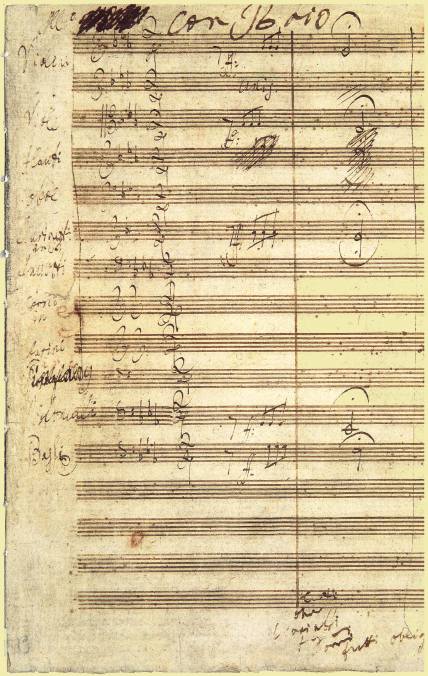
Beethoven’s working MS for the opening measures of his Fifth Symphony
A year ago I ran into this great lecture on YouTube by Leonard Bernstein about the first movement of Beethoven’s Fifth. And Bernstein used precisely this language – not approximately this language – exactly this language of inevitability, perfect accordance to its internal logical structure and how difficult and tortuous it was for Beethoven to figure out. He used precisely the same language we use in mathematics and theoretical physics to describe our sense of aesthetics and beauty.
In “Reading the Difficult: A new critique of the New Criticism” – an article in this month’s Poetry magazine – Peter Quartermain reflects on the confounding “simplicity” of the kinds of poems that the New Critics disdained. With all their armory of explication de texte, interpretive analysis, and scansion exercises, they were at a loss when confronted with poems that don’t “care whether you are puzzled or not” but simply exist as “an event, and you can join it, take part in, or not.”
Especially in the case of the short poems of William Carlos Williams, there is an “implacability in the language that resists both paraphrase and explication. The language is so spare, the details so sparse, the statement so stubbornly there before the reader, uncompromising, that the reader’s knowledge cannot intervene, cannot interfere with the poem; indeed it renders that knowledge irrelevant, the poem open.”
Quartermain goes on to discuss the paradox of poets who “demand that we respond to the poem, to the language of the poem, as a what is, a thereness, a something outside.”
They ask us to recognize in the poem’s facticity what Giorgio Agamben calls the irreparable: “that things are just as they are, in this or that mode, consigned without remedy to their way of being.” Yet once we have read the poem, indeed as we read it, it inescapably moves within us, is within us, and in this the poem is like the world in which we move, which moves us, and is in us whether we are conscious of that or not. Our condition in language, our condition as language animals, is irremediable, irreparable. It is beyond “repair,” and doesn’t permit (presuming we want it) the perfect reading [the New Critics] sought, in which we all acquiesce and are of one mind, “completely” understanding one another. We are inside and outside at the same time, irreparably.
This opens up a rich perspective for thinking about the Modernist preoccupation with originality, with making it new (“Kinder, schafft Neues!”) – and not just in poetry, but in theater, music, the visual arts. Each of the poets Quartermain considers “posits language as a condition of the human, as constitutive of it, constitutive of meaning and hence necessarily of experience, inextricably part and parcel of apperception and conduct and understanding. Language is not, then, a means, nor is it, certainly, a precondition.”
And the poem? Maurice Blanchot, perhaps echoing Celan, thinks that the poem comes from that inexpressible place before words, from that gap between what might be the world and what might be words for what we find. Perhaps the poem comes from that odd cusp between the two sides of language, the outside and the inside that, mostly unknowingly, we inhabit. What is clear is that the poem brings into being what it says, and does not know ahead of time.
Study for The Nose by Wm Kentridge; photo by Nick Heavican
I met with an interesting group today for the Met’s HD simulcast of The Nose. A few of us recalled and shared our impressions of the Return of Ulysses production by Stephen Stubbs’ Pacific MusicWorks, which featured the unforgettable work of director William Kentridge and the Handspring Puppet Company of South Africa.
The excellence of Kentridge’s Shostakovich production – originating in 2010 and the Met’s first staging of The Nose – comes from his approach to the opera’s absurdism. Together with his first-rate design team, Kentridge gives full scope to this example of Shostakovich’s unbridled imagination, refusing to settle for a merely surreal comic tone.
With the opera’s massive cast and complex array of minor parts, Kentridge could have all too easily overwhelmed us with visual distractions, yet the many layers he adds to the narrative – the acres of newsprint reconfigured as collage, the animated film segments showing the separate “life” enjoyed by the autonomous Nose, and the urban chaos of early-Bolshevik Petersburg/Leningrad – all cohere and enhance the opera’s effectiveness.
Nikolai Gogol’s 1836 short story about the hapless assessor Platon Kuzmich Kovalyov – who wakes up after getting a shave from his aggressive barber to discover his nose has gone missing – predates Kafka’s The Metamorphosis by more than three-quarters of a century. (Along with its Kafka reference, Philip Roth’s The Breast reverses Gogol’s conceit into synecdoche.)
Like the German playwright Georg Büchner (Woyzeck dates from the same time), Gogol inspired a modernist opera in the following century. Berg’s take on his source became an instant classic, while Shostakovich’s disappeared for decades. Kentridge in turn makes this fascinating score, which soon after its premiere staging in 1930 fell into oblivion, come alive for the 21st century. (What other operas involve a declaration of independence by body parts? I can only think of Poulenc’s Les mamelles de Tirésias, with its breasts-turned-to-balloons that float away from the fed-up Thérèse – but she celebrates her sex change.)
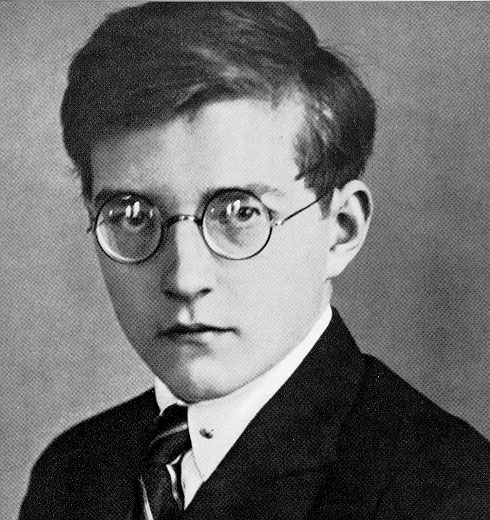
This ranks among the finest new productions the Met has ventured under Peter Gelb’s tenure. What an illuminating discovery this score is for anyone whose familiarity with Shostakovich is limited to the Fifth Symphony or even the great string quartets. The incendiary brilliance of the young artist – he had already made a splash with his First Symphony at age 19 – is almost frightening. Sheer invention abounds in every corner of the orchestra, including innovative writing for percussion, along with a declamatory setting of the text that carries Mussorgsky’s ideas of natural musical speech rhythm forward – Shostakovich isn’t afraid of dispensing with the comforts of mere melody.
Young Shostakovich
It all drives home how much the art of opera lost as the result of the dreadful turning point in Shostakovich’s career, when his next opera was denounced by Stalin’s culture police six years after The Nose came and went. My colleague Roger Downey, a superb critic and an expert in opera and theater, wondered how Shostakovich would have developed if he hadn’t been forced to bend to the strictures of Socialist Realism. The Nose contains so many intriguing what-ifs in that regard.
One quibble with the production – or perhaps with the structure of the opera itself: up to the end of the second act, the story follows Kovalyov’s desperate quest for his nose-gone-rogue clearly enough. (A wonderful idea was to provide ad hoc “entr’acte” music by having the orchestra improvise on the ritual of tuning.) So what’s all the business with the police and the train station in the third act? Why do they suddenly turn on the Nose and subdue it? Of course the absurdism is only strengthened by playing the narrative logic “straight,” but here it just becomes confusing.
The Nose of course demands to be read as an allegory – whether of the gullibility of us readers (Gogol), or of social hierarchy and the indifference of government bureaucracy (not so interesting), or of the inner division we feel as creative individuals (Kentridge’s take).
It occurred to me, especially from our current perspective, that The Nose could also be viewed as an allegory for the tension in early Modernism between the purist objective of autonomy (the abstract ideal) and the mongrel forms of the avant-garde imagination. Shostakovich himself emphasized the centrality of collaboration in this opera, its status as music theater and not “pure” music – precisely the strengths of Kentridge’s production.
In a recent review of Jacques Rancière’s Aisthesis, Hal Foster evaluates the French philosopher’s model of three “regimes” of art in the Western tradition. He points out that the new stylistic freedom permitted by the “aesthetic regime” – in which “the image is no longer the codified expression of a thought or feeling” (Rancière) – doesn’t require a contradiction between Modernist abstraction and the Dadaist/Surrealist “mission to reconnect art and life” in Rancière’s model: “the aesthetic regime is precisely this dialectic of modernist purity and avant-garde worldliness.”
By now, the extraordinary interview Pope Francis gave to fellow Jesuit Fr. Antonio Spadaro, which was recently published in America Magazine, has generated incredible interest on many fronts, from the Pope’s comments on moral priorities and his memorable metaphor of the Church as a “field hospital” to his discussion of art and creativity.
When discussing human understanding, Pope Francis revealed a fascinating perception of Wagner:
When does a formulation of thought cease to be valid? When it loses sight of the human or even when it is afraid of the human or deluded about itself. The deceived thought can be depicted as Ulysses encountering the song of the Siren, or as Tannhäuser in an orgy surrounded by satyrs and bacchantes, or as Parsifal, in the second act of Wagner’s opera, in the palace of Klingsor. The thinking of the church must recover genius and better understand how human beings understand themselves today, in order to develop and deepen the church’s teaching.
Maybe I’m on the totally wrong track here, but I almost notice an echo here of Wagner’s own formulation of the relation between art and religion from the time of Parsifal:
When religion becomes artificial, art has a duty to rescue it. Art can show that the symbols which religions would have us believe literally true are actually figurative. Art can idealize those symbols, and so reveal the profound truths they contain.
The entire interview with Pope Francis, “A Big Heart Open to God,” is in English translation here.
(Percy Byssshe Shelley, portrait by Alfred Clint, 1819)
Nowadays the received wisdom seems to follow the Oscar Wilde line — literally, that is, without his archness — that “all art is quite useless.” Especially when the art in question is poetry and, even more, music. This alleged uselessness is then either trumpeted as a glorious thing — a refuge from the brutal world of commerce — or turned into a weapon to arm Philistines (“uselessness” abused).
A recent example of the former strategy is the poet and scholar Meena Alexander’s musing, in an address to the Yale Political Union last April, that poetry stands apart from the everyday world of historical reality: “The poem is an invention that exists in spite of history. Most of the forces in our ordinary lives as we live them now conspire against the making of a poem.”
Noah Berlatsky challenges Alexander by arguing that the whole issue of worrying about whether poetry in the abstract is “useless” is a detour: it arises from the “myth of an essential poetry, poetry that is important because of what it is, rather than because of what it says.”
When poets or writers have been persecuted, it’s generally not because of some abstract contradiction between tyranny and poetry. It’s because the persecuted poets said specific things the tyrants didn’t want to hear….
It’s long past time, therefore, that we stopped asking “What Use Is Poetry?” and started asking, “What Use Is This Poem?” In some cases, maybe, we’ll find uses we didn’t know existed. And in many cases, we’ll can respond, “none; this poem—not poetry as a whole, but this poem—is useless. Away with it, and let it bother us no more.”






 MEMETERIA by Thomas May