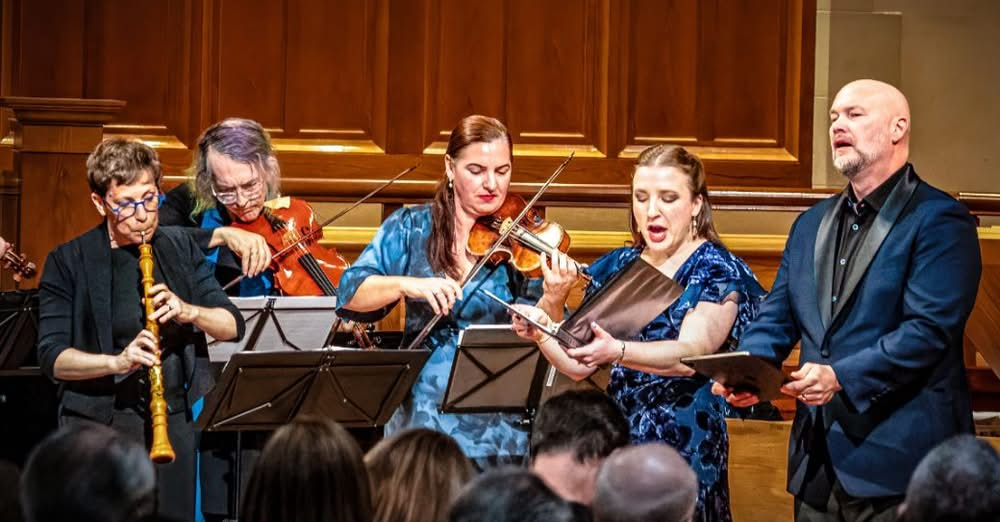
Seattle Bach Festival orchestra and Evergreen Ensemble (choir), with SBF founder Tekla Cunningham (in blue), during their concert of Bach cantatas at St. Mark’s Cathedral in May. They will perform Bach’s “Christmas Oratorio” this year and next. (Dennis Browne)
For some, Handel’s “Messiah” remains a cherished ritual.
For others, it has become so predictable as to feel almost unavoidable — a seasonal monument polished smooth by repetition.
This season, the Seattle Bach Festival is offering a different way into the Christmas story — one that trades “Messiah’s” grand sweep for a more kaleidoscopic, scene-by-scene celebration of the Nativity: Johann Sebastian Bach’s “Christmas Oratorio.”…
Debra Nagy, Tekla Cunningham, Hannah De Priest and Tyler Duncan
The second of this past weekend’s wonderful Baroque programs, courtesy of Seattle Bach Festival – my review of Tekla Cunningham and friends’ ‘The Eloquent Oboe’ for the aptly named Bachtrack:
Launched as recently as January, the Seattle Bach Festival is already becoming a force in the Pacific Northwest’s Early Music landscape…
“You should always try to escape your own success,” Víkingur Ólafsson says. “Because that success so easily turns against you and limits you and your choices and what you want to do next” …
As Arvo Pärt turns 90, British cellist Matthew Barley speaks about creating ’Touching Eternity’, a candlelit program that weaves Bach, Pärt and Tavener into a shared ritual of sound and silence.
A recent performance of Bach’s “Markus Passion” in New York City featured Chatham Baroque and soloists (left to right, front row) Cody Bowers, Pascale Beaudin, Joseph Marcell, James Reese and… (Tatiana Daubek)
Sacred music lay at the heart of Johann Sebastian Bach’s creative life. His vast output includes hundreds of choral works written for the principal churches in Leipzig, Germany, where he oversaw musical programming….
João Carlos Martins at Carnegie Hall Farewell Concert, 9 May 2025; photo: Jorge Gustavo Elias
Happy 85th birthday to o Maestro, João Carlos Martins! Born on 25 June 1940 in São Paulo, Martins established himself as one of the most brilliant keyboard interpreters of Johann Ses=bastian Bach in the second half of the 20th century.
Yet his Bach legacy is just one component of an artistic journey marked by both acclaim and adversity. João Carlos Martins’s story is as much about resilience and reinvention as it is about musical brilliance. Following prodigious beginnings – he made his Carnegie Hall debut at age 20 – repeated injuries to his hands forced Martins to step away from the piano, just as he was reaching the height of his international career. But rather than retreat from music, he redirected his focus to conducting, bringing the same fervor and eloquence to the podium that once defined his playing.
Martins additionally became an enormously influential cultural force in Brazil. Through his Bachiana Foundation, he has brought classical music to thousands of young people, many from underserved communities, creating access where there was none. Alongside this work with the Fundação Bachiana, Martins has also been a champion of Latin American composers.
His initiatives have blended high artistic standards with social impact, forging a vision of music as both an expressive art and a tool for transformation. Under his leadership, the Bachiana Filarmônica SESI-SP has become one of Brazil’s most dynamic cultural foundations – a platform for emerging talent and a vehicle for national pride, performing everywhere from favelas to major concert halls.
Martins’s late-career return to the keyboard – made possible by specially adapted bionic gloves – has added an inspiring new chapter to an already remarkable artistic narrative. Following his moving farewell concert at Carnegie Hall last month, Martins continues to extend a career that has continually defied limitation as he devotes himself to a broad new initiative to improve music education across Brazil.
Feliz Aniversário, Maestro! Your artistry continues to resonate far beyond the concert hall.
João Carlos Martins at Carnegie Hall Farewell Concert, 9 May 2025; photo: Jorge Gustavo Elias
From left: Debra Nagy, Tekla Cunningham, Danielle Reutter-Harrah, David Morris, Tyler Duncan and Ross Gilliland perform at the Whidbey Island Music Festival, founded and directed by Cunningham. Cunningham is also founder and director of the new… (Dennis Browne)
The brilliant violinist, artistic director, and educator Tekla Cunningham has been extra-busy of late laying the groundwork for a promising new venture that launches this weekend. I had the privilege to speak with Tekla about the inspiration behind the Seattle Bach Festival:
For Tekla Cunningham, music happens in the connections — not only between the notes but between the humans who produce and experience them. … continue
Wrapping up a rich and lively weekend of music in Seattle, Víkingur Ólafsson paid a visit to Benaroya Hall on Sunday afternoon May 4 for a program solely devoted to J.S. Bach’s “Keyboard exercise, consisting of an ARIA with diverse variations for a harpsichord with two manuals” — or, as posterity knows the work, theGoldberg Variations.
Seattle was the latest stop on the Icelandic pianist’s current world tour of the work, which comprises no fewer than 88 concerts, in homage to the number of keys on the modern piano (quite a few more than the 54 keys of Bartolomeo Cristofori’s original “gravicembalo” or the 60-something keys Bach was used to when playing one of his harpsichords).
As Ólafsson explained to the culture journalist Paul Hodgins, the fact that he turned 40 this year inspired him to think up “thinking that I wanted to have a “a different kind of touring season. I thought, ‘What if I do a whole world tour with the Goldberg Variations and challenge myself, hopefully to keep renewing myself and finding … new truth in this work — do 88 variations on these 30 variations and try to try to find something unique each night?’” In reality, demand has been so high that Ólafsson has ended up extending the number up into the 90s.
But once the Seattle audience had settled into place — an impressively large gathering for a solo recital on a Sunday afternoon — and the boyish-looking Ólafsson strolled out onto the lonely stage, it was as if he were confronting his awe at this colossal monument for the first time.
Nothing could have been further removed from the routine or predictable. Even though the basic outlines of his interpretation of the Goldbergs are available from the DG recording he released last October — coming in at about 74 minutes total — he radiated such presence and intensity in this live performance that he gave the impression he had only just arrived at his understanding of the work and its interconnections.
Indeed, it would be fascinating to compile the pianist’s observations throughout his odyssey, following each performance, of what struck him as unique or different in that particular iteration, in that specific exchange with the audience.
At the same time, the signatures of Ólafsson’s style were there, presented with compelling grace and concentration. His first statement of the Aria was like gifting a troubled world with an object of pellucid, crystalline beauty, each note value and ornament having its raison d’être. Throughout, Ólafsson chose subtle rather than flamboyant alterations in the repeats — variations of the variations — that heightened the sense of mindful attention his performance encouraged.
But there was no dearth of drama, signaled already by the leap into Variation 1, following the mood carefully established by his phrasing of the Aria: an abrupt intrusion of velocity that audibly took the breath of some in the audience. As if to say that the peaceful quietus mimicked by the final cadence of the Aria’s return in its first statement was an illusion, now the business of living begins, the whirlwind of experience.
I could single out numerous specific reactions and associations set loose by each station on Ólafsson’s journey — that overused metaphor for music-in-action, virtually impossible to avoid in this case. His way of slowly dialing up the weight of a bass line on its return, the exuberant, life-affirming trills of Variation 14, the shock of the first turn to a full variation in the minor in No. 15, itself dwarfed by the seemingly inextricable situation of tragedy in the Adagio Variation No. 25 — Wanda Landowska’s famous “black pearl” — which, in Ólafsson’s hands, fell just short of ten minutes by the clock but seemed an eternity of wandering in a labyrinth of grief.
I’m well aware of the critiques of Ólafsson — not a few of which seem to make a great deal out of the non-musical topic of the photo essay accompanying the DG recording, with its mannered poses and hand displays waiting for a contemporary Rodin to sculpt. It’s no surprise that Bach’s 1741 masterpiece provokes such intense and contradictory responses and defenses. This is a work that reminds us of what is really at stake when music matters.
For my part, I failed to see Ólafsson’s choices as a display of self-indulgence or arbitrary exaggeration. Instead, I was won over by his ability to encompass so many shades of emotion and states of being while deploying the most extraordinary technique. I relished his deeply songful legato lines and transformation of toccata display into unfettered joy. With his magician-like hand-crossing and suspended right-hand gestures, the visual dimension also fascinated. My only question, not even necessarily a quibble, was the degree to which Ólafsson seemed to rely on the pedal for his legato bliss and tonal mixings.
The Quodlibet was vigorous and hearty, but instead of leading to the moment of final reassurance, the Aria’s return came shrouded in melancholy or even a touch of disbelief — is this all our experience amounts to? Unlike Marx’s notion of recurrence a second time as “farce,” Ólafsson’s has spoken of the Aria’s comeback as a tragic moment: “And that’s what (we feel) collectively when we have that moment together. The aria comes back, and then we lose it again. It’s one of the most tragic moments in music. Not because the music sounds so tragic, but because we feel our own impending death. It is going on without us.”
photo (c) Carlin Ma
Yet there is optimism in the endurance of Bach’s own work, which the Thomas Cantor described as “composed for connoisseurs, for the refreshment of their spirits.” Ólafsson, in his essay accompanying the album, resorts to the metaphor of “a grand oak tree, no less magnificent, but somehow organic, living and vibrant, its forms both responsive and regenerative, its leaves constantly unfurling to produce musical oxygen for its admirers through some metaphysical, time-bending photosynthesis.”
At the end of it all, Ólafsson acknowledged the several rounds of applause with self-effacing sincerity, pointing gratefully to the Steinway. With no apparent depletion of the energy with which he had first beelined his way there an hour and a quarter before, he explained why an encore simply wasn’t in the works (though I’ve seen reports of an occasional encore offered in other venues on this tour): “There’s already an encore built into the Goldbergs, with the repeat of the Aria. And if I played that again, I’d have to continue with the first variation, and the second, and … We’d still be here for awhile….”
Ólafsson also mentioned how happy he was to be in Seattle, since it have him a chance to reunite with a former classmate at Juilliard who had been a source of inspiration: Seattle Symphony concertmaster Noah Geller.
A couple days before, on Friday evening (May 2), Geller had been in the spotlight as the curator and featured artist of the SSO program Noah Geller’s Playlist — the last in a new series this season that has also featured such artists as Mahani Teave and Conrad Tao.
Noah Geller with the Seattle Symphony and conductor Sunny Xia; photo (c) Brandon Patoc
Played without intermission and with SSO reduced to a chamber size ensemble, the concert was filled with delights from start to finish — and offered yet more music of Bach. Geller was joined by principal second violinist Elisa Barston as co-soloist in Bach’s Double Violin Concerto in D minor, BWV 1043 — which Geller characterized as “the happiest that D minor has ever been made to sound.” The highlight of their account was the lyrically urgent Largo (in F major), while the fast outer movements flowed with overlapping waves of energy.
If Bach creates the illusion of a unified mega-instrument from the two soloists — Geller and Barston playing off each other with stylishly expressive flourishes — the great sonatas and partitas fashion a mirage of plurality from the solo instrument. Geller later played as an encore a heartfelt, deeply touching account of the Andante from Bach’s Sonata No. 2 in A minor for solo violin.
It followed his marvelously satisfying interpretation of the last and most-popular of Mozart’s canonical violin concertos, K. 219 in A major. SSO assistant conductor Sunny Xia elegantly guided the sonic balance. Geller seemed to be revisiting the hallucination of an idyll that had been imagined by his first, quasi-“slow motion” appearance in the opening movement, free this time to ponder its meaning at ecstatic length and singing high above the ensemble voices with sweet but never syrupy tone. He showed swashbuckling virtuosity in particular in the speedy section of the curiously constructed Rondeau finale. The entire piece emanated personality and multifaceted charm.
Composer Samuel Carl Adams; photo (c) Brandon Patoc
Between the two repertoire items, Geller selected a new piece by the composer Samuel Carl Adams. Hailing from Berkeley (where his famous father, John Adams, resides), Adams is of late a locally based artist, having moved to Seattle with wife Helen Kim, SSO associate concertmaster. Composed in 2018, Movements (for us and them) is composed for string orchestra with a concertino string quartet (Geller did not perform here).
It was an inspired choice, juxtaposing the shifting textural currents of Bach’s concerto grosso format and Mozart’s solo concerto plot with a richly reimagined drama of single and collective voices. A composer whose textural innovations are matched by a solid understanding of architecture and long-range form, Adams found inspiration in the Italian writer and journalist Italo Calvino’s Six Memos for the New Millennium (planned as part of the Charles Eliot Norton Lectures at Harvard). Movements pulsates with exciting rhythmic layering and polyphonic bounty, reflecting the composer’s desire to explore “cooperation and fluidity” in musical terms.
I had the pleasure of writing the program essay for Sir András Schiff’s series of recitals devoted to the keyboard works of J.S. Bach currently under way at the Boulez Saal in Berlin.
Boulez Saal is publishing lots of terrific content on its digital platform. The selection of exclusive video productions includes introductory talks (free access) as well as performances (with a membership) by the celebrated pianist.
Seattle Baroque Orchestra offers a program this weekend of J.S. Bach cantatas. Titled Jubilation and Redemption, the concert features the Portland-based soprano Arwen Myers as the soloist in Jauchzet Gott in allen Landen, BWV 51, and Mein Herze schwimmt im Blut, BWV 199, with SBO’s Baroque trumpet expert Kris Kwapis directing the ensemble. Part of the Early Music Seattle season, the concert takes place Saturday 4 November at 7.30pm at Bastyr University Chapel and Sunday 5 November at 2pm at Nordstrom Recital Hall at Benaroya Hall.
Kris Kwapis on Bach’s cantatas as a “treasure trove for trumpet”:
While a fair number of monumental works written by J. S. Bach are among the typical Baroque canon, at least among the reach of the enthusiastic readers of this blog, specific works among the catalog of cantatas tend to be lesser known and subsequently not as frequently programmed. Most attentive audience members are at least familiar with the larger pieces such as the Mass in B Minor, Magnificat, and Christmas Oratorio, which, of course, are outstanding works of art that also happen to have wonderful (and delightfully challenging!) trumpet parts. But the cantatas, perhaps because Bach wrote around 300 during his lifetime, are sometimes overlooked….




 MEMETERIA by Thomas May