Some thoughts on Seong-Jin Cho’s recent Seattle recital:
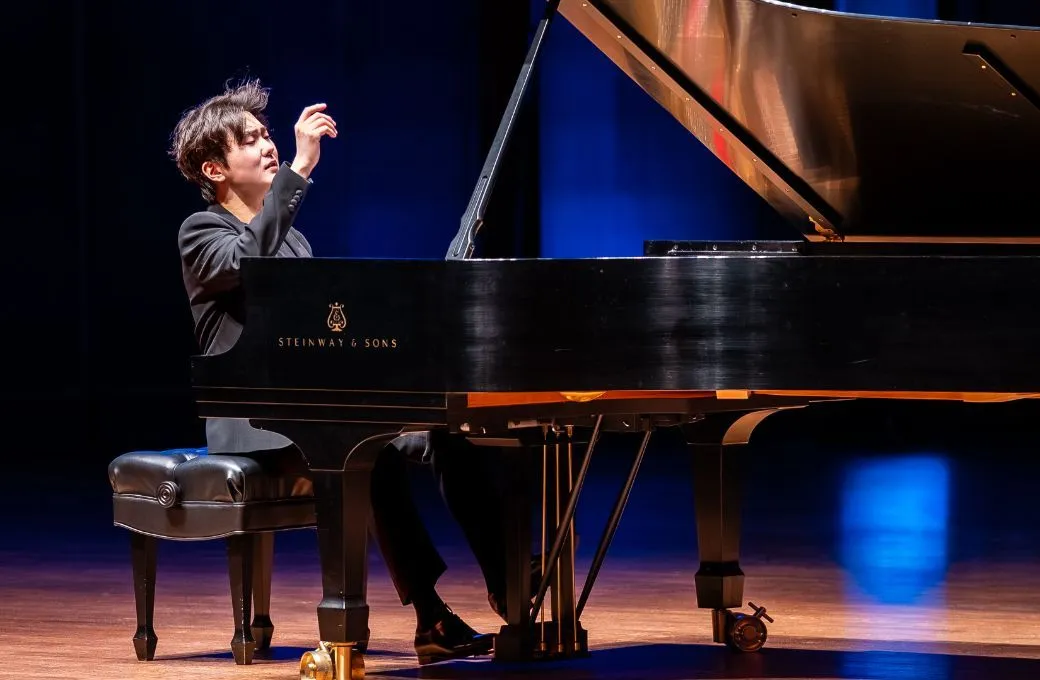
The self-effacing persona Seong-Jin Cho projected from the Benaroya Hall stage throughout his solo recital stood in striking contrast to his musical confidence – a confidence grounded not only in extraordinary technical security but in an evident willingness to take risks. Cho’s sense of interpretive freedom made itself felt from the outset, in a program that invited close attention and repaid it generously…
David Robertson conducts the Seattle Symphony; photo (c)Brandon Patoc
David Robertson guest conducted the Seattle Symphony last week in a program of Ligeti, Bartók, and Rachmaninoff. My review:
Since it lacks a music director, the Seattle Symphony is presenting a smorgasbord of guest conductors throughout the season. These have been mostly younger artists still early in their careers, but David Robertson’s engagement marked the return of a seasoned conductor already well-liked by the players and in full command of a formidable talent….
And they’re off to an auspicious start… Here’s my review of opening night for Bachtrack:
Nothing could stop this show from going on — not even a popped viola string nearly midway through Béla Bartók’s grueling String Quartet no. 6 at the center of the program that opened the Seattle Chamber Music Society’s 2022 Summer Festival…
Roderick Cox conducting the Seattle Symphony Orchestra; photo (c)James Holt
I left last night’s performance convinced that Roderick Cox is a major talent destined for something great. Winner of the 2018 Sir Georg Solti Conducting Award, Cox had caught my interest last year leading a Barber in San Francisco Opera’s return to live performance. Those were unusual circumstances dictated by social-distancing rules (with a parking lot as the auditorium, the music transmitted to our car radios), so it was splendid to get to experience this young conductor in the limelight, with a full orchestra, unhampered by any pandemic restrictions more cumbersome than a mask. [UPDATE: Check out the film Conducting Life, an intimate portrait of Roderick Cox and his path toward his vocation.]
Cox chose a challenging program that revealed an impressive gift for communicating his musical vision. The first half was given to William Levi Dawson’s Negro Folk Symphony of 1934–a landmark of early 20th-century American symphonic writing has been shamefully, disgracefully neglected while so many tireless mediocrities continue to clutter the repertoire.
This performance had the quality of a double epiphany, confirming what an excellent piece of music we’ve allowed ourselves to be missing out on and at the same time shedding light on the journey Dawson’s symphony traces–outwardly, the harrowing passage from Africa to the New World, but also an implicitly personal journey. He clarified the originality of Dawson’s response to the challenge Dvořák had issued to cultivate an authentically American voice. For Dawson, that meant writing a symphony that, as the composer put it, “is unmistakably not the work of a white man.”
Negro Folk Symphony is a marvel of the imaginative, indeed, symphonic, transformation of simple, ready-made folk material–Dawson draws on three spirituals in particular–into a complex, multi-faceted structure. Cox led a dramatically compelling account that highlighted Dawson’s elaborate use of rhythmic mottos as a unifying device, while also lavishing attention on the orchestral details that give this score such resonance. His spacing of the implacably tragic minor chords ending the “Hope in the Night Section” was especially memorable. This was the SSO’s first performance of the Dawson, and part of the excitement came from the sense of the players sharing in these discoveries along the way, clearly inspired by Cox’s guidance.
Concertmaster Noah Geller gave a deeply felt and polished interpretation of the 1904 Violin Concerto in A minor by Alexander Glazunov–who, like Dawson, straddled a period of drastic change in musical values and pressures. Basking in his warmly expressive lower register in the opening passage, the violinist kept the audience at an attentive hush in Glazunov’s extended cadenza, counterbalancing the piece’s gentler lyricism with its giddy high spirits and vivaciously articulated virtuosity.
Cox proved fearless in Belá Bartók’s Suite from The Miraculous Mandarin, a piece that doesn’t tolerate weak-willed, insecure conducting. He drew an electrifying performance from the outset, never letting go of the ominous, hair-raising tension and danger that animate this early Bartók score. The music echoes, though in a very original way, impulses from Stravinsky’s RiteofSpring and Strauss’s dancing Salome, also hinting at the spirit of film noir to come. Cox emphasized its brutal violence but also knew how to bring out the delicacy and spookily muted colors of Bartók’s orchestration, loosening the reins to give the platform to Benjamin Lulich for his arresting clarinet solos.
The glowing rapport between the players and Cox left me hoping to see much more of this conductor on the Benaroya stage. Thursday’s audience, though relatively sparse, was enthusiastic and grateful. What a pity it would be to miss this excellent program, which repeats Saturday at 8pm and Sunday at 2pm.
Sir András Schiff began a remarkable weekend of music with his appearance as guest conductor of the Seattle Symphony. My review:
For a long time, Seattle audiences have made clear their admiration for the artistry of Sir András Schiff whenever he comes into town for solo recitals – including one occasion 17 years ago, when his Bösendorfer had an unfortunate encounter with black ice while being transported across the continent and a replacement had to be found at the last minute.
Thursday night’s concert offered the first chance I’ve had to hear Ludovic Morlot in action so far this season with Seattle Symphony, and my reward was a thrilling, full-bodied program. The first half included a fiery account of Bartók’s 1927 Miraculous Mandarin Suite (about two-thirds of the score from his earlier ballet, responsible for one of the scandal-premieres of European modernism).
Morlot focused on the score’s lurid colors and unsettling, suspenseful atmospheres, abetted by characterful wind solos (the “decoy music” on clarinet, for one) and superb string ensemble. (The choice of Noah Geller as new concertmaster has clearly been paying dividends.) Some conductors emphasize the influence of Stravinsky’s Rite, but Morlot seemed more interested in the surreal aspects of Bartók’s score, especially in how the ironic, decadent waltz of seduction emerges.
A wonderful match of soloist and concerto followed, with the 33-year-old Russian-British violinist Alina Ibragimova proving herself to be a deeply sensitive, account of the Op. 129 Concerto in C-sharp minor, the second of Shostakovich’s violin concertos.
The violinist is called on to maintain a virtually continual presence in this score, and Ibragimova held me spellbound, mining the varied facets of melancholy and sorrowing desperation embedded in this late-period work. Her tone was rich but unforced, and above all achingly expressive.
Morlot effectively stage-managed the prominent duologues of the soloist with the winds, though coordination went somewhat awry in the finale. Still, it was a moving, substantial performance — far more welcome than a flashy and breezy rep staple would have been, since Seattle Symphony has dedicated this week’s performances to victims of hate crimes: “to the lives lost and all those affected by recent hate crimes brought on by racism and bigotry, particularly those who died in the recent tragic shootings at the Tree of Life synagogue in Pittsburgh, Pennsylvania, and while grocery shopping in Jeffersontown, Kentucky.”
Filling the second half was Brahms’s mighty, promise-fulfilling First Symphony, which premiered just a few months after the first complete Ring cycle, in 1876. (I’ve always found that coincidence especially fascinating.) Morlot seemed to pick up on some of the fiery, driven energy from the opening Bartók, conjuring a passionately dramatic vision of the First.
This came at the cost of some clarity, I found, in the first movement above all, whose overarching architecture was occasionally obscured. The Adagio radiated emotional complexity and a touching sense of Brahmsian harmonic color; it only needed, again, a more transparent elucidation of the composer’s dramaturgy of light and shade. I wanted more time for the music to breathe.
Morlot was more convincing with the rest of the work: the third movement served as a brief shot of optimism, an interlude that tees off the apocalypse and triumph of this finale-centered score. Here, Morlot paced events with confidence and focus, acting as a kind of film director to ensure that each episode carried weight.
More musical revelations at Lucerne Festival: thrilling Bartók Violin Concerto No. 2 featuring Patricia Kopatchinskaja in an unimprovable program of Bartók and Haydn by Mahler Chamber Orchestra led by the impeccable François-Xaver Roth.
The Haydn (Symphonies 22 and 96) was sleek and proto-Modernist in Roth’s interpretation, overflowing in invention and brought to life by the exquisitely fine-tuned playing of the Mahler Chamber Orchestra.
The Bartók Second — nicely complemented by the Dance Suite — spurred all Kopatchinskaja has to give: from her feistiest, most earth-rooted playing to star-drunk lyricism.
And then there was a post-concert treat in the “Interval,” from Kopatchinskaja plus her parents (dad Viktor on cimbalom and mom Emilia playing violin), with Venezuelan double-bassist Johane Gonzales: incisive Kúrtag and wonderful folk music arrangements.
Last night brought out still another side of Kopatchinskaja’s all-embracing artistry, in a Late Night concert with the Lucerne Festival Academy Orchestra led by Matthias Pintscher.
It’s clear that the Moldovan soloist regards Ligeti’s Violin Concerto as one of the ultimate masterpieces of the repertoire. Hearing her play it, you feel this is the only music in the world that matters, a world within world of where the concept of virtuosity itself is reimagined from the ground up.
Kopatchinskaja is the perfect violinist to advocate Ligeti’s wildly imaginative ideas, but also the formal ingenuity and, yes, melodic grace of this score. She also brought out the best from the incredibly gifted young Academy musicians. I can’t wait to hear the full ensemble shine in Monday’s all-Cerha concert.
The program also included fascinating performances of composer-in-residence Michel van der Aa’s Hysteresis for clarinet, ensemble, and tape, with Martin Adámek as the soloist and Ligeti’s Piano Concerto, with pianist Dimitri Vassilakis.
It would be interesting to know how many audience members comprising the very full house for this performance were hearing their first-ever live Beethoven Fifth. Even for aficionados, the encounter was unusual. Ludovic Morlot and the Seattle Symphony created a boldly original framework in which to present the Fifth Symphony, their account of which also marked the conclusion to a two-year cycle of the complete symphonies and piano concertos.
I’m in a bit of shock realizing today marks the official debut of my professional career writing about music. Exactly 20 years ago, I published my first review as a freelance critic for the Washington Post (link below).
It wouldn’t have happened without the incredibly generous mentoring of Tim Page, who agreed to give a complete unknown this chance.
Tim remains one of my dearest friends. It all started with his encouragement.
Meanwhile, I hope I’ve made at least a modicum of progress in my writing since then.




 MEMETERIA by Thomas May