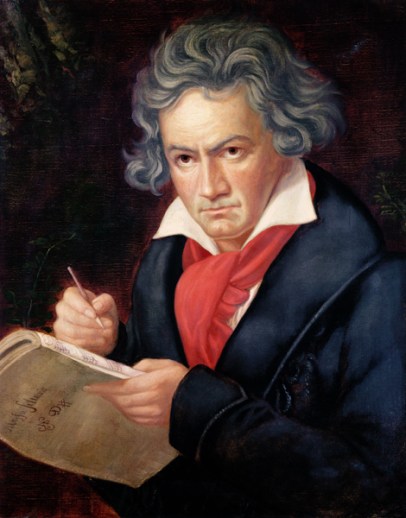
Portrait of Ludvig van Beethoven composing his Missa solemnis by Joseph Karl Stieler (1819) Beethoven Haus, Bonn, Germany/The Bridgeman Art Library International
Beethoven was my very first “classical music” love. And Beethoven remains inexhaustibly fascinating. I’m still digesting Jonathan Biss’s thoughtful performance of Op. 111 last weekend at Meany Center for the Performing Arts.
In honor of the composer’s (probable) birthday (we know at least that he was baptized on 17 December 1770), a few favorite quotes from the master:
“I must despise a world which does not feel that music is a higher revelation than all wisdom and philosophy, the wine which inspires one to a new generative process, and I am the Bacchus who presses out this glorious wine for humanity and makes it spiritually drunken.”
“My thoughts go out to you, my Immortal Beloved I can only live wholly with you or not at all-
“What you are, you are by accident of birth; what I am, I am by myself. There are and will be a thousand princes; there is only one Beethoven.”
“It seems I could wrest my ideas from nature herself with my own hands, as I go walking in the woods. They come to me in the silence of the night or in the early morning, stirred into being by moods which the poet would translate into words, but which I put into sounds — and these go through my head swinging and singing and storming until at last I have them before me as notes.”
“The true artist is not proud, he unfortunately sees that art has no limits; he feels darkly how far he is from the goal; and though he may be admired by others, he is sad not to have reached that point to which his better genius only appears as a distant, guiding sun. I would, perhaps, rather come to you and your people, than to many rich folk who display inward poverty.”
My Seattle Times interview with Jonathan Biss, who will perform in two events this coming weekend at UW:
At the advanced age of 36, Jonathan Biss finds himself fascinated by “late style” — the manner of expression an artist adopts as the end of life approaches.
Along with unveiling a world premiere by composer Agata Zubel, the Seattle Symphony continued its ongoing Beethoven cycle with a rhapsodic contribution by soloist Inon Barnatan at the keyboard.
With their first subscription concert of the new season, the Seattle Symphony and Ludovic Morlot have already scored a home run.
If you’re a fan of new music, you’ll regret missing this; ditto if you’re fan of the core classical repertoire. That in itself gives a good indication of just how remarkable this program is.
Last weekend I previewed Gabriel Prokofiev’s new work, an SSO commission.Having now heard the first full rehearsal as well as the live world premiere of this music, I’m genuinely thrilled by what Prokofiev has accomplished.
Titled When the City Rules, his new composition is a substantial, vividly imagined, and expertly constructed half-hour-long symphonic fantasia inspired by the phenomenon of the mega-city in contemporary life. It’s not program music in the old-fashioned sense of trying to “translate” a narrative into musical terms.
When I spoke to the composer recently, he said he relished the “magical” way in which music can generate images or feelings “without being super-exact”: how it can negotiate a space between pure abstraction and a medium like film, triggering multiple subjective “plots” according to each listener, since the musical images are so “open to interpretation.”
What he does in When the City Rules is to offer a broad suggestive framework for each of the four movements: an overview of the great, looming city and the life of its citizens (think London of today, where Gabriel Prokofiev resides). His “dramaturgy” juxtaposes the big picture with suggested “close-up” moments of characters or particular feelings.
So the first movement, opening with a beautifully sustained atmosphere of layered strings, evokes “the memories that cities hold” but also the modern city’s power; an “Andante Nostalgico” touches on the melancholy associated with cities and the desire to escape to something more pristine; considerable energy and excitement come to the fore in the third movement, which taps into the nervous, ceaselessly busy energy that not only keeps the city going but is a defining trait; and a “Rondo Brilliante” finale replete with echo effects to bring the work to a bracing climax and conclusion.
But it’s no simple affirmation: by then we’ve encountered a matrix of brooding, even oppressive sounds along with Prokofiev’s most animated writing. It’s tempting to work in a sci-fi level of interpretation, of a city becoming conscious of itself and its rulership over mere mortals.
Of course the four-movement pattern just outlined can suggest a more or less classically oriented symphony as well. The point is, there’s no doubt that When the City Rules is a milestone for Gabriel Prokofiev, whether you want to use that generic touchstone or prefer to approach it as a composition sui generis.
This is no mere patchwork of “impressions” or clever soundscape-vignettes, but an ambitiously conceived large-scale piece that works in real time (though I think it could perhaps benefit from a tad more tightening in a passage here or there).
Even though Gabriel Prokofiev first caught the music industry’s attention thanks to his talent for bridging the worlds of classical music and the electronica of the popular dance club scene — his Concerto for Turntables & Orchestra was featured at the 2011 Proms — When the City Rules is, notably, written entirely for acoustic orchestra, with no electronic “bells and whistles.”
And written with marvelous flair and fluency, using its rich palette in a way that makes the orchestra itself embody a vision of the city, both as ensemble and with its prominent roles for particular protagonists (flute, cello, and trumpet, most notably, and, to wonderful effect in the “nostalgic” slow movement, a solo saxophone).
When the City Rules moreover reveals a composer with a convincing sense of where his short, often rhythmic motifs can take us, of where the music needs to “go.” Anyone expecting a one-trick game — or a repeat of Prokofiev’s orchestral rethink of Sir Mix-A-Lot’s classic “Baby Got Back” (which brought another round of viral fame during his last collaboration with the SSO and Morlot, in 2014) — is in for a big surprise.
The masterfully built-up ostinato patterns that play such a key role in When the City Rules distantly recall a trait of his grandfather, Sergei Prokofiev, as does the tone of darkened, sardonic humor and even menace they sometimes conjure. There’s also a hint of 21st-century Sacre Stravinsky in the tracks of jagged rhythms that crunch and pop.
Prokofiev’s ongoing interest in electronic and dance club music remains present as an ongoing feature. “I think those styles work brilliantly in the concert hall,” he told me, citing the pervasive use of dance rhythms in the most familiar classical music. “They just happen to be dance rhythms that are 200 years old.” And from his work DJing, Prokofiev says he has learned techniques of “mixing and cutting something up — the way dance music will be manipulated to rise up to climaxes.” These are a contemporary version, in one way, of what Beethoven does with his slicing and recombining of short, potent motifs by way of “development.”
When the City Rules is an extraordinary achievement, but just as extraordinary is the fact that Morlot and the SSO, within a few days of first reading through the score together, have been able to deliver such a gripping and well-polished interpretation of this music for the premiere. Jeffrey Barker (flute), Efe Baltacıgil (cello), and David Gordon (trumpet) added particular flavor with their vividly characterized solo parts.
Any commission is by definition a risk: I’d like to think the generous patrons who underwrote this one (Norman Sandler and Dale Chihuly) realize what a winner they’ve picked.
And Gabriel Prokofiev’s piece was only one of the success stories of the program. Grandfather Sergei was also represented, with a performance of his compact but immensely varied and orchestrally eventful Symphonic Suite from his opera The Love for Three Oranges.
Prokofiev was a master composer for the stage, but he endured an absurd amount of bad luck in that arena. This Suite is an example of some of his best opera music being siphoned off into an arrangement for the concert hall. If Prokofiev’s wash of added percussion proved overpowering in the most vehement ensemble moments, the precision and balance of the strings were especially admirable. The detailed preparation of the Suite as a whole, with its many virtuosic flourishes, was nothing short of astounding, considering the amount of attention needed to prepare the brand-new score of the evening.
And then the Beethoven: since these reflections have already gone on at length, I’ll have to defer my more detailed impressions until later in the ongoing Beethoven cycle this season. To quickly sum up: it’s thrilling to observe how much more confident and focused Morlot is becoming in his approach to these icons of the classical rep.
This program in particular, framed by Beethoven’s First Symphony and his Eighth, even replicated something of that growth, with Morlot stepping even further out and taking greater risks in his account of the Eighth Symphony, which rounded this abundant evening of music off with a rousing conclusion.
There’s so much music news I’m still trying to catch up with: including the recent announcement of pianist Igor Levit’s big win. His mammoth account of three sets of variations — and it is a fantastic recording — was named 2016 Recording of the Year, the top prize from Gramophone.
My profile of Levit appeared in the Spring 2016 issue of Listen Magazine:
It’s early February, over lunch before his Seattle debut later in the evening, and Igor Levit can’t stop talking about how thrilled he is to be touring the United States. It was only two years ago that the Russian-German pianist made his first U.S. appearance — choosing the unusually intimate venue of the Board of Officers Room at the Park Avenue Armory (seating for about 150) — just a few days before jumping in at the last minute for Hélène Grimaud in a City of Birmingham Symphony Orchestra concert. (He did the same for Maurizio Pollini three months later.)
Hugo Shirley interviewed Levit when Gramophone first reviewed the recording — Bach’s Goldberg Variations, Beethoven’s DiabelliVariations, and Rzewski’s The People United Will Never Be Defeated! (Sony Classical) — for the November 2015 issue.
When I meet Levit in Berlin he is quick to make clear that he sees these composers as a trinity of equal importance. He doesn’t feel for one moment any sense of special pleading in the inclusion of Rzewski, the radical, consonant-heavy American composer (the name is pronounced ‘jefski’) whose People United was composed in 1975 as a modern complement to Beethoven’s great set of 33 variations on Diabelli’s simple little waltz.
The fact that it has 36 variations, following the 33 and 30 ‘Veränderungen’ (the German word implies something more transformational than the somewhat flat English equivalent) of the Diabellis and the Goldbergs respectively, offers just one pleasing numerical development between these works, with Bach’s set providing a foundational lexicon of variation techniques that both Beethoven and Rzewski build upon.
June 13, 2016 • 7:31 amComments Off on Fascinating Rhythms: New Music from Anna Clyne and Classics by Gershwin and Beethoven Make a Stimulating Mix at the Seattle Symphony
Not even half over, 2016 has been an unusually painful year, not least for the losses we’ve sustained in the arts. Yet the Seattle Symphony’s final program of the subscription season conveyed abundant reason for optimism, at least as far as the creative spirit goes.
My preview of the final Byron Schenkman & Friends concert of the season has now been posted by The Seattle Times:
When great artists are struggling, that pain sometimes comes through in their work — but not always. Take Beethoven and Schubert, who produced some of their loftiest music during periods of intense suffering.
Huck Hodge, portrait by Mark Rabinowitz for the American Academy in Rome
Pairing Beethoven with a world premiere: that’s my kind of program, and it’s what the Daedalus Quartet unpacked for their recital Friday night at Meany Hall under the auspices of the University of Washington’s World Series (soon to be rebranded as “Meany Center for the Performing Arts”).
The Daedalus Quartet consists of Min-Young Kim and Matilda Kaul, violins; Jessica Thompson, viola; and Thomas Kraines, cello. This adventurous young ensemble, which has been quartet-in-residence at the University of Pennsylvania since 2006 while also maintaining a busy touring schedule, is a proud champion of an impressive range of contemporary music: George Perle, Ligeti, Carter, Kurtág, Joan Tower, and Fred Lerdahl are all part of the group’s rep.
On Friday Daedalus gave the world premiere of The Topography of Desire by Huck Hodge. Currently an associate professor on UW’s School of Music Faculty, the 39-year-old Hodge studied with Lerdahl and Tristan Murail and spent time in Stuttgart and as a fellow of the American Academy in Rome — all the while evidently developing a heady mix of philosophical, psychological and poetic interests that are embedded in his bold musical investigations.
His output includes compositions that draw on such material for inspiration as the pre-Socratic philosophers, the Gestalt theory of perceptual illusions, stellar parallax, seascapes at night, the poetry of Jorge Luis Borges.
The program note for his new piece observes that Hodge is also inspired by “uniquely northwestern American light patterns … ‘the way that a piercing slant of light, breaking through a dreary cloudscape, casts an intense, otherworldly chiaroscuro on the landscape,’ the ethereal yellowness of the light in bas-relief against the yawning darkness of the sky.”
Hodge himself took to the stage to introduce The Topography of Desire — a substantial work for string quartet cast in a single movement, which shared the program with two Beethoven quartets. The central question he sets out to explore in this music is nothing less than the insatiability of desire itself: the unbridgeable “gap between our needs and the way we come to represent them in the mind.”
While the composer’s printed note frames the issue of desire and non-fulfillment in terms familiar from French post-structuralist theory, Hodge’s comments onstage yielded a more-straightforward description of the two basic musical techniques he used to construct the piece. First is “detuning” of the inner voices (second violin and viola) vis-a-vis the “normal” tuning of the other instruments by a fractional tone, so as to build in harmonic friction. Such dissonance becomes an audible symbol of the “gap” and the itch for unison harmony.
The second technique involves Hodge’s use of a “phantom theme” — the ever-present melodic source content that derives from the overtone series, appearing in spread-out or super-speeded-up incarnations such that we never hear it clearly spelt out. That strategy reminded me, conceptually, a bit of the “enigma theme” in Elgar’s famous Variations.
The result of these techniques of “deferring unity” is to generate what Hodge aptly calls a “poetics of the near miss.” Presented in this context, Topography initially brought to mind the way we often encounter a contemporary art installation, via explanatory placards that help guide the view and point the way toward interesting things to look for — and I mean that in a good way, because the concert music scene has much to learn, in my view, from the presentation of new visual art.
Of course the ineluctable difference is that, once the music starts, you can’t scurry back and forth between the wall text and “the piece.” (If you do dip back into the program notes, you’re already losing the music however long your distraction lasts.) Hodge’s Topography was genuinely immersive, continually revealing surprises and new, unexpected corners as it unfolded.
The Daedalus Quartet played with the conviction and focus necessary to thread listeners through this musical labyrinth. The key idea of desire, for example, is emphatically not something to be “gotten” as soon as your ears have acclimated to the weird tuning. That’s simply a given, part of the foundation Hodge uses to then design an astonishingly varied edifice. Sometimes the fractional pitch differences (at times played with a sort of vibrato effect by the same instrument) sounded more conventionally “dissonant,” yet Hodge creates pockets — through shifting tempo, register, and counterpoint — in which the effect suddenly turns curiously peaceful and serene.
The composer referred to his experiences in Indonesia last summer studying Balinese gamelan music and the shimmering, vibrant quality of multiple tunings. Hodge manages to replicate this sensation with his scoring for four Western string instruments: Goethe’s famous metaphor of the Classical quartet as “a conversation among four reasonable people” is supplanted by a music alternately evoking confusion and prayer. At times it touches on the otherworldly spaces that Ligeti weaves with his micropolyphony.
Hodge’s intrepid ambition doesn’t stop at sharing a program with two Beethoven quartets (including what is arguably among the top five ultimate masterpieces in the genre, Op. 132). He also invites comparison with Richard Wagner, whom he mentioned in his remarks as the “grand master of the poetics of the near miss,” referring to the chromatic frustrations and delayed resolutions in Tristan und Isolde.
If you invoke Wagner/Tristan, you raise the issue of “the art of transition” — of mediating between strongly contrasting material through musically sensible and sensitive connections. Here I found myself less convinced by the structure of Topography — which is comparable in length to Schoenberg’s Verklärte Nacht (if not longer — I was unintentionally without watch). But the score is too richly layered to possibly grasp in one hearing, and I hope to have the opportunity for future encounters.
Heading outside at intermission after Topography, I was struck by how fitting the last glints of setting sun appeared as a commentary on the music — to the point of speculating how Hodge’s new work might sound as a site-specific, environment-based experience in the manner of John Luther Adams….
The Daedalus Quartet opened the program with the Quartet in D major from Beethoven’s inaugural Op. 18 set (replacing the originally announced Quartet in F major). Though no. 3 in the Op. 18 sequence, the D major is actually the first Beethoven completed.
Some indecisive intonation and tentative phrasing gave the impression that they hadn’t quite settled on an interpretation. Thematically, in any case, the yearning two notes of the opening phrase suggested an interesting Classical starting point for the music of desire that would follow in Topography.
They brought a more identifiable point of view to the ineffable Quartet in A minor, Op. 132, which filled out the program’s second half. Overall, the Daedalus steer clear of obvious dramatics. Their style is ultra-refined, elegant, even understated. There’s no playing to the gallery. This approach enhanced the mysterious melancholy of the first movement, which almost hinted at a dark undercurrent of repression.
Daedalus underscored the “normalcy”of the movements framing Beethoven’s “holy song of thanksgiving.” Even the theatrics of the recitative were restrained — too demure for my taste — and they kept the anxious passion of the finale from rising to a proper boil. Here, their subtlety of approach felt excessive, just when the reins should be loosened.
The centerpiece of Op. 132, the beyond-the-battle Heiliger Dankgesang, got an intriguing approach that was not without risk. They exaggerated the vibrato-less purity of the “Lydian” theme, which enhanced not only its archaic quality but the contrast with the “modern,” vibrato-colored Andante theme in this loose set of double variations.
Upon each variation of the opening section, they introduced more and more vibrato, converging on a richly resonant sonority in the final section. Initially the movement sounded too weightless, but the strategy proved to offer emotional satisfactions I wasn’t expecting.
Dutilleux City: Thanks to the vision and musicianship of Ludovic Morlot and Seattle Symphony, the Emerald City can legitimately claim to have become one of the globe’s top spots to hear authoritative performances of the French master.
This weekend’s program includes a not-to-be-missed chance to enjoy Dutilleux’s Timbres, espace, mouvement, which is being recordedfor release as part of the third volume in the SSO’s ongoing survey of his orchestral music on the house label. (Vol. 2, featuring soloist Augustin Hadelich, garnered the orchestra a Grammy in February.)
But nothing compares with the experience of this music in live performance. By now it’s a built-in expectation that Morlot and the SSO will sustain an almost superhuman focus when bringing a Dutilleux score to life — with the result that, to borrow Schoenberg’s famous encomium (re his student Anton Webern’s music): “every glance is a poem, every sigh a novel.”
It’s been fascinating to watch Morlot, over his now half-decade with the ensemble, inspiring the players to the level of poetic accuracy, of fluent command of an incalculably subtle idiom, such as was on display in last night’s performance. Even by Dutilleux’s standards, Timbres, espace, mouvement, ou “La nuit etoilée” (from 1978, with a section added in 1991) pushes the bar still higher.
Morlot gave a brief intro to the piece, accompanied by relevant visuals to contextualize some of the composer’s extra-musical inspirations: the constellations, a gorgeous interstellar nebula, and van Gogh’s famous painting cited in Dutilleux’s alternate title (“Starry Night”).
The music director explained that the last-named is reflected in the unusual scoring for a large orchestra, which however omits violins and violas: their lack focuses the registral weight at a lower band to evoke the nocturnal mystery especially at the bottom portion of van Gogh’s canvas.
The early Romantics had their “blue flower.” Dutilleux has his “blue flame,” as Morlot memorably characterizes the composer’s sound world, contrasting its unique incandescence with the more obvious brilliance of a yellow flame: “music that evaporates” before our ears, but not before kindling an extraordinary intensity.
None of this is “program music” in the old-fashioned sense — a soundtrack to the Big Bang, or an attempt to “illustrate” van Gogh’s painting. (Why would a masterpiece painting need to be illustrated anyway?)
A better way to think of the piece — which was certainly encouraged by this performance — is in terms of what the first part of the title itself indicates: timbres that move about in musical space, the mystery of sonorities as they begin to coalesce and cluster across the orchestral field.
A critical element here is the timing — not just what’s written in the score, but the unquantitatable rightness of overall pacing, of relation of part to whole, of the transition between ideas that should emerge in performance. Morlot tapped into and sustained the necessary sense of cosmic awe and mystery: source of our very capacity to experience beauty.
Especially captivating were the echoings of the long, sinuous melody that shoots across the orchestral canvas, as juxtaposed so effectively with Dutilleux’s watchmaker-precision scoring for his percussion section. (Terrific work from the woodwinds in particular, with a key role for Mary Lynch’s superb stylings on oboe.)
The piece’s spare but powerful climaxes aren’t narrative “events” or outcomes but announce sudden shifts of perspective, a kind of turning of the cosmic wheel. I also admired how Morlot countered the receding horizon of Dutilleux’s most amorphous gestures with a sense of finality in the score’s massive unisons.
How this composer achieved such rending beauty remains one of the mysteries of contemporary music — not the sort of beauty that washes lazily over a passive listener, but a co-creative beauty of imagination, requiring incarnation in sound…
The ensuing Beethoven — the Fourth Piano Concerto — marked a continuation of the SSO’s ongoing two-year cycle devoted to Herr Ludwig van. As usual with these strong contrasts, I couldn’t help but hear a few “foretastes” of those mesmerizing sinuosities from the Dutilleux in a few of Beethoven’s woodwind phrasings in the first movement, though I’m willing to concede that this might have resulted from some sort of psychoacoustic aftereffect.
Unfortunately, I have to report my deep disappointment in the contributions of the soloist, Imogen Cooper. The British pianist commands a formidable reputation on the international circuit — in particular for this repertoire — which is why I was all the more baffled by this experience.
Cooper’s point of attack and phrasing of the all-important opening solo immediately signaled the basic problem that, to this taste, bedeviled her account throughout. It was clear, clean … and bereft of poetry, personality, or point of view.
Despite Morlot’s efforts to tease out character from the orchestra’s interactions, the whole first movement came across as flaccid, too relaxed — mostly because the points of tension needed to anchor Beethoven’s serenely lyrical writing kept going slack in Cooper’s performance. Even that initial cleanness was offset at several points by notably strong left-hand attacks; but rather than suggest a particular reading, they simply made for an eccentric (and, frankly, off-putting) mannerism.
The middle movement accentuated the problem even more. Morlot whipped up the drama with sternly accentuated string recitative — the “wild beasts” to be tamed by Orpheus/the pianist, in the popular reading of this movement (which also anticipates the strategy of the Ninth’s finale.) Of this Andante Tchaikovsky wrote: “I know of no greater work of genius … and I always pale and chill when I hear it.”
But Cooper’s timid phrasings hardly initiated a dialectic, adhering instead to the same over-relaxed sonority at each entrance. Problems with coordination between Cooper and the ensemble recurred in the outer movements.
Morlot closed the program with the rarely heard final symphony by Prokofiev, the Seventh. Written near the very end of the Russian composer’s life, this is an enigmatic symphonic swan song: the big, sweeping, “Socialist Realist” rhetoric of Romeo and Juliet comes face to face with sonic images of innocence and childhood, of clocks winding down. It’s immensely accessible — and emotionally attractive, in the SSO’s rich-bodied but finely detailed performance — yet somehow riddling all the same.
Morlot played up the perplexing shifts in direction that accentuate the piece — especially in the curious second movement and in the final pages of the finale — as if to underscore the question marks that remain beneath the surface of such “simple” music.
The title of my review is actually only part of the story of last night’s performance by the Seattle Symphony and Ludovic Morlot. The program — which I recommend highly as one of the highlights of the season to date — will be repeated Saturday and Sunday. The Beethoven alone would be enough to justify my enthusiasm, but let me get to the other parts of the story first.
Also worth the price of admission is the chance to hear the mellifluously named French pianist Jean-Efflam Bavouzet in Bartók’s Third Piano Concerto and the relatively rare Three Places in New England of Charles Ives.
I suspect some of the remarkably palpable energy the players manifested last night has to do with a sense of anticipation regarding the 2016 Grammy Awards coming up Monday: the SSO nabbed three nominations for the second volume of their ongoing Henri Dutilleux series on the in-house label (including for Best Orchestral Performance).
What was particularly striking in the Ives — deeply challenging pieces, despite the sudden appearance of fragments of folk Americana that momentarily give the illusion of familiar reference points — was the refinement of detail within the most opaque, thickly laden textures of this score. The boisterous energy Morlot summoned for the famous clashing marches of the second place (“Putnams’ Camp”) was all the more startling on account of that refinement — a trait that reminded me of how the conductor searches for the right detail, le ton juste, inside one of Dutilleux’s intricately wrought orchestral canvases.
It was fascinating to hear the Ives so soon after last week’s rendition of Luciano Berio’s Sinfonia. You couldn’t help comparing the method of intrusive quotations, unprepared and free-associative, and wonder at the American maverick angle that leavened Berio’s European avant-gardism. Both composers resort to a collage aesthetic that seeks to replicate the complexity and porousness of musical memory — free of irony and mind games.
Indeed, at times Morlot elicited a curious innocence and tenderness from Ives’s decidedly unsentimental memory-soundscapes. Those qualities also came to mind in the Bartók concerto. On the surface this piece can almost be read as a kind of regression or longing for simpler procedures, a revocation of the composer’s Modernist street cred.
But Bavouzet’s enchanting, subtle interpretation had a cleanness of focus that suggested a mature master taking stock and paring away the inessential. Bartók knew he was dying when he composed the Third Concerto, and in this score the musical past returns not by way of collage and quotation but as acts of allusive, loving homage (above all to Bach and Beethoven — and of course to the rich loam of folk culture that Bartók accessed in a way so unlike the Romantics).
This was especially effective in the profoundly stirring central movement (“Adagio religioso”), where the pianist gave exquisite weight and voicing to Bartók’s harmonies and crisp, wonder-evoking articulation to the birdsong. Bavouzet — who had an opportunity to study with the pianist who premiered this work, György Sándor — projected winning charm along with a clear sense of purpose in the outer movements.
He returned for a most unusual encore (playing, incidentally, the new Steinway recently purchased for the SSO): three of the Notations by a 19-year-old Pierre Boulez, composed right around the time Bartók was working on his final concerto. Bavouzet played with Zen-like presence, or like a curator displaying a set of particularly rich gems, holding them up to glisten and sparkle in the light. This week’s concerts are being dedicated to the memory of the late Boulez.
So on to the Third Symphony of Beethoven. Morlot chose this work for his very first subscription concert after stepping to the podium as the SSO’s music director in September 2011 (pairing it on that occasion, curiously enough, with Dutilleux and a Frank Zappa piece Boulez himself had conducted).
Certain aspects echoed what lingers in my memory from that performance: above all, the historically informed performance touches that conferred a certain athletic fleetness and sharper focus. These were even more apparent — and more paradoxically “radical” in brushing aside the dust from overfamiliar passages — without determining every contour of the conductor’s approach.
I’d say that’s evidence of an increased confidence and interpretive vision Morlot is bringing to this score. The hammer blow chords at the end of the first movement’s exposition, for example, were genuinely shocking, while the use of a solo string quartet to voice one of the variation passages in the introductory section of the finale underscored the idea that textural transformations are just as crucial to Beethoven’s thinking as the thematic/harmonic ones that usually command attention.
Above all, the sheer energy of collaborating with the SSO on moment-by-moment decisions in the score gave this performance the stamp of authenticity that really matters, resulting in an electrifying Eroica. Not all those decisions worked: some of the rhythmic articulations of the Funeral March were sloppy, and the volcanic whirlwind that should launch Beethoven’s extraordinary finale (is there anything about the Eroica that isn’t extraordinary?) sounded curiously listless. But Morlot and the SSO sustained an edge-of-your-seat intensity across the work’s epic span, liberating it from any trace of the routine.
And Morlot inspired much fine, indeed heroic, solo work from the players, including Mary Lynch’s achingly expressive oboe solos (a key leitmotif of the Eroica) in the Funeral March and Jeff Fair’s fearless, flawless spotlights in the famously fear-inducing trio of the Scherzo.
Really, what more can you ask of a symphony program?




 My
My 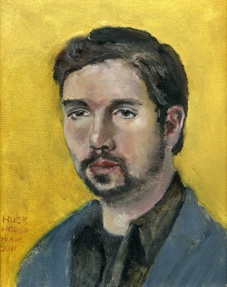


 MEMETERIA by Thomas May