My review of the concluding concert of the 2014 Summer Festival is now on Bachtrack:
The days are starting to grow noticeably shorter in the Pacific Northwest, and the end of the month-long Seattle Chamber Music Society Summer Festival brings yet another wistful reminder that we’re now facing the season’s inexorable downward slope. An immersive atmosphere of four weeks of three concerts each (plus free prelude recitals and additional events) gives the festival much of its flavour, making one all the more reluctant to bid adieu.
It’s been a month especially generous in discoveries, from the world première of an imaginatively crafted single-movement piano trio commissioned from Derek Bermel (with the Saramago-inspired title Death with Interruptions) to a welcome dose of vocal chamber music gems and other rarities mixed in with more standard fare.
On Saturday night the festival drew to a close with a typically diverse roster of musicians (totalling 15 over the course of the concert).
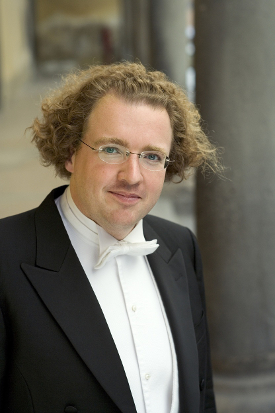
My review of this week’s Seattle Symphony program, with guest conductor Stéphane Denève and pianist Paul Lewis, is now live on Bachtrack:
This week’s Seattle Symphony programme brings the third and last of the current season’s co-commissions — all of which are United States premières — with The Death of Oscar by James MacMillan. Music director Ludovic Morlot led the SSO in the previous two (Pascal Dusapin’s violin concerto Aufgang and Alexander Raskatov’s piano concerto Night Butterflies); for the MacMillan, Stéphane Denève, a champion of the composer since his tenure with the Royal Scottish National Orchestra, was on hand as guest conductor. Denève had also premièred The Death of Oscar in November in Stuttgart, where he currently helms the Stuttgart Radio Symphony Orchestra.
Nike Wagner, the third of revolutionary director Wieland Wagner’s four children and the great-granddaughter of Richard, headed the Weimar Festival for a decade before being named new director of the Beethoven Fest Bonn.
Here’s an interview (in English) she recently gave host Peter Craven for Deutsche Welle’s Talking Germany program. Craven gets Nike to talk about what it was like growing up after 1945 as a Wagner, her relationship to the family (and especially her father), and its connections to Hitler.
There’s not very much about great-grandpa himself, though she attempts a capsule summary of the essence of Wagner’s genius. And Nike discusses some of her ideas about the Beethoven Festival, including the importance of dramaturgically thoughtful programming.
On his blog, Craven offers a few more glimpses of his guest:
Our initial encounter is very warm. She offers me a hand and, while I’m thinking that I like this lady, I’m also registering just how small her hand is, how thin her bones, and how frail and delicate she seems. It’s certainly a light frame, I reflect, to shoulder the heavyweight history of her family and the role it has for the better part of two centuries played here in Germany.
Eventually he gets Nike Wagner to share this:
“You know, everybody has a specific weight. I’m light. I love to jump, to run, to swim. And … what do you call it in English? … to hover. Not in a moral way. They always think I’m strict. I can be strict. I’m not a moralist: but any kind of injustice drives me mad. I change planes, trains, apartments. But I’m faithful. When I love a person, I love a person. And I love to go dancing. Waltzing. Discotheques. Well, not any more. Private parties these days. I love to move!”
As a descendant of Richard and Cosima Wagner, Nike is also the great-great-granddaughter of Franz Liszt. Here’s an interview (in German) on her planning while she was still heading the Weimar Festival:
My ears and nerves are still buzzing from the excitement of last night’s recital by the always-dependable Garrick Ohlsson (at the University of Washington’s Meany Hall). What generous programs he offers: Beethoven’s Op. 109 Sonata, Schubert’s Wanderer Fantasy (D760), a triptych of selections by Charles Tomlinson Griffes, and Chopin’s Third Piano Sonata in B minor. And as if that weren’t enough, two superbly characterized Chopin waltzes for encores: the Op. 18 Grand Valse Brillante and the Waltz in C-sharp minor (Op. 64, no. 2).
I tend to think of Ohlsson as one of today’s least pretentious and fussy pianists, an artist to be counted on to give performances that are filling and satisfying. Of course that’s possible only because of his utterly confident technique — that left hand! — and his deep knowledge and love of the repertoire. What seems at times to be a “straightforward” approach turns out to reveal subtle insights. In the miracle of late Beethoven, for instance, he was able to explore different facets of the last movement’s variations (the new angle on the ultra-minimal two-note motif over which Beethoven obsesses in the first movement) without seeming to short-shrift the larger architecture beauty.
The Schubert Fantasy emerged as it should: a virtuoso showpiece on the surface, sure, but far more exhilarating for its sheer scope of invention and the pleasure Schubert takes in the powers of transformation of a basic idea. Ohlsson left no doubt as to why the next generation of Romantics fell so deeply in love with this spectacular but anomalous example of Schubertian ambition.
The Chopin Sonata may have been the most satisfying interpretation among these three well-known works. What struck me as especially successful was Ohlsson’s understanding of Chopin’s rhythmic articulation, both in his swooningly beautiful skeins of melody and in the robust, hell-bent momentum of the finale. But this didn’t come across as an affected exaggeration, or at the expense of those other aspects essential to this magnificent score. The whole picture is always in view – it’s just that it resembles getting a higher resolution, more dpi for clarity and detail.
Charles Tomlinson Griffes (1884-1920)
And then there were the pieces by the early-twentieth-century American composer Charles Tomlinson Griffes. Two of the Roman Sketches, Op. 7, from 1916 (“The Fountain of the Acqua Paola” and “The White Peacock”) and the Scherzo from his Op. 6 Fantasy Pieces (1913). I found these to be an utterly delightful discovery. Hints of Griffes’s infatuation with then-new French music abound, but there’s something fresh about it all. The killer-energy Scherzo made for a nice cross-link with the Schubert.
Ohlsson recently released a recording devoted to this fascinating artist who died very young, a victim of the influenza pandemic. A gay man from Elmira, New York, Griffes was still of the generation when studying abroad was the done thing to gain any cred as a “classical music” composer.
Here’s what Aaron Copland had to say about this predecessor (in 1952, 32 years after Griffes’s death):
Charles Griffes is a name that deserves to be remembered … What he gave those of us who came after
him was a sense of the adventurous in composition, of being thoroughly alive to the newest trends in
world music and to the stimulus that might have derived from that contact.
Like modern physicists, practitioners of contemporary literary theory of the post-structuralist persuasion trade in ideas that can seem uncannily reminiscent of the ancient insights of Buddhism: ideas like the slippery elusiveness of language, the self/author as an illusion.
But even without the filter of once-fashionable theory, certain artists themselves trigger comparison with aspects of the Buddhist quest. Beethoven’s final piano sonata, the Opus 111, replaces the conventional design with a two-movement dialectic that is frequently likened to a transition from Samsara (the stormy world of struggle of the C minor first movement) to Nirvana (the serene variations of the Arietta). “The farewell of the sonata form,” as Thomas Mann’s character Kretschmar in Doktor Faustus puts it.
According to the writer Pico Iyer, Marcel Proust is another artist who brings Buddhism to mind. Proust “ventures into the farthest reaches of self-investigation and reflection on subjectivity, but brings his understandings back into language and archetypal episodes that anyone can follow.”
The Buddha, as I understand it, ultimately devoted himself to the simple exercise of sitting still and resolving not to get up until he had looked beyond his many delusions and projections to the truth of what he was (or wasn’t) and how to make his peace with that.
A recreation of Proust’s cork-lined bedroom (Musée Carnavalet in Paris)
Am I the only one who thinks that this sounds very much like someone in a cork-lined room, almost alone for years on end and turning a fierce and uncompromising light on all his experiences and memories so as to see how much of them might be wishful thinking, and what they owe to illusion and the falsifications of the mind? Marcel Proust never formally meditated, so far as I know, and he never officially quit his gilded palace to wander around the world, practicing extremes of austerity and cross-questioning wise men. But if I want to understand the tricks the mind plays upon itself—the ways we substitute our notions of reality for the way things are and need to dismantle the suffering false thoughts can create—I can’t think of a better guide and friend than the author of “À la recherche.”
[…]
Proust’s genius, like that of his compatriot Cartier-Bresson (who called himself “an accidental Buddhist”), is to register every detail of the surface and yet never get caught up in the superficial. Here is the rare master who saw that surface was merely the way depth often expressed itself, the trifle in which truth was hidden thanks to mischievous circumstance (or, others would say, the logic of the universe). It takes stamina, bloody-mindedness, concentration, and a fanatic’s devotion to stare the mind down and see how rarely it sees the present, for all the alternative realities it can conjure out of memory or hope. Proust had the sense to belabor us with little theology, academic philosophy or overt epistemology; yet nearly every sentence in his epic work takes us into the complications, the false fronts, the self-betrayals of the heart and mind and so becomes what could almost be called an anatomy of the soul. I’m not sure sitting under a tree in Asia 2,500 years ago would have produced anything different.
I think I mentioned elsewhere that I’ve started growing tired of “best-of-the-year” lists. Not that I don’t appreciate taking stock of a certain period — I’m actually kind of obsessive about that — but I’ve lately been finding those lists too arbitrary in the way they try to shoe-horn a whole year of experiences into some sort of hierarchy. Anyway, I always end up discovering that excellent things get left out, while trend-think makes undeserving ones crop up to annoy me.
So I won’t give in to this tiresome ritual, with all its problematic meritocracy.* And as the year ends and a new one approaches with its illusion of offering a blank slate, I prefer to focus not on perfection achieved but on the tortuous route toward it. Here are a couple of inspiring examples of the fight against settling for something that’s good but not good enough. Instead of pristine blank slates, let’s consider the crabbed, crossed-out traces of an inner battle to wrest a chaos of ideas into something that will work. It’s the principle of starting with something that’s maybe even unremarkable and then pressing on against the odds to squeeze some sort of beauty or meaning from it. Over and over, facing constant confusion and frustration.
I suppose Beethoven is the most-obvious example of what I’m referring to. To me what’s especially encouraging about the stories of his compulsion to get things right, working them over and over, is that we can see Beethoven sometimes starting out with some really mundane stuff.
In his study of the Missa solemnis (a current preoccupation), Roger Fiske quotes from Beethoven’s first attempts to work out the theme of the Credo: “No one need be surprised that Beethoven’s sketches for the start of the Credo verge on the inept; his preliminary sketches often do. He seems to have needed to write down something which (to us) looks totally unpromising before he could find what he wanted.”
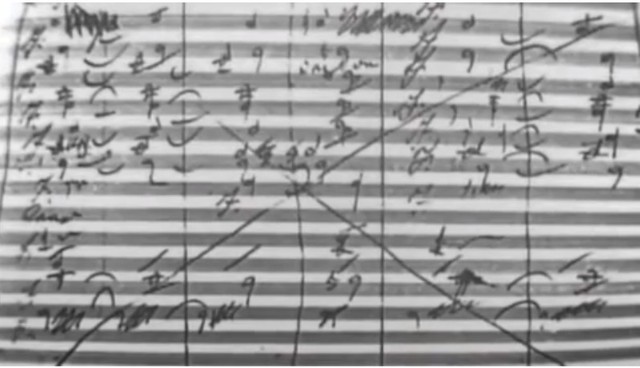
Leonard Bernstein even used the convoluted sketches for the Fifth Symphony to dramatize his point about Beethoven’s aesthetic struggle to write music that somehow seems “inevitable”:
Beethoven’s manuscript [in contrast to the gorgeous, flowing chirography of Stravinsky’s Symphony in Three Movements] looks kike a bloody record of a tremendous inner battle. Before he began to write this wild-looking score, he had for three years been filling notebooks with sketches….And so he tried a third ending, and this one worked…[H]e had to struggle and agonize before he realized so apparently simple a thing: that the trouble with his first ending was not that it was too short, but that it was not short enough. Thus he arrived at the third ending, which is as right as rain….
Imagine a whole lifetime of this struggle, movement after movement, symphony after symphony, sonata after quartet after concerto. Always probing and rejecting in his dedication to perfection, to the principle of inevitability….
[I]t leaves us at the finish with the feeling that something is right in the world, that something checks throughout, something that follows its own laws consistently, something we can trust, that will never let us down.
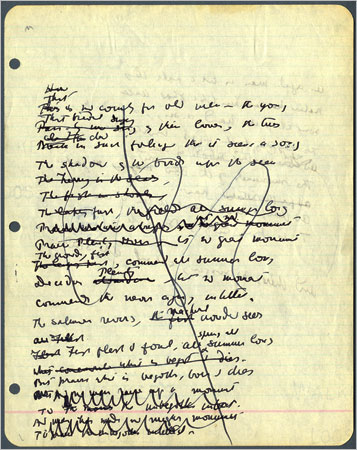
And there’s the example of William Butler Yeats, as Curtis Bradford (Yeats at Work) shows in his intriguing study of the poet toiling over drafts in his bound notebooks. The final version of “Sailing to Byzantium” encompasses a very small percentage of the lines Yeats wrote down in his first draft. The amazing (in every sense) opening line of “Leda and the Swan” — “A sudden blow: the great wings beating still” — started as “Now can the swooping Godhead have his will” or “The swooping godhead is half hovering still” (Yeats initially wanted to title it “Annunciation”).
Draft of a page from Yeats’s “Sailing to Byzantium”
“The Choice” (1932)
The intellect of man is forced to choose
perfection of the life, or of the work,
And if it take the second must refuse
A heavenly mansion, raging in the dark.
When all that story’s finished, what’s the news?
In luck or out the toil has left its mark:
That old perplexity an empty purse,
Or the day’s vanity, the night’s remorse.
–William Butler Yeats
Thanks to all for visiting my blog. I wish you all a happy and productive new year and hope you’ll continue to visit and share your thoughts.
*OK, now I’m going to go ahead and cheat and slip in a reference to these as absolutely unforgettable experiences I was privileged to enjoy in 2013: the Adams/Sellars Gospel According to the Other Mary in LA; Lucerne Festival AND Seattle Opera Rings; Morlot conducting Messiaen’s Turangalîla; Diaghilev and the Ballets Russes at the National Gallery; Mark Rylance and the RSC’s Richard III and Twelfth Night; the Richard Diebenkorn retrospective at the de Young Museum; SF Symphony concert of Tom Adès, Mendelssohn, Stravinsky, with Pablo Heras-Casado; Azeotrope Theatre’s Gruesome Playground Injuries (Seattle); Gregory Maqoma’s Exit/Exist; the Met’s Dialogues, Giulio Cesare, The Nose, and Frau; and The Good Person of Szechuan at the Public.
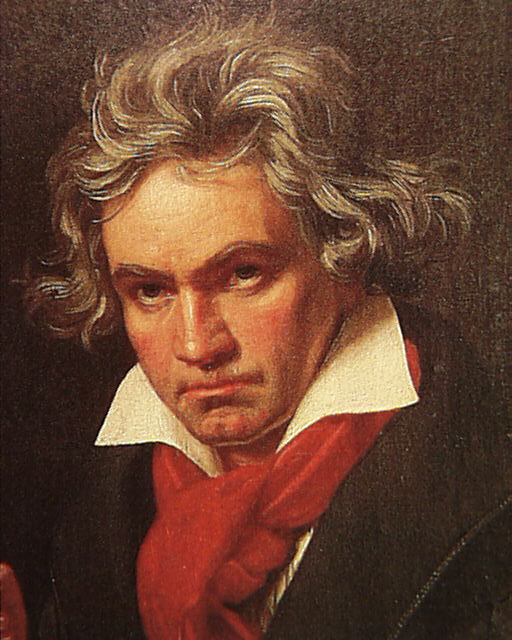
Portrait of Ludwig van Beethoven by Joseph Karl Stieler (1819)
He was an artist, but also a man, a man in every sense, in the highest sense. Because he shut himself off from the world, they called him hostile; and callous, because he shunned feelings. Oh, he who knows he is hardened does not flee! (It is the more delicate point that is most easily blunted, that bends or breaks.)
Excess of feeling avoids feelings. He fled the world because he did not find, in the whole compass of his loving nature, a weapon with which to resist it. He withdrew from his fellow men after he had given them everything and had received nothing in return. He remained alone because he found no second self. But until his death he preserved a human heart for all men, a father’s heart for his own people, the whole world.
Thus he was, thus he died, thus he will live for all time!
—Oration by the playwright and poet Franz Grillparzer delivered on the occasion of Beethoven’s funeral on 29 March 1827
To mark the occasion of the day celebrated as Beethoven’s birthday, here’s an account of what may well be Beethoven’s greatest large-scale composition – and his greatest “opera” – in an account led by Leonard Bernstein with the Concertgebouw: the Missa solemnis.





 MEMETERIA by Thomas May