
Great way to start the week – one of my favorite takes on opera’s “storm” meme:
Filed under: Berlioz

April 20, 2015 • 10:13 am 2
Great way to start the week – one of my favorite takes on opera’s “storm” meme:
Filed under: Berlioz
February 13, 2015 • 2:16 pm Comments Off on Berlioz’s Roméo et Juliette Symphony toute entière

Hector Berlioz didn’t even know English when he saw his first stagings of Shakespeare in 1827 in Paris, performed by a British company on tour. But it didn’t matter. “Shakespeare, coming upon me unawares, struck me like a thunderbolt,” he later recalled. “The lightning flash of that sublime discovery opened before me at a stroke the whole heaven of art, illuminating it to its remotest depths.”
Those reverberations mixed with the young French artist’s discovery of the Beethoven symphonies around the same time. And both epiphanies propelled Berlioz along his adventurous course as a musical revolutionary.
The work that fuses Berlioz’s reimagining of what a symphony could be with his Shakespearean obsession is Roméo et Juliette. Last night the Seattle Symphony performed RnJ in its entirety — to my knowledge, for the first time in their history. Ludovic Morlot led the expansive forces called for by the score: three vocal soloists, chorus, and orchestra (in this case splitting the first and second violins to left and right). There’s even a touch of acoustical “space music” in the positioning of a brief double choir offstage.
It’s a mammoth score (all told, around an hour and a half — not counting the intermission that was inserted here after the “Queen Mab Scherzo”). The instrumental sections are played as a kind of abridged suite often enough, but encountering the whole megillah is a rarity that brings home how radical were Berlioz’s ideas about music and its relation to text and drama. The result is that RnJ is more or less an acknowledged masterpiece that contains some of this genius’s finest music, yet, oddly, as a whole the work remains more often talked about than heard.
Following Maestro Morlot’s work with specific composers since his tenure began here has been fascinating — and the Berlioz thread has proved particularly satisfying artistically (La Damnation de Faust in his first season, an electrifying Symphonie fantastique this time last year).
Morlot and his musicians are showering love on Roméo et Juliette. Sorry if that sounds schmaltzy, but there’s really no other way to put it: the breathtaking precision of their dynamic shadings, the intensified expressivity, their Zen-like focus on detail, the awareness of complicated, even contradictory emotions in this score.
Berlioz carries further the idea from the finale of Beethoven’s Ninth of the instruments trying to break out into words by doing the opposite: after an orchestral introduction — the discipline of fugal writing paradoxically depicts violent disorder and passion — he stages an overall summing up of the play’s main action in a prologue “act” that features chorus and two soloists positioned behind the strings. (Sylvie Brunet-Grupposo contributed her velvety mezzo and tenor Kenneth Tarver sang with elegant fervor.)
But already you sense the instruments straining to take over the telling, with solemn, commanding rebukes from trombonist Ko-ichiro Yamamoto and the brass ensemble standing in for the Prince of Verona. And Berlioz reserves the most sublime passages for his orchestra, above all in the scene of Romeo alone and the nocturne of the young lovers meeting in the garden of the Capulet residence, beneath Juliet’s balcony. The woodwinds played with soulful poignance, with admirably individualized phrasing from Mary Lynch on oboe and clarinetist Ben Lulich; bassoonist Seth Krimsky sustained a mood of deep, anxious melancholy later in the Tomb Scene.
(The playing was so precise and riveting that I encountered a novel torture to add to the usual litany of cell phones, coughers, page-turners, seat kickers, and other occupational hazards of the concert hall: the penetrating sound that a pair of leather shoes squeaking against each other can generate, as a patron helpfully demonstrated during one of the score’s most heartbreaking moments.)
Morlot tenderly shaped the ebb and flow of the scène d’amour, with its sudden pullings-back and renewed outbursts of pained passion. Richard Wagner (Berlioz’s junior by a decade) was there at the historic premiere of this “symphonie dramatique” in Paris in 1839, and it was an epiphany for Little Richard as well.
It’s enlightening to compare/contrast the passionate melody of this music with its transmogrification in Tristan: the Classical transparency of Berlioz’s sensibility survives his most radical harmonic ideas, so that the French composer’s love music still betrays a moving awareness of limits and fragility that is a far reach from the oceanic transports Wagner permits his lovers to experience.
The players’ crisp focus on detail paid off richly, too, in the gorgeously nimble, ear-tickling “Queen Mab Scherzo” — Berlioz’s rendition, purely through the means of orchestral language, of Mercutio’s ingenious speech about the “fairies’ midwife.” Jeff Fair’s horn solo was outstanding, and Michael Werner’s light-as-a-feather pings on hand-held crotales echoed dreamily against infinitesimally delicate pizzicati. The rehearsals must have been incredibly focused, resulting in a lightning speed tempo and crystal-clear textures that throw the sheer weirdness of this music in high relief.
It should be noted that the text set by Berlioz — no mean wordsmith himself — originated in his own paraphrasing and rewriting, only loosely based on Shakespeare’s original; he had the poet Émile Deschamps craft this into a libretto, thus avoiding direct “competition” with Shakespeare’s verse. The “words” and actions of the lovers themselves are reserved strictly for the orchestra to impart.
Another highlight was Juliet’s Funeral March and the Tomb Scene (in the third part or “act,” which was performed after the intermission). A smaller subset of Joseph Crnko’s Seattle Symphony Chorale had appeared for the narrative of the Prologue. Here they came out in full force and sang with clarity and power. The restraint of their single repeated unison E gave way to emotion-laden elegy, its resplendent polyphony expertly balanced.
Arguably the lengthy finale is the weak link in Berlioz’s conception of this symphony-opera-oratorio hybrid. All the pain, longing, and ecstasy — and violence — that lead to the denouement feel swept aside in a superficially rousing reconciliation, the most overtly operatic scena of the work. Here Berlioz gravitates more obviously back toward the Beethovenian Ninth model of a choral finale. Baritone David Wilson-Johnson — filling in at the last minute — delivered the significant part of the peace-maker Friar Laurence with flair and charisma.
But Berlioz knew that “the very sublimity of this love” is beyond words, though not beyond expression. To access this he focuses in Roméo et Juliette on, as he described it, “the language of instruments, a language richer, more varied, less restricted, and thanks to its very indefiniteness, incomparably more potent.”
There’s one more chance to hear this performance of Berlioz’s Roméo et Juliette: Saturday 14 February 2015 at 8 pm at Benaroya Hall. Tickets here.
UPDATE: I asked SSO staff about an odd commotion that took place just as concertmaster Alexander Velinzon came out. A man started shouting something in an agitated voice (I couldn’t make out what he was saying) and walked up the aisle holding a pen and pointing it at one of the ushers. Apparently police were notified and came to Benaroya Hall after the gentleman had exited the hall. I’m told there were no other problems and that he was given a refund for the ticket he had purchased.
On Twitter, Terry Miller wondered whether the disturbance was from the Montague or Capulet side.
(C)2015 Thomas May. All rights reserved.
Filed under: Berlioz, conductors, review, Seattle Symphony
February 14, 2014 • 2:40 pm Comments Off on Morlot, Seattle Symphony, and Berlioz: An Explosive Match
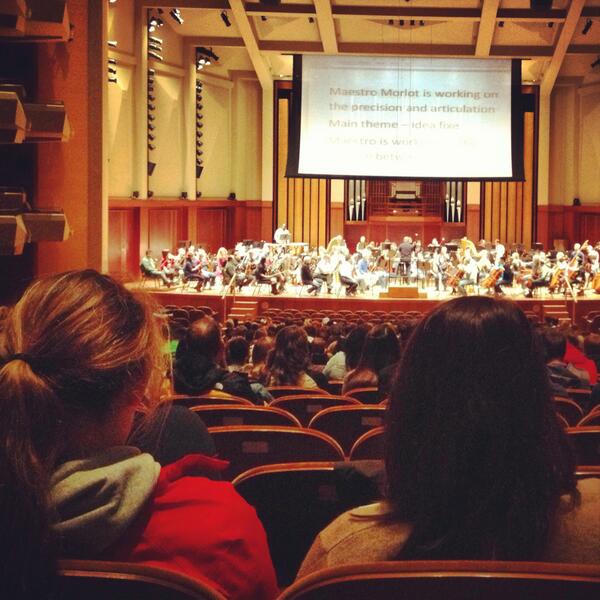
High school students discovering the world of Berlioz at a Seattle Symphony rehearsal
Ludovic Morlot is now back from his winter duties as chief conductor at La Monnaie in Brussels (where he just led performances of Janáček’s Jenůfa). And in its most incandescent moments, last night’s program — his first with the Seattle Symphony following the hiatus — blazed with the impatient passion of lovers meeting after an enforced absence.
The players were champing at the bit to whip up the energy of the brief concert opener, Emmanuel Chabrier’s Bourrée fantasque. Despite the nice thematic tie-in of the title, Chabrier’s piano piece felt like a mere diversion from the heart of the matter. The orchestration by the famous fin-de-siècle Wagnerian Felix Mottl layered lavish, high-calorie toppings over Chabrier’s zesty piano piece – frankly, at times, threatening to smother it.
Morlot has a genuine affinity for the music of the Romantics, so there’s a fascinating opportunity in this program to compare his approaches to the subjectivity of Robert Schumann versus Hector Berlioz. The issue of Schumann’s mental illness is by now such a cliche that it was refreshing to encounter a performance so alert to the astonishing mindfulness of his poetic reveries. In other words, what came across in the Cello Concerto wasn’t so much a sequence of “moody,” unsettled and changeable emotions as one lengthily sustained poetic fantasy.
The three chords in the orchestra that launch and unify the piece were shaped with an appropriately evanescent dreaminess, setting the tone for the Concerto’s primarily meditative as opposed to show-offy quality. The soloist, the French cellist Xavier Phillips, was especially memorable in the slow middle section of the three interlocking movements, when his orchestral “doppelgänger” (SSO principal cellist Efe Baltacıgil) engages him in a duet.
Phillips played with an inviting warmth and intimacy well-suited to Schumann’s elaborate lyricism, but the moment when the cello “rouses” the orchestra from the fantasy at the very end of the Concerto sounded underwhelming. Acoustic imbalances with the orchestra — a particular peril of cello concertos, and one reason composers avoided them for so long — were a persistent distraction. Still, there was breathtaking beauty to be enjoyed in Phillips’ sensitive and musically intelligent phrasing.
A good concert then became great in the program’s second half: Berlioz’s Symphonie fantastique, that blockbuster of Romanticism that flips the bird to the conventional polarities of French/German, Classical/Romantic, fact/fiction.
Too often we hear the Symphonie as a manifesto of its moment in time, a “textbook” of Romanticism with the usual checklist — and the result is a performance that sounds like the epitome of a museum piece (in the bad old sense of museums, before the smart ones started updating themselves).

Young Berlioz in 1832, around the time of the Symphonie fantastique ; painting by Émile Signol
Last night it suddenly occurred to me that Morlot’s understanding of Berlioz is of the same category as Leonard Bernstein’s identification with Mahler: apart from all the technical knowledge and even sensibility he brings to Berlioz, it’s as if Morlot internally identifies with this music and so is able to give his interpretations a uniquely compelling stamp.
That’s the only way I could make sense of the 3-D vividness of last night’s performance: colors and textures I’ve never noticed before, for sure, but most of all a sense of what’s at stake with the emotions and obsessions of Berlioz’s score. I found myself grinning with near disbelief at how shocking and still over-the-top parts of it can still sound.
Morlot got the SSO musicians to tap into that sense of conviction. There were memorable achievements from every single section of the orchestra. None of this would have worked without the artistry of Michael Crusoe (timpani), Valerie Muzzolini Gordon (harp), Stefan Farkas (English horn), Christie Reside (flute), Ben Haussman (oboe), Seth Krimsky (bassoon), for example, not to mention the thrilling playing by the strings and brass, particularly in the witches’ “orgy” of the last movement.
This wasn’t the usual colorful story of young Hector going all wild after seeing the actress Harriet Smithson and getting tangled in an insanely obsessive/possessive love attachment – the whole business is really a MacGuffin, anyway — just as it wasn’t the corny 1960s-flavored rethink of an orchestra on an LSD/mushroom/opium-fueled trip.
Morlot understands that Berlioz’s “protagonist” in the Symphonie fantastique is an artist above all else — that the Eros, the drive, the alienation, the hallucinations, all of it, are all components of a universe he imagines into being, not mere triggers of emotions that require expression. And that the entire epic he lays out for us in this score is an “instrumental drama” (the composer’s own phrase) that expertly transforms his musical material to give voice to a radical subjectivity.
I especially like how Morlot refuses to settle for one overall approach — stressing Berlioz’s Classical underpinnings, say, or staying focused on his novel orchestration. He understands the multidimensional character of this score and allows its widely varying facets to come out when they make sense in the dramatic context.
There was a particularly persuasive hint of Beethoven of the Pastoral in the beautifully played woodwind writing of the third movement. (Beethoven cast an enormous shadow over Berlioz at this point in his career.) Some of the “spatial” effects of offstage timpani and shepherd’s pipe anticipate Mahler.
The March to the Scaffold, sardonic as hell, actually helped set the scene for what usually seems an abrupt shift of tone in the Witches’ Sabbath/nightmare finale. And in that fantastic musical phantasmagoria, despite all the humiliations and horrors the protagonist endures, it’s the image of the cocky young artist Berlioz who emerges, dominating and enthralling his audience.
So what is it with Berlioz and obnoxiously intrusive noise in Benaroya? Two years ago, smack in the middle of one of my favorite Morlot performances to date — Berlioz’s La Damnation de Faust — a patron’s alarm actually forced the music to a halt for several minutes. Last night someone spoiled the carefully built-up atmosphere by ringing heedlessly away, audible at a good distance. Now that should be a damnable offence.
There’s one more chance to hear this program: Saturday night at 8:00 pm at Benaroya Hall.
(c) 2014 Thomas May – All rights reserved.
Filed under: Berlioz, review, Seattle Symphony
 Arts & Culture Stories from NPR
 MEMETERIA by Thomas May