The late, great Robert Hughes — one of my favorite critics — offers an art historian’s perspective on the American Revolution and its aftermath in his essay “The Decline of the City of Mahagonny” (from the anthology Nothing If Not Critical):
The American Revolution had held, deep in its heart, the vision of a corrupt Europe, a Europe whose hold was long and tenacious but which could be demystified by showing its moral obsoleteness. The idea that Europe was culturally exhausted was an important ingredient of American self-esteem. Its ancient craftiness, its subtlety, its strata of memory, its persistent embrace of elitist against “democratic” cultural values: these, in American eyes, were grounds for suspicion and even hostility…. Europe must be transcended, outdone.
Thus the power of Bernard Berenson’s appeal to the plutocrats of Chicago, New York and Boston at the turn of the century … was his promise of a new American Renaissance which would outdo the old, whose paintings and sculpture would nevertheless furnish indispensable refinement to the new.
Franco Moretti’s new collection of essays, Distant Reading, has been generating a lot of buzz. The National Book Critics Circle just honored it with its award for criticism last month (winning out over books by Jonathan Franzen and Janet Malcolm ).
Few critics, writes the Times Literary Supplement are “as hell-bent on rethinking the way we talk about literature.” Wired declares that “if his new methods catch on, they could change the way we look at literary history.” And Joshua Rothman recently offered this reflection on the revolutionary critic in The New Yorker:
Should literary criticism be an art or a science? A surprising amount depends on the answer to that question…. Almost no one…wants to answer the question definitively, because, for a critic, alternating between one’s artistic and scientific temperaments is fun—it’s like switching between the ocean and the sun at the beach. Franco Moretti, a professor at Stanford, fascinates critics in large part because he DOES want to answer the question definitively. He thinks that literary criticism ought to be a science.
[…]
Moretti’s impulses are inclusive and utopian. He wants critics to acknowledge all the books that they don’t study; he admires the collaborative practicality of scientific work. Viewed from Moretti’s statistical mountaintop, traditional literary criticism, with its idiosyncratic, personal focus on individual works, can seem self-indulgent, even frivolous.
Over at Nautilus, the science writer Dana Mackenzie considers Moretti’s approach of “distant reading” in the context of the “topic modeling” trend:
Topic modeling looks beyond the words to the context in which they are used. It can infer what topics are discussed in each book, revealing patterns in a body of literature that no human scholar could ever spot. Topic-modeling algorithms allow us to view literature as if through a telescope, scanning vast swaths of text and searching for constellations of meaning….
Other revolutionary aspects of topic modeling for humanities students, according to Mackenzie: it brings “quantitative arguments into the humanities,” allows scholars to “mine for new themes and topics,” and introduces the tool of falsifiability via statistical analysis.
Digital humanities technologies can help us see gradual changes, whether in literature or elsewhere. Humans have difficulty comprehending change that happens on the time scale of a human life, or longer. If Underwood’s hypothesis is correct, we need computers to help fill in our blind spot. Topic modeling does not overturn or replace our previous ways of seeing; it enhances them.
There are some real gems in the innovative, ongoing 33 1/3 series from Bloomsbury (which now numbers 90 crisp little volumes) — and I’m not claiming that just because I personally know several of the authors. Or because two of the most dazzling of those gems are by friends: Mike McGonigal on My Bloody Valentine’s Loveless and the latest in the series, on Aphex Twin’s seminal Selected Ambient Works Volume II by Marc Weidenbaum.
If you haven’t discovered it yet, I also highly recommend Weidenbaum’s fascinating and long-running webzine disquiet — named in honor of the Portuguese poet, critic, and philosopher Fernando Pessoa — where you can find his fascinating collaborations, interviews, experiments, and musings on ambient and electronic music.
Just published last month, his new book is already harvesting a bumper crop of impressive reviews — and deservedly so. Any in-depth consideration of a musical landmark needs to offer the simultaneous perspectives to which Weidenbaum alludes when he writes that Selected Ambient Works Volume II, as Aphex Twin (aka Richard D. James) enigmatically titled this 1994 album, “may be timeless music, but it is still very much a product of its time.”
Weidenbaum gracefully sustains that double focus through his close listenings to each of the 25 tracks and his evocative contextualization of the album’s origins, recounting, for example, its emergence amid “the populist flowering of British occultism, a rave-era echo of the Summer of Love.” He also deftly weaves into his discussion points about the cross-connections between ambient music and classical composers and ensembles like Alarm Will Sound.
When the composer Caleb Burhans (a member of Alarm Will Sound) was assigned the project of scoring the “Blue Calx” track for his group with only acoustic instruments, he played on references to the beginning of Mahler’s First Symphony; the music of John Tavener and Ingram Marshall provided other classical precedents as well.
Paul Gleason points out that this isn’t just another exercise in music criticism: “both the album and the book stretch listeners and readers to develop new definitions of what music means.” He continues:
One of the most compelling sections of Weidenbaum’s book is on the so-called “beatless” nature of “Selected Ambient Works Volume II.” To put it country simple, when people first heard the record back in 1994, they had a hard time hearing beats. This, of course, was anathema to any electronic music fan back then. But what Weidenbaum shows in some truly deft and exciting passages is that – get this – the record’s beats emerged over time. This analysis is so cool because it shows that a record’s meaning and innovations (the beats are subtle) emerge over time and that, more generally, the meaning of a work is created in time. I don’t know whether Weidenbaum was thinking about Martin Heidegger’s hermeneutics, but I certainly was.
[…]
Like all good critical studies, [his book] doesn’t provide the illusion of closure; rather, it expands minds, fostering the creation of textual meaning.
Weidenbaum has gathered together here all of the pieces he posted separately on disquiet for each of the album’s tracks (which were originally untitled, except for “Blue Calx”). In an interview with his publisher, Weidenbaum explains what attracted him to writing about Aphex Twin:
What drew me in particular was the album’s deep, resounding, unrepentant murkiness — which is to say, its absence of what might be considered particular. The record evades the idea of particular, except to the extent that its pronounced murkiness is particular to it. Tracks seem to bleed together, and to fall apart … … Ambient music is often packaged and promoted as being ephemeral, ethereal, but this album is more so than most; it’s tantalizingly difficult to get a grip on.
He also refers to one of the many challenges he has taken on here — and so beautifully addressed. Selected Ambient Works Volume II is almost entirely instrumental. Weidenbaum says:
One of the great benefits of a record with no words is how it doesn’t respond directly to your writing about it — it doesn’t purport to explain itself in the way that records that consist of words, such as a traditional rock and rap records, explain themselves. This is very enticing to me.
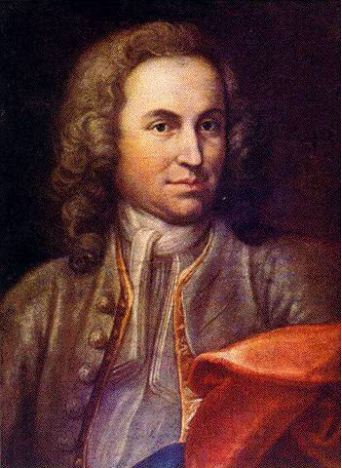
Possibly the young J.S. Bach c. 1715 — or possibly not; painting by J. E. Rentsch, the Elder
J.S. Bach has been much on my mind of late. I need to make time to plunge into John Eliot Gardiner’s new book on the composer, especially after George B. Stauffer’s review in the recent New York Review of Books has whet my appetite.
In Bach: Music in the Castle of Heaven, Gardiner distills a lifetime of devotion and study to the music of the Thomaskantor (one of the epithets by which Germans refer to Bach). According to Stauffer, this weighty tome basically revolves around the great question of “just how Bach managed to express the inexpressible, especially with regard to death, and what life experiences stood behind his compositional decisions.”
Gardiner recently started serving as president of the Leipzig Bach Archive and has managed to create a controversial portrait by drawing on recent findings of the archive — a portrait dramatically at odds with the longstanding image of an obedient musical citizen:
Moving beyond the hagiographies of the past, he presents a fallible Bach, a musical genius who on the one hand is deeply committed to illuminating and expanding Luther’s teachings through his sacred vocal works… but on the other hand is a rebellious and resentful musician, harboring a lifelong grudge against authority — a personality disorder stemming from a youth spent among ruffians and abusive teachers. Hiding behind Bach, creator of the Matthew Passion and B-Minor Mass, Gardiner suggests, is Bach “the reformed teenage thug.”
What sounds especially fascinating is that, according to Stauffer, Gardiner roots his speculations in the music (though he apparently omits discussion of the instrumental and keyboard pieces), since he views the music as “the anchor to which we can return again and again, and the principal means of validating or refuting any conclusion about its author.”
The result is that Gardiner “forces us to rethink Bach’s life and how adversity and faith affected his vocal compositions. And [he] takes us inside his world, allowing us to see the works from the standpoint of composer, performer, and listener.”
Over at The Guardian, Peter Conrad points out that Gardiner takes Bach’s intense faith for granted in his exploration of the sacred music, yet “he still makes the effort to account for the emotional force and consolatory balm of Bach’s music in ways that are humanly engaging.”
He treats the cantatas as psychodramas, and thinks of the Passions as three-dimensional versions of opera which, rather than exhibiting the vocal and histrionic antics of sacred monsters in a fictional world onstage, address us directly when the soloists perform their hortatory arias and require us, in chorales that were sung by the entire congregation, to participate in Christ’s tragedy and in the divine comedy that is its sequel. Gardiner’s analogy for the way the Passions work comes from a literary form that could not be less spiritually exalted: he draws on theorists of the novel such as Bakhtin to explain the “dialogic threads” and complementary “subjectivities” that Bach draws together, and despite his own orthodoxy he makes frequent allusions to Philip Pullman, for whom art is our demonic repudiation of an oppressive God.
While the title Bach in the Castle of Heaven suggests something emphatically pious, Conrad adds, “Gardiner’s is a festive book, enlivened by the ‘joy and zest’ of Bach’s ‘dance-impregnated music.’ Those dances are sacral but also rowdily profane… Quoting the sociologist Émile Durkheim, he defines religion as a ‘collective effervescence,’ a shared ecstasy – more readily available, perhaps, in the mud at Glastonbury or clubbing under the arches in Vauxhall than at a church service in 18th-century Leipzig.”
Just like Shakespeare, Bach will always be the mirror of our own age as well.
I came across this very interesting London Review of Booksdiscussion of Brian Levack’s The Devil Within Possession and Exorcism in the Christian West by Terry Eagleton. According to the jacket copy by one of my erstwhile employers, Yale University Press, Levack’s examination of the epidemic of reported demonic possessions in Reformation Europe takes into account “the diverse interpretations of generations of theologians, biblical scholars, pastors, physicians, anthropologists, psychiatrists, and historians.”
The “common sense” model today of course ascribes what was believed to be or presented as possession to the symptoms of mental or physical illness. But Levack’s contextual approach argues that “demoniacs and exorcists—consciously or not—are following their various religious cultures, and their performances can only be understood in those contexts.”
Eagleton, a prominent literary critic who delivered the Terry Lectures in 2008, homes in on this cultural contextualization as a problematic method:
“In [Levack’s] view, falling prey to the lures of the Devil is always culturally specific. One cannot, he claims, use contemporary psychological models to explain the mentality of people who lived several centuries ago. This is surely implausible. Psychological ailments, like physical ones, display a degree of continuity across the ages….All illnesses, Levack writes, ‘are socially constructed, and can be understood only if they are studied in the cultural context in which they took place’. Yet cancer is not a social construct in the sense that melancholy is, and a German physician could treat an arthritic Peruvian peasant without knowing much about his or her cultural context.
In capitulating to a fashionable culturalism, Levack is unclear about what part if any he considers mental illness to play in demoniac behaviour. On the one hand, he is deeply suspicious of universalist claims, regards the modern definition of hysteria as far too protean to be useful, and dismisses too briskly the notion of mass hysteria, which would seem a reasonable explanation for the various epidemics of diabolical invasion which erupt from time to time. On the other hand, he concedes that psychological disturbance may account for some aspects of the business in hand. His book thus combines a scepticism of medical explanations with the concession that hysteria and demonic possession may be closely related.
I’m also intrigued by Levack’s focus on the “performative” aspects both of those possessed and of the rituals devised to exorcize them. According to Eagleton, Levack believes that “demoniacs have to be understood as acting out a script encoded in their religious cultures, in a theatrical performance which involved themselves, the exorcist and the community as audience. Though the performance was predetermined, the occasional ad lib was permissible. People mugged up on their roles by reading accounts of other possessions, so the growth of printing played a vital role in the whole business.”
But Stuart Clark, author of Thinking with Demons: The Idea of Witchcraft in Early Modern Europe, finds Levack’s thesis of possession as the expression not of illness but of the religious cultural context in which it is rooted to be plausible. Clark writes that this explanation “restores a powerful sense of agency to those affected and gives meaning to their bizarre behaviour.”
Eagleton, on the other hand, while he admires Levack’s “erudite, absorbing account,” comes to a very different conclusion about possession and agency:
The idea of being appropriated by alien powers challenges the modern concept of individual autonomy. In its own way, it recognises that there is a level at which men and women do not belong to themselves. Our relation to ourselves is not like our relation to a piece of property. As the concept of the unconscious would suggest, there are destructive forces over which we have only precarious mastery, and which can assume a deadly momentum of their own. It is just that there are more productive ways of recognising that at a certain level we do not belong to ourselves than spewing up frogs.
Reviewer Christopher Hart points out that the book offers fascinating examples of the many ways creative types “discover for themselves Flaubert’s famous advice that one should live like a bourgeois and put one’s bohemianism into one’s work.”
Thomas Mann evidently loved his kip, rising at 8am, enjoying a good hour’s nap in the afternoon and going to bed around midnight, in a separate bedroom from his wife. Richard Strauss appears to have slept a good ten hours a night. The results of all this bourgeois self-discipline and these early nights are plain: many of those who followed such a regimen were hugely prolific as well as great, from Bach to Balzac to Dickens. F Scott Fitzgerald, I was astonished to learn, sometimes wrote up to eight thousand words a day. This is approaching Barbara Cartland levels, but it didn’t seem to do his prose much harm.
But don’t forget the importance of exercise:
The best inspiration often came while walking. Beethoven always took a pencil and paper with him in the Vienna Woods, and Kierkegaard often came home and started scribbling again still in his hat and coat. Some always wrote standing up – Hemingway and, I think, Virginia Woolf (who is not covered here). Nabokov started standing up, then progressed to sitting and finally lying down. Few seem to have practised any more violent exercise than walking, apart from Byron with his boxing and riding and, rather surprisingly, Joan Miró. The dreamy surrealist was an ardent practitioner of boxing, running and ‘Mediterranean yoga’. He detested going to parties, telling an American journalist, ‘They get on my tits.’
Rosemarie Bodenheimer paints a detailed portrait of Charles Dickens as relentless walker:
Walking was essential, to bring his books into being, and to calm the effects of his intense engagement with his characters. Repeatedly his letters mention extended periods of walking as he worked toward a new project. The activity of walking allowed him to think his way into new fictional worlds, while allaying the increased restlessness that came upon him when he was still in a state of uncertainty.
And pretty soon it will be time again for those New Year’s resolutions…..
Just how “tailor-made” were Shakespeare’s plays for the particular actors in his company? In the TLS, Charles Nicholl reviewsShakespeare in Company by Bart Van Es. This new book “seeks to show that Shakespeare’s achievement as a writer was in crucial ways communal; that the contributions of his playhouse colleagues, indeed his whole immersion in the business and practice of the theatre, are woven into the fabric of his plays; and that in a broadly chronological framework one can see his literary skills evolving in response to certain changes in his working conditions.”
Van Es offers a corrective to the later Romantic image of the lone “lofty genius” — with interesting comparisons to be made along the way, incidentally, with the give-and-take of composers like Handel who wrote for particular performers and within a demanding commercial framework. According to Nicholl, Ven Es gives us a down-to-earth portrait of “a poet at work in the daily professional context of a busy and successful theatre company.”
Of special fascination is the influence of writing for the tragedian Richard Burbage and the comedian Robert Armin. The arrival of the latter to replace the previous “star comic” Will Kemp led to “a stylistic watershed in Shakespearean comedy.” Nicholl explains:
Kemp was an old-style “jigs and bawdry” man, whose typical Shakespearean parts were lovable bozos like Bottom and Dogberry; he may also have been the world’s first Falstaff. By contrast, the parts written for Armin during the first few years of the new century are the more complex, mercurial “fools”, whose wit is satirical and edgy yet tinged also with melancholy. The first role specially tailored for Armin was Touchstone in “As You Like It”….
Further Armin roles, in probable order of composition, are Feste in “Twelfth Night,” Thersites in “Troilus and Cressida,” Lavatch in “All’s Well” and the Fool in “Lear.” The last of these is a radical relocation of the truth-telling jester to the terrain of tragedy. Armin’s last identifiable Shakespearean role is Autolycus in “The Winter’s Tale.”
Increasingly in this centenary year of Stravinsky’s Rite of Spring, we’re coming to see how much of modernism has involved an unpredictable marriage of the avant-garde and commercialism. Serge Diaghilev was a daring impresario but also a canny businessman. As for Schoenberg’s “air from another planet,” people who tend to write off atonality nowadays forget its far-reaching presence in film scores.
The management of color, too, turns out to have played a significant role in retuning tastes to the modern era. Regina Lee Blaszczyk’s The Color Revolution gives a fascinating account of color as a potent psychological and social tool manipulated by “color engineers.”
Blaszczyk’s lively history of the modern era’s preoccupation with color and her discussion of color’s influence on innovation in industry and design make me wonder how this shift affected perceptions of music as well — contemporary and canonical. Her focus is on American industry, which took important cues from the Paris scene. But Blaszczyk mentions other developments and influences from Europe, such as Alexander Scriabin’s experiments with color projections synchronized to his scores.
“Ever since Isaac Newton, people had been fascinated by the apparent analogy of the seven steps in the musical scale and the seven spectral colors in the rainbow,” writes Blaszczyk. This line of thinking even led to attempts at social engineering:
During the Enlightenment, a mathematician named Louis-Bertrand Castel dazzled Paris society with the first color-music instrument, an ocular harpsichord that diffused pigment light through windowpanes at the strike of a key. In 1893, a British inventor named Alexander Wallace Rimington had patented a Colour Organ that used gas jets and arc lamps to generate colored light as an accompaniment to musical instruments; the idea was to translate musical tones into visual hues. Rimington’s taste-making objectives presaged those of Albert Munsell: he hoped to sharpen the senses of the British working class and to teach them to prefer the palette of the Chartres rose windows over the crass aniline shades of Manchester calicos.”
And yet there is something symmetrical about Lear and Cordelia; they both, at the beginning of the play, know exactly what they want. And I don’t think we solve this problem by saying…that what Cordelia wants is better than what Lear wants.





 MEMETERIA by Thomas May