Next up from Byron Schenkman & Friends: on Sunday 14 November 2021at 7:00 PM, Pacific Time, Byron is joined by violinist Rachell Ellen Wong and violist Susan Gulkis Assadi for an all-Mozart program. You can watch the performance free on YouTube (you can donate here).
To get in the mood, tonight, Friday 5 November, Sean MacLean hosts all three musicians in a live studio performance on Classical KING FM 98.1at 8:00 PM. They will play Mozart’s “Kegelstatt” Trio in E-flat major from the upcoming concert and other musical gems Byron wants to share.
Program for 14 November Concert
Wolfgang Amadeus Mozart:
Sonata in G Major, K. 301, for violin and piano
Wolfgang Amadeus Mozart:
Sonata in C Major, K. 330 (300h), for piano
Wolfgang Amadeus Mozart:
Adagio in C Major, K. 356 (617a), for glass harmonica (or piano)
Wolfgang Amadeus Mozart:
Trio in E-flat Major “Kegelstatt” K. 498 for violin, viola, and pian
Byron Schenkman & Friends launch their ninth season on Sunday, 17 October, with the program Joy and Sorrow Across the Waters. It promises to be a fascinating program, presenting traditional music and stories of the Coast Salish People alongside 17th-century European Baroque music for violin and harpsichord from Spain, Italy, Germany, and the Netherlands. The performers include Native American flutist Paul Chiyokten Wagner, Ingrid Matthews, and Byron Schenkman.
Byron Schenkman & Friends presents an homage to the Thomaskirche Cantor with Happy Birthday, J.S. Bach! This concert features Joshua Romatowski on flute, Ingrid Matthews on violin, Caroline Nicolas on viol, and Byron Schenkman on harpsichord.
In addition to works by J.S. Bach, this program includes music composed around the time of his birth by Isabella Leonarda and Johann Kaspar Kerll.
This is a free digital concert and will be streamed at 7:00pm PST on Sunday, March 21, 2021; it will remain available at Byron Schenkman & Friends and on BS&F’s YouTube channel.
The video link above is to BS&F’s February concert, Piano Songs & Fantasies, which offered a remarkable program of Mozart, Teresa Carreño, Florence Price, Johannes Brahms, Margaret Bonds, Hale Smith, and Franz Schubert.
PROGRAM:
Johann Sebastian Bach: Sonata in D major, BWV 1028, for viol and harpsichord
Johann Kaspar Kerll: Passacaglia for harpsichord
Johann Sebastian Bach: Partita in A minor, BWV 1013, for flute
Isabella Leonarda: Sonata, op. 16, no. 12, for violin and continuo
Johann Sebastian Bach: Adagio Cantabile in G major, BWV 1019a, for violin and harpsichord
Attention choral music fans: on Saturday evening 20 February at 5pm PSTSeattle Pro Musica, led by Karen Thomas, will inaugurate the series Choral Tapas: Bite-Size Concerts online atyoutube.com/seattlepromusica. Broadcasts available for free, donations welcome. No registration required. Each episode features two choral works (one old, one new), an appetizer demo by Erica Weisman (both a very fine SPM alto and the chef and co-owner of Seattle Cucina Cooking School), and a cocktail recipe by SPM Executive Director and cocktail aficionado Katie Skovholt. Recipes are available here so you can “play along”: Patas Bravas snackRestless Amadeus cocktail The inaugural event on February 20th features music by Marques Garrett and Wolfgang Amadeus Mozart.
And the Orchestra Now, directed by James Bagwell, will offer a free livestreamed concert on Sunday, 21 Feb. (2pm EST). This program of works for strings includes the world premiere of Falling Together by composer Sarah Hennies, who was recently profiled in The New York Times; and the 2005 piece Popcorn Superhet Receiver by Radiohead guitarist Jonny Greenwood, which was used in the film There Will Be Blood. The program also includes Grieg’s Holberg Suite and Fantasia on a Theme by Thomas Tallis by Vaughan Williams.
Access: RSVP at theorchestranow.org starting on January 27 to receive a direct link to the livestream on the day of the concert. This concert will be available for delayed streaming on STAY TŌNED starting on February 25.
AND
On Sunday February 21 at 7pm PST, Byron Schenkman & Friends presents Piano Songs and Fantasies: music by Mozart, Teresa Carreño, Florence Price, Johannes Brahms, Margaret Bonds, Water Hale Smith, and Franz Schubert. William Chapman Nyaho, Joseph Williams, and Byron Schenkman will perform.
The livestreamed program includes the E minor Violin Sonata, K. 304 (300c); Six Variations on Au bord d’une Fontaine, K. 360 (374b); and the Piano Quartet in G minor, K. 478. Byron Schenkman is joined by violinist Ingrid Matthews, one of today’s most respected baroque violinists; violist Susan Gulkis Assadi, principal viola at the Seattle Symphony; and cellist Nathan Chan, the assistant principal cello at Seattle Symphony.
Tune in for Bach & Baroque Virtuosity from Byron Schenkman & Friends on Sunday, 27 December (7:00pm PST). The concert features Rachell Ellen Wong, Andrew Gonzalez, and Byron Schenkman and will remain available for the foreseeable future on the BS&F YouTube channel.
For this concert harpsichordist Byron Schenkman is joined by violinist Rachell Ellen Wong and violoncello da spalla (“cello of the shoulder,” an unusual Baroque instrument rediscovered in recent years) player Andrew Gonzalez. The program journeys through music by Antonio Vivaldi,; Jean-Marie Leclair; Johann Sebastian Bach (the Partita in D Minor, which includes the famous Chaconne); and Elisabeth Jacquet de la Guerre, who was one of the most-celebrated French composers of her time. In addition to music for violin and harpsichord we offer a rare opportunity to hear the violoncello da spalla (cello of the shoulder), an unusual Baroque instrument only rediscovered in recent years.
If you’re in the Seattle are, there’s a lot to choose from this weekend. One more chance to catch the incomparable violinist Gidon Kremer, who has become a major champion of the long-neglected Mieczysław Weinberg (1919-96). Earlier this week, Kremer gave an intimate performance at Octave 9, playing his transcriptions of half of Weinberg’s 24 Preludes for Solo Cello as well as his vast First Sonata for solo violin and the Bach D minor Chaconne.
Under Dausgaard’s baron, he will perform Weinberg’s Violin Concerto (from 1960) again on Saturday evening. Last night’s account was a major discovery, leaving me moved, thrilled, enraptured–and hungry for more. Weinberg is routinely compared to Shostakovich (same thing happens to Galina Ustvolskaya), but for all the superficial resemblances, I was drawn to Weinberg’s distinctive lyricism and the pockets of hopefulness he weaves into this score. It delighted me no end that Kremer chose what I immediately selected as my favorite of the Preludes for his encore.
The rest of the program was magnificent: Dausgaard mixed rich oil with theatrical flair in the Romeo and Juliet Fantasy Overture — Tchaikovsky’s early breakthrough — and brought out many a smile from the musicians in a heartfelt, vibrant, even deliriously unbuttoned interpretation of Dvořák’s Symphony No. 8. SSO principal flutist Demarre McGill’s exquisite solos alone negated any excuse to miss this.
Sunday brings a real feast. Octave 9, which has been on overdrive lately with not-to-be-missed concerts, will present one of the most compelling young cellists at work today: Seth Parker Woods, in a program titled Difficult Grace. The teaser reads: “Inspired by Dudley Randall’s poem “Primitives,” this interactive concert features five world premieres and one Seattle premiere by Monty Adkins, Nathalie Joachim, Pierre Alexandre Tremblay, Fredrick Gifford, Ryan Carter and Freida Abtan. ‘Difficult Grace’ showcases an array of visual art and music by some of today’s most imaginative storytellers.”
Parker Woods is also a brilliant curator, so there’s bound to be some excellent discoveries here. More background on the cellist.
Elsewhere in the Benaroya Hall complex on Sunday evening, Byron Schenkman & Friends will perform a program enticingly titled Baroque Bacchanalia. The wonderful harpsichordist Byron Schenkman has curated an evening of selections on mythological themes by Bernier, Campra, Jacquet, and Rebel, with bass-baritone (and composer) Jonathan Woody as the featured vocalist.
Earlier on Sunday, Early Music Seattle presents a semi-staged production of Vivaldi’s Motezuma at Town Hall. This version was reconstructed and reimagined by Matthias Maute, music director of the Montreal-based Ensemble Caprice Music Director. The Other Conquest, a response to Vivaldi’s colonialist distortions by composer Héctor Armienta and Seattle poet Raúl Sánchez, is being presented Saturday evening (free of charge) at Broadway Performance Hall.
Also Sunday afternoon: Temple de Hirsch Sinai on Capitol Hill (1441 16th Ave) is presenting a free concert at 2pm featuring pianist Judith Cohen, SSO clarinetist Eric Jacobs, and violinist Hal Grossman. Their program is titled Bernstein, Copland, Bloch, & Gershwin: Legendary Jewish Composers of the 20th Century. I’m especially looking forward to hearing Copland’s Vitebsk Trio, a study in quarter-tones from 1929. The concert is actually just one of a weekend-long series of events at Temple de Hirsch Sinai celebrating Shabbat Shirah (Shabbat of Song).
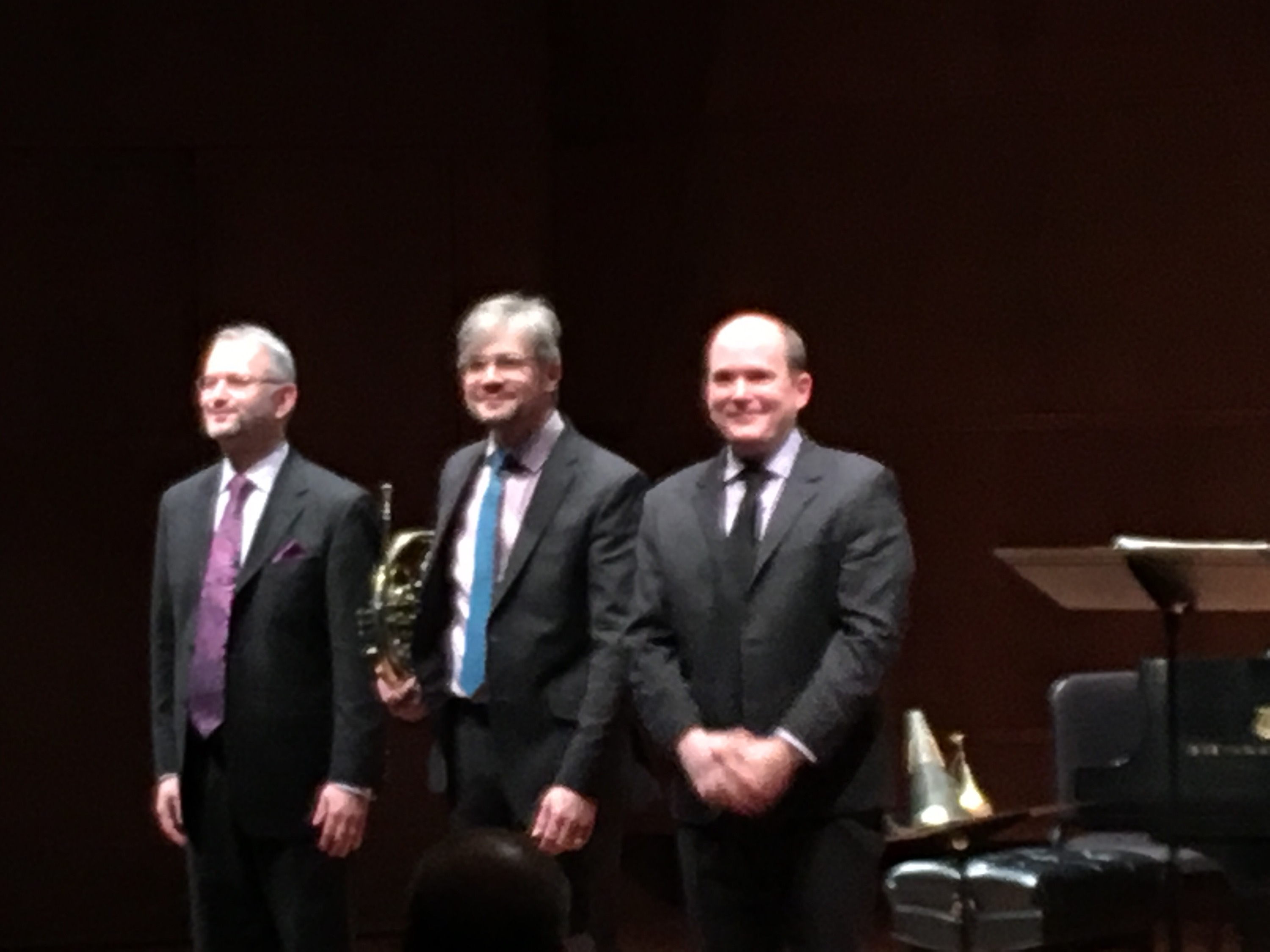
Still basking in the emotions from Sunday evening’s program courtesy of Byron Schenkman & Friends – said friends on this occasion being tenor Zach Finkelstein (in his Nordstrom Recital Hall debut), Seattle Symphony principal horn player Jeff Fair, and cellist Nathan Whittaker.
Schenkman’s programming is always an art in itself, but this one really stood out for its combination of poetry and music, focusing on a pair of composers who rank among the most sensitive writers for the voice. Schubert lieder framed the evening, with a set of four songs to begin — “Der Musensohn,” “An die Laute,” “Ganymed,” and “Du bist die Ruh” — and “Auf dem Strom,” one of the miraculous products of his final year, at the close.
Finkelstein’s refined, expressive phrasing and gorgeous tone hit the mark. The tenor was alert to every nuance Schubert uses to paint the emotions evoked by the poet, adding just enough pressure and urgency to make an apparently simple melodic turn suddenly light up with hidden colors. (See the video below for more on this wonderful singer, including some of his insights on Britten.)
“Auf dem Strom” — thought to be possible a tribute to the late Beethoven, who had died the year before — came off as a thoroughly involving miniature drama. I also admired Schenkman’s affinity for this repertoire, which shows off a very different side of his artistry from the early music fare I more frequently hear him perform. Jeff Fair emphasized the touching mellifluousness of the horn part, with hints of nostalgic heroism as well.
Schenkman, Finkelstein, and Fair all have collaborated on a to-die-for recording of all five of Benjamin Britten’s Canticles, which came in 2017. Before performing the two Canticles featured on this program, Schenkman and Finkelstein read the long, intricate poems which Britten set to music: Canticle I, Op. 40 (“My Beloved Is Mine”) by Francis Quarles, composed in 1947 for his life partner, tenor Peter Pears; and 54 the 19Canticle III, Op. 55 (“Still falls the rain: The raids 1940. Night and dawn”), to a poem by Edith Sitwell, which calls for a solo horn part in addition to the piano accompaniment.
These two highly contrasting pieces — the one a mystical ode to love, the other an unsparing reflection on human nature’s darkest side, while still reaching for hope — made for a powerful juxtaposition. Canticle III is of Turn of the Screw vintage and felt both cathartic and emotionally exhausting.
When introducing the first Canticle, Schenkman pointed out the composer’s bravery in living with a same-sex partner during a period when Alan Turing was subjected to such injustice, recalling, too, how Queen Elizabeth sent a personal letter of condolence to Pears following his companion’s death in 1976. Schenkman also referred to Britten’s role in reaffirming the stature of Mendelssohn following the Nazis’ attempt to erase him from history, noting how Mendelssohn himself played a pivotal role in rescuing nearly lost Schubert masterpieces from oblivion.
Schenkman and Nathan Whittaker gave a glowing account of Mendelssohn’s Variations concertantes for cello and piano, Op. 17, after the first Canticle. The cellist also treated listeners to the solo piece The Fall of the Leaf by Imogen Holst (daughter of Gustav Holst and a close friend of Britten and Pears). Written in 1963 for Pamela Hind o’Malley, it comprises “short studies … on a 16th-century tune” from the Fitzwilliam Virginal Book (by Martin Peerson). More eloquent, even grief-stricken, than restrained, Whittaker brought out the thoughtful melancholy of the descending, fatalistic theme, while playfully suggesting the ghost of a lute in Holst’s pizzicato chords.
Sunday evening’s Byron Schenkman & Friends program looks delicious: focusing on two early cantatas by Handel (including Vedendo Amor from his sojourn in Rome), it also includes some of his instrumental music plus pieces by Domenico Scarlatti, Antonio Caldara, and Anna Bon.
For some background, here’s my piece in this month’s Juilliard Journal on Handel in Rome (on p. 16).
Complete program:
George Frideric Handel:
Sonata in G Major, op. 1, no. 5, for flute and continuo
Domenico Scarlatti:
Four keyboard sonatas, K. 238, K. 239, K. 99, K. 100
George Frideric Handel:
Cantata “Vedendo Amor” for voice and continuo
Antonio Caldara:
Cantata “Soffri, mio caro Alcino” for voice and continuo
Anna Bon:
Sonata in F Major, op. 1, no. 2, for flute and continuo
George Frideric Handel:
Cantata “Mi palpita il cor” for voice, flute, and continuo
Performers:
Reginald Mobley
COUNTERTENOR
Joshua Romatowski
FLUTE
Nathan Whittaker
CELLO
Byron Schenkman
HARPSICHORD
Concert starts 7pm on Sunday 18 November at Benaroya’s Nordstrom Recital Hall.
Tickets here.



 MEMETERIA by Thomas May