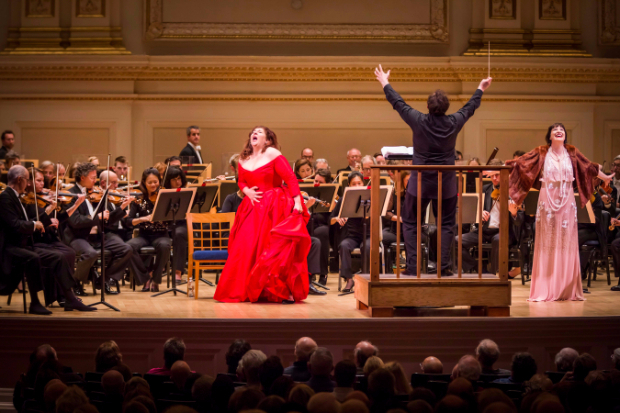
Elektra (left, Christine Goerke) and Chrysothemis (right, Gun-Brit Barkmin), with Andris Nelsons conducting the Boston Symphony; photo (c) Chris Lee
Every year around Halloween, it seems, it gets harder to find ways to spook willing celebrants of the pagan holiday. How can the ritual rechanneling of anxieties and existential fear into thrillers and other forms of entertainment — our society’s safety valve — possibly compete with the daily onslaught of news in the real world today?
Yet, under the right conditions, a few landmarks of art can still deliver the shock that Aristotle tried to justify with the concept of “catharsis.” It’s especially ironic when works once viewed as the spearheads of Modernism accomplish this for contemporary audiences.
When a piece like The Rite of Spring does so, it’s no longer because the music is inextricably identified with a specific moment in music history — a moment of upheaval that can no longer pack that particular punch for jaded ears — but in fact the opposite: because it has graduated to classic, “timeless” status.
The Boston Symphony Orchestra got me thinking along these lines with this week’s concert performance of Elektra at a packed Carnegie Hall. With Andris Nelsons conducting and a (mostly) dream cast headed by Christine Goerke, this foray into concert opera brought Richard Strauss’s score (premiered in 1909) to thrilling, astonishing, and, yes, shocking life for ears and sensibilities in 2015.
From the very first onslaught — an outburst of D minor chords that are the Big Bang generating much of Elektra‘s music — Nelsons kept the tension at a high voltage shouted at full force until the audience was left gasping for air nearly two intermissionless hours later. A rare-for-Carnegie Hall standing ovation followed.
Nelsons marshaled the BSO as if at the operating console of a massively complex, sleek machine. The musicians responded with split-second precision, delivering immaculate ensemble textures and sinuous solo lines (the extensive woodwind section by itself forming a kind of Greek chorus that restlessly comments on musical events).
Thanks to the Isaac Stern Auditorium’s acoustics, countless details registered with maximum impact — perhaps most terrifyingly in the sudden pauses as the opera approaches its climactic murder scene, the silences ripping a chasm into Strauss’s otherwise ceaselessly roiling score.
Each time Strauss anticipates the voluptuously lyrical idiom of Der Rosenkavalier in Elektra, such passages seemed suspect (though not necessarily ironic), for all their swooning beauty — momentary lulls in the brutalist energy Nelsons kept at the center of attention.
He also emphasized the driving mania underlying the dance rhythms in a way that de-familiarized them and underscored their frighteningly unforgiving force. I’d never realized until this performance how close Strauss comes here to the acid-drenched satires by Weimar artists like George Grosz and John Heartfield (whose work is currently in focus over in the Neue Galerie’s riveting Berlin Metropolis exhibit). A similar sense of an insane world pretending everything is in order applies to Elektra as well.
Even those who experienced Christine Goerke’s unforgettable Dyer’s Wife in the Met’s revival of Die Frau ohne Schatten must have felt unprepared for the blazing, fearless glory of her singing Wednesday night.
While she conveyed an impression of Elektra’s pitiful state with the vulnerable accents of her first great solo, her steeliness and power never let up: vocally Goerke embodied the monomania that makes Elektra such a threat to her mother and her mother’s lover Aegisth but that also keeps her mired in a state of hypersensitive angst. Her frequent high notes were lightning bolts, signals of a tormented consciousness.
Even in this unstaged (semi-staged?) performance, Goerke complemented all this with impressive physical energy, swirling about in a dance that could easily rival the fevered tarantella of Ibsen’s Nora Helmer.
I was especially taken with the German soprano Gun-Brit Barkmin as Elektra’s sister Chrysothemis, who longs for a simple, normal life free of all this drama. She was more vocally forceful than what I usually expect in this role but also contrasted effectively with the darker shadings of Goerke and the grotesqueries of Klytämnestra, sung with bat-shit-crazy delirium by Jane Henschel. The sick mindset that holds sway was swiftly established by the opening scene of the gossiping maids.
Only the great recognition scene between Elektra and the disguised, returning Orest — portrayed with a touch too much heroic grandeur by James Rutherford — seemed to be missing an element of passion. And that’s mostly because everything else was kept so taut that there was little room for the expansiveness (musically and psychologically) of this moment to register in more depth.
As the drunken Aegisth heading right on schedule toward his doom, Gerhard Siegel recalled suggested a touch of the clueless Baron von Ochs mixed with the chilling perversity of Herod. No film score has surpassed the music Strauss writes during his fatal entrance into the unlit palace.
I could find no mention of a stage director or costume designer, but the blocking on Carnegie’s very crowded stage — Elektra calls for the largest orchestra Strauss ever used in an opera — worked without drawing undue attention. (In concert opera it can often seem too gimmicky and distracting.)
The costumes drew attention to the Freudian era of Elektra‘s composition, with Goerke’s red strapless dress the undying flame of her obsessive love for her father Agamemnon and the symbol of its associated bloodlust.
As in Salome, Strauss has numerous opportunities to illustrate through the orchestra what his characters tell us they are hearing: above all for Elektra, but also for Chrysothemis and Klytämnestra, these moments emanated a kind of hallucinogenic haze, adding another layer to whichever perspective comes into the spotlight in Hofmannsthal’s libretto.
For all the powerhouse stamina Nelsons sustained from the players and cast, there was nothing crude or garish in this interpretation. Details stood out but never became speed bumps to the evening’s choke-hold momentum and only enhanced the suspense.
In Elektra George Bernard Shaw discerned a portrayal of “cancerous evil” that surpasses “the Klingsor scenes in Parsifal.” The only way out the drama allows for is an orgy of death. More than a century after the opera’s premiere, its demonic power remains unexorcized.
(C) 2015 Thomas May. All rights reserved.
Filed under: Andris Nelsons, Boston Symphony, Carnegie Hall, review, Strauss






 MEMETERIA by Thomas May