It’s such a commonplace cliché of a cliche: the string quartet as the embodiment of “classical music” — and hence the emblem of ultra-“serious” art, by which is really meant stuffy attitudes, not substance, as the commercial images all around us present it.
But when Haydn began working with the medium he eventually standardized into the format still used today — drawing from diverse sources — much of the original impulse was simply to have musical pleasure, an occasion for the fun of it.
At least that’s the way Haydn’s first biographer spun it, portraying his focus on the string quartet as happening essentially by chance:
A baron Furnberg had a place some way outside Vienna, and he from time to time invited his pastor, his manager, Haydn, and the cellist Albrechtsberger in order to have a little music. The Baron requested Haydn to compose something that could be performed by these four amateurs. Haydn took up this proposal and so originated his first quartet, which, when it immediately appeared, received such general approval that Haydn took courage to work further in this form.
The notion of chamber music in general as a kind of musical conversation had been an ongoing metaphor in the eighteenth century. The Paris publisher who first brought Haydn’s earliest quartets into print, for example, titled them “quattuors dialogues.”
Goethe later famously codified that image of a conversation specifically to the string quartet when he remarked near the end of his life:
The string quartet is the most comprehensible genre of instrumental music. One hears four reasonable people conversing with one another and believes one might learn something from their discourse and recognize the special characters of their instruments.
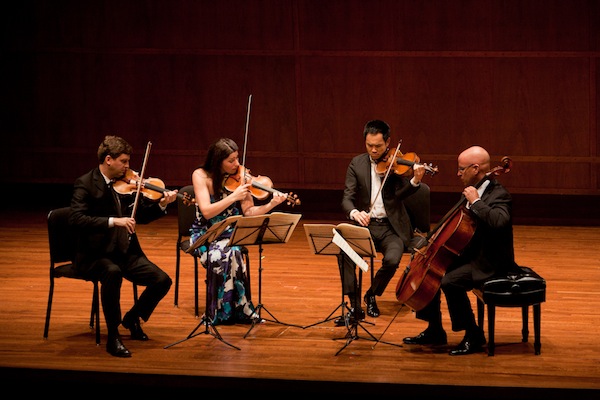
(l to r): James Ehnes, Amy Schwartz Moretti, Richard O’Neill, and Robert deMaine. Photo by Jerry Davis.
My CityArts preview of the latest edition of the Seattle Chamber Music Society’s Summer Festival, featuring a new commission from Derek Bermel:
For classical music lovers, summer has genuinely arrived when the top floor of Benaroya Hall is thrumming to the beats of Schubert, Shostakovich and Ravel at the Seattle Chamber Music Festival, which opens on July 7 and continues for four weeks.
Hearing a super-charged performance of Béla Bartók’s Third String Quartet by the Ehnes Quartet on Sunday – a condensed cosmos of formal and tonal experimentation – reminded me of why this composer’s quartets are genuinely comparable to what Beethoven achieved with the medium.
By happy coincidence, my friend Philip Kennicott, one of the most brilliant critics writing today, had just been immersed in the entire Bartók cycle on the other coast, back in my old hometown. The performers were the Takács Quartet. (I’d heard their two-evening Bartók cycle in D.C. back in the ’90s.)
In his reflections on the experience, Kennicott makes a very important point about the much-misunderstood presence of “folk elements” in Bartók’s music: “The turn to folk music was not, for Bartók, nostalgic, but rather a way forward. What he found there wasn’t simplicity, but density, and in that density was a modernity as vital as anything hatched in the musical systems of Paris and Vienna.”
And on Bartók’s sense of an ending:
So the music is always anxious, always driving forward, which is both exhausting and exhilarating, and perhaps that’s why Bartók’s endings—ironically anticlimactic, humorously flippant, pompously emphatic—are so appealing. By the time Bartók ends something, no honest listener could claim to want to hear more. The idea, the gesture, the mood has been wrung out, used up, finished off. And then it’s on to the next thing, with renewed energy and relentlessness.
Kennicott then works George Steiner’s interpretation of the door metaphor in Bartók’s Bluebeard’s Castle into his discussion:
We open successive doors in Bluebeard’s castle because “they are there,” because each leads to the next by a logic of intensification which is that of the mind’s own awareness of being. To leave one door closed would be not only cowardice but a betrayal—radical, self-mutilating—of the inquisitive, probing, forward-tensed stance of our species.
This was Steiner’s best hope for hope, after the brutality of World War I, the obscenity of Hitler, ages of anti-Semitism, and the terrors of the post-war age, especially its predation on what was once called, without embarrassment, Culture. It is also a perfect description of the powerful, dutiful, heroic denial of self in Bartók’s string quartets, which also proceed by a logic of intensification, and which leave the listener grasping at “the mind’s awareness of being.”
l to r: James Ehnes, Amy Schwartz Moretti, Richard O’Neill, and Robert deMaine; Photo by Jerry Davis
As if the Super Bowl victory weren’t enough, yesterday chamber music-loving Seattleites were treated to a spectacularly satisfying program to conclude the brief Winter Festival of the Seattle Chamber Music Society. James Ehnes and his quartet of fellow SCMS regulars (violinist Amy Schwarz Moretti, violist Richard O’Neill, and cellist Robert deMaine) played a knock-out recital of Beethoven, Bartók, Josef Suk, and Ravel.
And then they’re off on their first-ever tour of Europe — with stops in Birmingham, Oxford, London, Tilburg, and Paris. Not to miss, I’d say: above all, their explosive but many-faceted Bartók.
Here’s a shorter version of my recent interview with violinist and SCMS artistic director James Ehnes for Crosscut.com in connection with his latest Seattle visit:
James Ehnes became the artistic director of SCMS two seasons ago. In his “off” time from Seattle, the native Canadian is a prized soloist and chamber musician in demand around the globe.
This fall, for instance, took him to Melbourne, Moscow and Glasgow. And just a few weeks ago, when his duo partner became ill right before a recital in London’s Wigmore Hall, Ehnes saved the day stepping up to perform two of the monumentally challenging Bach solo partitas.
Ehnes feels a strong sense of loyalty to Seattle and has been involved with SCMS as a performer since he was still a teenager. Yet while the long-running festival is part of his blood, he’s been artfully introducing some subtle changes.
For anyone who relishes the amazing craft, interpretive spontaneity and emotional directness that give the chamber music medium such power, it’s good to see Ehnes bringing a new focus to the string quartet.
His own quartet is taking the stage for Béla Bartók’s First and Third Quartets and Beethoven’s “Harp” Quartet, Op. 74, as well as the Ravel Quartet in F and Josef Suk’s Meditation on the old Czech Chorale “St. Wenceslas.”
The Bartók quartets represent Ehnes’s ongoing advocacy for the Hungarian composer. Ehnes has already made splendid recordings of Bartók’s concertos and solo works for violin, and he launched his first full season two years ago with a program that included a breath-taking performance of the pioneering Fourth String Quartet.
“We’ve been doing a bit of focus on Bartók for the last few festivals. His is one of the greatest and most unique musical voices of the 20th century, and it bothers me that despite his name having great recognition among music lovers, a very great majority of his music remains unknown to the general public.”
As usual, Ehnes’s programming ideas encourage intriguing cross-connections and discoveries to be made. The Jan. 31 concert, for example, offers music by Bartók’s compatriot Zoltán Kodály. “I think it will be fascinating for our audiences to compare the Kodály [Serenade for Two Violins and Viola] to the Bartók String Quartets.”
And Ehnes has no qualms about programming one of the best-loved warhorses in all chamber music for opening night: Dvořák’s Op. 77 Quintet for Strings. After all, his birthday (January 27) falls in the middle of the festival. “I have to admit this quintet is one of my very favorite things in the world, particularly the unbelievably beautiful third movement. So I programmed this as a bit of a present to myself.”
Yesterday evening Seattle’s Benaroya Hall was the gathering place for a large crowd of musicians, music lovers, friends, and members of a very extended family who were there to commemorate Toby Saks. She died two and a half months ago, just after a particularly successful edition of the annual summer Seattle Chamber Music Society Festival, her baby, had come to an end.
Toby Saks’s legacy as a cellist, educator, festival organizer, champion of new talent, and overall remarkable human being was recalled last night from many different angles. There were moving personal anecdotes from her circle of friends and peers. Most significantly, the event centered around performances featuring a combination of local musicians and others traveling from around the country — over 60 musicians, all told. They made it clear that it is through living music most of all that Toby would want to be remembered.
Quite a few were wearing buttons custom-made with a photo of the cellist smiling and the inscription “I’m Here for Toby.” The official program was framed by excerpts from Toby’s extensive archives — performances restored from reel-to-reel tapes and converted to digital format by her brother, Jay David Saks, a musical producer for the Metropolitan Opera.
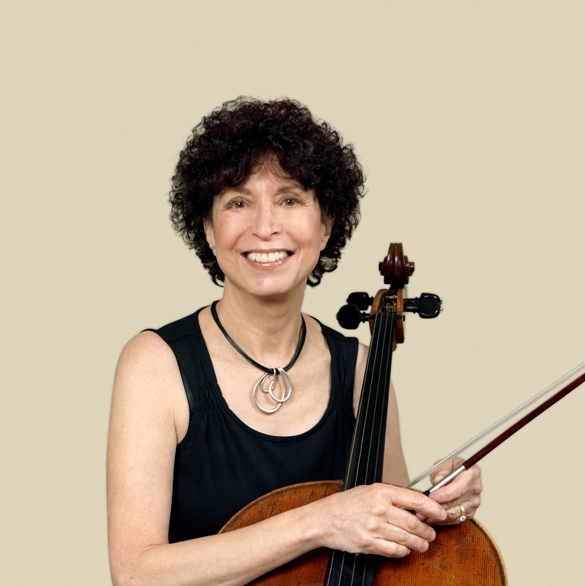
Toby Saks – (c)Seattle Chamber Music Society
One of the restored pieces listed in the program was of the Dvořák Cello Concerto as recorded by Toby at 19 with the Kol Yisrael Symphony Orchestra (in Jerusalem, 1961). Gerard Schwarz, the Seattle Symphony’s conductor laureate, spoke eloquently of the first time he had heard her playing, which happened to be this very work. It took place at the High School of Performing Arts in New York – her alma mater, where Schwarz was then studying – as Toby as en route to participating in and winning the Pablo Casals Competition in Israel.
Schwarz reminded us that Toby was among the very first women cellists of the New York Philharmonic and noted the many ways in which her musicality continued to astonish and inspire him throughout their decades together in Seattle. Schwarz himself led a string orchestra (some Seattle Symphony players with mostly SCMS associates) in a rich-voiced account of the “Elegia” movement from Tchaikovsky’s Serenade for Strings to open the celebration. For all the sense of loss and the meditative, even solemn character of most of the musical selections, that’s exactly what the event was: “This is a celebration of life,” her husband, Dr. Martin Greene, reminded everyone. “It’s not about mourning.”
Greene introduced a video tribute looking back over Toby’s 30 years heading the Chamber Music Festival she had founded in 1982. Her fellow musicians competed to outdo each other with their praise and gratitude for how much she had influenced their lives, their careers, converging on a shared theme of “Mama Tobs” as an insatiably generous and passionate advocate for music. Violinist James Ehnes, who took over as artistic director of SCMS two years ago, described what a vital force she had been, operating a complicated network and interacting with hundreds of musicians through the years. Robin McCabe, director of University of Washington’s School of Music, recalled Toby’s “feisty” vitality and fierce love of her students.
Of the many remarkable musicians who were on hand to perform in Toby’s honor, cellist Robert deMaine’s performance of the Largo from Chopin’s Cello Sonata (with pianist Jon Kimura Parker) struck me as especially heart-felt, to the point that his warmth of phrasing seemed to be speaking directly to Toby – cello to cello, as it were.
A particularly notable moment was the premiere of a new piece, spontaneously composed in memory of Toby Saks by Lawrence Dillon as soon as he learned of her passing. Dillon had gotten to know her only recently in connection with the chamber work he was commissioned to write for this past summer’s festival. His Passing Tones, for three cellos and violin (Ehnes and deMaine, Jeremy Turner, and Andrés Díaz). This compact, elegiac essay carried a poignant reminder of the principles of ensemble and the individual voice, the creative tension between them, that’s at the heart of chamber music making – and about which Toby was so passionate.
Martin Greene introduced the closing number, remarking there could be no better way to end than with a composer his wife especially loved, rendered by an orchestra of her favorite instrument, the cello. And so 19 cellists took the stage, with Schwarz again conducting, to play the arrangement by Heitor Villa-Lobos of Bach’s Prelude No. 8 in E-flat minor from Book One of the Well-Tempered Clavier. A prelude, not a postlude, speaking worlds about the enduring ways in which Toby touched the lives of those around her.
My take on the opening week of the Seattle Chamber Music Society’s Summer Festival, now underway (from crosscut):
Everyone has their individual barometer when it comes to deciding whether summer has actually “arrived” in our fickle city. But for many local music lovers, Seattle Chamber Music Society’s (SCMS) summer festival clearly marks the cultural solstice…






 MEMETERIA by Thomas May