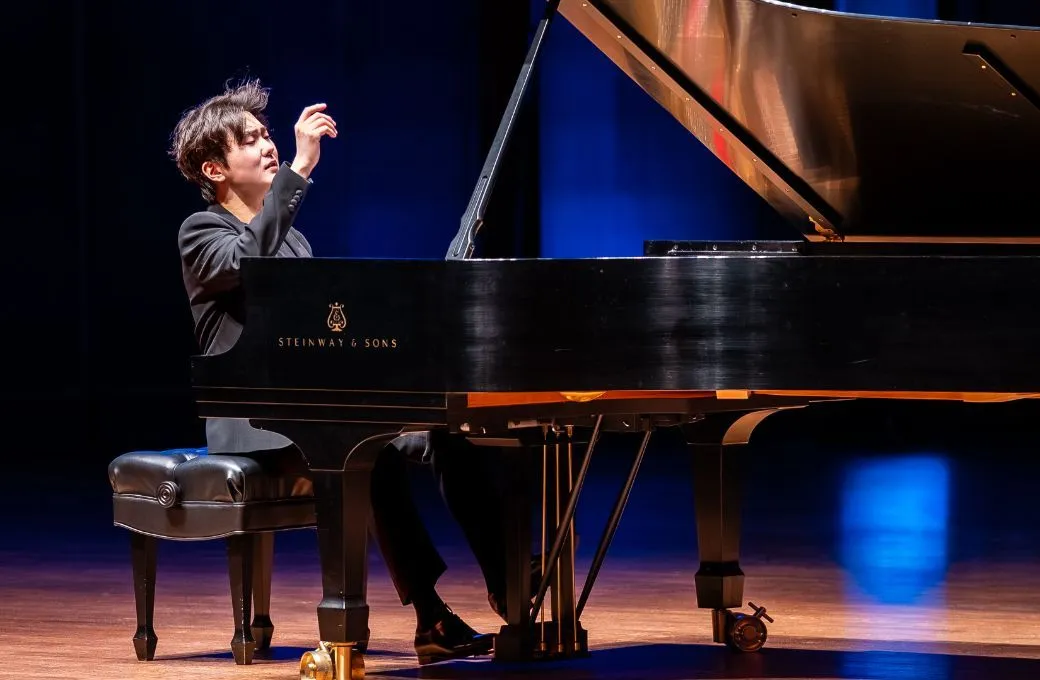
Some thoughts on Seong-Jin Cho’s recent Seattle recital:
The self-effacing persona Seong-Jin Cho projected from the Benaroya Hall stage throughout his solo recital stood in striking contrast to his musical confidence – a confidence grounded not only in extraordinary technical security but in an evident willingness to take risks. Cho’s sense of interpretive freedom made itself felt from the outset, in a program that invited close attention and repaid it generously…
Yulianna Avdeeva‘s Sunday afternoon recital at Benaroya Hall seemed to be timed especially well: The New York Times published a story that day about the unexpected find of a waltz by Chopin. Her refined interpretations of that composer suggested how much remains open to discovery, even in the case of long-familiar pieces.
Avdeeva burst on the scene when, at the age of 25, she took the gold medal in the 2010 Chopin Competition (the first woman since Martha Argerich to have garnered the award). She recently released Chopin: Voyage, an album focused on late works that he composed while surrounded by nature, which the Moscow-born pianist recorded in the idyllic setting of Tippet Rise Art Center in Montana. She performs widely across Europe but still seems to be something of a well-kept secret in the US. On the basis of Sunday’s performance, I certainly hope that changes.
Though for years they lived just a few minutes away from each other by foot in Paris, Chopin and Liszt inhabit such strikingly different worlds that it was fascinating to find them juxtaposed on Avdeeva’s program, with one half devoted to each composer.
She began with Chopin, lingering on the first note as she launched into the Op. 30 Mazurkas, as if preparing to whisk us away from ordinary life. In his 1851 biography of Chopin (likely co-written with his Polish mistress, Princess Carolyne von Sayn-Wittgenstein), Liszt ascribes to Chopin’s mazurkas “the most delicate, tender, and evanescent shades,” evoking impressions that are “purely personal, always individualized and divided.”
Each of the four mazurkas in the Op. 30 set, which Avdeeva played without breaks, indeed seemed to be a separate microcosm rather than another elaboration on a type. Her management of micro-transitions, of the slightest fluctuation of mood, was especially impressive. Even in the more assertive No. 3 in D-flat, an inner melancholy shaded the echoing phrases.
Avdeeva maintained a spirit of improvisation while executing compelling and clearly thought-out ideas about each piece with breathtaking precision.
The Op. 60 Barcarolle in F-sharp major suggested an idealized singer in a state of ecstasy – a melody beyond human reach yet fallible with emotion, as far as could be from mechanical virtuosity.
Avdeeva spun out the sense of mystery and enigmatic wandering that makes the Op. 45 Prelude in C-sharp minor so beguiling, while the Scherzo No. 3 (in the same key) abounded in well-judged contrasts and textural control.
It was above all in the Andante spianato and Grande Polonaise brillante, Op. 22, that Avdeeva revealed new facets. Her Chopin involves such complex, meticulously articulated gradations of weight and light that you realize how much variety lives within a single miniature – not just Schumann’s “cannons buried in flowers” in the case of Op. 22, but an entire epic encompassing heroic adventures and bravely intimate confessions. Rhythmic and dynamic nuances are a special forte with this pianist, who is equally subtle in she staging of rubato and crescendo.
Avdeeva then turned from Chopin’s lyric poetry to the mystical, tormented Romanticism of his far longer-lived peer, Franz Liszt – and showed that she had a great deal to say on that score as well. Her combination of two late-period, avant-garde works from 1885 with the B minor Sonata – all played seamlessly, as if transcribing a single brooding meditation by the robed, solitary Abbé – proved intriguing.
On the one hand, with the Bagatelle sans tonalité and Unstern! – Sinistre, the difference and distance from Chopin could not have been more pronounced. Avdeeva seemed to depict a stark search for threads of meaning amid Liszt’s harmonic vagaries, stalled by abysses of silence. The effect was utterly mesmerizing.
When she arrived at the B minor Sonata, Avdeeva drew on the full arsenal of her stupendous technique to portray an intense psychic drama. The Benaroya Steinway resounded with the most thunderous playing of the afternoon, but Avdeeva also relished Liszt’s celestial harmonies and gossamer ornaments, articulating with a scintillating transparency that recalled Chopin – and what Liszt admired in Chopin’s playing. Her two encores once again confronted the two personalities, offering prismatic accounts of Chopin’s Op. 42 Waltz in A-flat major and the Concert Paraphrase Liszt made from Rigoletto.
My review of Yuja Wang’s recital at Benaroya Hall last Friday evening has been posted here:
It would be facile to suggest that the program Yuja Wang chose for her North American tour this spring was intended to display her astounding versatility – a versatility that is merely one manifestation of the artist’s virtuoso showmanship….
The Houston-based chamber music and jazz presenter DACAMERA is offering a holiday gift of Chopin performed by one of the leading interpreters of his music, the Grammy Award-winning Garrick Ohlsson. Listen to his Chopin recital, which opened DAMERA’s season, as a free stream for two weeks, available herewith registration.
Reviewing Maurizio Pollini’s recent Carnegie Hall recital, Anthony Tommasini captures what makes the 73-year-old pianist’s Chopin so unique:
The high point came after intermission, with Mr. Pollini’s revelatory account of a later Chopin work, the Polonaise Fantaisie in A flat. This enigmatic 13-minute piece is like a free-roaming, pensive fantasy from which a dark yet snappy polonaise tries to emerge. Ambiguity was exactly the quality Mr. Pollini, long admired for his Chopin, emphasized in his fascinating performance.
The opening alternates short flourishes of majestic chords with curious strands of lacy lines that trail up the keyboard. Is some kind of march about to begin? Or is the music already consumed with self-reflection? It’s both at once, as Mr. Pollini’s playing suggested. Hearing this performance, I realized as never before that every time the dancing elements of the polonaise emerge, the themes are quizzical, the harmonies wayward.




 MEMETERIA by Thomas May