The Isidore Quartet at Honens: Adrian Steele, Phoenix Avalon, Joshua McClendon and Devin Moore, with finalist Carter Johnson in the centre; photo: Jorge Gustavo Elias
–> Follow the final round and announcement of awards starting at 7pm MDT on the Honens livestream here.
For a string quartet, sharing the spotlight with fellow chamber musicians is second nature – but not usually in circumstances like this. The New York City-based Isidore Quartet took the stage last night (23 October) for the chamber-music final of the 2025 Honens International Piano Competition, held at the Jack Singer Concert Hall in the Werklund Centre, downtown Calgary, Alberta. ..
from left: Jordan Nobles, who received the Azrieli Commission for Canadian Music; host Sylvia L’Écuyer; Jason van Eyk, Managing Director of the Azrieli Centre for Music, Arts and Culture; Ana Sokolović, Chair of the Advisory Council for the Azrieli Music Prizes and Juan Trigos, who won the first-ever Azrieli Commission for International Music;(c) Tam Photography for Danylo Bobyk
The biennial 2024 Azrieli Music Prizes (AMP) laureates have just been announced by the Azrieli Foundation. They include Yair Klartag, who received the Azrieli Commission for Jewish Music; Josef Bardanashvili, who won the Azrieli Prize for Jewish Music; Jordan Nobles, who received the Azrieli Commission for Canadian Music; and Juan Trigos, who won the first-ever Azrieli Commission for International Music — a prize created to promote greater intercultural understanding. View a recording of the livestream of the announcement here.
Each Laureate will receive a prize package valued at over CAD 200,000, including a cash award of CAD 50,000; a world-premiere performance of their prize-winning work in Montréal by the Orchestre symphonique de Montréal Chorus at the AMP Gala Concert on October 28, 2024; two subsequent international performances; and a professional recording of their prize-winning work.
Each cycle of AMP’s four music prizes focuses on an instrumentation category. The 2024 Laureates will compose choral works for a cappella choir and up to four additional instruments and/or vocal soloist(s).
This year, three distinguished panels of luminaries and experts selected the winning submissions, including Chaya Czernowin, Tania León, Dr. Neil W. Levin, Samy Moussa, Gerard Schwarz, and Ana Sokolović.
The Azrieli Prize for Jewish Music is awarded to a composer who has written the best new undiscovered work of Jewish music. Josef Bardanashvili won for his Light to My Path Choral Fantasy for Mixed Choir, Saxophone, Percussion, and Piano. Each movement in his composition grows from one of the various states of belief – supplication, ecstasy, doubt, gratitude – outlined in the Book of Psalms.
In selecting Bardanashvili, the Jury noted that his “music is beautiful. It is clear the composer is putting his own inner musical and sacred world on display and, in so doing, inviting the listener to enter it.”
The Azrieli Commission for Jewish Music is awarded to encourage composers to creatively and critically engage with the question, “What is Jewish music?” It is given to the composer who displays the utmost creativity, artistry, technical mastery and professional expertise in their response to this question.
For the Commission, Yair Klartag will create The Parable of the Palace, an 18-minute work for choir and four double basses. The work will draw on Jewish philosopher Maimonides’s (1138-1204) famous parable to investigate the limits of logic and reason in explaining reality and the metaphysical. The Parable of the Palace will divide the choir and double basses into four smaller ensembles, in which each choir approaches–but never quite reaches–the pitch of the double bass.
The jury praised Klartag for “meeting a very high standard in how his music clearly connects at all levels and yet manages to evade our expectations.”
The Azrieli Commission for Canadian Music is offered to a Canadian composer to create a new musical work that engages with the complexities of composing concert music in Canada today. Jordan Nobles’s proposal – Kanata for Large Choir – will be a 15-minute tribute to the Canadian landscape inspired by travel across Canada. Each section of the new work will be composed on the land as Nobles travels through it. The work will feature the modern and First Nation names of the rivers, lakes and mountains from each province.
The jury credited Nobles as “a strong composer who writes music that is unashamedly honest and clearly in his voice. His compositions are elemental, expansive and engaging, pulling you into his sound world.”
The Azrieli Commission for International Music is offered to a composer who engages with the world’s diverse cultural heritage. 2024 laureate Juan Trigos will honour the pre-Hispanic culture of his native Mexico with his commissioned work Simetrías Prehispánicas. The 20-minute composition for chorus, amplified flute, trombone, percussion, and keyboards will incorporate text by anonymous and major Aztec poets from the 15th century in their original Nahuatl and Spanish translations.
Reviewing Trigos’s proposal, the jury praised him as “a gifted composer whose music is polished, rhythmic, original, well-orchestrated and directional.”
More details about the AMP Gala Concert, featuring the premiere of all four Prize-winning works by the OSM Chorus, conducted by Andrew Megill, will follow in 2024.
Bows (l to r): Georgia Mann, Pouyan Biglar, Iman Habibi, Jessika Kenney, Sharon Azrieli, Steven Mercurio, Zhongxi Wu, Rita Ueda and Naomi Sato (photo: Chris O’Donovan Photography)
Launched a little less than a decade ago, the Azrieli Music Prizes (AMP) have already grown to become Canada’s largest competition devoted to music composition. The biennial initiative has expanded to embrace an international scope and last weekend made its London debut at Cadogan Hall with a programme of all three prize-winning works from the 2022 rounds. Steven Mercurio, a member of the AMP Jewish Music jury, led the Philharmonia Orchestra and guest soloists.
SILVER: DALÍ QUARTET, Ari Isaacman-Beck (Violin), Carlos Rubio (Violin), Adriana Linares (Viola), Jesús Morales (Cello) – Philadelphia, Pennsylvania
BRONZE: Zagrab Philharmonic Orchestra: QUINTETO EMEDEA, Mathias Naon (Violin), Lysandre Donoso (Bandoneon), Emilie Aridon-Kociołek (Piano), Adrien Merahi (Electric guitar), Lucas Eubel-Frontini (Double bass) – Paris, France
SPECIAL PRIZES
CONCERT: Zagreb Philharmonic Orchestra /Quinteto Emedea
CONCERT: Grosseto Symphony Orchestra and Anton Stachev, St. Petersburg
CONCERT: Athens Philharmonia Orchestra and Rose Wollman, Indiana
MASTERCLASS Pablo Ziegler Award: Sonus Piano Trio, California
MASTERCLASSES iClassical Academy Award: Pianoduo LUSTRE, Osaka
MASTERCLASSES iClassical Academy Bonus Award: Gonzalo Esteban Antuña, Río Cuarto, Argentina
MASTERCLASSES iClassical Academy Bonus Award: Nada Brahma Graz, Austria
Proceeds from the competition, totalling $10,000, are being donated to the Playing for Change Foundation to support music and art education in under-resourced communities around the world.
This year marks Astor Piazzolla‘s centenary: he was born on 11 March 1921 in Mar del Plata, Argentina. The Fundación Astor Piazzolla and PARMA Recordings are honoring the occasion by collaborating to establish the Piazzolla Music Competition. This virtual competition, which will accept submissions until 18April 18 2021, is open to all musicians, professional and otherwise, soloist or ensemble, instrumentalist or singer, who have an affinity for works of this trailblazing 20th-century composer.
The jury includes Pablo Ziegler, Héctor del Curto, David Binelli, Cesere Chiacchiaretta, Arthur Gottschalk, Walther Castro, Pablo Petrocelli, and Sandra Rumolino as well as performing arts executives and arts managers. They will award the grand prize winners (solo and ensemble) with a cash prize, a recording deal with PARMA Recordings, and a performance tour through China, organized and funded by the Competition. Additional special prizes will be awarded, including concerts in the 2022-2023 season with the Zagreb Philharmonic Orchestra, Grosseto Symphony Orchestra, or Athens Philharmonia Orchestra to be scheduled, booked, and funded by the orchestras.
The finalists will be announced in May, and the winners will be announced on 15 June 2021.
More on the inaugural Piazzolla Music Competition:
The Piazzolla Music Competition seeks to continue Piazzolla’s legacy as the single most influential figure in the history of tango, by identifying and celebrating highly talented musicians of any instrument or voice type with an affinity for the inimitable style and virtuosity of Astor Piazzolla’s compositions • The esteemed individuals comprising the jury include: Grammy Award-winning pianist and composer Pablo Ziegler (President of the Jury); Grammy Award-winning bandoneonist Héctor del Curto; bandoneonist /composer David Binelli; Daniel Villaflor Piazzolla, grandson of Astor Piazzolla and vice president of Fundación Astor Piazzolla; tango singer, actress, and dancer Sandra Rumolino; accordionist, bandoneonist, and composer Cesere Chiacchiaretta; Professor of Music Composition at Rice University, Arthur Gottschalk; Walther Castro, bandoneonist, composer and arranger; performing arts manager Pablo Petrocelli; Croatian Music Institute President Romana Matanovac Vučković, Institution Management owner and arts consultant Masae Shiwa; and Jia Rui, Vice President of JoyTitan Entertainment • Judged through video submissions sent in by applicants, the competition winners will be announced on 15 June 2021 • Inclusive of all pre-professional and professional soloists and ensembles of 6 or fewer of any nationality, state, or country of residence, any contestant over the age of 13 (at the time of video submission) is eligible to apply • The Piazzolla Competition offers the highly coveted grand prize, in both the solo and ensemble divisions, of a cash prize ($1500 USD for soloist, $3500 USD for ensemble), a recording and release deal with PARMA Recordings’s Navona Records, as well as a concert tour throughout China arranged and funded by PARMA • Second and Third Prize winners receive Silver or Bronze medallions, respectively, to mark their outstanding talent and potential • Special Prizes include the Pablo Ziegler Award, a masterclass for the soloist or ensemble recipient and Maestro Pablo Ziegler, facilitated by PARMA Recordings; or an invitation to perform with the Zagreb Philharmonic Orchestra, Grosseto Symphony Orchestra, or Athens Philharmonia Orchestra in the 2022-23 season, with concerts scheduled, booked, and funded by the respective acclaimed ensembles • The application process, designed with inclusivity of resource availability at the forefront, requires musicians to submit by video at least two pieces totaling a minimum of six minutes, performing only music of Astor Piazzolla, from any time between 18 April 2011 and the application deadline of 18 April 2021. Submission videos must show the musicians with hands and faces fully visible in one, unedited take. In order to comply with COVID-19 precautions, new ensemble videos may be recorded “frame-in-frame” in one unedited take, and must date to January 1, 2020 or later • Applications are open from today • Finalists will be listed publicly on May 18, 2021, and the Winners Announcement will take place on 15 June 2021
This afternoon at 5pm ET, tune in to the Violin Channel for the final round of the 7th annual Getting to Carnegie competition. It will be streamed live and audiences across the globe can cast their vote for the winner (after registering to vote): 50% of the vote comes from the audience, the other half from a jury of professional musicians including the past six winners (Haeji Kim, violin; Chae won Hong, cello; Emily Helenbrook, voice; Nathan Meltzer, violin; Rachel Siu, cello; Brianna Robinson, voice) and violinist Dmitri Berlinsky. The voting will be open for 48 hours and the winner will be announced Jan 14 at 5pm EST on the Violin Channel’s Facebook page.
The competition rotates annually between violin, cello, and voice. This is the year of the violin, and the four young finalists are from Spain, South Korea, Hong Kong, and the United States, respectively: Maria Dueñas (age 18), Sory Park (20), Angela Chan (23), and Sophia Stoyanovich (24).
The competition is the brainchild of pianist and composer Julian Gargiulo, whose mission is to make classical music “relevant and fun” for younger generations. For this year’s final round, Gargiulo has written a new violin sonata; each finalist will perform one movement from the sonata with him on piano via split screen, giving its world premiere performance, with commentary and interviews in between.
The 27-year-old Japanese composer Aya Yoshida has won the 2019 Zemlinsky Prize for Composition, which has been presented to young composers from around the world since 1990 by the University of Cincinnati’s College-Conservatory of Music (CCM).
Along with a cash award of $30,000, Yoshida will receive a major new orchestral commission for dance, to be given its world premiere by CCM’s Philharmonia Orchestra and Ballet in December 2020, which will also record the piece.
Aya Yoshida, a native of Kobe who is based in Amsterdam, was chosen for Double Face, a ten-minute orchestral piece. The Danish National Symphony Orchestra premiered the work in 2016.
From the press release:
The title [“Double Face”] is open to interpretation, but like
many of Yoshida’s pieces (e.g. “Polka dots,” “Tone on Tone Check,” “Pointed toe”), this work also has a fashion resonance. “Double face,” meaning reverse clothing, is a term commonly used in the rag-trade.
Second prize of $20,000 went to Tomasz Skweres, 34, a Polish composer living in Vienna, for his piece “über das farbige Licht der Doppelsterne…” Third prize of $10,000 was awarded to 24-year-old Joel Jäventausta, a Finnish composer based in London, for his piece “Cantus.”
More than 200 compositions were submitted for consideration before five finalists were shortlisted in September by an international panel of leading composers: Colin Matthews (London), Missy Mazzoli (New York/Chicago), Iris Ter Schiphorst (Vienna), and Carl Vine (Sydney). The shortlisted works were then submitted anonymously to a final judging panel, which included the Dean of CCM, Stanley E. Romanstein, and CCM Philharmonia Conductor, Mark Gibson.
Missy Mazzoli said Yoshida’s winning entry “showed true originality, combined with skillful orchestration and a well-balanced approach to form…This daring work really communicated a mini-world of fantastic orchestral colors.” Carl Vine praised it “as redolent with intriguing musical gestures and textures.” Colin Matthews said, “Aya Yoshida’s piece came out on top from a very impressive line-up” and noted “it was good to see the unanimity of choice between a panel of composers all with very different stylistic personalities.”
Expressing her gratitude, Aya Yoshida said: “After my opera in 2017, I have been somehow dreaming of composing for ballet in my 20s or 30s, so I am thankful, humble, surprised and really happy to have the opportunity. Music is a collection of movements; the texture of the sound itself and also the physical gestures of the musicians. I am looking forward to exploring the connections between ballet and music in my new piece for CCM Philharmonia Orchestra.”
My report on the 2019 Concours Musical International de Montréal:
The 2019 edition of the Concours musical international de Montréal (CMIM), devoted this year to the violin, started off with added pressure – for the organisers, that is. Because of the convergence of several of the most high-profile violin tournaments elsewhere this spring – from Auckland to Augsburg, from Sendai to Brussels – the recently completed CMIM also had to compete with the competitions.
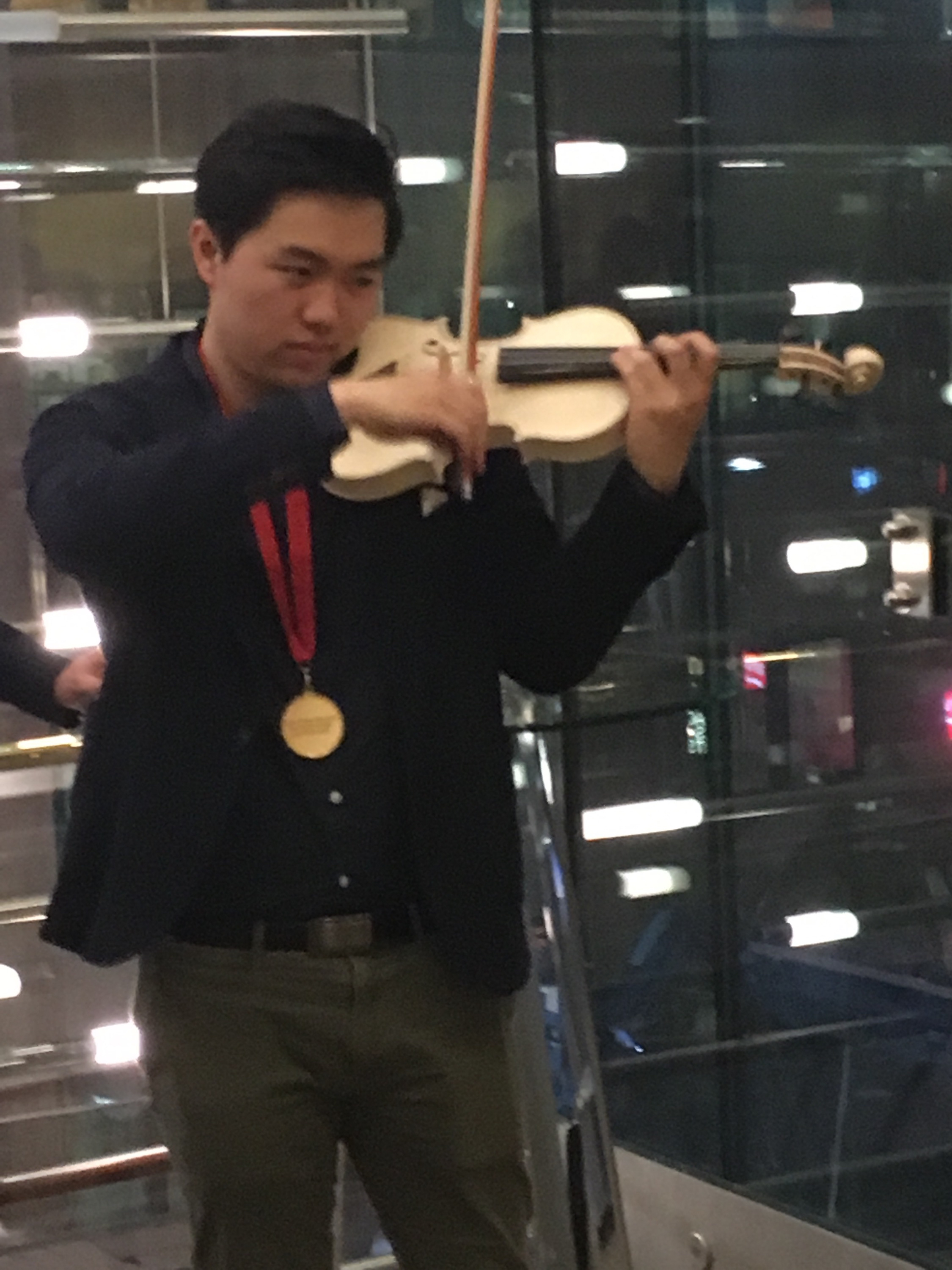
Hao Zhou for the first time playing the brand-new violin and bow handmade by the Maker’s Forum — gifted to him as first prize winner
Heartiest congratulations to U.S. violinist Hao Zhou, who won first prize at the 2019 Concours musical international de Montréal, as well as the Radio-Canada People’s Prize. And to second prize winner Johanna Pichlmair, who played the Brahms concerto, and Fumika Mohri, who took third prize for her account of the Sibelius concerto.
Mr. Zhou’s prize includes $30,000 from the City of Montreal, the Joseph-Rouleau career development grant of $50,000 from the Azrieli Foundation, a violin and bow handmade by the Maker’s Forum (valued at $20,000), an artist residency at Canada’s Banff Centre for the Arts, and a concert engagement at the New Generation Festival.
The distinguished jury was presided over by Zarin Mehta and included Pierre Amoyal (France), Kim Kashkashian U.S.), Boris Kuschnir (Austria), Cho-Liang Lin (U.S.), Mihaela Martin (Romania), Barry Shiffman (Canada), Dmitry Sitkovetsky (UK/U.S.), and Pavel Vernikov (Israel/Switzerland).
Here is Hao Zhou in his prize-winning performance last night of the First Violin Concerto by Dmitri Shostakovich (with the Orchestre symphonique de Montréal conducted by Alexander Shelley):
Here is Johanna Pichlmair’s soulful Brahms Concerto:
And the remarkable Fumika Mohri plays the Sibelius here:



 MEMETERIA by Thomas May