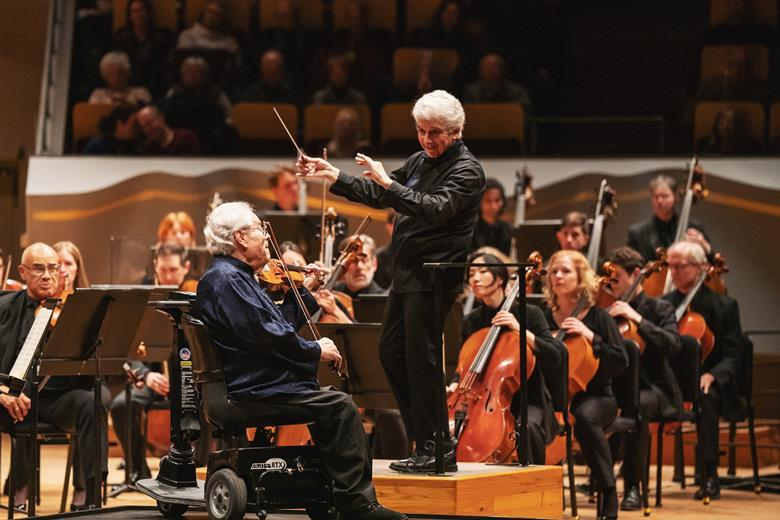
Itzhak Perlman and Peter Oundjian with the Colorado Symphony; photo: Amanda Tipton
Ahead of their Carnegie Hall appearance together on Sunday, February 1, with the Colorado Symphony, I spoke with Itzhak Perlman and Peter Oundjian for The Strad about their enduring friendship and shared musical values:
A few weeks before their reunion on stage at Carnegie Hall with the Colorado Symphony, Itzhak Perlman and Peter Oundjian reflected on a relationship shaped over many decades. They spoke from different locations – Perlman from Florida, where he was leading this year’s edition of the Perlman Music Program, and Oundjian from his home in Connecticut – ahead of their joint appearance on 1 February, which marks both the orchestra’s first performance at Carnegie Hall in nearly half a century and a return to shared music-making for two artists whose connection began in mentorship and has evolved into enduring friendship.
Deeply grateful for the chance to experience both Concertgebouworkest concerts at this summer’s Lucerne Festival. On the first night, Janine Jansen seemed to guide us along a silvery path into the stars with Prokofiev’s First Violin Concerto — sans the guilt of escapism from a troubled world: the effect was too transfiguring. On either side of the Concerto were
Mozart’s ‘Paris’ Symphony, scintillating with surprise, and a Concerto for Orchestra that caught the double edge of Bartók’s thinking in this last-minute artistic reprieve, the grip of its shadows yet allowing for the persistence of hope.
The second program began with Berio, in his fascinating and now seldom-heard “Rendering”, as he summoned Schubert’s friendly, curious, half-smiling ghost, without a trace of rear-view mirror parody, but neither as a holy relic drifting through fragments. The culmination was pure revelation: Mäkelä led a Mahler Fifth overwhelming in its simultaneity of detail, yet which clarified the sense of Mahler at an existential crossroads in life and art. Above all, the sheer vibrancy of the finale swept away the cranky Adorno-inspired doubts about “happy endings” (though the Seventh remains another story entirely). I really felt as if I were hearing the Fifth for the very first time. Brilliant, packed pre-concert lectures by Lucerne Festival dramaturge Susanne Stähr filled the KKL Auditorium and set the stage for each program.
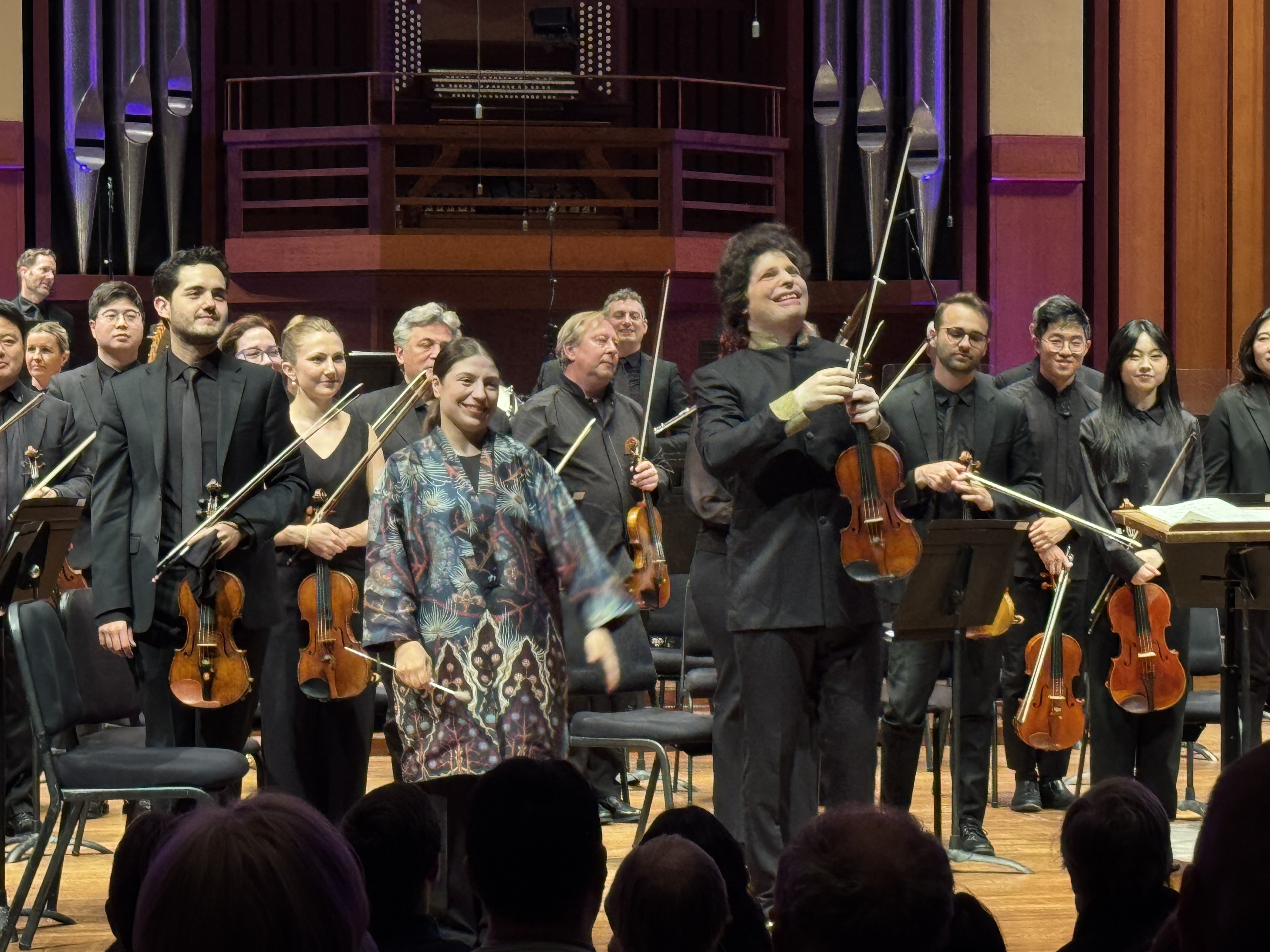
Dalia Stasevska and Augustin Hadelich with Seattle Symphony; (c)Jorge Gustavo Elias
Dalia Stasevska has returned to guest conduct Seattle Symphony this week with a relatively brief but refreshing program. Thursday night’s performance offered plenty of dazzling energy, albeit a curious combination of early Prokofiev sandwiched between two vibrant Latin American works.
Alberto Ginastera’s Malambo from the 1941 ballet Estancia — music that put him on the international map – launched the concert with such kinetic force that it reminded me what a crime it is that his music remains so rarely programmed in the US. (Bravo to the Miró Quartet for recording the entire Ginastera string quartet cycle, forthcoming later this year as part of the ensemble’s 30th-anniversary celebrations.) Stasevska articulated the layered rhythms and boldly strident dissonances of Ginastera’s dance with razor-sharp clarity. Even at just a few minutes in duration, it left the audience breathless.
So did violin soloist Augustin Hadelich — though in a very different way. A Seattle favorite – he gave a deeply memorable account of the Britten Violin Concerto on his last stop with the orchestra two years ago – Hadelich brought his signature artistry Prokofiev’s precocious Violin Concerto No. 1.
From his first phrases, which open the concerto, Hadelich astonished with the sheer beauty of his sound, caressing Prokofiev’s melodic line as if entering into a dream. Phrasing glissandi with effortless sprezzatura, he brought a transportive intensity to his account that was never schmaltzy. Hadelich embraced the concerto’s oneiric, fairy-tale character with personal warmth. Stasevska created a more integrated, immersive orchestral blend by positioning the brass stage right and offered sensitive, fluid support.
Hadelich then delighted with an encore that nodded to the evening’s Latin American framing: his own arrangement of Carlos Gardel’s Por una Cabeza, proving, with wryly elegant melancholy, that it doesn’t always take two to tango.
The concert’s second half was devoted to Mexican composer Silvestre Revueltas’s La noche de los Mayas, a quasi-symphony fashioned from his score for the now-forgotten 1939 film of the same name, which uses a tragic love story to romanticize pre-Columbian Mayan culture. Stasevska underscored the piece’s rhythmic elan and churning colors, along with its touches of chaos a la Stravinsky Rite.
The musicians seemed to thoroughly enjoy giving their all to the score – whether in the weighty brass chords evoking solemn ancient rituals, the mixed meter and collective revelry of a nighttime fiesta, or a touching Mayan serenade duet for flute and percussion.
The last movement opened up into a tour de force spectacle for a massively expanded percussion section that calls for an orchestra-within-the-orchestra, complete with rattles, güiro, and conch shells. I came way impressed by Stasevska’s versatility—a world away from the Sibelius of her last Seattle appearance, and wholly in the spirit of the evening’s exuberance.
Here’s the essay I wrote for the Cleveland Orchestra’s program this week featuring guest conductor and composer Thomas Adès:
Among the preeminent composers of our era, Thomas Adès has likened the practice of creating art — whether music, literature, or painting — to fashioning “a simulacrum of the real world, a reflection”…
It’s been a long wait … But Seattle Symphony has finally secured its next music director. Xian Zhangwill begin her five-year tenure at the start of the 2025-26 season, it was announced today. A fantastic choice.
This season, Zhang can be heard in two programs with SSO: Holst’s The Planets (paired with Billy Childs’s saxophone concerto Diaspora, with soloist Steven Banks) on March 27-20, 2025; and a Beethoven-Prokofiev program June 12-15, 2025 (with Hilary Hahn as the soloist in Beethoven’s Violin Concerto).
From the press release:
The Seattle Symphony is pleased to announce Xian Zhang as its next Music Director, beginning a 5-year contract in the 2025/2026 season. Zhang is a long-term collaborator with the Symphony, debuting at Benaroya Hall in 2008. Zhang has a special relationship with Seattle; she supported the Seattle Symphony throughout the height of the pandemic as one of the first conductors to return to the stage with our orchestra. Throughout her career, Zhang has gained international acclaim, most notably in her eight seasons as Music Director of the New Jersey Symphony and in her recent appearances as guest conductor at the Metropolitan Opera, Philadelphia Orchestra (with which she won a Grammy in 2023), Los Angeles Philharmonic and Boston Symphony Orchestra, among others. Zhang also holds the positions of Artistic Ambassador of Melbourne Symphony Orchestra and Conductor Emeritus of Orchestra Sinfonica di Milano.
Her commitment to advancing diversity, equity and inclusion in the arts has been a hallmark of her career. She has made a point of raising the profile of music composed by women and people of color while being a trailblazer herself. Zhang is the New Jersey Symphony’s first woman Music Director and the first woman to serve as Music Director of any Italian symphony orchestra. She will now be the first to lead a major West Coast orchestra.
Zhang brings boundless energy to the stage, inspiring a powerful sound and a strong connection with both musicians and audience. Most recently, she conducted the Seattle Symphony in performances of Carl Orff’s Carmina burana and Aaron Copland’s Appalachian Spring, filling the house and impressing audiences with inspired pairings of well-known works with cutting-edge contemporary pieces. Zhang performs at Benaroya Hall twice during the 2024/2025 season as Music Director Designate. First, on March 27, 29 and 30, to conduct Holst The Planets: An HD Odyssey, also featuring saxophonist Steven Banks in a new concerto by American composer Billy Childs. Next, she conducts Hilary Hahn Plays Beethoven, on June 12, 14 and 15, featuring Beethoven’s Violin Concerto and Prokofiev’s triumphant Fifth Symphony.
“I am overjoyed to be the next Music Director of the Seattle Symphony and continue creating music with this exceptional orchestra,” said Xian Zhang, Seattle Symphony Music Director Designate. “For many years, I have been inspired by the Symphony’s incredible talent and keen desire to bring new music to the stage. Joining the Seattle Symphony now feels like coming home. From my 2008 Benaroya Hall debut to joining the orchestra in 2020 for its careful return to live performances, I have long felt a special bond with these incredible musicians. Visiting Seattle has always been a treat as well, for its beautiful landscapes, and of course, to see the clear devotion audiences have for the local arts community. As Music Director, I look forward to connecting with audiences on a deeper level, experiencing inspiring concerts together and discovering new music at Benaroya Hall, one of my all-time favorite performance halls to conduct in. Thank you to all of the wonderful people I have been able to work with at the Seattle Symphony so far — musicians, board members and administrative staff. I look forward to a wonderful future together.”
“Today we are witnessing history being made with the appointment of Xian Zhang as the Music Director of the Seattle Symphony,” said Seattle Symphony President & CEO Krishna Thiagarajan. “Her passionate musicianship is inspiring, her technique is clear and precise and the resulting performances captivate our audiences in heart and soul. Xian was among the first conductors to return to the stage with our orchestra during the COVID-19 pandemic. Since then, she has forged strong bonds here in Seattle. In fact, her concerts rank among the highest-attended performances since audiences have returned to Benaroya Hall. As Seattle has grown into an important world city and gateway to the Pacific, Xian’s diverse expertise across Asian, Oceanian, European and American orchestras and music schools — from Beijing to New York, Melbourne to Milan — makes her the perfect choice to lead the orchestra in this new era. I am excited by the possibilities and personally could not be happier to gain such a wonderful colleague for our organization. I want to thank the Seattle Symphony search committee, musicians, staff and audiences, who all played a crucial role in this process, as we welcome Xian and her family to the Pacific Northwest. What seemed like a dream a few months ago has now become a reality. Welcome, Xian Zhang!”
“Xian Zhang’s outstanding performances with the orchestra during this search process easily made her a leading choice for Music Director of our Seattle Symphony,” said Susan Detweiler, MD, Seattle Symphony Music Director Search Committee Chair and Board Member. “Our musicians immediately responded to the depth of Xian’s artistry, producing performances that thrilled both us and the audience, making the Board confident that her extensive experience and deep understanding of classical repertoire will further enhance the Symphony’s artistic development. We eagerly await her return to the Seattle Symphony’s podium in March.”
Happy 80th birthday to Leonard Slatkin! I had a chance to speak with the great American maestro about his career — and ongoing projects — for this story in Gramophone‘s August issue:
His vivid curiosity is unmistakable in the variety of projects planned for this milestone birthday year. These range from publishing a pair of books and spending more time on his own composition to launching a new partnership as artistic consultant to the Las Vegas Philharmonic. Appearances on the podium are naturally also on the calendar. This autumn brings reunions with the three American orchestras indelibly shaped by Slatkin’s years at their helm (in St Louis, Washington DC and Detroit); some international conducting engagements beckon as well.
Gemma New with Seattle Symphony; photo (c) Ben VanHouten
A few weeks ago, Gemma New led the Seattle Symphony in an interestingly unusual program centered around Vaughan Williams’s Antarctic Symphony. The New Zealand-born conductor made an unexpected return visit this past week, when she agreed to take on another guest program in lieu of Elim Chan, who had been originally scheduled to make her debut with the orchestra but canceled owing to a family emergency.
New had just the week before stepped in for Marta Gardolińska at San Francisco Symphony — where, as in Seattle, she took on the program that had been announced, with no changes. That remarkable confirmation of New’s versatility and grace under pressure enhances her already impressive profile.
Thus New opened the first night of Seattle Symphony’s program (17 May) with a contemporary piece she had to learn under extra pressure: Unsuk Chin’s Subito con forza. The piece — so texture- and idea-rich that the term “concert opener” really doesn’t do it justice — was one of the many commissions around the (ill-fated) Beethoven anniversary year in 2020 for compositions reflecting in some way or other on the legacy of Beethoven.
Chin has described Beethoven as “the first consciously modern composer, in the sense that every piece asked for original solutions, even if this meant breaking through existing forms.” She adds: “What particularly appeals to me are the enormous contrasts: from volcanic eruptions to extreme serenity.” Subito con forza — meaning “suddenly, with power,” a phrase in the style of a Beethovenian musical indication such as “Allegro con brio” for the first movement of the Fifth Symphony — abounds in eruptions and contrasts. The opening gesture, for example, alludes to the Coriolan Overture and then explodes into a parallel but unfamiliar universe of chiming percussion and extended technique and quickly gutters into ghostly shiverings on the strings.
Seeming to explore untapped potential or multiple other directions Beethoven might have followed with his raw material, Chin’s approach differs in fascinating ways from Jörg Widmann’s Beethoven homage Con brio. New elicited a sense of the incandescent fire of Chin’s imagination, harnessed through the composer’s formidable orchestral technique.
It made for a wonderful companion piece to the second half of the program, the Symphony No. 1 by Beethoven himself. The audience was treated to an engrossingly fresh account that conjured a sense of the young composer bursting with ideas and the passion to stake his claim. New avoided the temptation to play up Beethoven as an eccentric flouting convention, which made his surprise moves in this work all the more effective, from the harmonic detour of the opening measures and the dam-rupturing energy of the extended coda in the first movement to the teasing, step-by-step presentation of the finale’s main theme.
The conductor’s style of sweeping, balletic gestures signaled the mellifluous, fully layered sound she elicited from the orchestra, with careful attention to dynamics and inner lines, but nothing over-polite or smoothed over. New was particularly sympathetic to the wit and humor of Beethoven’s First and — abetted by the Benaroya Hall acoustic — emphasized a somewhat brighter sonority overall, with Alexander White’s trumpet part always clearly discernible. She aligned the double basses in a curious configuration on stage left, divided into two subsections stretching to the wall. I couldn’t quite notice a difference in the sound, but I assume it supported a particular balance she was looking for. New left a vivid impression of having something to say with this familiar rep, and I’m eager to hear more Beethoven from her.
James Ehnes and Gemma New with Seattle Symphony; photo (c) Ben VanHouten
The program also offered an account of the Samuel Barber Violin Concerto featuring Jame Ehnes, one of the piece’s most eloquent advocates today. Any chance to hear Ehnes is to be cherished, but this performance struck me as particularly special, with the violinist adding a darker perspective to the work than I’ve heard before. The unwavering technique and consistently beautiful phrasing were there, but Ehnes touched on a more tragic than consoling aspect to Barber’s long-limbed lyricism.
Oboist Ben Hausmann — who also deserves kudos for his significant role in the Beethoven symphony — set the tone for the Andante with a solo of heartrending sincerity, while Ehnes countered with a melody of his own that seemed to have been generated in the moment. The Andante also allowed him to display the full richness of his 1715 “Marsick” Stradivari’s lower range. The frenzied virtuosity of the brief, perpetual-motion finale takes a drastically different turn from the preceding movements but felt like a necessary counterpart to so much lyrical effusion. New gave the orchestra a good deal of leeway, which, aside from a few issues of balance, encouraged an especially engaging rapport with the soloist.
Ehnes offered a substantial encore with his account of Eugène Ysaÿe’s single-movement Sonata No. 3 in D minor for solo violin, matching passion with flawless technique for this music clearly close to his heart.
Conductor Valentina Peleggi will conduct Seattle Opera’s upcoming “The Barber of Seville.” (Chris Beasley)
The young Italian conductor Valentina Peleggi make her Seattle Opera debut this weekend in a revival of Lindy Hume’s popular production of The Barber of Seville, running through 19 May. In advance of the opening, I wrote a profile of Peleggi for the Seattle Times:
No matter how many times you’ve seen “The Barber of Seville” — let alone heard the hit tune that Figaro, the title character, sings as his first entrance — you can expect fresh insights into this well-known score under Valentina Peleggi’s baton….
Shiyeon Sung conducts cellist Alisa Weilerstein and the Seattle Symphony; photo (c) Carlin Ma
Thursday evening’s program with Seattle Symphony brought the season’s latest guest conductor, Shiyeon Sung, whose international career took off when she won the Sir Georg Solti International Conductors’ Competition in 2007. Typically introduced as the first female conductor from South Korea to achieve international renown, Sung brought musical intelligence and sensitivity to her collaboration with the players, beginning with an effervescent account of Carl Maria von Weber’s Oberon Overture.
Jeff Fair’s evocative “magic horn” call established the wonderland atmosphere of early German Romanticism, and Benjamin Lulich followed suit with his beautifully shaped clarinet solo. A few balance issues with the strings aside, Sung brought out the blend of wonder and zestful joy of Weber’s fine score from his last opera, which was written in English for the London stage and premiered in 1826 (the year of Mendelssohn’s Overture toA Midsummer Night’s Dream).
The evening’s other guest was the intrepid cellist Alisa Weilerstein (who made her belated Seattle Chamber Music Society debut last summer with memorable results). Performing as the soloist in Witold Lutosławski’s Cello Concerto is about much more than a fearless display of virtuosity. Clad in vivid red, Weilerstein inhabited the role of Lutosławski’s determined, feisty, and ultimately transcendent solo protagonist with passion and persuasiveness, underscoring the piece’s riveting theatricality.
Incredibly, this marked the SSO’s first-ever performance of the landmark concerto written by the Polish composer in 1970 for Mstislav Rostropovich. Weilerstein made a powerful case for the work, whose four movements unfold without a pause and call for strenuous, nearly continuous participation from the soloist. It is up to the cellist, for example, to hold our attention in an opening soliloquy lasting several minutes. Lutosławski indicated that this passage should be played “indifferently,” even frivolously, but Weilerstein intensified the suspense, her repeated D’s implying a ticking time bomb that is eventually set off by the brutal interruption of the brass.
At the same time, the cellist tapped into a deeply Romantic reserve of soul-stirring expression for the cantilena’s lyrical refuge. Always, though, Weilerstein projected a bravely independent and defiant persona, whether with insouciant pizzicatos or in her vertiginous flights in the uppermost register. The conductor is at times relegated to overseeing traffic control and cueing the aleatoric orchestral responses. Shiyeon Sung led the orchestra sympathetically, giving ample rein to the soloist. After the orchestra’s monstrous, full-force chord near the end, Weilerstein emerged in the epilogue with renewed energy and insistence, a voice crying out against the collective insanity.
As an encore, Weilerstein turned to her recent preoccupation with Bach’s Cello Suites (cf. her Fragments project), offering a moving interpretation of the Sarabande from Suite No. 4 that was especially notable for its unusual degree of probing fragility.
The program’s second half was devoted to Dvořák — the under-programmed Sixth Symphony of 1880, to be precise. Shiyeon Sung showed herself a wonderful colorist in possession of an admirable technique, eliciting Dvořák’s ingratiating blends of woodwinds with sensitivity and refinement, especially in the Adagio. The elegantly controlled diminuendo she shaped near the end of the first movement illuminated a major turning point in the symphonic journey before the concluding flare-up to full, joyful sonority. Rollicking energy dominated, as it should, in Dvořák’s scherzo, its furiant syncopations defiantly exuberant despite the minor key. Rambling detours make the finale the weakest part of the Sixth and pose a challenge to the conductor, but Sung guided the SSO through its leisurely musings with a sense of purpose.
Randall Goosby, Christian Reif and the Seattle Symphony; photo (c)Brandon Patoc
While the search for a permanent music director continues, versatility has been in high demand at Seattle Symphony in recent seasons. Week after week, the musicians have had to adjust to the remarkably varied styles of a revolving door of guest conductors. But the latest visitor to the podium, the German conductor Christian Reif, brought the added challenge of a program calling for drastic shifts in style from one work to the next ….





 MEMETERIA by Thomas May