Here’s my review for Bachtrack of Bernard Haitink’s Saturday concert with the London Symphony Orchestra (Prom 40):
Having celebrated his 85th birthday this past March, Bernard Haitink continues to demonstrate that he profits from the advantages of age whilst commanding the deftness of a conductor decades his junior. His programme at the Proms on Saturday evening with the London Symphony Orchestra offered musical perspectives on youthfulness and memory by way of Schubert and Mahler, culminating in the songs of innocence and experience of which the latter’s Symphony no. 4 in G major is woven.
Early into this year we lost one of the greatest musicians of our era with the death of Claudio Abbado. Today brings the sad news of Lorin Maazel’s sudden passing. These were the great conductors I grew up with, so another stark reminder of how quickly that world is fading away.
I recall a very engaging conversation with Maestro Maazel some years ago about his thoughts on Richard Strauss. (Unfortunately the interview is no longer online and I don’t have the file handy so can’t post it for the time being at least.)
Here are a few of the immediate critical reactions:
Maazel was a musical titan who ruled at the podium with a cool, penetrating technical brilliance. This made him a divisive figure through his career, particularly since he didn’t suffer fools lightly…
Mr. Maazel was a study in contradictions, and he evoked strong feelings — favorable and otherwise — from musicians, administrators, critics and audiences.
[…]
He was revered for the precision of his baton technique, and for his prodigious memory — he rarely used a score in performances — but when he was at his most interpretively idiosyncratic, he used his powers to distend phrases and reconfigure familiar balances in the service of an unusual inner vision.
Some reactions from the Twittersphere:
Esa-Pekka Salonen: “Thank you for many unforgettable experiences, Maestro. You had many huge fans among colleagues. I for one certainly.”
Robert Lind: “Rest in peace Lorin Maazel! I remember well when I sang Beethoven’s Ninth Symphony with you a few years ago!”
Matthew Worth: “RIP, Maestro. You gave me one of my first professional jobs after conservatory. Thank you for your faith and nurture.”
And from a 2011 profile in The Guardian by Nicholas Wroe, when Maazel was in London to conduct the Philharmonia in Mahler:
“To be honest I don’t look back with great satisfaction at all the various people I’ve been over the decades,” [Maazel] says. “In fact I often shake my head in dismay at the immaturity and puerile view of life and have the greatest compassion for young people who are going through these same stages. But hopefully you mature and you get smarter, in life and in music. If you sharpen your mind and become open to new ideas you become less enclosed in the ghetto of your fanaticisms.”
He says his relationship with the Mahler symphonies has been lifelong education, “and the place where you learn is on the job. I’m not sure I could listen to my early recordings with the Vienna Philharmonic today. Not because they would be wrong or bad, but the maturing and learning process only progresses inch by inch over the years so this lifetime of interaction with the music now feels part of a much larger experience.
In fact it feels more akin to jumping out of a window and seeing your life pass before your eyes, and I now find myself delivering a performance, simultaneously, both in retrospect and in the present moment. Of course I’m very familiar with interacting with masterpieces, but the emotions engendered by the music are leaving me overwhelmed at the end of the performance. And I’m not the sort of person who is accustomed to being overwhelmed.”
Remembering the conductor Julius Rudel, one of the personalities who shaped my love of opera as I was first discovering what the art was all about.
Mr. Rudel died on Thursday at the age of 93 in his home in Manhattan. How sad he was able to witness the death of New York City Opera, the company he did so much to transform into a significant force in the opera world.
His company never rivaled the proud Met, with its world-class stars and grand stage productions. Nor was it meant to. But Mr. Rudel won international acclaim with innovative programming. It included premieres of many American operas, high-quality Broadway musicals, Gilbert and Sullivan romps and contemporary European musical dramas, besides the classical repertory of Mozart, Puccini and Verdi, often remastered into English and given novel production twists.
As I try to work through some of the titles that have grabbed my attention from the most recent pileup of CD releases:
—El Maestro Farinelli with countertenor Bejun Mehta and Pablo Heras-Casado conducting the Concerto Köln. I have yet to hear anything routine from the amazing Spanish conductor. These performances of music by little-heard Baroque opera composers (including Porpora, Hasse, de Nebra, Jomelli, Corradini, Marcolini, and Traetta; there’s also a C.P.E. Bach Sinfonia title “Fandango”) show off the many-faceted Maestro Heras-Casado’s early-music expertise.
The guiding idea behind the program is to retrieve works Farinelli produced during the years he served as an imperial impresario in Madrid and Aranjuez — works long since fallen into oblivion. (Apparently many of these composers’ orchestral scores were destroyed in a palace fire in the 19th century.)
Mehta sings only two numbers (one a brief zarzuela duet with a decidedly non-“HIP” overdubbing of his voice for both parts) but channels all the mystery and charisma of an 18th-century Klaus Nomi for the compelling Porpora aria (“Alto Giove, è tua grazia,” from Polifemo). I wish there were more vocal music here.
Heras-Casado and the players bring stylish, pointed energy to the instrumental selections — the bulk of the material here — but my first impression is that too much of the program may be the 18th-century equivalent of easy-listening music, perky and caffeinated as it is. But what’s wrong with guilty pleasures? (Note: This is Heras-Casado’s debut for Archiv Produktion label just relaunched by Deutsche Grammophon.)
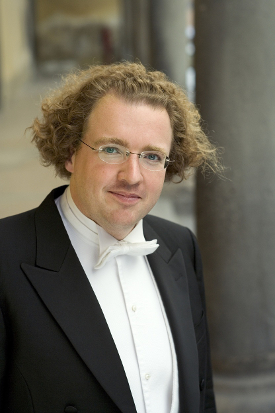
My review of this week’s Seattle Symphony program, with guest conductor Stéphane Denève and pianist Paul Lewis, is now live on Bachtrack:
This week’s Seattle Symphony programme brings the third and last of the current season’s co-commissions — all of which are United States premières — with The Death of Oscar by James MacMillan. Music director Ludovic Morlot led the SSO in the previous two (Pascal Dusapin’s violin concerto Aufgang and Alexander Raskatov’s piano concerto Night Butterflies); for the MacMillan, Stéphane Denève, a champion of the composer since his tenure with the Royal Scottish National Orchestra, was on hand as guest conductor. Denève had also premièred The Death of Oscar in November in Stuttgart, where he currently helms the Stuttgart Radio Symphony Orchestra.
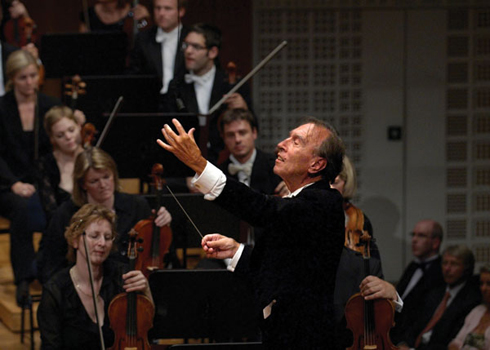
What terribly sad news to wake up to: today Claudio Abbado died at his home in Bologna. He was 80. This should be a front-page news story instead of just a link on the New York Times homepage.
Michael Haefliger, the director of the Lucerne Festival, pays homage to the musician who was a central musical pillar of the festival. The Maestro gave his final concerts leading the elite Lucerne Festival Orchestra, one of the ensembles he was acclaimed for founding:
“Wanderer, there are no paths. There is only wandering.” This quotation, which Claudio Abbado’s long-time friend, the Italian composer Luigi Nono, discovered on the wall of a monastery in Toledo, might also serve as an emblem for the life of Claudio Abbado: not to map out one’s life according to certain paths but rather to proceed, to live, and to remain open to experiencing what is new. In other words, a pathless wandering and searching. In just this sense Claudio Abbado always “pathlessly” sought out the new and unknown in his creative work, and he did so right up until the last second of his very full and fascinating life.
Allan Kozinn describes his self-effacing tendencies:
Mr. Abbado was also known for his disdain for the trappings of a modern, media-driven conducting career. As communicative as his podium manner was, through much of his career he seemed slightly awkward coming on and off the stage. Explaining this in a 1973 interview, he likened himself to the conductor Hans Knappertsbusch, whose habit was to refuse curtain calls.
“I used to be somewhat like that,” he said. “Now I take the time to be polite. Look, I like the reaction of the audience. I’m not sincere if I don’t say that, but it still embarrasses me to take bows. I’m not a showman. I hate all that.”
It was a point of pride for him that he never actively sought the music directorship of any orchestra. But directorships came his way anyway.
Abbado in Lucerne
Included among the in-depth coverage at The Guardian is Tom Service’s eloquent appreciation of Abbado and the “life-changing events” that were his concerts:
The Lucerne project was the zenith of a life in music that had as its essential credo a word that you don’t always associate with conductors, those supposed tyrants of the podium: “listen”… The message of listening was about encouraging every player in the huge ensemble needed to play Mahler’s symphonies to listen to one another, to know the score as well as he did. Their performances of all but the 8th, which Abbado didn’t have the chance to play in Lucerne, are the most revelatory and moving Mahler performances of recent decades – arguably ever.
[…]
[W]ith those musicians in Lucerne, Abbado was able to lift the veil on some other realm of experience, to put us in touch with a larger mystery even than the notes the orchestra was playing.
[…]
[His final Lucerne concert] was a communion between Abbado and his players of devastating intimacy and astonishing emotional bravery, which asked the most profound questions about what the musical experience, and even what life might be about, with its beginnings and unfinished endings, its questions and unfilled answers, its sounds and its silences. Abbado’s concerts weren’t mere performances of pieces of music, they were searing, transformative existential journeys. That they have come to an end is an unimaginable loss.
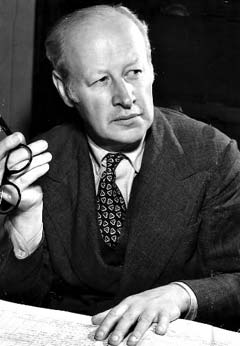
For the Handel bicentennial in 1959 (200 years since George Frideric’s death, that is), the conductor Sir Thomas Beecham proposed giving Messiah a face lift. In a rather bizarre essay, he argued that advances in the sphere of orchestral music had so shifted public taste that audiences were no longer willing “to tolerate a collection of voices singing…with little or no relief from the orchestra” for the duration of a full-scale piece. Beecham commissioned Sir Eugène Aynsley Goossens (1893-1962) — his younger (and recently knighted) assistant, who was also a composer — to re-orchestrate the entire score for a fee of £1,000.
Goossens came from a renowned family of musicians that had migrated from Belgium to England. Beecham jump-started his conducting career, and Goossens eventually developed into a famous and influential figure (especially as a new-music champion). Noël Coward even name-checks him in his lyrics for “Russian Blues” (“My heart just loosens when I listen to Goossens”). A series of globe-trotting posts kept him at the helm of American orchestras for over two decades. He then moved on to Australia to lead the Sydney Symphony and helped found the city’s new opera house.
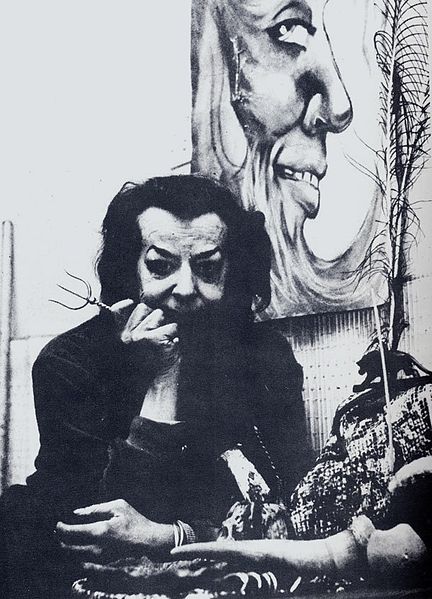
But just a few years before Goossens’ former mentor came calling with his Handel project, a tabloid scandal caused an abrupt fall from grace for the esteemed maestro. The precise details remain murky, but they involve a suitcase of erotic materials that linked Goossens to his lover Rosaleen Norton, an Australian occult artist and practicing witch (the so-called “Witch of Kings Cross”).
Rosaleen Norton (the “Witch of Kings Cross”)
A guilty plea for importing “blasphemous, indecent, or obscene works” led to a fee, and Goossens had to resign his positions. The made-for-tabloid scandal later inspired the play The Devil is a Woman by the Sydney-based writers Mandy Sayer and Louis Nowra, Onez Baranay’s novelPagan, and even an opera (Eugene and Roie by the Australian composer Drew Crawford).
The whole affair sent Goossens’ career into a nosedive. He spent his final years back in England, where he prepared his Messiah score: 364 pages of 30-stave manuscript paper that dwarfed Handel’s original autograph of 259 pages. A team of five copyists clustered nearby, madly scribbling away to meet Beecham’s deadline.
Even though the project was conceived to enhance performances in large concert halls, Beecham conducted a single live account (at the Lucerne Festival, on 12 September 1959). It was actually his best-selling studio recording (for RCA) that won this new version of the oratorio an iconic status. The first public performance of the reupholstered Messiah in the UK didn’t happen till forty years later, at the Proms, where it was billed as a “Messiah for the Millennium.”
In the interim, Goossens’ central role as the orchestrator of this version was glossed over. Carole Rosen, an authority on the Goossens family, refutes claims that a dissatisfied Beecham had himself retouched most of the orchestration. “Apart from a few passages,” she argues, “the whole of the rest of the work as recorded by Beecham was orchestrated by Sir Eugène Goossens.”
The basic premise behind retrofitting Handel’s score — in this case, to “modernize” it by using an enlarged, late-Romantic symphonic ensemble — would nowadays of course be taboo. Yet Messiah‘s long, rich performance tradition in a sense entails a series of revivals that did precisely that.
For his own annual revivals, the ever-pragmatic Handel frequently tailored the score to adapt to particular performers and venues (his revival of 1751, for example, used a boys’ choir for the treble voices). Mozart introduced the work to Vienna audiences in 1789 by clothing it with a full complement of classical woodwinds. A tendency toward expansion snowballed in the following century. Festival performances reached circus-size proportions, featuring choruses sometimes numbering in the thousands.
Despite its reputation for being “over the top,” the Beecham/Goossens edition was intended as a middle-of-the-road approach in the face of some truly wayward distortions. “If Handel is to be brought back into popular favor,” Beecham declared, “some reasonable compromise must be effected between excessive grossness and exaggerated leanness of effect, and this is what has been aimed at in the present version.”
To audiences who have absorbed the insights of the early-music movement in the half-century since, the jingling triangles in “For Unto Us” or march-band cymbals and piccolo in the “Hallelujah” Chorus probably sound like the definition of excess. Many would reject it out of hand, more or less along the lines of anti-Regie operaphiles who are disgusted by interventionist stage directors. Yet it’s too dismissive to simply write off the Beecham/Goossens Messiah as a perverse exaggeration or a noisy showboating at the expense of a pristine original.
Listened to with a less-judgmental attitude, it reveals a fresh take on over-familiar music. After all, Goossens’ approach wasn’t merely to “pile on” sonorities. Flowing harp accompaniment, pizzicato strings, a fortress of brass, and brightly chattering woodwinds cause us to listen to the tunes and counterpoint we know by heart from another perspective. The Goossens Messiah reminds us that a genuine classic is not an immutable, tamper-resistant object. Its vitality comes from its inexhaustible capacity to surprise.




 MEMETERIA by Thomas May