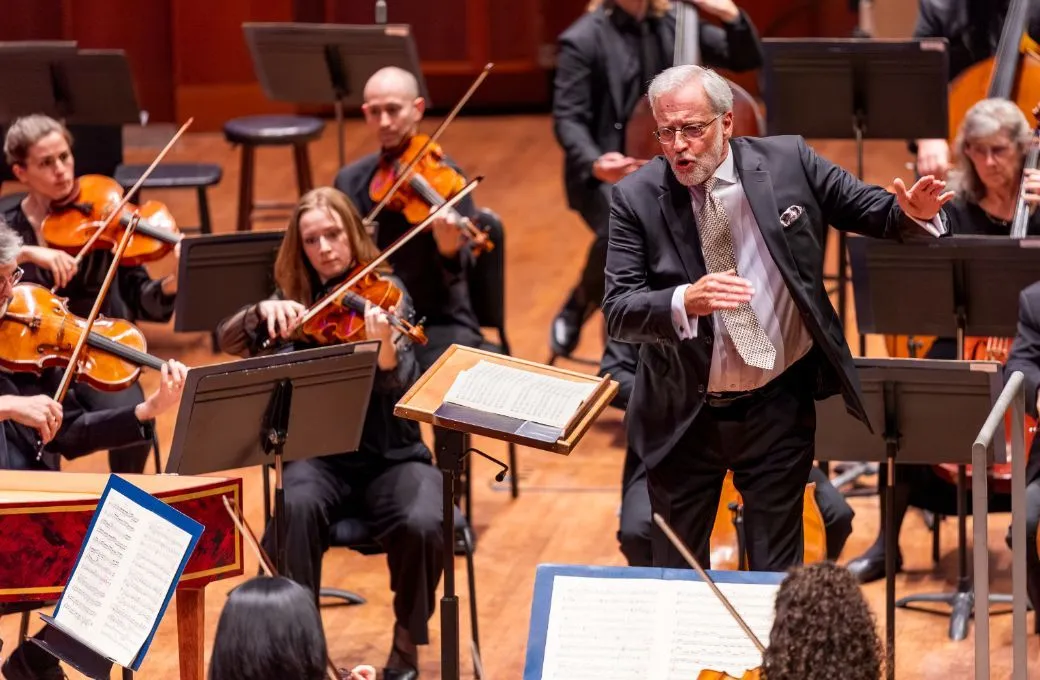
The Seattle Symphony turned agile chamber band for its all-Baroque evening under guest conductor Ivars Taurins, joined by resident organist Joseph Adam. With the Seattle Opera season opening across town – the company orchestra comprises Seattle Symphony musicians – the program made a virtue of proportion and dramatic resourcefulness…. continue
Like Starbucks rolling out its festively colored holiday cups, performances of “Messiah” make an inevitable appearance each December. For many, it’s as much a part of the season as twinkling lights and the scent of pine….
I’d meant to post this last month but got distracted by a very busy December. For Chorus America’s TheVoice, I wrote about some recent approaches to Handel’s Messiah by choral ensembles seeking to engage with wider communities: from the Saint Paul-based Ahmed Anzaldúa and his group Border CrosSing’s bilingual El Mesías to the choral thought leader Jace Kaholokula Saplan’s Messiah i ka ’Ōlelo Hawai’i.
I’m looking forward to this program with Seattle Symphony — and to the next chance to hear associate conductor Lee Mills in action, having been deeply impressed by his last-minute stand-in performance for an incredibly challenging program in November, which featured a world premiere by Hannah Lash and a rarity from Amy Beach.
Regarding Mozart’s take on Handel, Lindsay Kemp offers a helpful summary here of the profound effect that Baron van Swieten’s collection of Baroque music had on the composer. Van Swieten held private concerts in Vienna to explore choral music from the past and “invited Mozart to prepare new performing editions of a group of Handel oratorios…Doubtless Mozart was glad of the money, but, far from being workaday, the job he carried out on the scores is careful and considered, clearly born out of respect for Handel’s skill and creative personality.”
Kemp writes: “His main objective was to recast Handel’s music — whose original Baroque orchestral line-up of strings, oboes and bassoon and occasional brass and timpani would have seemed a little thin to Classical ears — for an up-to-date ensemble which added flutes, clarinets and horns. He thus brings a warm Viennese glow to the music, but in places Mozart also added his own gloss to events, as for instance in Messiah when he adds a contrapuntal shadow to the stark unison accompaniment of ‘The people that walked in darkness’…..”
Sunday evening’s Byron Schenkman & Friends program looks delicious: focusing on two early cantatas by Handel (including Vedendo Amor from his sojourn in Rome), it also includes some of his instrumental music plus pieces by Domenico Scarlatti, Antonio Caldara, and Anna Bon.
For some background, here’s my piece in this month’s Juilliard Journal on Handel in Rome (on p. 16).
Complete program:
George Frideric Handel:
Sonata in G Major, op. 1, no. 5, for flute and continuo
Domenico Scarlatti:
Four keyboard sonatas, K. 238, K. 239, K. 99, K. 100
George Frideric Handel:
Cantata “Vedendo Amor” for voice and continuo
Antonio Caldara:
Cantata “Soffri, mio caro Alcino” for voice and continuo
Anna Bon:
Sonata in F Major, op. 1, no. 2, for flute and continuo
George Frideric Handel:
Cantata “Mi palpita il cor” for voice, flute, and continuo
Performers:
Reginald Mobley
COUNTERTENOR
Joshua Romatowski
FLUTE
Nathan Whittaker
CELLO
Byron Schenkman
HARPSICHORD
Concert starts 7pm on Sunday 18 November at Benaroya’s Nordstrom Recital Hall.
Tickets here.
What a pleasure to get to hear Julia Lezhneva and partner in crime Dmitry Sinkovsky again, just a couple months after the Easter Festival in Lucerne. This time was the soprano’s Seattle debut. A heavenly evening of Vivaldi and Handel, with “Vivo in Te” as their encore.
In the mood to ignore this brutal Siberian cold spell and enjoy tonight’s Serse from 1738 (the Stefan Herheim production, conducted by Konrad Junghänel) at the Komische Oper.
Writes Richard Wigmore:
‘One of the worst that Handel ever set to music’, ran a contemporary verdict on the libretto of Serse, whose ‘mixture of tragic-comedy and buffoonery’ fazed London audiences in 1738. History, of course, has had its revenge. Today the very qualities that puzzled its original hearers – the lightly ironic, occasionally farcical tone, the fluid structure (many short ariosos, relatively few full-dress da capo arias) – have made Serse one of Handel’s most attractive operas for stage directors and audiences alike. There are episodes of high seriousness, above all in the magnificent sequence of Act 2 arias beginning with Serse’s aria di bravura ‘Se bramate’. But much of the invention has an airy melodiousness, whether in the dulcet minuet songs for the coquettish Atalanta, or Serse’s invocation to a plane tree, ‘Ombra mai fu’, immortalised and sentimentalised as ‘Handel’s Largo’.




 MEMETERIA by Thomas May