My recent essay on the unusual (if most popular) of Handel’s oratorios:
Handel’s masterpiece has long been at the heart of the repertory, but it marked an unusual departure for the composer
If you could do the time warp and choose a few of the legendary premieres in music history to be teleported back to, what would make your list? Likely contenders might be Beethoven’s Ninth, Stravinsky’s Rite of Spring, perhaps Berlioz’s Symphonie fantastique and Monteverdi’s L’Orfeo, and — surely Messiah?
This list forms the basis for Thomas Forrest Kelly’s lecture series, published as First Nights, which teems with fascinating factoids to help us reimagine what the scenes of said premieres may have been like. Following the public rehearsal of Messiah on April 9, 1742, the official world premiere occurred on April 13, 1742, at the Great Music Hall in Dublin, having been postponed a day to allow for “several persons of distinction” to be able to attend; the “ladies who honour this performance with their presence” were requested to attend “without hoops” so as to make room for others. All told, the Great Music Hall would have accommodated about 700 (hoopless) people — though of course a seat would be reserved for our prospective time-traveler.
Just to whet your appetite: a snippet from this deliciously sophisticated Handel comedy.
I’ll post my new essay on Handel’s Partenope as soon as San Francisco Opera publishes it. The production, which took the Olivier Award for Best Opera when it premiered at English National Opera, is directed by Christopher Alden, and I had a chance to spend time with him as he was rehearsing the SFO cast (a dream cast, I might add).
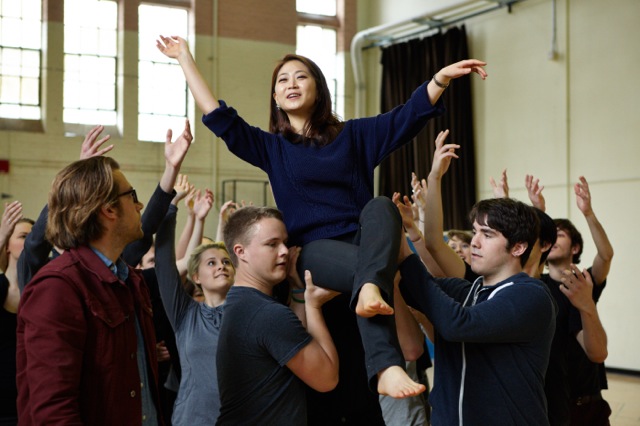
Director James Darrah rehearsing Semele, with Haeran Hong as the title heroine; photo by Steve Korn
Music lovers in the Seattle area will not want to miss this weekend’s performances of Semele, a joint effort by Pacific MusicWorks and the University of Washington School of Music.
I was lucky to be able to attend one of the rehearsals, where I found myself spellbound by the flow of ideas and inspired rapport between director James Darrah and the cast — all this without a stage or costumes and only harpsichord accompaniment. Semele is a late Handel work (1743) that never fit comfortably into the era’s expectations for either opera or oratorio, but Darrah and company are treating it as the liveliest brand of music theater, full of humor, wit, enchantment, and (literally and figuratively) epiphany.
It’s easy enough to imagine the musical and theatrical potential Handel saw in this material, retooling a libretto more than 30 years old — it includes the work of Alexander Pope — which itself retells the classical myth of Semele and Zeus/Jupiter. The human Semele has a fateful love affair with none other than the king of the gods, triggering the jealousy of his wife. Juno’s plan to avenge herself results in the destruction of Semele as a mortal woman but leads to the birth of Dionysus/Bacchus — a boon for humanity.
Handel knew how to carve into the meat of the mythic matter with this story of human aspirations for the impossible, of divine vulnerability to human emotion, of the power of irrepressible desire. A century later, Wagner noted the archetypal aspects of the tale and its similarities to Elsa’s ill-fated questioning of Lohengrin in another human-meets-transcendent encounter. (Another variant is found in Apuleius’s marvelously elaborate narrative of Cupid and Psyche.)
Seattle has tended to be a Handel-deprived zone for far too long, but Stephen Stubbs — the visionary artistic director of Pacific MusicWorks — is changing the playing field with his musically and theatrically stimulating advocacy of early and baroque composers. An internationally acclaimed musical director and lutenist, Stubbs marries the energies of his early music expertise with an appreciation of cutting-edge stage direction and interdisciplinary artistic creativity.
And his choice of the Los Angeles-based director and visual artist James Darrah bodes well. (Darrah has worked with the likes of Peter Sellars and John Adams, and among his upcoming projects is a collaboration with Michael Tilson Thomas next month for the San Francisco Symphony’s semi-staged production of Peter Grimes.)
During the rehearsal I saw, Darrah was coaching the appealing cast of young artists singing the chorus into how to develop into a major character in their own right rather than a passive, fly-on-the-wall musical presence. The chorus became a visible and dynamic extension of the power play among Semele, Juno, and Jupiter. And far from purveying an arbitrary “concept,” Darrah showed with his sensitivity to the subtexts of Handel’s melody and counterpoint that he commands an intimate understanding of the score and of the way Handel constructs his narrative arc.
It should be fascinating to compare the final results of performance with what will happen on the Seattle Opera stage next February-March, when the director Tomer Zvulun returns for a mainstage production of Semele. Meanwhile, Stubbs is spearheading experiments in smaller-scale productions involving partnerships between different organizations and even with companies across the Northwest — all of which promises to enliven the ecology of Seattle’s art scene, for early music and contemporary composers alike.
If you go: Pacific MusicWorks and the University of Washington School of Music present Handel’s Semele Friday and Saturday, May 16 and 17, at 7:30 pm and Sunday, May 18, at 2:00 pm at UW’s Meany Hall. (Sunday’s matinee performance is presented by the student cover cast.) Tickets at 206.543.4880 or 1.800.859.5342 or here.
(c) 2014 Thomas May All rights reserved.
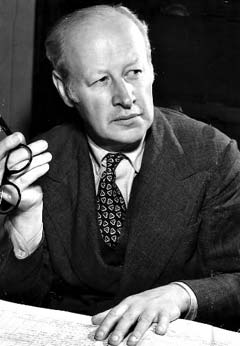
For the Handel bicentennial in 1959 (200 years since George Frideric’s death, that is), the conductor Sir Thomas Beecham proposed giving Messiah a face lift. In a rather bizarre essay, he argued that advances in the sphere of orchestral music had so shifted public taste that audiences were no longer willing “to tolerate a collection of voices singing…with little or no relief from the orchestra” for the duration of a full-scale piece. Beecham commissioned Sir Eugène Aynsley Goossens (1893-1962) — his younger (and recently knighted) assistant, who was also a composer — to re-orchestrate the entire score for a fee of £1,000.
Goossens came from a renowned family of musicians that had migrated from Belgium to England. Beecham jump-started his conducting career, and Goossens eventually developed into a famous and influential figure (especially as a new-music champion). Noël Coward even name-checks him in his lyrics for “Russian Blues” (“My heart just loosens when I listen to Goossens”). A series of globe-trotting posts kept him at the helm of American orchestras for over two decades. He then moved on to Australia to lead the Sydney Symphony and helped found the city’s new opera house.
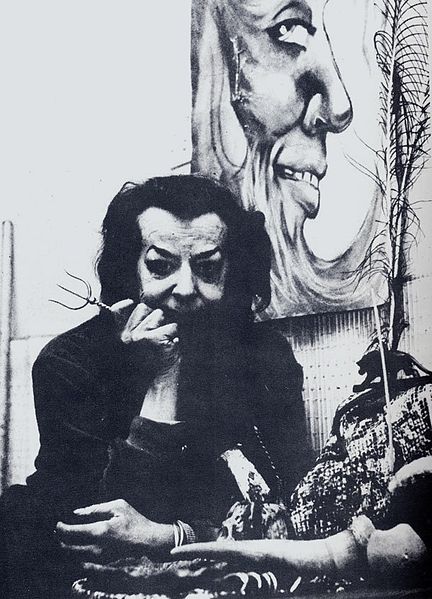
But just a few years before Goossens’ former mentor came calling with his Handel project, a tabloid scandal caused an abrupt fall from grace for the esteemed maestro. The precise details remain murky, but they involve a suitcase of erotic materials that linked Goossens to his lover Rosaleen Norton, an Australian occult artist and practicing witch (the so-called “Witch of Kings Cross”).
Rosaleen Norton (the “Witch of Kings Cross”)
A guilty plea for importing “blasphemous, indecent, or obscene works” led to a fee, and Goossens had to resign his positions. The made-for-tabloid scandal later inspired the play The Devil is a Woman by the Sydney-based writers Mandy Sayer and Louis Nowra, Onez Baranay’s novelPagan, and even an opera (Eugene and Roie by the Australian composer Drew Crawford).
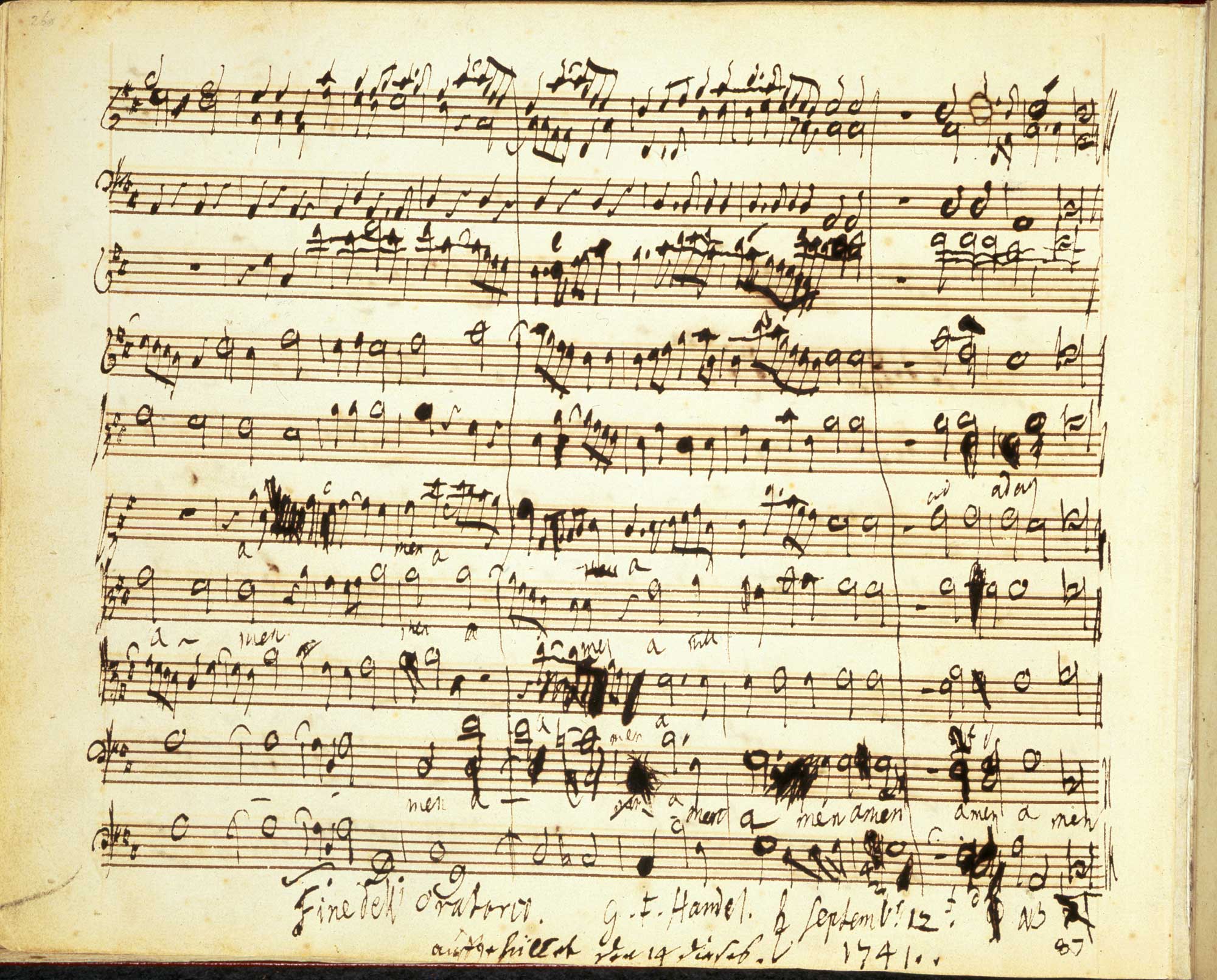
The whole affair sent Goossens’ career into a nosedive. He spent his final years back in England, where he prepared his Messiah score: 364 pages of 30-stave manuscript paper that dwarfed Handel’s original autograph of 259 pages. A team of five copyists clustered nearby, madly scribbling away to meet Beecham’s deadline.
Even though the project was conceived to enhance performances in large concert halls, Beecham conducted a single live account (at the Lucerne Festival, on 12 September 1959). It was actually his best-selling studio recording (for RCA) that won this new version of the oratorio an iconic status. The first public performance of the reupholstered Messiah in the UK didn’t happen till forty years later, at the Proms, where it was billed as a “Messiah for the Millennium.”
In the interim, Goossens’ central role as the orchestrator of this version was glossed over. Carole Rosen, an authority on the Goossens family, refutes claims that a dissatisfied Beecham had himself retouched most of the orchestration. “Apart from a few passages,” she argues, “the whole of the rest of the work as recorded by Beecham was orchestrated by Sir Eugène Goossens.”
The basic premise behind retrofitting Handel’s score — in this case, to “modernize” it by using an enlarged, late-Romantic symphonic ensemble — would nowadays of course be taboo. Yet Messiah‘s long, rich performance tradition in a sense entails a series of revivals that did precisely that.
For his own annual revivals, the ever-pragmatic Handel frequently tailored the score to adapt to particular performers and venues (his revival of 1751, for example, used a boys’ choir for the treble voices). Mozart introduced the work to Vienna audiences in 1789 by clothing it with a full complement of classical woodwinds. A tendency toward expansion snowballed in the following century. Festival performances reached circus-size proportions, featuring choruses sometimes numbering in the thousands.
Despite its reputation for being “over the top,” the Beecham/Goossens edition was intended as a middle-of-the-road approach in the face of some truly wayward distortions. “If Handel is to be brought back into popular favor,” Beecham declared, “some reasonable compromise must be effected between excessive grossness and exaggerated leanness of effect, and this is what has been aimed at in the present version.”
To audiences who have absorbed the insights of the early-music movement in the half-century since, the jingling triangles in “For Unto Us” or march-band cymbals and piccolo in the “Hallelujah” Chorus probably sound like the definition of excess. Many would reject it out of hand, more or less along the lines of anti-Regie operaphiles who are disgusted by interventionist stage directors. Yet it’s too dismissive to simply write off the Beecham/Goossens Messiah as a perverse exaggeration or a noisy showboating at the expense of a pristine original.
Listened to with a less-judgmental attitude, it reveals a fresh take on over-familiar music. After all, Goossens’ approach wasn’t merely to “pile on” sonorities. Flowing harp accompaniment, pizzicato strings, a fortress of brass, and brightly chattering woodwinds cause us to listen to the tunes and counterpoint we know by heart from another perspective. The Goossens Messiah reminds us that a genuine classic is not an immutable, tamper-resistant object. Its vitality comes from its inexhaustible capacity to surprise.



 MEMETERIA by Thomas May