For this Easter weekend, you can stream the Good Friday performance of Scottish composer James MacMillan’s St. Luke Passion from King’s College, Cambridge (the compose conducts).
In a recent interview with Boosey & Hawkes, MacMillan speaks about the work:
I’ve always enjoyed a fruitful fascination with the Passion story, and there are deep reasons through history why artists and composers have been attracted to it, right up to our own times. The story is compelling and the images are powerful, prompting a variety of responses. Each time I return to it I try and find different perspectives. Some works are purely instrumental reflections following Haydn’s example, such as my Fourteen Little Pictures for piano trio, or the Triduum of orchestral works written in the mid-90s. Others follow more familiar formats with choir, such as the Seven Last Words from the Cross or the St John Passion.
As to why he chose the narrative found in Luke’s gospel:
My setting of the St John Passion took a particular approach, examining the human drama, and was almost operatic in impact. So returning after a five-year interval I wanted to take an alternative direction. St John stands apart from the other three so-called synoptic Gospel writers who share structure and common material and, of those three, St Luke has a special appeal for me. As well as relating Christ’s life and teachings, Luke is concerned with the idea of the Kingdom of God which points forward to the same author’s Acts of the Apostles. This started me thinking about a more spiritual, inward, and pared-back approach to create a focused work about an hour long.
Meanwhile, here is the incomparable Jordi Savall conducting Bach’s St. Matthew Passion (featuring Le Concert des Nations at the Palau de la Música Catalana, Barcelona).
Not to be missed, even if not specifically Holy Week-related: Bach’s Mass in B minor from Sir John Eliot Gardiner’s recent tour with the English Baroque Soloists and Monteverdi Choir (which included a stop at the Lucerne Easter Festival; this performance is from the Paris Philharmonie.
For good measure, here’s Johann’s son Carl Philipp Emanuel Bach’s cantata on the Resurrection and Ascension of Jesus, Wq240:
The culmination of Mahler’s Symphony No. 2 (“Resurrection”), a composition tailor-made for Leonard Bernstein:
A toast to John Adams, who needs no introduction. Today, as Mr. Adams turns 68, he continues to astonish with his inexhaustible creative drive.
Just last month the St. Lawrence String Quartet unveiled his Second Quartet at Stanford University. At the Grammies the St. Louis Symphony and David Robertson’s recording of City Noir and the Saxophone Concerto nabbed the award for Best Orchestral Performance. And next month brings the world premiere of Scheherazade.2, a “dramatic symphony for violin and orchestra.”
This very weekend, Opera Omaha is presenting a new production of his 2006 opera A Flowering Tree directed by James Darrah and conducted by Christopher Rountree.
Composed by John Adams, “A Flowering Tree” made its debut in 2006 and is still relatively unfamiliar to opera lovers. It has its roots in a 2,000-year-old Tamil Indian folk tale and is decidedly dark…
Although this all might seem narratively challenging to communicate in just a little over two hours, James Darrah delivered a mesmerizing production.
The works Mr. Adams has given us since my anthology was published nearly a decade ago show this American master working at a sustained peak of creative power. Here’s to many more years to come!
One of my favorite string quartets is celebrating its 25th anniversary with a typical overdrive of crative activity. Here’s my recent portrait of the St. Lawrence for Stanford Arts:
“It’s a great time both to be playing in a string quartet and to be writing string quartets,” remarks Geoff Nuttall, first violinist and cofounder of the St. Lawrence String Quartet (SLSQ). He’s thrilled about how both pursuits—those of the recreative performing artist and of the composer who creates from scratch—will be fused in three distinctive ways during the course of the SLSQ’s upcoming season at Bing Concert Hall.
I’m deeply grateful to Tom Luce to be able to publish his insightful review of the world premiere of the opera staging of John Adams’s The Gospel According to the Other Mary. Directed by Peter Sellars, the production just opened this past weekend at English National Opera.
Review by Tom Luce: The Gospel According to the Other Mary
World Premiere Staging of John Adams’s and Peter Sellars’s Masterpiece
On Friday 21 November, English National Opera unveiled its new production of the Adams/Sellars “alternative” version of the crucifixion of Christ. The two-act work, described by its creators as a “Passion Oratorio”, was premiered in a concert performance at Disney Concert Hall by the Los Angeles Philharmonic in May 2012 under Gustavo Dudamel’s baton. The following year came the first semi-staged concert performance, also featuring the LA Philharmonic under Dudamel. That version later toured to New York and Europe (including a stop at London’s Barbican). Dudamel’s interpretation was released on a recording by Deutsche Grammophon earlier this year, so the music has been accessible to the public at large since then.
Directed by Sellars himself, ENO’s production was the work’s first full staging. Along with its two creators, it deservedly received a prolonged ovation from a rapt and obviously much moved audience.
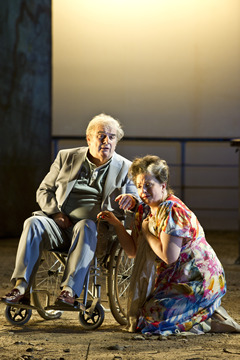
The performance was uniformly excellent, with cast and chorus admirably meeting the challenging mixture of singing, movement, and acting Sellars demands of and inspires from his performers. All the principal singers — Patricia Bardon as Mary Magdalene, Meredith Arwady as Martha, and Russell Thomas the Lazarus — were committed and effective, as were dancers Banks, Stephanie Berge, Ingrid Mackinnon, and Parinay Mehra, who variously shadowed them and contributed other parts to the narrative.
The musical side at ENO was in the hands of Joana Carneiro. Of Portuguese origin, she is better known in the U.S. than in Britain, having for some years been music director of the Berkeley Symphony. Her technical mastery and impassioned commitment to this highly complex score were remarkable. The ENO orchestra played magnificently.
Those familiar with Sellars’ “ritualisations” of the two Bach Passions with the Berlin Philharmonic Orchestra would find nothing to surprise them in his staging. One hallmark is his use of dance, mime, and body movement to externalise and heighten emotion. “Put your body where your belief is”, he says in the ENO’s introductory video. Another is the subtle intermingling of narrative and representation. The main thrust is narrative, but to heighten impact at critical points in the drama, the narrators act out the events — just as the Evangelist in the Berlin Bach Passions both expounds the story and at times impersonates characters — e.g., Peter in denial, or Christ at his death. This subtle shifting of roles keeps crude dramatisation at bay but facilitates a wide variety of dramatic tone and effects. I have not seen anything comparable in other directors’ work; it is one of Sellars’s most skilful and original attributes.
The stage design by George Tsypin, subtly lit by James Ingalls, is spare but eloquent: sand and barbed wire represent a Middle East riven by conflict and oppression, simultaneously biblical and contemporary.
The work juxtaposes and fuses ancient and modern in presenting Mary and Martha as running a hostel for homeless, impoverished, and marginalised people, with Jesus as a mixture of family friend, honoured guest, and spiritual patron. He is also a miracle worker in the raising of their dead brother Lazarus, sacrificial victim of the elites whose power he challenges, and a source of hope for the future of the world.
The literary sources are the Bible — especially St John’s Gospel — supplemented and re-interpreted through modern American cultural figures: poet and author Louise Erdrich, who is partially of native American descent; Dorothy Day of the radical Catholic Worker movement; Rosario Castellanos, the Mexican writer, activist, and diplomat; and the black poet June Jordan (who wrote the libretto for an earlier Adams/Sellars collaboration, I Was Looking at the Ceiling and Then I Saw the Sky).
In the ENO video Sellars also says: “The moment you feminize Christianity and you go into feminine spirituality, you go into a very different space and it operates very differently”. It is of the essence in Sellars’s dramatic work that he sees the cultural myths we have inherited through women’s eyes. This is as much an emotional and dramatic as a political standpoint.
The main originality of his St Matthew Passion ritualisation lies in its inspiration and liberation in the listener and viewer of wider and wilder feelings going well beyond the conventional liturgical responses or the “authentic” musical response to a deeper human involvement in the passion of Christ and its human and political significance. In doing so he responds to the injunction in the very first line of the work: “Come, ye daughters, help me lament”. (The discreet presence in the audience of Mark Padmore, the Evangelist in the Berlin Passions, at Friday’s Gospel premiere served to underline the connection between the Bach and Adams ventures.)
John Adams’s music reaches new levels of emotional profundity, dramatic responsiveness, and absence of mannerism, going even beyond his achievement in The Death of Klinghoffer. There is an extraordinary richness and flexibility of harmony and melody and a fascinating orchestral sound, to which a cimbalom gives an exotic edge without ever sounding kitschy. Amongst many fine moments, the most deeply moving for me is the aria with which the first act ends, sung by Lazarus after the Passover evening: “Tell me, how is this night different? … This is the night we eat the bread of affliction so that evil may turn into good”. Within an orchestral palette evoking a kind of Nachtmusik, Adams here creates a deep and movingly optimistic reflection on the events of the opera. Over many years I have heard nothing finer from a contemporary composer.
With this production English National Opera cements its standing as the world’s most committed John Adams house, having previously mounted Nixon in China and Doctor Atomic and having originated the Klinghofferproduction admired recently at the Met.
The work itself will surely take a high place in the canon of works from the last century or so in which great composers address themes of human injustice and inequality. It will be alongside Tippett’s A Child Of Our Time (1944) and his The Knot Garden (1970), an opera featuring a female revolutionary fighter and a mixed-race/same-gender couple, which sadly seems to have slipped out of the repertoire in recent years); Hans Werner Henze’s dramatic cantata The Raft of Medusa; and above all Alban Berg’s Wozzeck. Its full unveiling at last week’s premiere was an event of real significance.
Tom Luce lives in London and Seattle. He has followed musical events for over 50 years. He wrote music reviews for Seattle’s Crosscut.com.
The full opera staging of John Adams’s The Gospel According to the Other Mary premieres tonight at English National Opera in London, in a production directed by the brilliant Peter Sellars (recently named Musical America’s Artist of the Year).
Here’s a clip with Peter Sellars and John Adams discussing the work:
One of my favorite string quartets is celebrating its 25th anniversary with a typical overdrive of crative activity. Here’s my recent portrait of the St. Lawrence for Stanford Arts:
“It’s a great time both to be playing in a string quartet and to be writing string quartets,” remarks Geoff Nuttall, first violinist and cofounder of the St. Lawrence String Quartet (SLSQ). He’s thrilled about how both pursuits—those of the recreative performing artist and of the composer who creates from scratch—will be fused in three distinctive ways during the course of the SLSQ’s upcoming season at Bing Concert Hall.
Here’s my recent essay for the Metropolitan Opera’s Season Book on the most controversial opera of the season:
Behind the Headlines
In the world of opera, it’s common for a new work to take some time to establish its place in the repertoire. Just think of Così fan tutte, written in 1790 but largely ignored until the mid-20th century, or Les Troyens, which didn’t reach the United States until more than a century after its composition. A generation has passed since the 1991 premiere of John Adams’s second opera, The Death of Klinghoffer, but for the most part the work is still known solely by its controversial reputation. Apart from that original production, only two other full stagings have been seen in the U.S., and both of these took place within the past three years (at Opera Theatre of Saint Louis in 2011 and Long Beach Opera in spring 2014).
In this excerpt from John Adams’s review of Jens Malte Fischer’s Mahler biography, it’s intriguing to see what one great composer zeroes in on when describing the creative process of another:
When [Mahler] composed he did it in a white heat, sketching the outlines of his large symphonic forms in a hasty shorthand scrawl, going as fast as his quicksilver mental powers allowed him, usually during all-too-brief summer “vacations” in picturesque alpine settings. A symphony might be composed in the course of one or two of these summer retreats.
But the painstakingly detailed writing out and preparation of performance materials would occupy him for another two or more years before the work would be publicly performed. He was in every sense what we’d now call a control freak. He insisted on conducting all first performances, often treating early rehearsals as a further composing phase, trying out this and that effect on often hapless and confused orchestra members.
His printed scores are full of admonitions to the performers. Musical ideas are marked with emphatic underlinings, accents, and notational and verbal reminders that seem to shout at or plead with the performer to do exactly as the composer wanted. Mahler, long used to dealing with careless or indifferent musicians, appears to have had little faith in the ability of future generations to get his music right.
What would Mahler have thought about his interpreters today? Which ones would have pleased him most — or displeased him least?
The Spoleto Festival USA for 2014 just opened with a production of a John Adams masterpiece, El Niño, fully staged by John La Bouchardière. Here’s the essay I wrote for Spoleto’s book:
Is it possible to be touched by a sense of the miraculous today? In our guarded, cynical age, can we feel anything remotely similar to the experience of wonder that was the norm rather than the exception for most of human history?
Just before the turn of the millennium, John Adams began a risky new project to explore art’s power to re-enchant us. El Niño is the intensely beautiful and moving result. It’s a work that offers an unforgettable entrée into his musical world — and one that tends to keep a high position on the favorites list of the composer’s most ardent fans.
“I’m very interested in the dramatic staging of musical works,” says Spoleto Festival USA’s new Director of Choral Activities Joe Miller, “and so I proposed doing El Niño at the Festival. One of the aspects that draws me so strongly to it is how Adams presents different perspectives on such a familiar story. I also love novels written about the same event from many different character perspectives. Adams does something very similar here.” Miller explains that the libretto’s use of other perspectives from Latin American poets to supplement and comment on the biblical narrative of Jesus’ nativity calls for an extraordinary richness of musical perspectives as well: “It resembles a website where you click on a link and are able to continue exploring with more depth. Adams brings up these other references within the basic narrative frame.”
For example, the 20th-century feminist novelist and poet Rosario Castellanos (1925-1974), who came of age in the mountainous country in the south of Mexico, provides the textual source for some of the most psychologically pivotal moments in El Niño. One of these is her poem “Memorial de Tlatelco,” about the killing of hundreds of students by police during a heated political protest in Mexico City in 1968. Adams sets this as the dramatic climax of the second part. This soprano aria forms the dark heart of El Niño, the violent negation of all the hope encompassed by the imagery of birth. “Castellanos brings a grittiness and reality to this story, along with a sense of skepticism, that make the hopefulness the piece attains again have all the more meaning,” says Miller.
The conductor’s love affair with El Niño began when he was invited to prepare the choral forces for a high-profile performance at Carnegie Hall in 2009. Adams himself was on hand as lead conductor. “What he imprinted on me was his incredible attention to each detail of his score,” recalls Miller, “and his over-the-top enthusiasm for each of the characters, coaching the singers in nuances of the Spanish text.” The prevalence of non-scriptural Spanish sources represents a key to Adams’s vision in El Niño. Working with his longtime artistic collaborator and friend, the director Peter Sellars (to whom El Niño is dedicated), Adams crafted a libretto from pre-existing sources.
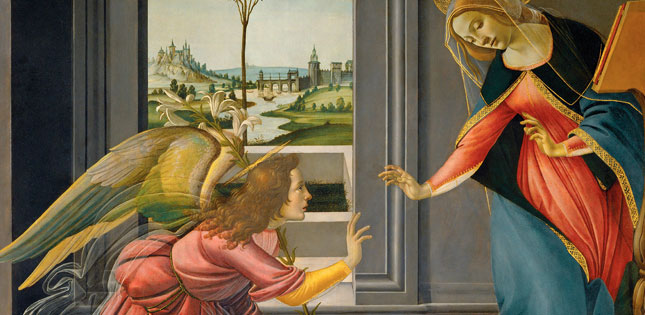
Together they worked out a schema to interweave the well-known “plot points” as depicted in the New Testament — the Annunciation and mystery of the virgin birth, Mary’s visitation with her cousin Elisabeth, the humble surroundings of the birth itself, the homage of the Three Wise Men, Herod’s massacre of the innocents, and the flight into Egypt — with folk-like tales from the apocryphal gospels and poetry spanning from the Middle Ages to the 20th century — much of it by Latin American women poets.
By interpolating the voices of these women, Adams and Sellars wanted to add a fresh perspective to the conventional account of the nativity. A retelling of that specific narrative, Adams realized, could simultaneously serve as the basis for far-ranging meditations on the miraculous reality of birth in general. Mary’s experience of pregnancy in El Niño represents the pregnancy of women across time, much as the birth of Jesus figures the birth of all children.
“All of us know the nativity story, but what we don’t see and hear about is a palm tree bending on the command of the Christ child to quench the thirst of his mother,” remarks Spoleto Festival USA General Director Nigel Redden. “We don’t expect Spanish language poetry from other centuries to suddenly show up the middle of a depiction of the nativity. Through taking up this story John [Adams] is trying to remind us of what redemption means. But it’s a story that is fundamentally incomprehensible to us today in the way that it was for well over a millennium to people.”
An attempt to rekindle the sense of the miraculousness that fuels this story inspired the choices made by Peter Sellars for his inaugural staging of El Niño (which received its world premiere in Paris in December 2000). Sellars’s central concept was to emphasize the everydayness of the characters; their story unfolds in tandem with an accompanying silent film in which Latino actors from Los Angeles re-enacted a contemporary allegory of the Nativity.
“I think Sellars’s idea of a social allegory of outsiders is very valid,” observes Redden, “but we decided on an entirely different approach.” He invited the British stage director John La Bouchardière to develop a full-scale staging for the Memminger Auditorium. Ever since El Niño’s initial unveiling in a theatrically staged context, performances have tended to go in the direction of straightforward concert presentations in the manner of an oratorio — looking back to the role of Handel’s Messiah as an important model for Adams’s conception. This new production by Spoleto Festival USA therefore represents a significant new chapter in the reception history of a major contemporary masterpiece.
“I wanted to push it as far as possible in the other direction of a dramatic staging,” explains La Bouchardière, “whilst accepting the conventions of the piece itself. He points out that this aspect of El Niño; could be confusing to audiences expecting a linear narrative with one-on-one, naturalistic correspondence between the performers and characters. Instead, roles are fluidly exchanged. Both the soprano and mezzo-soprano, for example, represent different aspects of Mary, while the bass-baritone alternately sings the parts of Joseph and Herod and, at one point, even projects the voice of God. “It became important to find a way to play the story that would allow these characters to be consistent.”
La Bouchardière found a solution in his research into medieval miracle plays and didactic religious plays used by Franciscans in the New World (see p. X for director’s note), , providing “vessels” that anchor the biblical characters in a recognizable iconography. “They provide a way of accessing the nativity play through the medieval world — the last period in which miracles were believed in, in which the story was not told as a metaphor,” La Bouchardière elaborates. “John Adams, for example, was brought up to think of religious stories as allegories, and he wrote El Niño as an attempt to understand what is meant by a miracle. In our staging, the subject is not just the story of Jesus’s birth but the story of us and Jesus’s birth. We see the characters onstage reacting to the narrative, as in the Memorial scene itself.”
Redden draws an analogy with our internet age of too-much-information: “To some extent with so many instant answers at our disposal, we’ve lost the excitement and majesty of the unknown. This new production seeks a way not just to make the old familiar story surprising and fresh again but to have it captivate us with that newness as well.”
For Joe Miller, the music Adams has created makes this possible. “El Niño combines a sense of heat — the heat of the street — and pulsation with ingenious orchestration. There is both lyricism and athleticism to the vocal writing, and the music for the countertenors is pointillist. It all conveys a tremendous sense of light and wonder. El Niño is a very 21st-century work because it is so active and alive.”





 MEMETERIA by Thomas May