Prom 32 this week featured Esa-Pekka Salonen conducting the Philharmonia Orchestra in Schoenberg’s A Survivor from Warsaw, Mahler 1, and Dutilleux’s The Shadows of Time (one of his last works). The concert is still accessible to hear online for a few more days here.
Meanwhile, Daniel Stephen Johnson reports on the Seattle Symphony’s latest addition to its acclaimed Dutilleux series under conductor Ludovic Morlot:
While the orchestral playing is as ravishing as listeners have come to expect from Morlot and Seattle, the soloists brought in from outside the band are among the very hottest players on their respective instruments. The playing of violinist Augustin Hadelich, fresh from his Grammy win for last year’s entry in this Dutilleux cycle, is as intensely expressive in Sur le même accord as it is precise, while harpsichordist Mahan Esfahani executes Les citations with his characteristic wit and panache, and the cimbalom playing of percussionist Chester Englander lends an unexpected delight to Mystère de l’instant.
And my own recent profile of Hadelich for Strings Magazine is available here. September’s Gramophone will have my story on the Seattle Symphony and Dutilleux.
My preview of Seattle Symphony’s upcoming festival of American music, from Charles Ives to Julia Wolfe and John Luther Adams:
“There are as many sides to American music as there are to the American people,” Leonard Bernstein remarked in one of his popular Young People’s Concerts devoted to the topic “What Is American Music?”
“Maybe that’s the main quality of all — our many-sidedness. Think of all the races and personalities from all over the globe that make up our country. We’ve taken it all in,” he said.
Bernstein broadcast that message almost six decades ago in 1958. Since then the musical landscape has become vastly more diverse, many-sided and multi-layered. The old-fashioned image of the melting pot seems quaint compared to the dazzling, complex intersections and border crossings that make today’s musical scene so vibrant and self-aware.
The title of my review is actually only part of the story of last night’s performance by the Seattle Symphony and Ludovic Morlot. The program — which I recommend highly as one of the highlights of the season to date — will be repeated Saturday and Sunday. The Beethoven alone would be enough to justify my enthusiasm, but let me get to the other parts of the story first.
Also worth the price of admission is the chance to hear the mellifluously named French pianist Jean-Efflam Bavouzet in Bartók’s Third Piano Concerto and the relatively rare Three Places in New England of Charles Ives.
I suspect some of the remarkably palpable energy the players manifested last night has to do with a sense of anticipation regarding the 2016 Grammy Awards coming up Monday: the SSO nabbed three nominations for the second volume of their ongoing Henri Dutilleux series on the in-house label (including for Best Orchestral Performance).
What was particularly striking in the Ives — deeply challenging pieces, despite the sudden appearance of fragments of folk Americana that momentarily give the illusion of familiar reference points — was the refinement of detail within the most opaque, thickly laden textures of this score. The boisterous energy Morlot summoned for the famous clashing marches of the second place (“Putnams’ Camp”) was all the more startling on account of that refinement — a trait that reminded me of how the conductor searches for the right detail, le ton juste, inside one of Dutilleux’s intricately wrought orchestral canvases.
It was fascinating to hear the Ives so soon after last week’s rendition of Luciano Berio’s Sinfonia. You couldn’t help comparing the method of intrusive quotations, unprepared and free-associative, and wonder at the American maverick angle that leavened Berio’s European avant-gardism. Both composers resort to a collage aesthetic that seeks to replicate the complexity and porousness of musical memory — free of irony and mind games.
Indeed, at times Morlot elicited a curious innocence and tenderness from Ives’s decidedly unsentimental memory-soundscapes. Those qualities also came to mind in the Bartók concerto. On the surface this piece can almost be read as a kind of regression or longing for simpler procedures, a revocation of the composer’s Modernist street cred.
But Bavouzet’s enchanting, subtle interpretation had a cleanness of focus that suggested a mature master taking stock and paring away the inessential. Bartók knew he was dying when he composed the Third Concerto, and in this score the musical past returns not by way of collage and quotation but as acts of allusive, loving homage (above all to Bach and Beethoven — and of course to the rich loam of folk culture that Bartók accessed in a way so unlike the Romantics).
This was especially effective in the profoundly stirring central movement (“Adagio religioso”), where the pianist gave exquisite weight and voicing to Bartók’s harmonies and crisp, wonder-evoking articulation to the birdsong. Bavouzet — who had an opportunity to study with the pianist who premiered this work, György Sándor — projected winning charm along with a clear sense of purpose in the outer movements.
He returned for a most unusual encore (playing, incidentally, the new Steinway recently purchased for the SSO): three of the Notations by a 19-year-old Pierre Boulez, composed right around the time Bartók was working on his final concerto. Bavouzet played with Zen-like presence, or like a curator displaying a set of particularly rich gems, holding them up to glisten and sparkle in the light. This week’s concerts are being dedicated to the memory of the late Boulez.
So on to the Third Symphony of Beethoven. Morlot chose this work for his very first subscription concert after stepping to the podium as the SSO’s music director in September 2011 (pairing it on that occasion, curiously enough, with Dutilleux and a Frank Zappa piece Boulez himself had conducted).
Certain aspects echoed what lingers in my memory from that performance: above all, the historically informed performance touches that conferred a certain athletic fleetness and sharper focus. These were even more apparent — and more paradoxically “radical” in brushing aside the dust from overfamiliar passages — without determining every contour of the conductor’s approach.
I’d say that’s evidence of an increased confidence and interpretive vision Morlot is bringing to this score. The hammer blow chords at the end of the first movement’s exposition, for example, were genuinely shocking, while the use of a solo string quartet to voice one of the variation passages in the introductory section of the finale underscored the idea that textural transformations are just as crucial to Beethoven’s thinking as the thematic/harmonic ones that usually command attention.
Above all, the sheer energy of collaborating with the SSO on moment-by-moment decisions in the score gave this performance the stamp of authenticity that really matters, resulting in an electrifying Eroica. Not all those decisions worked: some of the rhythmic articulations of the Funeral March were sloppy, and the volcanic whirlwind that should launch Beethoven’s extraordinary finale (is there anything about the Eroica that isn’t extraordinary?) sounded curiously listless. But Morlot and the SSO sustained an edge-of-your-seat intensity across the work’s epic span, liberating it from any trace of the routine.
And Morlot inspired much fine, indeed heroic, solo work from the players, including Mary Lynch’s achingly expressive oboe solos (a key leitmotif of the Eroica) in the Funeral March and Jeff Fair’s fearless, flawless spotlights in the famously fear-inducing trio of the Scherzo.
Really, what more can you ask of a symphony program?
You couldn’t come away from last night’s Seattle Symphony concert without a feeling that you’d been privy to a major occasion — a genuine historic moment for the orchestra, for music director Ludovic Morlot, and for audiences both longterm and new to the art.
The occasion was the SSO’s first time tackling Sinfonia, the Luciano Berio masterpiece that is simultaneously viewed as an icon of the end of the modernist era and as a template for postmodernism and today’s aesthetic of collage. Indeed, Berio’s project can arguably be described as a rebuttal of the main tenets promulgated by his colleagues Boulez and Stockhausen — rather as Ligeti likewise represents a powerful refutation. Even so, all of these composers are sometimes clustered together as “Modernists.”
Keep in mind that Sinfonia was composed for the New York Philharmonic’s 125th anniversary under the tenure of its dedicatee Leonard Bernstein, before the Pierre Boulez era there. A very different kind of “modern music,” in other words.
The smart thing is just to set the labels aside and recall that Berio earned a powerful reputation as a rare (at that time) contemporary “classical” composer who managed to bridge the divide between far-flung experimentalism and an apparent willingness and capacity to communicate with audiences.
His outlook was all-embracing, which,for Berio, meant a passionate conviction that music had to be intimately connected to all aspects of the surrounding cultural context. And the context of Sinfonia‘s composition, in 1968-69 — the “heavy” years of the 1960s, a time of revolution, confusion, and upheaval — still reverberates.
The SSO’s performance — the Berio occupied the second half of the program –was prefaced by a dramatic darkening of the house and a brief, wonderfully personal video introduction from Morlot, projected onto a screen. Just enough to set the mood for a taste of that context, with a mix of musical and political reference points.
Playing to what appeared to be close to a packed house, Morlot and the SSO were joined by the vocal ensemble Roomful of Teeth (for a contemporary updating of sorts of the role played by the group Berio originally had in mind — the Swingle Singers). The orchestra itself swelled across the stage, massively enlarged, with speakers placed downstage; the amplified Roomful singers were discreetly “embedded” in their ranks (I couldn’t tell what other elements may have been slightly amplified).
In his intro, Morlot referred to his initial experience of Sinfonia, to how hard it seemed to figure out what was happening in this music. And the sense of being inducted into a bafflingly unanticipated world drove this performance. It was irresistibly present in the opening gestures — the mysterious, almost atavistic summons from the tam-tam, which passes on to the seemingly disembodied voices of the octet.
[Boulez himself conducting Sinfonia]
From that moment forward, it was as if Morlot and the ensemble had set off sailing down a daunting, mythic river. Earlier in the week Morlot had led the Curtis Institute Symphony Orchestra in Sinfonia at Carnegie Hall, yet there was never an impression of neatly worked-out solutions and answers to Berio’s unprecedented challenges. Rather, much of the thrill came from sensing that everyone was out on a limb, unsure of how — or even whether — it would all work out.
“I think Berio’s music has inspired a lot of us to treat instruments in a virtuoso way that is nevertheless humane,” observes the composer Steven Stucky. “I mean both humane to the performers and humane to the listeners, a kind of friendly, Italian virtuosity…” For me, Morlot tapped successfully into this idea of virtuosity and complexity. Berio’s strategies came across as much more than technical adventures to be surmounted.
And the capacity of this music to shock, in a post-Rite of Spring world (the Stravinsky is of course part of Berio’s collage-scape), was in this performance also remarkable. For example, in passage where Berio isolates a gesture like a sforzando and exaggerates it through repetition, Morlot elicited a savage intensity of accentuation that suggested the struggle for a new kind of musical speech.
Much is made of the “overwriting” on the canvas of the scherzo from Mahler’s Second Symphony (in the pivotal third movement of Sinfonia). But a highlight for me was the apocalyptic “panic chord” from Mahler’s Third that also surfaces — a moment of awareness in nature, before the arrival of human consciousness, as Mahler construes it. In this reading Berio’s commentary and contextualization seemed to pinpoint the arrival of in surmountable despair, from which Sinfonia has to work out a “breakthrough” of its own.
Overall, Morlot’s account paid special heed to Berio’s interrogation of the intersection between instruments and voices, between words as purely “musical” melismas and as intelligible signifiers. The fine line dividing chaos/noise from musical sense is being renegotiated by Berio in a new social contract.
A contract that was rudely shredded by a cell phone in the row ahead of me cruelly timed to ring as accompaniment to Sinfonia‘s final measures — not a mere errant ring followed by an awkward silencing, but the entire cycle of rings, the owner of the device displaying not the slightest degree of concern over inflicting this on his fellow humans.
Certainly the solutions of ultra-programmatic music offered by a Richard Strauss were no longer viable. Which may be why, in part, I was rather unsatisfied with the concert’s opener, the early tone poem Don Juan. Or that may just be down to the somewhat ruffled ensemble from the strings.
Morlot brought a few intriguing ideas to the score, pumping up the opening with an adrenaline rush and lingering over the tender passages with surreal, stop-motion gazes — abetted by Mary Lynch’s glorious oboe solos and Jeff Fair’s rich, glowing horn. Some of it, though, felt like special pleading. Call it a moment of crisis, but I found myself growing impatient with Strauss’s tricks and poses.
It was delightful to hear the underrated Beethoven Second Piano Concerto in such a thoughtful, finely chiseled account — continuing Morlot and the SSO’s success with their Beethoven concerto series (the First, last October, was spellbinding). Soloist Yefim Bronfman’s restraint, bordering even on understatement, surprised those familiar with his stentorian keyboard presence — a quality he confirmed in a thundering encore of the scherzo from Prokofiev’s Second Piano Sonata.
One more chance to catch this program: Saturday 6 February at 8pm: go here for tickets.
In the immediate aftermath of the 9-11 attacks, music presenters struggled to readjust programmes so that they could provide an appropriately solemn response. For some this seemed the only justification to enjoy music at all in the face of nightmarish reality.
But the act of making music with care and conviction is itself life-affirming and humanity-empowering, as Leonard Bernstein knew when he famously declared: “This will be our reply to violence: to make music more intensely, more beautifully, more devotedly than ever before”.
Bearing an exotically enigmatic title — Nu.Mu.Zu — the new work by the 80-year-old Georgian composer Giya Kancheli left a distinctly memorable impression in its North American premiere by the Seattle Symphony Orchestra under Ludovic Morlot. The world premiere took place only a few weeks ago in Brussels (Kancheli’s current residence is in Antwerp), with Andrey Boreyko and the National Orchestra of Belgium; both that ensemble and the SSO co-commissioned the piece. continue reading
One unfortunate trend in how concert music is often marketed these days showers disproportionate attention on a ‘star’ soloist, who basks in the limelight and the obligatory standing ovations, as though the orchestra were merely the house ‘backup band’ graciously permitted to share the stage.
What a delight this concert was, in contrast, when Alexander Melnikov joined with the Seattle Symphony under Ludovic Morlot’s baton to reaffirm the unadulteratedly collaborative experience of a concerto.
Rather than a parade of quirks justified as ‘virtuosity’ or a psychogram of a performer’s dominating personality, the 41-year-old Russian pianist provided a deeply satisfying, richly musical account of Beethoven’s Piano Concerto no. 1 in C major. And much of that satisfaction came from the sympathy Melnikov, Morlot and the SSO found in their partnership.
My latest review of Ludovic Morlot and the Seattle Symphony is now live on Musical America (behind a paywall).
Here I cover the first two programs of the season that recently began (Beethoven’s Fourth Symphony and Mahler 1 in the first, Strauss’s Don Quixtore and Brahms’s Third Symphony in the second):
Now in his fifth season as the Seattle Symphony Orchestra’s music director, Ludovic Morlot has hit a sweet spot. The momentum he initially brought to the SSO has not slackened…
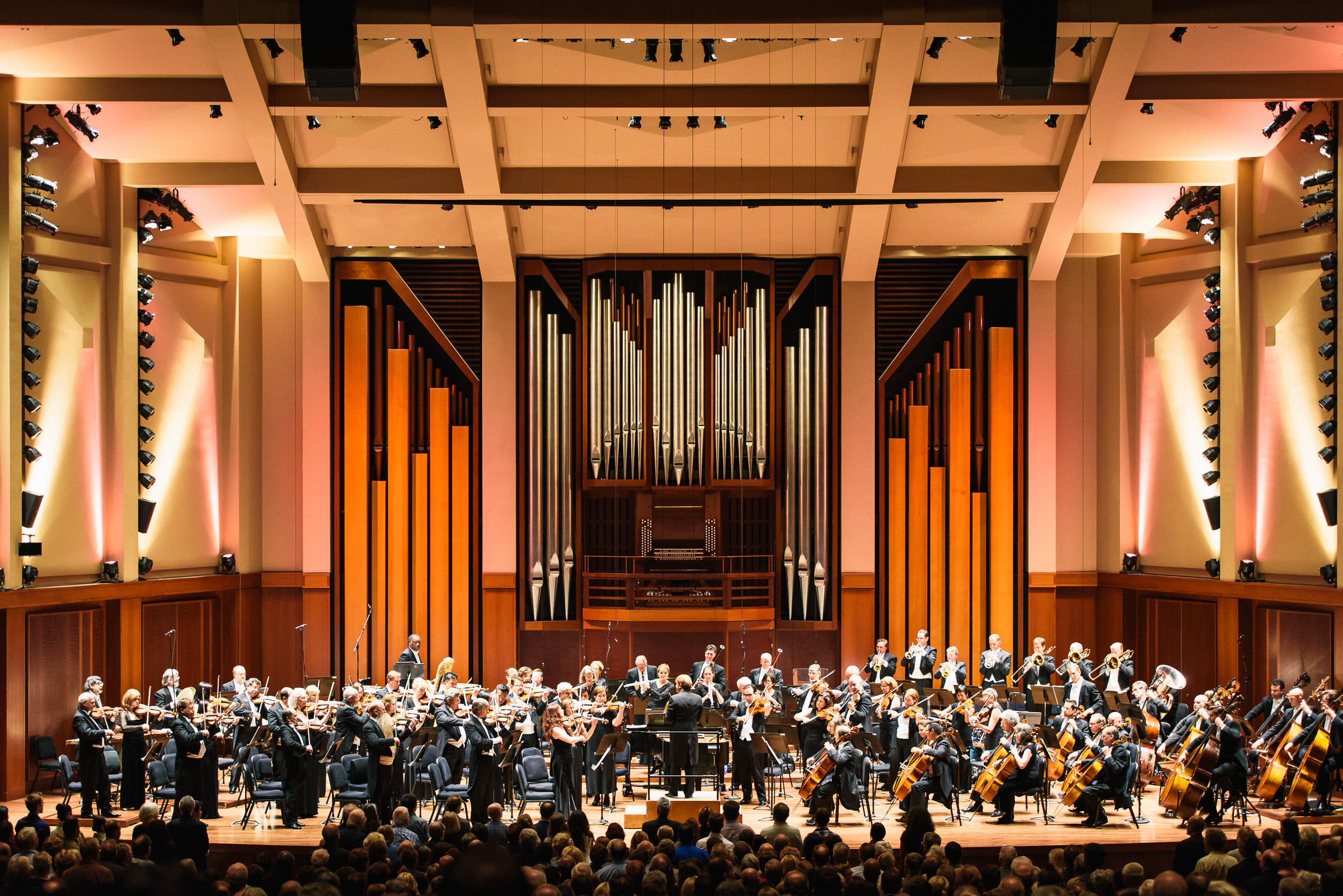
SSO: Opening Night Gala with Ludovic Morlot and Piano Competition winner Kevin Ahfat. Credit: Brandon Patoc Photography
I imagine some people are doing a double take when they realize Ludovic Morlot has just started his fifth season helming the Seattle Symphony. Well, it is hard to believe we’re almost a decade into his tenure: his approach to me feels as fresh as ever. But with the added benefit of confidence accruing. (Here’s another double take: this is the orchestra’s 113th season.)
Saturday evening’s season opener certainly had several Morlot trademarks: a lovely pairing of American and French composers that showed off the health and vigor of the musicians, along with a like-minded peer in the guest artist for the second half.
The performances also overturned a couple of pesky clichés. One is the matter of non-native-born Americans supposedly having a hard time with getting across an authentic feel for the “American” sound — meaning in this context primarily the jazz-inflected rhythms of such popular 20th-century composers as Leonard Bernstein.
Morlot was perfectly at home in the Overture to Wonderful Town and inspired a deliciously stylish reading from the players, complementing Bernstein’s warm lyricism with brash joie de vivre. Instead of over-emphasizing them, Morlot let Lenny’s meter shifts propel the music with an elegantly giddy, light-as-air verve.
The artistic high point came with the orchestral suite Copland fashioned from his original chamber-orchestra score for Appalachian Spring. Here was a touching example of Morlot’s fresh perspective. My reaction was similar to what I felt when he gave us the same composer’s Lincoln Portrait for the concert opener in 2012.
Copland’s suite sounded as if it were being sung in a single tender breath. The performance featured another Morlot trademark: mindful, deftly balanced timbral blending and well-judged phrasing that allowed a particular gesture to reverberate with maximal impact (as right after the final tutti variant of the “Simple Gifts” tune). The result made this music sound so much richer and affecting than you might expect from an aging chestnut. Contributions from the winds were particularly lovely, including guest clarinetist Frank Kowalsky.*
Opening Night Gala Credit: Brandon Patoc Photography
The piano dominated the rest of the program. I have mixed feelings about the prominence given to guest artists at a symphony orchestra’s opening concert: it often seems to decenter the musicians we should be celebrating and enjoying, making them secondary as the spotlight is turned over to a “star.” (And, yes, I get the necessity of this to stir up donor interest and create buzz.**)
But Jean-Yves Thibaudet was the perfect choice to fill the star role. Not only are he and Morlot natural artistic partners: he plays with the orchestra with genuine empathy and give-and-take. In addition to which, Thibaudet will be coming back several times this season in his role as artist in residence with the SSO.
So it was a treat to hear them join together for the fifth of Camille Saint-Saëns’s piano concertos, also known as “the Egyptian.” (Saint-Saëns wrote it while staying in Luxor and also alludes to music he heard in Egypt.) The second cliché that got overturned: the formula that composer X writes difficult music for the soloist whose “virtuosity is not an end in itself, but a vehicle for [fill in the blank with some “higher” purpose].”
Well, not so much in the Saint-Saëns. The virtuosity called for is often over the top, a vestige of the composer’s Lisztian side, and many stretches are exactly for the sake of virtuosity, period. But what fun when played by an artist of such refined taste and intelligence. Thibaudet truly dazzled and charmed, even eliciting a note of dreamy mystery in the Andante, with spirited collaboration from the orchestra.
The concerto was prefaced by the Danse Bacchanale from Saint-Saëns’s opera Samson et Dalila, extending the “Orientalist” theme (and pinpointing one source of Hollywood’s musical orientalism). Much of it is wonderfully trashy, sequence upon sequence, but Morlot had a way of making it sound better than it is.
The piano figured in the middle of the first half as well, when the young Canadian-born Kevin Ahfat took to the keyboard to play the final movement from Samuel Barber’s Piano Concerto. Ahfat had just been announced as the winner of the Seattle Symphony’s inaugural Piano Competition. Along with a $10,000 cash prize, the victory nets him a future performance with the SSO next season.
I had to miss the competition itself, so this was my first time hearing Mr. Ahfat, but he instantly made a powerful impression. I liked the choice of the too-seldom-heard Barber, and though this movement really exhibited only one side of his artistry — a very extroverted, showy side — his playing brimmed with personality and flair. If he can just grow out of the Juilliard mode of exhibitionistic technique-centrism…
To close the concert, Morlot pulled a shtick a la Itzhak Perlman, having Thibaudet come out (joined by Ahfat on another keyboard) for a pretend audition as they embarked on a humorously awkward account of “Les Pianistes” from Saint-Saëns’s Le carnaval des animaux, bringing the curtain down with the finale to the same suite.
*Although the “official” Seattle press has ignored this news, principal clarinetist Ben Lulich has been appointed “new acting principal clarinet” of the Cleveland Orchestra but will perform at some of the SSO’s concerts this season (where he’s technically on leave for the season).
**According to an SSO Tweet, $785,000 was raised for education and mentoring at the post-concert gala:
Drum roll please…last night our community raised a record-shattering $785,000 for education and mentoring! #Seattlepic.twitter.com/ZjBo0MMZxQ
With the seemingly boundless D major chord that ends Mahler’s Third Symphony as final benediction, the departing audience encountered a series of suspended chimes in gentle tintinnabulation: part of a recent installation in Benayoya Hall’s grand lobby by Trimpin, Seattle Symphony’s composer-in-residence. continue reading



 MEMETERIA by Thomas May