MEMETERIA by Thomas May

Music & the Arts

Cav/Pag

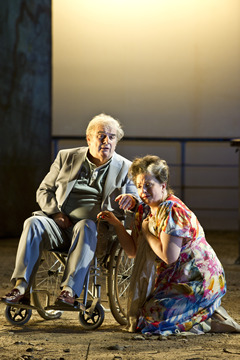
The Met’s new production of the popular double bill, directed by one of my favorites, David McVicar, opens tonight. The cast includes Eva-Maria Westbroek as Santuzza, Patricia Racette as Nedda, Marcelo Álvarez singing Turiddu and Canio, George Gagnidze as Alfio and Tonio, with Fabio Luisi conducting.

From the Met’s company history:

“Cavalleria” was first performed by the Met on tour in Chicago in December 1891, paired with Act I of Verdi’s “La Traviata.” “Pagliacci” followed in December 1893 at the opera house in New York, in a double bill with Gluck’s “Orfeo ed Euridice.” The Met was the first opera company to present “Cav/Pag” together on December 22, 1893, and this combination soon became standard practice around the world, but occasional pairings with other operas were still common into the early 20th century.

“Cavalleria” and “Pagliacci” individually shared the Met stage with such diverse works as “Il Barbiere di Siviglia,” “Don Pasquale,” “Lucia di Lammermoor,” “La Fille du Régiment,”Il Trovatore,” “Rigoletto,” “La Bohème,” and even Rimsky-Korsakov’s “Le Coq d’Or.” An unlikely double bill of “Pagliacci” and “Hansel and Gretel” was especially popular, with almost 100 performances between 1906 and 1938.

Among the notable early interpreters of the leading roles were Emma Eames, Emma Calvé, Johanna Gadski, Olive Fremstad, Emmy Destinn, and Rosa Ponselle (Santuzza), Francesco Tamagno and Enrico Caruso (Turiddu), Nellie Melba, Destinn, Lucrezia Bori, Claudia Muzio, and Queena Mario (Nedda), Caruso (more than 100 performances) and Giovanni Martinelli (Canio), and Pasquale Amato (Tonio). A new production in 1951 starred Zinka Milanov and Richard Tucker in “Cavalleria” and Delia Rigal, Ramón Vinay, and Leonard Warren in “Pagliacci.”

This was succeeded by another new staging in 1958, with Lucine Amara as Nedda, Mario Del Monaco as Canio, and Milanov and Warren reprising their roles. The following production, directed and designed by Franco Zeffirelli,
premiered in 1970 with Leonard Bernstein conducting “Cavalleria Rusticana” and Fausto Cleva conducting “Pagliacci” and a cast that included Grace Bumbry and Franco Corelli in “Cavalleria” and Amara, Richard Tucker, and Sherrill Milnes in “Pagliacci.”

Among the many other artists who have appeared in the two operas since the late 1950s are Giulietta Simionato, Eileen Farrell, Fiorenza Cossotto, and Tatiana Troyanos (Santuzza), Teresa Stratas and Diana Soviero (Nedda),
Jon Vickers, James McCracken, and Giuseppe Giacomini (Canio), and Cornell MacNeil and Juan Pons (Tonio). Tenors who have faced the challenge of taking on both leading roles include Plácido Domingo, Roberto Alagna, and José Cura.

Filed under: Metropolitan Opera

Verdi’s Don Carlo at the Met

My essay Verdi’s Don Carlo for the Metropolitan’s current revival of the Nicholas Hytner production:

The longest and most ambitious of Verdi’s works, Don Carlo seems to encompass multiple operas. Parading across its vast canvas is an array of richly characterized individuals who elicit the full range of the composer’s art; their particular relationships play out against an epic backdrop of conflicting social, political, and religious forces. Scenes of searing intimacy and familial turmoil are juxtaposed with grand spectacles that formidably display the power of church and state.

continue reading (pdf beginning on p. 40)

Filed under: essay, Metropolitan Opera, Verdi

Verdi’s Ernani at the Met

The Met’s production of Ernani is back on the boards. Here’s my essay for the Met’s program:

With Ernani, the fifth of his 28 operas, Verdi was able to exercise a degree
of control over the creative process that had been unprecedented
thus far in his career. Not only did he enjoy one of the key successes of
his early years as a result, but the experience also helped clarify his sense of the
untapped potential for a powerful new style of music drama hidden behind the
conventions of Italian opera.

continue reading (p. 39 of pdf)

Filed under: essay, Metropolitan Opera, Verdi

Finding the Light, Facing the Darkness

It seems — at least as of now — that tonight’s opening of the Met’s double bill of Tchaikovsky and Bartók will proceed as planned, despite the blizzard arriving. It’s a new production directed by Mariusz Trelinski and starring Anna Netrebko as the blind Princess Iolanta for the Tchaikovsky one-act.

Toi toi toi!

My program essay:

Only two decades separate the composition of Iolanta and Bluebeard’s Castle. Yet during these years, the music of fin-de-siècle Romanticism sounded the last gasps of a philosophy that was rapidly being made obsolete by the efforts of a diverse generation of radical younger composers. That, at least, is the narrative we’re usually told. In fact the shift toward modernism was not nearly so clean-cut or abrupt.

You can find the whole piece here (pdf: starting on p. 3 of the insert, after p. 36)

Filed under: Bartók, essay, Metropolitan Opera, Tchaikovsky

The Tales of Hoffmann at the Met

Bart Sher’s Tales of Hoffmann production is returning to the Met this week.

Here’s my essay on Offenbach’s fascinating, problematic masterpiece for the Met Playbill (starts on p. 35 [pdf format]):

Les Contes d’Hoffmann is a most unusual swan song. In its formal ambition
and psychological scope, the opera represents a striking makeover.
Jacques Offenbach hoped to reinvent himself as an artist, proving that he
was capable of more than the wickedly satirical but lightweight brand of lyrical
theater on which his reputation had been built. And Hoffmann did secure his
place in the operatic pantheon, although the truncated version through which it first became known made a jumble of Offenbach’s original vision.

continue reading

Filed under: directors, essay, Metropolitan Opera

Coming into the Light: Tchaikovsky’s Final Opera

Enjoy your Nutcracker this season, but me, I’d much rather have the other part of the double-bill with which the ballet was first paired in 1892: the one-act fairy-tale opera Iolanta.

I’m currently admiring Peter Sellars’s enlightening interpretation, paired on DVD with Stravinsky’s Perséphone from a production at the Teatro Real.

“It is a very radical opera, it is the start of symbolism in Russia, of modern art, of the search for light,” says Peter Sellars in an interview for El País.

Iolanta was Tchaikovsky’s very last opera and suffered from terrible bowdlerization under Soviet authorities. A new production starring Anna Netrebko — in a double-bill with Bartók’s Bluebeard’s Castle and directed by Mariusz Trelinski — comes to the Met early in 2015.

Filed under: directors, Metropolitan Opera, Tchaikovsky

Die Meistersinger

My new essay on Die Meistersinger for the Metropolitan Opera’s program book (production starts 2 December 2014):

In the spring of 1861, Richard Wagner endured the very worst humiliation of his mature career—a humiliation of Beckmesserian proportions. The high-profile revival of his early opera Tannhäuser, thoroughly revised for its Paris premiere, caused such a scandalous uproar that Wagner pulled up stakes and canceled the production after only three performances. That failure reinforced his burning sense of resentment against the opera capital of the world, where he had already experienced crushing rejection nearly two decades before.

continue reading (essay starts on p. 42 of pdf)

Filed under: essay, Metropolitan Opera, Wagner

The Death of Klinghoffer

NFBB_klinghoffer_feature4

Tonight John Adams’s opera The Death of Klinghoffer opens at the Met. Here’s the full program as a pdf, including my program note.

And here’s another introductory essay I wrote for the Met.

Filed under: American opera, John Adams, Metropolitan Opera

The Death of Klinghoffer at the Met

ENO-Klinghoffer

Here’s my recent essay for the Metropolitan Opera’s Season Book on the most controversial opera of the season:

Behind the Headlines
In the world of opera, it’s common for a new work to take some time to establish its place in the repertoire. Just think of Così fan tutte, written in 1790 but largely ignored until the mid-20th century, or Les Troyens, which didn’t reach the United States until more than a century after its composition. A generation has passed since the 1991 premiere of John Adams’s second opera, The Death of Klinghoffer, but for the most part the work is still known solely by its controversial reputation. Apart from that original production, only two other full stagings have been seen in the U.S., and both of these took place within the past three years (at Opera Theatre of Saint Louis in 2011 and Long Beach Opera in spring 2014).

continue reading

Filed under: American opera, John Adams, Metropolitan Opera

The Sound of an Ending


Yesterday I was among the legions of opera fans around the world taking for granted the high-tech synchronization that makes the Met’s live performances in HD possible. During this performance of Massenet’s Werther, I noticed a couple of slightly ominous flickerings on the screen — subliminal heralds of the désastre to come.

And then the unthinkable happened: at the opera’s emotional climax, as Charlotte tries to comfort the dying Werther — who has finally acted on his threat to commit suicide — the audio feed also died. (I’m not sure how widespread the problem was, but it apparently affected many theaters around the U.S. at least.) It died at the worst possible moment. Had this occurred, say, during Albert’s aria or the drinking music at the inn, that would have been annoyingly disruptive enough. But in these crucial final minutes, the impact was devastating. On a larger scale, this was more like reaching the Immolation Scene in Götterdämmerung, only to have the plug pulled out. Even if the sound were to have been restored, Massenet’s spell had already been broken — and it quickly became apparent there would be no Audio ex machina.

I even imagined a sardonic director deliberately choosing this moment to expose us to a cruel new genre of performance art in which the audience is brought to the precipice and then plunged into silence at the moment of cathartic payoff, left with visual cues and English surtitles alone to which to cling like a life raft. The graphic image of Werther’s blood-spattered wall became especially searing. (Of course this would have required a coup deposing Richard Eyre, the actual director who had so sensitively shaped Massenet’s most beautiful opera up to this point.)

This was the aesthetic opposite of the Stendhal syndrome. A colleague with whom I attended the cinemacast — the critic Roger Downey — coined the term “opus interruptus.” (I didn’t venture to correct this with “opus interruptum,” which would have been unforgivably pedantic — not to mention far less effective than Roger’s invention.)

So, with a little grammatical poetic license, “opus interruptus” it is. We both experienced a distinct sense of emotional disorientation which the genre of opera intensifies to the maximum. This has little to do with narrative fulfillment, with the compulsion to get to the end of the story that Scheherazade uses as her secret weapon. It’s about the investment of emotional energy through Massenet’s careful pacing of musical characterizations and events. Suddenly this was denied the resolution we know must be there in the music: a metaphorical cadence, perhaps.

And modern technology simply can’t “patch” that up.

At any rate, the Met has provided a link to the full final scene — ironic “Noels” and all – here.

(c) 2014 Thomas May. All rights reserved.

Filed under: aesthetics, Metropolitan Opera, technology

Archive

Enter your email address to follow this blog and receive notifications of new posts by email.