MEMETERIA by Thomas May

Music & the Arts

Stirring Up a Storm

Tempest

Quite happy to see Tom Adès take the Best Opera Grammy for The Tempest. I had the opportunity to write this essay for the Met when the production staged by Robert Lepage first appeared there:

When The Tempest opened at London’s Royal Opera House in February 2004, the anticipation couldn’t have been more intense. Composer Thomas Adès—only 32 at the time—had already been thrust into the international spotlight in the previous decade and found himself having to live up to recurrent comparisons with his similarly precocious compatriot and predecessor Benjamin Britten. Despite all this pressure, the overwhelming, almost unanimous response to Adès’s second opera seemed to confirm the parallels. “Only time will tell whether the first night of The Tempest in 2004 was a moment to set alongside the first night of Peter Grimes in 1945 in the history of British music,” wrote The Guardian the day after the occasion. “But it felt that way in the theatre.”

Time has proved that the initial verdicts weren’t idle hyperbole. The Tempest belongs to that rare group of contemporary operas whose critical acclaim is matched by the ultimate practical test of stage-worthiness. In fact, The Tempest—still less than a decade old—can already boast an astonishing track record of five different productions: the original Covent Garden staging (which was revived in 2007 and recorded for EMI’s award-winning CD), the American premiere at Santa Fe Opera in 2006, two separate productions in Germany, and now the opera’s premiere at the Met, which promises to be among the highlights of the new season.

Robert Lepage’s staging is a co-production of the Met, Opéra de Québec, and the Vienna Staatsoper and will also feature Adès (pronounced AH-diss) making his company debut as conductor. Reprising his performance as Prospero is baritone Simon Keenlyside, whose combined vocal and physical presence were widely admired as ideally suited to the role he created at the Royal Opera House.

The once-obligatory references to Britten became a kind of shorthand for English critics eager to spell out the high expectations pinned on Adès. In fact, he is an artist whose voice is unmistakably and audaciously original. Many gifted young composers demonstrate an eclectic, anxiety-free facility when it comes to claiming elements from the musical past for their own creative tool kit, but what was especially striking about Adès, while he was still just in his twenties, was the uncanny confidence with which he forged a rich, complex, allusive language with a coherence all its own.

Even more, before the millennium Adès had already found exciting ways to develop his flair for formal, abstract structures, vivid orchestration, and spirited detail while also demonstrating a compelling theatrical instinct. His range was apparent, whether in writing for a large Mahlerian orchestra (the symphonic Asyla, commissioned for the Berlin Philharmonic, for example) or in his first work for the stage, the chamber opera Powder Her Face (1995).

The latter, which used the scandalous story of an aristocrat’s fall from grace to ironically turn the mirror back on a tabloid-saturated culture, also revealed Adès’s extraordinary feel for portraying characters in music. With the far vaster canvas of The Tempest, he progressed to a mature mastery of his art, taming the often volatile energy found in his youthful scores into a sustained, emotionally gripping arc.

Shakespeare’s beloved final romance, remarks Adès, “is famously full of references to music, while the intangibility of some of its characters has always inspired music.” Purcell, Tchaikovsky, Sibelius, and Berio are just a few of the many composers who have fallen sway to its spell; even Mozart, near the end of his life, may have contemplated turning The Tempest into an opera. Yet instead of finding himself daunted by the weight of associations bound up with the source material—above all by the sheer power and poetry of Shakespeare’s language—Adès discovered a fresh approach to “translating” the Bard’s vision into opera.

The composer collaborated closely with librettist Meredith Oakes, an Australian-born playwright and poet whose talent for evoking traditional poetic patterns through “a very specific, archaistic style” felt particularly appropriate. Oakes distilled the original verse into pithy, condensed couplets that echo the play’s most famous passages in eminently singable phrases—instead of competing with them. Many of the couplets take the form of half-rhymes or slant-rhymes that acquire an extra charge by being ever so slightly off. The result, Adès says, “is a translation of Shakespeare into modern English, to be all the more faithful and concentrate the drama.”

Yet the three-act opera remains remarkably true to the arc of Shakespeare’s story and the spirit of his characters, while at the same time opening up the creative space necessary for Adès to add the unique perspective of his musical imagination. “I want it to be The Tempest. I want it to be Shakespeare and to bring that vision into the opera house as faithfully as possible,” the composer points out. “We actually started further away from the play than we ended up but found ourselves going back to Shakespeare’s structure much more.” But to achieve such fidelity—as opposed to a pale imitation—Adès and Oakes determined early on that they needed to swerve away from dogged, literal re-creation.

The most striking shift involves the opera’s conception of Prospero, the former Duke of Milan who, in the back story, has been usurped by his brother Antonio and shipwrecked on an island with his young daughter, Miranda. Prospero’s desire for vengeance is more pointed in the opera, as is his related assertion of control over the island’s indigenous creatures—Ariel and Caliban—and over Miranda’s emerging emotional autonomy as she falls in love with Ferdinand, his enemy’s son.

The libretto provided Adès with clearer “musical emotions” that motivate the dynamics of enslavement and liberation in the story as well as the transforming power of love and compassion. The real turning point, observes the composer, comes when Ariel tells Prospero that the suffering he has caused his enemies to endure would soften Ariel’s own heart if he were human. “And it’s the moment when Prospero realizes he’s gone too far and has to stop.”

Lepage, familiar to Met audiences for his stagings of Berlioz’s The Damnation of Faust and Wagner’s Ring cycle, praises the opera for capturing the “magic” of what is often considered the playwright’s final artistic testament. Not surprisingly for this wizard of theatrical illusion, the figure of Prospero has long fascinated Lepage, who has directed numerous productions of Shakespeare’s play. Each time he returns to it, he uncovers new insights. For his own concept of the opera, Lepage has expanded its aura of magic into a metaphor for artistic performance itself, envisioning Prospero as an 18th-century impresario of La Scala, the opera house in Milan, which he has recreated on the island of his banishment as a reminder of home.

“In those days, La Scala was a very magical place to set operas because it had all of the new state-of-the-art machinery,” Lepage explains. “The beach where everybody is marooned is actually a stage that’s been planted there and constructed by Prospero.” Lepage adds that each of the three acts presents a different perspective—from the stage itself, from the auditorium, and what goes on behind and off stage—to encompass this “opera-within-an-opera house.”

Members of his creative team will be making their Met debuts: Jasmine Catudal designed the sets, and the costumes are by Kym Barrett (known for her collaborations with Baz Luhrmann and her work on The Matrix films). The overall look will marry a sense of the island’s “native, aboriginal culture” with the Italian Baroque sensibility imported by the European interlopers.

Lepage’s mastery of both traditional stagecraft and its most up-to-date technological forms provides an ideal complement to the composer’s unique fusion of a classic play with a contemporary vision of opera. In his musical characterizations of the five leads, for example, Adès developed wonderfully effective alternatives to the vocal type casting that might have tempted a less-imaginative composer. While Ariel, a male character played by a soprano, sings in a stratospheric tessitura (frequently perching on Ds, Es, and Fs above high C, even reaching to G), “this isn’t a way of expressing high emotion and shouldn’t feel like the top of the singer’s range. That’s where she lives.”

Ariel is an elemental force of nature who—in another alteration of the original source—sings the final airborne phrase and becomes the wind again. Her island counterpart, the “monster” Caliban, is depicted not as a “lumpen, earthy brute” with a bass voice but is a lyrical tenor. “He’s often described in the play as being like an eel or a fish, and I suddenly thought he could be more like one of those exotic, wonderful voices from the East, with a weird elegance. And of course he is an aristocrat, not only in his own mind,” says Adès, who gives Caliban one of the most radiantly beautiful passages in the score: his aria reassuring the shipwrecked newcomers not to fear the island’s “noises.”

As for Prospero, the composer created a fully dimensional baritone role (with shades of Verdi’s and Wagner’s authoritarian father figures) who nevertheless defies the stereotype of the wise old sage. Adès was especially inspired by crafting the role for Keenlyside. “Simon’s a terrifically physical performer who projects youth. In a way, it’s that characterization, as much as the extraordinary voice, that was on my mind. I don’t think of Prospero as an old man. This is the only play of Shakespeare which observes the classical unities of happening in one place, in one day. When Prospero meditates on the evanescence of life, my feeling is actually it’s not that he does that every day and has been doing it for years and he’s an old bore. It’s that he’s just realizing it at that exact moment. That’s the first time he’s thought this.”

While Adès writes for the voice with great character, his score is also distinguished by its symphonic intricacy and architecture. This quality provides the opera with a richly satisfying cohesion and unity. Adès achieves this not through conventional leitmotif technique but by expertly manipulating his uniquely evocative harmonic language. He explains: “The music has its own internal logic of relationships; it doesn’t just do what it wants to do because the characters suddenly decide to go somewhere. It’s a tissue that’s woven in, so that everything is related in the music, and all the elements create a view of the world that’s whole, a sphere.”

(c) 2012 Thomas May – All rights reserved.

Filed under: Metropolitan Opera, new music, opera, Shakespeare
The Met’s Falstaff in HD

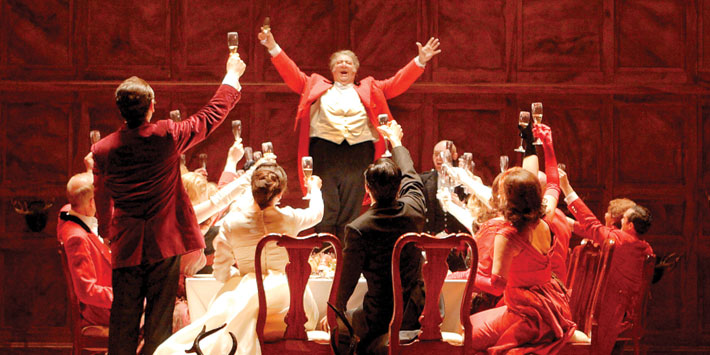
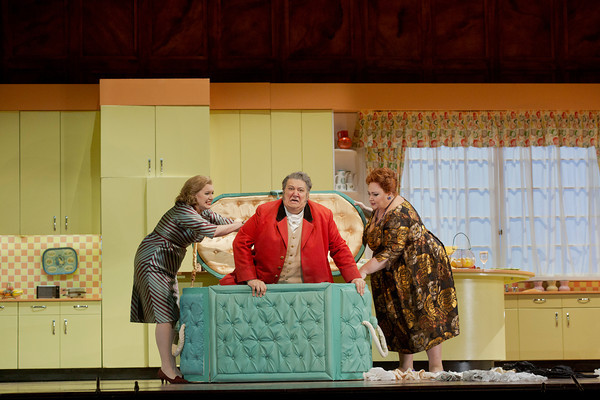
Jennifer Johnson Cano, Ambrogio Maestri, and Stephanie Blythe in the Met's Falstaff; photo by Ken Howard

Jennifer Johnson Cano, Ambrogio Maestri, and Stephanie Blythe in the Met’s Falstaff; photo by Ken Howard


Looking ahead to the Met’s Live in HD broadcast of its new Falstaff production tomorrow, I gathered a sampling of the critical responses:

[T]his was a perfectly respectable Falstaff. It just wasn’t the superb Falstaff the occasion called for….This level of micro control is put to the test in Falstaff. For this sparkling comedy based on Shakespeare’s The Merry Wives of Windsor, Verdi wrote a quicksilver score that, when conducted precisely, feels improvisational. But when the conducting is off even by a hair, the music seems to lurch and halt like a car whose driver is riding the brakes. And that’s how Mr. Levine’s Falstaff felt: We reached our destination, but the ride was a little rough.

James Jorden/New York Observer

The opera turns on a dime between slapstick, romance, and poignancy, but the production, while good-natured, isn’t so agile….Falstaff is a James Levine signature piece and he brings a bounce and light to the music that was missing from the production (particularly in the last act). It’s quick, light, and transparent, but quiet when it needs to be. That being said, there were a few ensemble coordination issues in Act 1, particularly between the two sides of the stage (men on one side, women on the other). Things improved….

Ambrogio Maestri, however, was not a particularly interesting Falstaff. He’s got the big round voice for it, and the round shape, but while musically fine it was a one-dimensional characterization, little more than a teddy bear….As Alice Ford, Angela Meade put in a valiant effort, acting-wise, and this was by far the most animated performance I’ve seen from her….Nanetta’s music is a gift to any light soprano, and the Met has fortunately cast Lisette Oropesa, possibly the best singer they have in this Fach….On the low side, Stephanie Blythe as Mistress Quickly sounded like a very loud trombone. This role is her ideal Fach as well–she’s much better here than she is in higher Verdi stuff.

Micaela Baranello/Likely Impossibilities

At 6 foot 5 with his Falstaffian physique, Mr. Maestri certainly looks the part. A natural onstage, and surprisingly light on his feet, he makes Falstaff a charming rapscallion and sings with consummate Italianate style. …
Inspired by the librettist Arrigo Boito’s breezy adaptation of Shakespeare’s comic verse [only a fraction of Merry Wives is actually in verse (Ed.)], Verdi wrote music that responded minutely to the patterns and flow of the words. The music is like a gossamer fabric of sewn-together snippets. Mr. Levine revealed the continuity and structure of those snippets in this performance. The tempos he chose were sometimes restrained, allowing for enhanced richness and breathing room….But, there were shaky moments in the performance. “Falstaff” is an opera of ensembles, and some of these passages were a little scrappy….Over all, when it comes to theatrical flair, captivating costumes, stage antics and imagination, there are not many shows on Broadway to rival the Met’s new “Falstaff.”

Anthony Tommasini/New York Times

[W]hile conventional productions might assume Verdi and his librettist Boito created a silly, self-deluded shell of a knight descending to society’s dregs, Carsen shows Falstaff in upper-echelon men’s clubs and someone to be ridiculed only at your own risk….Carsen went far to solve the central problem that makes the opera more respected than loved. For all its distilled, compact music, Verdi’s final opera often seems to be an enshrinement of buffoonery while the soprano/tenor love interest have far-less-than-usual stage time and everybody else has a high old time practicing the un-exalted human pastimes of humiliation and revenge….

Now for the reservations: The clear narrative lines that are typical of Carsen broke down a bit in larger crowd scenes. The bigger problem is that, aside from the coup-de-theatre kitchen and and the nighttime scene in the final act, Paul Steinberg’s sets are surprisingly plain with a lot of bourgeois wood paneling.

David Patrick Stearns/WQXR/Operavore

The Met’s much-loved 1964 Franco Zeffirelli production, which dated back to the old 39th Street house, will be missed, but Robert Carsen’s new take on Verdi’s final opera is a true delight….Carsen sets his version in late-1950s London, well after the war but just before the Mod revolution. It was a time when existing social systems were crumbling, and Carsen has great fun contrasting the twilight of aristocracy with the rise of the middle class.

Eric Myers/New York Classical Review

Carsen is known for his trademark motif of theater-within-theater for most of his productions. He manages to ignore it for most of the work but manages to get it in during the final choral fugue….This “Falstaff” is one of the finest productions of general manager Peter Gelb’s tenure and the perfect way to end the 2013 bicentennial celebration of Verdi’s immortal genius.

David Salazar/Latinos Post

Filed under: Metropolitan Opera, Verdi

A Tragedian Turned Comic Master

Ambrogio Maestri as Falstaff

Ambrogio Maestri as Falstaff


The Met’s new production of Falstaff, opening tonight, replaces the long-standing Zeffirelli production with a staging directed by Robert Carsten – and it brings James Levine back to the pit for what he has declared to be his favorite Verdi opera.

I was fortunate to have another opportunity to write about this crowning glory of Verdi’s career. Here’s my essay for the Met’s program:

“The great dream has come true,” wrote Arrigo Boito, the librettist of Verdi’s Otello and Falstaff, shortly before the former opera was unveiled in 1887. Otello‘s premiere was an internationally feted success, bringing to fruition a proposal that had started eight years earlier when it was tentatively broached over the course of a dinner conversation.

Boito refers to Verdi’s dream of creating a new opera based on his beloved Shakespeare, but he might just as well have marveled at the feat of luring the aging composer out of his self-proclaimed retirement from the opera stage. Otello didn’t just represent a late-career comeback: it marked the summit of Verdi’s achievement as the greatest of Italy’s operatic tragedians.

Verdi had become so identified with the tragic genre that Otello must have seemed the perfect culmination of his life’s work. Yet Boito was determined, as he put it in a letter to a friend, “to make that bronze colossus resound one more time.” Verdi, for his part, had long harbored a desire to prove that the scope of his art extended beyond the dramas of gloomy passion with which he had built his reputation.

continue reading (starts on p. 12)

Filed under: Metropolitan Opera, program notes, Verdi

Reflections on Shadow

Anne Schwanewilms as the Empress, Torsten Kerl as the Emperor, and Scott Weber as the Falcon; photo by Ken Howard

Anne Schwanewilms as the Empress, Torsten Kerl as the Emperor, and Scott Weber as the Falcon; photo by Ken Howard

I’m still ruminating on the recent peak experience I had at the Metropolitan Opera: this season’s revival of Richard Strauss’s Die Frau ohne Schatten, directed by the late Herbert Wernicke (which I had missed when it was unveiled in 2001).

The world of Strauss and Hofmannsthal has long felt very familiar to me, but there’s no question that Frau emits a strangeness that veer perilously toward the overly precious or the downright obscure if all its elements aren’t carefully balanced.

But when they are – as they were for this overall superb production – the rewards defy comparison with just about any other opera experience I can summon. Frau doesn’t merely reaffirm the excellence of opera as an art form: it suggests an entirely new dimension of operatic possibility rarely hinted at even by many acknowledged masterpieces.

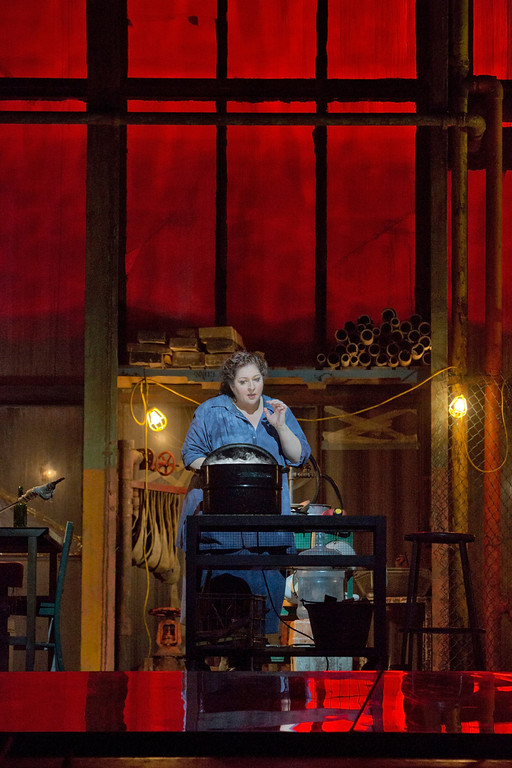
Christine Goerke as the Dyer’s Wife; photo by Ken Howard

Christine Goerke as the Dyer’s Wife; photo by Ken Howard

Not everything is perfect in the Met’s production, not all the questions this phantasmagoria of Hofmannsthal and Strauss leaves you wrestling with get answered, or even clarified as questions (are they even meant to?). Some of these are mundane, some of key relevance to the opera’s meaning: Why do we occasionally see the Empress’s shadow (or were those reflections?)? Why are Barak and Keikobad the only characters with names? Why does Keikobad relent in a Sarastro-like reversal of the way he’s been introduced to us? What really drives the Nurse? And on and on….

Here’s a little collage from some of the more interesting reviews of the recent revival:

John Yohalem:

Herbert Wernicke’s 2001 production, now revived and revised, is a fine, gaudy bit of stagework. The walls of mirror for the magical realm, enhanced by projections, doubles, torches and the Met’s underappreciated stage elevator (absolutely silent as the four- or five-story set slithers back and forth, in and out, up and down!) make a dandy backdrop for multidimensional show, and the mirrors conceal inopportune shadows until the story is ready to receive them. The seamless flow of stage-high trickery in Act III should tickle any theatrical fancy.

Ildikó Komlósi as the Nurse; photo by Marty Sohl

Ildikó Komlósi as the Nurse; photo by Marty Sohl

Micaela Baranello

Wernicke’s Met production is a great success, and actually lives up to the music’s energy and atmosphere…The design—all by Wernicke—is the primary attraction. The world of the Empress, Emperor, and Nurse is a mirrored box, whose transformations are seen in various dramatic flickering lighting effects. In contrast to this glamour, the Dyer’s house is in a gritty sewer or subway, located below the box and connected by a fire escape staircase…The upper level is timeless and mythic, the lower contemporary and realistic…

The upper level is timeless and mythic, the lower contemporary and realistic (Act 1 ends with the dyer Barak poignantly staring into an open refrigerator). The implication is vaguely Marxist: the Empress (surrounded by narcissistic mirrors) is exploiting the literal underclass, for whom she gradually learns compassion. The finale is Brechtian–or lieto fine-ian—with the lighting scaffold descending to reveal the stage mechanism and the singers addressing the audience directly. Since the music does not follow suit in any way, I found this gesture a little ineffective, but overall this is a very strong and convincing production.

James Jorden:

[Frau] represents the Met at its peak: Every element melds into an overwhelming artistic experience. It’s how you dream opera ought to be. The Woman without a Shadow even feels like a dream or rather a nightmare one might have dozing off while cramming for a final exam on Advanced Jungian Analysis….

In an interview published at the time of the production’s premiere, [Wernicke] declared, “The shiny, mysterious realm of spirits and the poor, low-class world of the Dyer, Barak—that’s just like New York’s lofty Central Park West apartments, in their harsh contrast to the underworld of poor people and outcasts and the subways, where the homeless fight over leftovers with the rats.”

 Christine Goerke as the Dyer's wife) and Johan Reuter as Barak; photo by Ken Howard

Christine Goerke as the Dyer’s wife) and Johan Reuter as Barak; photo by Ken Howard

Eric Simpson:

In Wernicke’s concept, the Emperor and Empress rule over an ethereal plane represented on the stage by a mirrored tunnel. It is remarkable how much is accomplished here using only scrims and lighting (it’s hard to remember a time when computer projections weren’t the industry standard). In the mirror-world, the various characters have strongly evocative auras that light up the set. The stunning pink-and-blue diffusion that accompanied the Empress’s first entrance gave the audience a sense of what life might be like on the inside of a jellyfish.

When the time comes to journey into the mortal realm, the entire set rises up to reveal a dreary warehouse that serves as the dyer Barak’s home and workplace. The contrast between the two settings is striking—where the upper plane is blindingly radiant but physically spare, the dyer’s workshop is fully and realistically furnished but lit only by overhead factory lights.

Martin Bernheimer:

It began – and ended – in 2001. Herbert Wernicke startled the basically conservative Met with an astonishingly progressive production of Richard Strauss’s magnificently bloated Die Frau ohne Schatten. He actually made theatrical sense of Hugo von Hofmannsthal’s high-minded, hopelessly convoluted libretto.

Serving as his own designer and lighting magician, Wernicke played the spiritual scenes in a surreal hall of mirrors. For the mundane episodes, he created a contemporary milieu resembling an industrial warehouse. For the ultimate resolution, he introduced neo-Brechtian imagery. He dealt in revelations at all levels.

I tracked down a full program (in German only) from Robert Carsen’s production for the Wiener Staatsoper, which is brimming with information and fascinating essays.

Meanwhile, Krzysztof Warlikowski’s production of Frau for Bayerische Staatsoper will be streamed live this coming Sunday (December 1), starting at 6 pm CET. Be careful: this is heavily addictive stuff.

Filed under: Metropolitan Opera, opera, Strauss

Tosca-nizing

Tosca, Act II, from pre-1914 Met Opera staging

Tosca, Act II, from pre-1914 Met Opera staging


In honor of today’s live HD broadcast of Tosca from the Met, I decided to gather some of the critical reactions to the controversial production by Swiss director Luc Bondy when it was first introduced as the season opener in 2009.

Anthony Tomassini in The New York Times:

[T]he booing, if a little unfair, was understandable… Mr. Bondy had scoured the work, it seemed, looking for every pretense to flesh out, literally, the eroticism of the lovers and the lecherous kinkiness of Scarpia. ..Mr. Bondy seems to be after mood, intensity and emotion, not logic. And some of the acting that he draws from his cast is intricate and involving…[He] probably wanted to rid his Tosca of stock clichés, yet his heavy-handed ideas are just as hackneyed.

Anne Midgette in The Washington Post:

Bondy certainly tried to clear away the layers of encrustation from the opera, rather like a restorer trying to clear the varnish from a painting. The problem was that he didn’t always seem to have a vision of the strong underlying image he was trying to reveal. His modus operandi seemed to be to get rid of all of the Tosca traditions and start afresh, but “afresh” often involved gestures every bit as gratuitous as the ones he was trying to replace…The strongest guiding hand of the evening was James Levine in the pit, who generally offered a reminder that this opera’s music can indeed still be fresh, vital and (in a couple of solo spots in particular) absolutely ravishing.

Alex Ross in The New Yorker:

By all means, then, let’s have a new Tosca. But it needs to be good. And this is not…. [Bondy] has failed to find a clear angle on Tosca, and instead delivered an uneven, muddled, weirdly dull production that interferes fatally with the working of Puccini’s perfect contraption…The major gaffe of the night comes after Tosca kills Scarpia, when, according to the libretto, she places candles by his side and a crucifix on his chest. ..[S]omething should happen during the thirty-bar postlude that Puccini composed for the ritual. Here…Tosca murders, then dithers…While there is nobility in an ambitious failure, there is no glory in ineptitude.

Ed Pilkington in The Guardian:

There was some egregious silliness to the Bondy version, which no doubt goes some way to explain the cat calls… In act two Scarpia is being pleasured by a courtesan kneeling between his legs, a wholly gratuitous addition to Puccini’s portrayal of an evil torturer who exudes suppressed sexuality in any case.Those incongruities aside, the puzzling thing about the audience reaction last night was that in most other regards the Bondy production is striking by how safe it is, how little risk-taking and how traditional.

Justin Davidson in New York magazine:

Bondy has stripped the piece of specificity and replaced it with a grim collection of non-locales and coarse interpolations…Though Bondy has never worked at the Met before, his fashionable Euro-minimalism has become something of a house style: dim light, blank walls, black costumes, and dour abstraction….I hope the Met’s Peter Gelb is already trying to figure out how soon he can scrap this staging.

And the dependably acerbic Martin Bernheimer in The Financial Times:

Abetted by his designer, Richard Peduzzi, Bondy has turned Puccini’s sleazy masterpiece into sterile melodrama with raunchy trimmings…A different directorial gimmick cheapens the ending of each act…Bad timing, bad ideas.

Filed under: Metropolitan Opera, opera

A Nose Job That Works

Study for The Nose by Wm Kentridge; photo by Nick Heavican

Study for The Nose by Wm Kentridge; photo by Nick Heavican

I met with an interesting group today for the Met’s HD simulcast of The Nose. A few of us recalled and shared our impressions of the Return of Ulysses production by Stephen Stubbs’ Pacific MusicWorks, which featured the unforgettable work of director William Kentridge and the Handspring Puppet Company of South Africa.

The excellence of Kentridge’s Shostakovich production – originating in 2010 and the Met’s first staging of The Nose – comes from his approach to the opera’s absurdism. Together with his first-rate design team, Kentridge gives full scope to this example of Shostakovich’s unbridled imagination, refusing to settle for a merely surreal comic tone.

With the opera’s massive cast and complex array of minor parts, Kentridge could have all too easily overwhelmed us with visual distractions, yet the many layers he adds to the narrative – the acres of newsprint reconfigured as collage, the animated film segments showing the separate “life” enjoyed by the autonomous Nose, and the urban chaos of early-Bolshevik Petersburg/Leningrad – all cohere and enhance the opera’s effectiveness.

Nikolai Gogol’s 1836 short story about the hapless assessor Platon Kuzmich Kovalyov – who wakes up after getting a shave from his aggressive barber to discover his nose has gone missing – predates Kafka’s The Metamorphosis by more than three-quarters of a century. (Along with its Kafka reference, Philip Roth’s The Breast reverses Gogol’s conceit into synecdoche.)

Like the German playwright Georg Büchner (Woyzeck dates from the same time), Gogol inspired a modernist opera in the following century. Berg’s take on his source became an instant classic, while Shostakovich’s disappeared for decades. Kentridge in turn makes this fascinating score, which soon after its premiere staging in 1930 fell into oblivion, come alive for the 21st century. (What other operas involve a declaration of independence by body parts? I can only think of Poulenc’s Les mamelles de Tirésias, with its breasts-turned-to-balloons that float away from the fed-up Thérèse – but she celebrates her sex change.)

This ranks among the finest new productions the Met has ventured under Peter Gelb’s tenure. What an illuminating discovery this score is for anyone whose familiarity with Shostakovich is limited to the Fifth Symphony or even the great string quartets. The incendiary brilliance of the young artist – he had already made a splash with his First Symphony at age 19 – is almost frightening. Sheer invention abounds in every corner of the orchestra, including innovative writing for percussion, along with a declamatory setting of the text that carries Mussorgsky’s ideas of natural musical speech rhythm forward – Shostakovich isn’t afraid of dispensing with the comforts of mere melody.

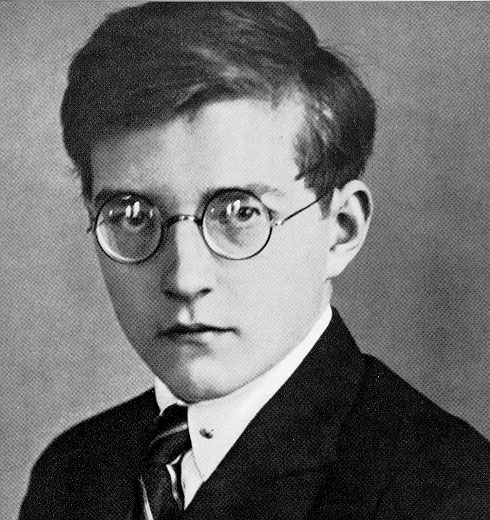
Young Shostakovich

Young Shostakovich

It all drives home how much the art of opera lost as the result of the dreadful turning point in Shostakovich’s career, when his next opera was denounced by Stalin’s culture police six years after The Nose came and went. My colleague Roger Downey, a superb critic and an expert in opera and theater, wondered how Shostakovich would have developed if he hadn’t been forced to bend to the strictures of Socialist Realism. The Nose contains so many intriguing what-ifs in that regard.

One quibble with the production – or perhaps with the structure of the opera itself: up to the end of the second act, the story follows Kovalyov’s desperate quest for his nose-gone-rogue clearly enough. (A wonderful idea was to provide ad hoc “entr’acte” music by having the orchestra improvise on the ritual of tuning.) So what’s all the business with the police and the train station in the third act? Why do they suddenly turn on the Nose and subdue it? Of course the absurdism is only strengthened by playing the narrative logic “straight,” but here it just becomes confusing.

The Nose of course demands to be read as an allegory – whether of the gullibility of us readers (Gogol), or of social hierarchy and the indifference of government bureaucracy (not so interesting), or of the inner division we feel as creative individuals (Kentridge’s take).

It occurred to me, especially from our current perspective, that The Nose could also be viewed as an allegory for the tension in early Modernism between the purist objective of autonomy (the abstract ideal) and the mongrel forms of the avant-garde imagination. Shostakovich himself emphasized the centrality of collaboration in this opera, its status as music theater and not “pure” music – precisely the strengths of Kentridge’s production.

In a recent review of Jacques Rancière’s Aisthesis, Hal Foster evaluates the French philosopher’s model of three “regimes” of art in the Western tradition. He points out that the new stylistic freedom permitted by the “aesthetic regime” – in which “the image is no longer the codified expression of a thought or feeling” (Rancière) – doesn’t require a contradiction between Modernist abstraction and the Dadaist/Surrealist “mission to reconnect art and life” in Rancière’s model: “the aesthetic regime is precisely this dialectic of modernist purity and avant-garde worldliness.”

Filed under: aesthetics, Metropolitan Opera, opera

Truth and Beauty

Met opening night 23 Sep  2013

(Met Instagram image of opening night: chandeliers and the crowd on plaza)

Tonight kicks off the new season at the Metropolitan Opera. Here’s my feature for the opening production — one of my favorite operas — Tchaikovsky’s Eugene Onegin:

Scenarios of unrequited love are the stock-in-trade of opera composers, but with Eugene Onegin Tchaikovsky achieved something far beyond another varia-
tion on an all-too-familiar theme. For Deborah Warner, the opera offers “a complete portrait of the human condition, viewed through the frame of the young approaching
life and love for the first time.”


(Letter Scene, Act I: Anna Netrebko in rehearsal for opening)

continue reading

Filed under: Metropolitan Opera, opera

Archive

Enter your email address to follow this blog and receive notifications of new posts by email.