To celebrate their 10th anniversary, Byron Schenkman & Friends have been offering an extraordinary season of new music, revealing juxtapositions, and, simply, great music making. On Sunday evening, 14 May at 7pm, they will give the season finale. The Jasper Quartet joins Schenkman for this program of Romantic gems by Antonín Dvořák, Alexander Glazunov, and Florence Beatrice Price. See below for program details. Tickets are available here.
Recognized as one of the leading American string quartets on the performance stage today, the Jasper String Quartet has been described by Gramophone as “flawless in ensemble and intonation, expressively assured and beautifully balanced.”
Byron Schenkman is a queer Jewish keyboard player and scholar with a background in historical performance and a passion for connecting people through music. In addition to performing live on piano, harpsichord, and fortepiano, Byron can be heard on more than forty CDs, in numerous online and in person performances with Byron Schenkman & Friends.
Now in its tenth season, Byron Schenkman & Friends brings a diverse set of 21st-century perspectives to artistically excellent ensemble music, inspired by European traditions of the 17th through 19th centuries.
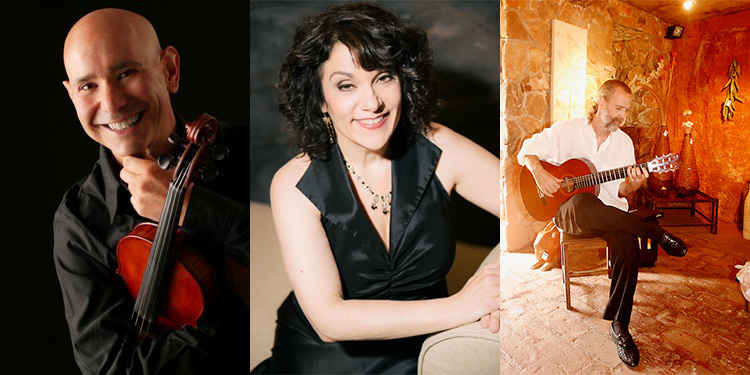
left to right: Hal Grossman, Judith Cohen, and David Burgess
Pianist Judith Cohen, a Steinway artist and one of Seattle’s musical treasures, presents her latest program as longtime Artistic Director of The Governor’s Chamber Music Series. Titled Small Plates: Tasty Musical Tapas from around the World, the concert features Cohen at the keyboard with colleagues David Burgess on guitar and Hal Grossman on violin and will be presented in Bellevue this weekend before the Governor’s Mansion performance in Olympia.
The Bellevue performance begins at 7.30 on May 13 at Resonance Events in Bellevue. Tickets here.
You can also experience this program in the beautiful setting of the Governor’s Mansion in Olympia on Monday, May 15, at 6.45 pm. Tickets here.
ABOUT THE ARTISTS
Judith Cohen made her European recital debut in 2002, performing two solo recitals in Budapest, Hungary, and since then has returned three times for concert tours of Hungary. She has performed solo recitals in Mexico, under the sponsorship of the Instituto Nacional de Bellas Artes. Critic Robert Somerlott of the Mexico City News hailed her as “an artist of unusual talent who captivated the audience with both her musicianship and stage presence.” She has performed solo and chamber music recitals throughout the Pacific Northwest, in Massachusetts, New York, Florida, Kentucky and Texas. She has also been presented in solo recitals by the Dame Myra Hess Recital Series in both Chicago and Los Angeles, and by the Florence Conservatory of Music in Italy.
Violinist Hal Grossman has been hailed by critics for his “tremendous virtuosic technique” and “outstanding artistic sense”. As concerto soloist, he has appeared with American, European, and Canadian orchestras including the Rochester Phil Harmonica, the North Carolina Symphony, Polish Symphonette, the Illinois Lima, Guelph, and Battle Creek Symphonies. He was the Grand Award Winner of the Lima Young Artist Competition and Silver Medalist of the International Stulberg Competition. Mr. Grossman also received First Prize Awards at the prestigious International Cleveland Quartet Competition and the National Fischoff Chamber Music Competition. He has performed for the Royal Highnesses, Prince Charles and Princess Diana in his New York debut at Carnegie Hall.
Classical guitarist David Burgess studied music at Mexico City’s Estudio de Arte Guitarrìstico under the noted Argentine guitarist Manuel López Ramos, subsequently landing a full scholarship to study in Italy with Oscar Ghiglia. An occasional pupil of Andrés Segovia throughout the mid-’80s, Burgess also took top honors in the Andrés Segovia Fellowship Competition in New York City, and placed first in the Mexico City’s Ponce International Competition, Toronto’s Guitar ’81 competition and Munich’s 31st International Music Competition. A onetime instructor at the University of Washington and the Cornish Institute of the Arts, in time Burgess settled in New York City, releasing his solo debut Silver Nuggets and Fool’s Gold.
The Governor’s Mansion Foundation, with more than 200 members, is an all-volunteer, non-profit, non-partisan organization, that honors the historical and cultural importance of the Washington State Governor’s Mansion by maintaining and enhancing furnishings and art for the public rooms of the Mansion, educating the public about the Mansion and its history, and advocating on its behalf. GMF is not affiliated with the Governor or the Governor’s office. For more information on GMF go to www.wagovmansion.org.
Jean-Yves Thibaudet and an ensemble from the Colburn School perform a chamber program this evening at Boulez-Saal in Berlin.
Frank Gehry, architect of Boulez-Saal and a friend of Daniel Barenboim, has also designed a 100,000 square-foot expansion of the Colburn School campus in downtown LA, including a 1,000-seat, in-the-round performance space, a studio theater, dance studios, and public gardens and green spaces. Reuniting with Gehry for that project is another name familiar to Berliners: Yasuhisa Toyota of Nagata Acoustics, who served as acoustician for Boulez-Saal (along with other Gehry buildings, including Disney Concert Hall). The new Colburn performance hall, expected to open to the public in 2025, will have parallels with Boulez-Saal.
A new model for promoting diversity in the concert hall through a multifaceted collaboration among composers, performers, and educators reaches one of its first milestones this weekend. The inaugural orchestral concert of Composing Inclusion, a partnership between the Preparatory Division, the New York Philharmonic, and American Composers Forum, takes place on May 6 at the renovated David Geffen Hall.
My preview of this event for the Juilliard Journal is here.
Here’s my profile of James Díaz, whose and does the Moon also fall? is among the new commissions.
The program:
Jordyn Davis As I AM (World premiere—Juilliard Preparatory Division Co-Commission with the New York Philharmonic and American Composers Forum)
James Díaz and does the Moon also fall? (World premiere—Juilliard Preparatory Division Co-Commission with the New York Philharmonic and American Composers Forum)
Trevor Weston Subwaves (World premiere—Juilliard Preparatory Division Co-Commission with the New York Philharmonic and American Composers Forum)
Jordyn Davis’ and James Diaz’ commissions are part of Composing Inclusion: a collaboration between the New York Philharmonic, American Composers Forum, and Juilliard’s Preparatory Division, made possible with funding from the Sphinx Venture Fund.
Trevor Weston’s work was co-commissioned by American Composers Forum, Juilliard’s Preparatory Division, and the New York Philharmonic. It was funded, in part, with support from the National Endowment for the Arts.
This is the final concert in a three-concert series traversing Biber’s Mystery Sonatas. The Glorious Mysteries begin with the events of Easter and the Resurrection. The capstone of the final set of sonatas is the Passacaglia for solo violin (also known as the “Guardian Angel”).
The concert takes place in the intimate St. Augustine’s in-the-woods Church in Freeland on Whidbey Island, which boasts spendid acoustics.
And to top it off: Tekla Cunningham’s trademark springerle cookies pressed with images of a Guardian Angel will be served at the reception.
PROGRAM:
The Glorious Mysteries
Sonata XI in G Major: The Resurrection Heinrich Ignaz Franz von Biber (1644-1704)Sonata – Hymn: Surrexit Christus hodie and variations
Canzona on ‘Christ ist erstanden’ Georg Reutter der Ältere (1656-1738)
Sonata XII in C Major: The Ascension H.I.F. von BiberIntrada – Aria tubicinum (trumpet) – Allemanda – Courante and double
Ricercar in G minor for solo cello Domenico Gabrieli (ca. 1651-1690)
Sonata XIII in D minor: The Descent of the Holy Ghost H.I.F. von Biber Sonata – Gavotte – Gigue – Sarabanda
Intermission
Sonata XIV in D Major: The Assumption of the Virgin H.I.F. von Biber[Sonata] – Arias 1 and 2 – Gigue
Capriccio in G Johann Jakob Froberger (1716-1767)
Sonata XV in C Major: The Coronation of the Virgin Mary H.I.F. von Biber Sonata – Aria with 3 doubles – Canzona – Sarabanda and double
Passacaglia in G minor for solo violin H.I.F. von Biber
From Whidbey Island Music Festival:
About the Mystery Sonatas:
Named for the 15 Mysteries of the Rosary (also known as the Rosary Sonatas), these three sets of 5 sonatas for violin and continuo, plus a concluding Passacaglia for solo violin, were completed around 1676. Dedicated to the Archbishop Gandolph in Salzburg, these sonatas are as compelling, affecting and moving as they were when they were written almost 350 years ago. In the manuscript copy, each sonata has a copper-plate print at the opening of the sonata showing the story of the piece.
About scordatura:
Scored for a single violin supported by continuo, Biber asks the violinist to tune differently for each sonata. Only the first sonata (the Annunciation) and the final Passacaglia share the standard G-D-A-E tuning. The Resurrection sonata has the most extreme tuning, involving switching the G and the D strings. This technique of mistuning the violin, called scordatura, gives a tremendous range of affects and emotions to this music. Retuning brings the violin into different key areas and creates a kaleidoscope of overtones and sonic effects, helping Biber to create specific emotions or affects in the listener.
ARTIST BIOS
Tekla Cunningham
Elisabeth Reed, Oakland, CA teaches Baroque cello and viola da gamba at the University of California at Berkeley and at the San Francisco Conservatory of Music, where she is co-director of the Baroque Ensemble. Recent teaching highlights include master classes at the Juilliard School, the Shanghai Conservatory and Middle School, and the Royal Academy of Music. A soloist and chamber musician with Voices of Music, Pacific Musicworks, Archetti, and Wildcat Viols, she has also appeared with the Smithsonian Chamber Players, the American Bach Soloists and the Seattle, Portland, Pacific, and Philharmonia Baroque Orchestras. Elisabeth directs “Voice of the Viol”, the renaissance viola da gamba ensemble of Voices of Music. She can be heard on the Virgin Classics, Naxos, Focus, Plectra, and Magnatunes recording labels and has many HD videos on the Voices of Music Youtube channel. She is a Guild-certified practitioner of the Feldenkrais Method™ of Awareness Through Movement ™ with a particular interest in working with musicians and performers.
Hailed by The Miami Herald for his “superb continuo… brilliantly improvised and ornamented,” GRAMMY-nominated historical keyboardist, composer, and conductor Henry Lebedinsky has performed with the Seattle Symphony, Seattle Opera, the St. Paul Chamber Orchestra, Pacific Northwest Ballet, the Charlotte Symphony, Seraphic Fire, Sonoma Bach, and the Cantata Collective, among others. Recent conducting engagements include the Seattle Baroque Orchestra and Sonoma Bach’s Live Oak Baroque Orchestra. As part of a career built on collaboration, he serves as co-Artistic Director of the San Francisco Bay Area’s AGAVE and Seattle’s Pacific MusicWorks. With countertenor Reginald L. Mobley, he has introduced listeners on three continents to music by Black composers from Baroque to modern, including recent appearances at the Musée d’Orsay in Paris and Festival Printemps Musical des Alizés in Morocco. In 2014, he founded Seattle’s Early Music Underground, which brought Baroque music to brewpubs, wineries, and other places where people gather, and presenting it in multimedia contexts which both entertain and educate. Lebedinsky’s works for choir and organ are published by Paraclete Press, Carus-Verlag Stuttgart, and CanticaNOVA, and two volumes of his poetry and hymns are in preparation. He holds degrees from Bowdoin College and the Longy School of Music, where he earned a Master of Music in historical organ performance as a student of Peter Sykes. Currently entering his third decade as a church musician, he serves as Missioner for Music at St. Augustine’s Episcopal Church on Whidbey Island.
ABOUT THE WHIDBEY ISLAND MUSIC FESTIVAL
Founded in 2006 by Tekla Cunningham, the Whidbey Island Music Festival is a beloved annual event that presents great performances of baroque and classical chamber music in relaxed and intimate indoor and outdoor venues on beautiful Whidbey Island, with repertoire from Monteverdi to Florence Price. We bring music of the past four centuries to life with vivid and moving concert performances on period instruments.
All Classical Portland (one of the largest classical radio stations in the U.S.) today announced their relocation from the Portland Opera building to downtown Portland’s KOIN Tower in early 2024. The move will expand the range of activities All Classical can offer.
And it is hoped that this move will serve as a national beacon for arts-based urban regeneration at a time when many businesses and organizations have been moving out of downtown Portland. The new state-of-the-art location at KOIN Tower is in the heart of Portland’s downtown, where All Classical is building a new space to host community concerts and events. The recording studio will be made available to document local artists.
UPDATE: See Michael Schell’s insightful comments on the new season announcement here.
The Seattle Symphony’s (SSO) 2023-24 season announcement was released today. The orchestra will celebrate two anniversaries: 120 years since its founding and 25 years since the opening of Benaroya Hall, which became home base in 1998. Main areas of focus: broader programming across all SSO series to connect with new audiences, an increase in the presence of living composers, a greater concentration of works new to SSO’s repertoire, and the launch of a new curated series (“Playlist”).
Opening night will replicate part of the SSO’s first-ever concert from December 29, 1903 (Schubert’s “Unfinished” and Massenet’s Overture to Phèdre) and the first concert the musicians played at Benaroya Hall on September 12, 1998 (selections from Wagner’s Götterdämmerung — which featured Jessye Norman back then); Arthur Honegger’s Pastorale d’Été will also be introduced to the SSO’s repertoire; LudovicMorlot conducts.
SSO’s distinguished emeritus will return for another program in June (versus three separate programs led by Morlot in the current season). Aside from appearances by Sunny Xia, SSO’s Douglas F. King Assistant Conductor, the rest of the season will be led by a wide range of visiting conductors — many of whom have already guested here. Alpesh Chauhan and David Robertson led especially impressive performances earlier this season, so it’s nice to see that they will return. Making their debuts on the podium are Kevin John Edusei, Christian Reif, Bernard Labadie, Sarah Hicks, and Andy Einhorn. I’m also looking forward to hearing the much-touted Dalia Stasevska (I wasn’t able to make her SSO debut a year ago). She will be joined by her composer/electric bassist husband, Lauri Porra, in a program of the Sibelius Fifth complemented by Porra’s concerto for electric bass, Entropia, andNautilus by Anna Meredith. Note that this is not a continuation of the halfway-completed Sibelius cycle paired with new commissions that Thomas Dausgaard had launched before the pandemic. That endeavor has been discontinued.
The SSO has been keeping quiet about the ongoing search for a music director. The Press Office states that “the search is well underway and many performances from seasons past, current, and future are all carefully being considered by the Search Committee.”
I also asked about this press release statement: “The 2023/2024 season brings a continuation of creative partnerships that welcome not only the next generation of composers and performers, but new members of our community as well.” The response was that this refers to less traditional programs like the Metropolis evening and the weeklong residency in January of film composer, conductor, and pianist Joe Hisaishi, as well as popular programming with artists like Audra Macdonald. It also refers to programs and series featuring newer voices among the young generation of classical musicians and SSO’s educational programming.
On the new music front: the press release calls out the following among the “more than 35 living composers” who are part of the programming: “Salina Fisher, Nina C. Young, Aaron Jay Kernis, Reena Esmail, Lauri Porra, David Robertson, Steven Mackey, Linda Catlin Smith, Gretchen Yanover, Donghoon Shin, Dorothy Chang, Han Lash, Sarah Gibson, Alexandra Gardner, Angélica Negrón, Fazil Say, Jake Heggie, Jennifer Higdon, Edgar Meyer, Jessie Montgomery, Kevin Puts and more.” The last five named are co-collaborators for the Elements Concerto featuring Joshua Bell, which Marin Alsop will conduct on the closing program of the season. It should also be noted that several of these are part of the Octave 9 season performed in the SSO’s adjacent experimental space. The SSO began expanding this sold-out series during the current season.
A focus on “firsts” is also on the agenda. Remarkably, Bach’s St. John Passion will receive its first-ever SSO performance. Other firsts for the orchestra: Julia Perry’s Short Piece for Orchestra, John Adams’s Harmonium, Salina Fisher’s Rainphase, Lutoslawski’s Cello Concerto, Dorothy Chang’s Northern Star, Donghoon Shin’s Of Rats and Men, Fagerlund’s Stonework, Aaron Jay Kernis’s Elegy (For Those We Lost), the previously mentioned ElementsConcerto and Meredith and Porra pieces. A program that looks especially intriguing will be the SSO’s first-ever performance of Vaughan Williams’s Symphony No. 7 (Antarctic) led by Gemma New and featuring soprano Jennifer Bromagen. This event promises “an immersive multimedia experience of the doomed Terra Nova Expedition” — Robert Falcon Scott’s journey to the Antarctic in 1910-13 — with original visuals from 1912.
Among debuting soloists, I’m delighted to see that the pianist Mahani Teave will be making her SSO debut in Mozart’s K. 466 piano concerto in October. A native of Easter Island and has an amazing story I wrote about for the New York Timeshere. Teave will also inaugurate the new no-intermission Playlist Series, which will be curated by Conrad Tao and Noah Geller.
As far as new commissions, however, I see only one by SSO on the program (versus five commissions this season, four of them orchestral): a not-yet-titled work for solo cello an video design by Gretchen Yanover, which will be premiered on the Octave 9 series. Reena Esmail’s wonderful Concerto for Hindustani Violin, co-created with soloist Kala Ramnath, will make a welcome return after its premiere here last year.
Complete chronological listing of the 2023-24 season:
This weekend, 26-28 February, the Lowell Milken Center for American Jewish Experience at UCLA’s Herb Alpert School of Music is presenting a series of performances and discussions to launch its new Music & Justice series. The events include a revival of Dave Brubeck’s visionary cantata from 1969, The Gates of Justice, performed in dialogue with contemporary compositions around social justice themes. There will also be a day-long public conference featuring prominent scholars and experts.
I wrote a feature on this project for Chorus America, which includes input from two of the three Brubeck sons, Darius and Chris, who will join to play the jazz trio in The Gates of Justice.
Students and alumni of the Barenboim-Said Akademie, among whom are a number of musicians from Türkiye and Syria, initiated a benefit concert to be held on Monday, February 20, 7.30pm in collaboration with the Pierre Boulez Saal. Focusing on the theme “2Home,” the concert will contribute to efforts aiding those affected by the massive earthquake in these two countries.
The program includes works of Western classical music as well as compositions from the Middle East, especially from Türkiye and Syria.perform at the Pierre Boulez Saal on February 20.
In addition to the concert at the Pierre Boulez Saal on Monday, February 20, there will be three smaller concerts in the foyer of the Barenboim-Said Akademie on February 16, 17, and 18, each at 4pm. Admission to the foyer concerts is free; donations are welcome. Proceeds from all four concerts will go to the Earthquake Relief Fund of the German Red Cross. Call +49 30 4799 7411 for tickets.
As a huge fan of Missy Mazzoli, I’d meant to post this wonderful gift from Den Norske Opera & Ballett but let it slip through the cracks. The company recently made this recording of its world premiere production of her latest opera, The Listeners, available on YouTube until 12 May 2023.
Premiered last September as part of the Ultima Oslo Contemporary Music Festival,The Listeners continues Mazzoli’s longstanding collaboration with the librettist Royce Vavrek. They developed an original story by Jordan Tannahill based on the phenomenon of the “global hum,” the dynamics of cults, and the abuse of power.
Synopsis from Den Norske Opera’s website:
“The Listeners” follows Claire, a suburban high school teacher living in the southwestern United States. Her life spirals out of control when she begins to hear a mysterious low-frequency hum. The Hum keeps her awake at night and threatens her sanity, but she finds an ally in Kyle, a student who also hears the all-consuming noise. When Kyle discovers a group that meets regularly in hopes of understanding and eliminating the source of the Hum, Claire is optimistic that this might be a turning point in her crisis. The group is led by the charismatic Howard Bard and his second-in-command Angela, who provide a compassionate environment for the beleaguered Claire and Kyle.
As the group grows in number the meetings devolve into strange, ritualistic behavior. When former soldier Dillon is expelled from the group after suggesting that the noise is a government conspiracy, he attempts to shoot down a mobile phone tower. He is arrested and criminal attention is placed on Howard and the cult of Listeners. The group explodes when it is revealed that Howard has abused his power and manipulated the members. Claire, armed with newfound confidence, picks up the pieces in an effort to harness the power of the Hum.






 MEMETERIA by Thomas May