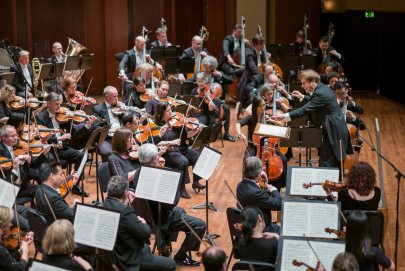
Opera star Joyce DiDonato is shown with Ludovic Morlot and the Seattle Symphony last September. Morlot and DiDonato will appear together in Berlin later this week. (Carlin Ma)
The Seattle Symphony’s music director has been asked to replace an ailing colleague as guest conductor of this week’s concerts with Berlin Philharmonic — one of the world’s most prestigious orchestras.
In an era that seems ever more intent on throwing up walls, musicians are once again proving the benefits of cooperation and bridge-building. Take Maestros Gidon Kremer and András Keller. Starting 25 May 2017, they embark on a bold new adventure with the two ensembles they respectively lead, Kremerata Baltica and Concerto Budapest, as they undertake a ten-day joint tour of Asia.
The autograph piano score of the first of Mahler’s Kindertotenlieder, “Nun will die Sonn’ so hell aufgeh’n,” has been discovered and identified, reports Deutsche Welle. Identified by musicologist Berthold Over, the rediscovered score — in the possession of an anonymos private owner — is the missing part of the puzzle in the chronology of Kindertotenlieder‘s creation.
Mahler wrote three of the five songs comprising Kindertotenlieder in the summer of 1901 and then resumed the cycle in 1904, when he wrote the other two directly into the orchestral score, skipping the process of writing out a preliminary piano score. The orchestral scores from 1904 and two of the handwritten piano scores from the 1901 songs were preserved, but up to now there had been no trace of the one missing score.
According to DW: “The discovery of that fifth song — No. 1 in the official sequence — means ‘that it’s now possible to say which three were composed in 1901 and which two in 1904,’ Over explained to DW. ‘Establishing the chronological order of Mahler’s works is sometimes difficult because he didn’t date his manuscripts.'”
Alexander Odefey has a fuller report (in German) here.
Seattle Symphony’s press office released a statement on Friday afternoon announcing Music Director Ludovic Morlot’s decision to leave that position at the end of the 2018-19 season, after eight seasons with the orchestra.
Maestro Morlot gave the following statement:
I will be forever grateful and proud to have been given the opportunity to help write a chapter in the history of the Seattle Symphony. And what a beautiful chapter it is; thrilling performances played to full houses, the appointment of so many outstanding musicians, three Grammys, a strong list of commissions and premieres, a memorable concert at Carnegie Hall, an upcoming residency at Berkeley, and so much more. I am also extremely appreciative of the commitment that the community as a whole has offered to me at the artistic helm of this extraordinary organization. The decision to step down as Music Director when my contract comes to an end in 2019 is not one I have taken lightly. We are in the midst of a wonderful, stimulating and exciting artistic journey and I look forward to continuing this in the next two seasons. However, I feel that by 2019 the time will be right for me to explore new musical opportunities and for the Symphony to have the inspiration of new artistic leadership.
The news comes as something of a shock and is especially disconcerting to Seattle music lovers, since Morlot’s presence has done nothing less than transform the city’s music scene. His work with the SSO is a model for how to make the institution of an orchestra relevant in contemporary life while maintaining the highest musical standards.
Everyone has kept tight-lipped about whatever new project Morlot has on the horizon. In the meantime, local audiences will be savoring his every moment at the podium more than ever.
What are your favorite moments to date from Morlot’s tenure with the SSO?
Today the remarkable Hungarian composer György Kurtág celebrates his 91st birthday.
He and his wife Márta Kurtág were just announced as the winners of a 2017 Borletti-Buitoni Trust prize (usually a distinction conferred on young artists — they received the Franco Buitoni Award). The press release for the award, which was awarded today, reads:
Franco Buitoni Award presented to György and Márta Kurtág
19 February 2017
Today, Hungarian composer György Kurtág is 91 years old and also celebrates his 70th wedding anniversary. He and his pianist wife, Márta, have been presented with a Borletti-Buitoni Trust award (£30,000) in recognition of their distinguished contribution to the world of music, as well as their long and devoted musical partnership. This special tribute is in memory of Franco Buitoni (1934-2016) who co-founded the Borletti-Buitoni Trust (BBT) in 2002 with his wife, Ilaria.
Ilaria Borletti Buitoni, who travelled to Budapest with BBT trustee Mitsuko Uchida to present the award, said: “My husband, Franco, passed away last August. He and I founded BBT in 2002 to help talented young musicians develop their careers. From the very beginning we were pleased to have the artistic guidance and ideas of our founding trustee, Mitsuko Uchida, who was also a dear friend to Franco. I wanted to honour my husband’s own lifetime of loving and supporting music with this special award and there seemed no better person to nominate a worthy recipient than Mitsuko.”
Mitsuko Uchida commented: “Intense, mysterious, dark, otherworldly and innig; these are the words that come to my mind when I think of György Kurtág’s music. He is inspirational and fiercely honest but there is also a deep love that glows through his music. This may be an expression of his extraordinary relationship with his wife, Márta. Anybody who has heard the Kurtágs play, four hands, would know what that means. We know György Kurtág the great composer but with him always is Márta the wonderful pianist. They live music together. Therefore, the special Franco Buitoni Award goes to György and Márta Kurtág. We are honoured that they have accepted this award on his 91st birthday and their 70th wedding anniversary. We have all been so lucky to have known them and their music, me especially.”
BBT presented its first awards in 2003 and, since then, has proudly supported more than 100 musicians and ensembles all over the world.
It’s so satisfying to see a genuinely first-rate writer getting the honor he deserves. In 2013 he was awarded the Pulitzer Prize in Criticism. Kennicott’s eloquent writing is consistently original, stimulating, and richly insightful. Enjoy this prize-winning piece from one of our very finest critics:
It was in the fifth or sixth grade, in the class of a teacher I remember for only two things: he was portly, and his pants were too bright. Everything else is a blur, except for one afternoon when he decided his pupils needed to know something about musical theater, so he brought a stack of records to class and proceeded to play his favorite bits. Among them were snatches of Hello, Dolly!, The Music Man and Mame, and — for reasons I can’t quite figure out — Cavalleria Rusticana and Pagliacci.
Mr. Cohen was an unlikely and reluctant pop star, if in fact he ever was one. He was 33 when his first record was released in 1967. He sang in an increasingly gravelly baritone. He played simple chords on acoustic guitar or a cheap keyboard. And he maintained a private, sometime ascetic image at odds with the Dionysian excesses associated with rock ’n’ roll.
[…]
“The changeless is what he’s been about since the beginning,” the writer Pico Iyer argued in the liner notes for the anthology “The Essential Leonard Cohen.” “Some of the other great pilgrims of song pass through philosophies and selves as if through the stations of the cross. With Cohen, one feels he knew who he was and where he was going from the beginning, and only digs deeper, deeper, deeper.”
The program for the 2017 Summer Festival in Lucerne has just been announced. The overall theme is “Identity.” Patricia Kopatchinskaja and Jay Campbell will be featured as “artistes étoiles,” and Michel van der Aa will be the composer-in-residence for 2017’s Summer Festival.
Lucerne has also launched a new magazine packed with interviews, commentary, and articles and listings of the programming for all three festivals.
Gramophonelooks back over the long, influential career of a master:
Sir Neville Marriner’s natural habitat for the past half-century has been the recording studio. With the Academy of St Martin in the Fields he has made hundreds of recordings of a breadth of repertoire that few other conductors (even the equally eclectic Herbert von Karajan) achieved…. His performances of music of the Classical period … were characterised by the vitality and energy of which Murray Perahia speaks.
The decision to name the ensemble the Academy of St. Martin in the Fields was a practical one.
“It was the place where we gave our first ever concert back in 1958, so there’s significance in that,” Mr. Marriner told the London Daily Telegraph in 2014. “But the real reason we took the name was that the vicar let us rehearse there for free so long as we publicized the church. That was the deal. And it was his idea that we should be an ‘academy’ rather than the ‘chamber orchestra’ we’d originally planned to call ourselves.”





 MEMETERIA by Thomas May