MEMETERIA by Thomas May

Music & the Arts

Paul Taub Presents New Works for Flute + Ensemble

The intrepid flutist Paul Taub — a terrific force for new music in Seattle — is planning to present a program of five new commissions of works for chamber music and flute. The event is planned for 20 November at Seattle’s Chapel Performance Space.

The composers in the lineup are Tom Baker, Andy Clausen, David Dossett, Jessika Kenney, and Angelique Poteat. They’ve been asked to write pieces for an ensemble of flute (Taub) as well as clarinet (Laura DeLuca), cello (Walter Gray), contrabass (Joe Kaufman), piano (Cristina Valdes), and percussion (Matthew Kocmieroski).

Given Paul’s credentials as a passionate and effective new music advocate — he’s also a member of the adventurous Seattle Chamber Players — this program should be well worth attending.

Here’s some more from the press release on the criteria for this project:

Composers Tom Baker, Andy Clausen, David Dossett, Jessika Kenney and, Angelique Poteat have been chosen to participate in this project because of the high artistic quality of their work, the diversity of their styles, the varied stages of their career trajectories, and above all, because their music truly speaks to the public.

The variety of musical styles is a key element of the project. Baker and Kenney are well-established “mid-career” composers, with impressive resumes and works that have been played internationally. Poteat, in her late 20s, is emerging as a significant voice in the Seattle and national music world, with recent pieces commissioned by the Seattle Symphony. Emerging composers Dossett and Clausen (whose band The Westerlies has taken the jazz world by storm), are recent college graduates (Cornish College of the Arts and the Juilliard Jazz Program). The composers’ musical styles are varied and contrasting, with influences as diverse as jazz, electronics, Persian modes, classical music and improvisation.

Filed under: commissions, music news
Protected: Slipped Disc Slip-Up

This content is password-protected. To view it, please enter the password below.

Filed under: music news

New General Director of San Francisco Opera

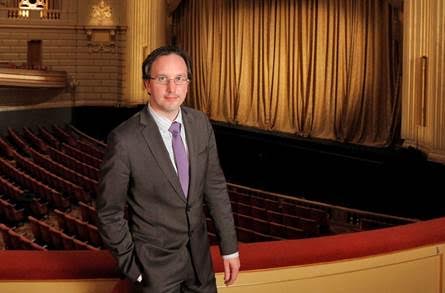
Matthew Shilvock

Matthew Shilvock

They sure know how to keep a secret. San Francisco Opera finally has finally announced who will succeed David Gockley, and it’s an insider: current Associate General Director Matthew Shilvock takes on the reins as the company’s seventh General Director starting August 1, 2016. His contract is for five years, through July 2021.

From SFO’s press release: “Mr. Shilvock, born and educated in England, joined San Francisco Opera in 2005 and has served as Associate General Director since 2010. As Associate General Director, Mr. Shilvock manages and leads five departments: Music Operations (orchestra, chorus, dancers, commissions); Electronic Media; Education; the San Francisco Opera Center (professional artist training programs); and Rehearsal. He currently also serves as Interim Director of Development.

Joshua Kosman observes: “In signing Shilvock, 38, to a five-year contract, the Opera has made a choice that emphasizes continuity in the company’s leadership over experience or a proven track record. Over the course of his decade in San Francisco, Shilvock has taken an active role in just about every aspect of the company’s activities, from artistic planning and labor negotiations to financial development and educational outreach. But this will be his first time at the helm of an opera company.”

Kosman offers the following roundup of Shilvock’s responses in regard to programming philosophy:

“We want to strengthen the brand of San Francisco Opera, so that people come to us not simply because they recognize a title, but because they have faith in what we’re doing. ‘Butterfly’ will always sell better than ‘Jenufa,’ but we want to give audiences the motivation to come to a piece like ‘Jenufa’ that may not be familiar to them.”

In response to a question about new and recent works that he had found particularly rewarding, Shilvock cited Jake Heggie’s “Moby-Dick,” Philip Glass’ “Satyagraha” and Carlisle Floyd’s “Susannah” as examples of the kinds of work the company should be doing.

Shilvock pointed in particular to the Diane B. Wilsey Center, the 299-seat theater scheduled to open next year in the newly renovated Veterans Building, as an engine for experimentation.

“The programming will have a shorter lead time, and we’ll be able to do works there with greater intimacy, or that find different resonances with the audience. There’s a wonderful sense of innovation that can happen there.”

“By choosing Shilvock, the San Francisco Opera has gotten to have it both ways: opting for the status quo by continuing Gockley’s tradition, while coming down on the side of youth and freshness,” remarks Anne Midgette in The Washington Post.

New York Times reporter Michael Cooper points out that the selection of Shivlock “signaled that the search committee — which had been grappling with whether to appoint someone with a background as an artist or an administrator —–saw his understanding of the practicalities of running the opera house as critical.”

Filed under: music news, San Francisco Opera

“Lament and Moaning of a Heart”

Igor Stravinsky and Charlie Chaplin

Igor Stravinsky and Charlie Chaplin

An apparent missing link in the development of the young Igor Stravinsky has been unearthed.

Titled Funeral Song (Pogrebal’naya Pesnya in Russian), the piece was written by the 26-year-old composer as a memorial to his recently deceased mentor Rimsky-Korsakov in 1908. After a single performance, the manuscript was never published and was long believed to have been irretrievably lost in the 1917 upheaval and its aftermath.

But it turned out to be hibernating amid a pile of old manuscripts gathering dust somewhere inside the St. Petersburg Conservatory.The Stravinsky authority Natalya Braginskaya described the find at hte International Musicological Society in St Petersburg early this month.

According to the eminent Stravinsky expert Stephen Walsh:

Stravinsky recalled it as one of his best early works, but could not remember the actual music.
[…]
Braginskaya, who has studied the orchestral parts (the full score has not turned up and will need reconstructing), describes “The Funeral Song” as a slow, unvarying processional with contrasting instrumental timbres: a dialogue of sonorities, very much as Stravinsky himself vaguely remembered it in his autobiography 25 years later. There are echoes of Rimsky-Korsakov, but also, she says, of Wagner, whose music Stravinsky admired more than he was later prepared to admit.

In his post on the find, Zachary Woolfe quotes from one of the reviews of the premiere (which predated Stravinsky’s sudden fame with The Firebird in Paris:

One critic described “the lament and moaning of a heart against the backdrop of a somber landscape,” while another chastised it for chilliness: “Better keep silence if losing a friend and teacher leaves us cold.”

Filed under: music news, Stravinsky

New Leadership at the Lucerne Festival Academy

Wolfgang Rihm

Wolfgang Rihm

Add this to the news about major changes in the Lucerne Festival leadership, including the announcement that Riccardo Chailly is taking on the role left behind by Claudio Abbado heading the LF Ochestra.

The Festival’s other big pillar, the Lucerne Festival Academy, will now be helmed by the eminent composer Wolfgang Rihm, with his younger peer Matthias Pintscher at his side as Principal Conductor.

About his future plans, Rihm stated:

“For young artists it can be tremendously enlightening to work with composers from their own time. It often happens that misleading, myopic views that are commonplace impede access to the reality of a score. Conversely, an encounter with praxis is often essentially more important for young composers than yet another turn of the artificial screw.

For imagination also arises from knowledge of the technical conditions for realizing a score. And so this is what we expect from an Academy: that cultural spheres of knowledge and skill will be brought into mutual contact, shaping and enhancing each other in terms of the potential for understanding and realization. A musical text requires a performance that makes it a reality. Yet this is a form of prefigured understanding. Academy is dialogue!

Filed under: Lucerne Festival, music news

Gramophone and ECHO Klassik Awards 2015

28947935643

I’m beginning to catch up on some big news items after being sidelined by deadlines.
The ceremony honoring the Gramophone Classical Music Award Winners for 2015 will take place at St John’s, Smith Square, London, on September 17. At this ceremony the winners of the special awards — including Recording of the Year, Artist of the Year, and Lifetime Achievement — will be revealed.

And here’s the complete list of winners in the 12 categories of the Gramophone Award”

Baroque Instrumental

JS Bach: Cello Suites; David Watkin vc (Resonus)

Baroque Vocal

Monteverdi: Vespri solenni per la festa di San Marco; Concerto Italiano / Rinaldo Alessandrini (Naïve)

Chamber

Smetana: String Quartets No 1 (From My Life) & 2; Pavel Haas Quartet (Supraphon)

Choral

Elgar: The Dream of Gerontius. Sea Pictures; BBC SO and Chorus/Sir Andrew Davis (Chandos)

Concerto

Beethoven: Piano Concertos 3 & 4; Maria João Pires/Swedish Radio Symphony Orchestra/Daniel Harding (Onyx)

Contemporary

Nørgård: Symphonies Nos 1 & 8; Vienna Philharmonic Orchestra/Sakari Oramo (Dacapo)

Early Music

The Spy’s Choirbook; Alamire; English Cornett & Sackbut Ensemble/David Skinner (Obsidian)

Instrumental

Bach: English Suites Nos 1, 3, & 5; Piotr Anderszewski (Warner Classics)

Opera

R Strauss: Elektra; Soloists; Orchestre de Paris / Esa-Pekka Salonen; Stage director Patrice Chéreau; video director Stéphane Metge (Bel Air Classique)

Orchestral

Bruckner: Symphony No 9; Lucerne Festival Orchestra/Claudio Abbado (DG)

Recital

A French Baroque Diva; Carolyn Sampson Ex Cathedra/Jeffrey Skidmore (Hyperion)

Solo Vocal

Schubert: Nachtviolen; Christian Gerhaher, Gerold Huber (Sony Classical)

The ECHO Klassik Awards were also announced in Berlin, with a ceremony to follow on October 18 at the Konzerthaus. Find the complete list of 58 winners here.

Filed under: music news

A Day for Pierre Boulez

Pierre Boulez (photo: Georg Anderhub/LUCERNE FESTIVAL)

Pierre Boulez (photo: Georg Anderhub/LUCERNE FESTIVAL)

This past Sunday, Lucerne Festival’s Summer 2015 edition presented an entire “Day for Pierre Boulez” to mark the 90th birthday of one of music’s great revolutionaries (the actual birthday fell on on March 26). Sadly, Boulez was unable to be present in person due to health reasons, but the day argued for his profound enduring influence.

Studded across all of the programmes were eight world premieres from a collection of composers of different vintages and Boulezian inspirations…It was the works written expressly in homage to Boulez that were most revealing of the legacy and challenge he leaves his fellow composers…[T]wo new pieces by György Kurtág and Wolfgang Rihm, both performed with unwavering conviction by the young players of the Academy Orchestra, [were] the most subtle, striking, and moving tributes to Boulez’s life and music…
As the whole Day for Pierre showed, it’s not just the inspiraton of his work as composer, conductor, writer, and teacher: Boulez, it turns out, is an attitude of mind, a way of being in the creative world.

–Tom Service in The Guardian

Every concert was exquisitely curated, and established Boulez in the context of the tradition he founded…
But it was the evening’s programme in Lucerne’s world-renowned concert hall that spoke most loudly of Boulez’s legacy. New works by living masters Wolfgang Rihm and György Kurtág were performed alongside that of young composers by the Lucerne Academy Orchestra…
For the second half, the Academy orchestra donned Boulez T-shirts for the Notations, which, in one form or another, have occupied the composer all his life. The fully orchestrated versions, composed towards the end of the century, were laid bare by the presentation of the original piano pieces of 1945, written when he was just 20. It was a revelation.

–Jonathan McAloon, Telegraph

Here’s a summary of the items that were on the program for this marathon celebration:

13.30, 18.00, and 19.00 | KKL Luzern, Roof Terrace
Chiaki Tsunaba | Justin Frieh
Boulez Dialogue de l’ombre double for Clarinet and Tape

14.00 | Tribute to Boulez 1 | KKL Luzern, Lucerne Hall
Ensemble intercontemporain | students of the LUCERNE FESTIVAL ACADEMY | Matthias Pintscher
Boulez Rituel in memoriam Bruno Maderna | world premieres by Pintscher and Mason

15.15 and 16.00 | Tribute to Boulez 2 & 3 | Kunstmuseum Lucerne
ensembles of the LUCERNE FESTIVAL ACADEMY | Julien Leroy | Yi Wei Angus Lee | Raphaël Ginzburg | Jaclyn Dorr
Boulez Messagesquisse (two versions) |
Mémoriale (… explosante-fixe … Originel)

15.15 | Tribute to Boulez 4 | KKL Luzern, Terrace Hall
string quartets of the LUCERNE FESTIVAL ACADEMY
Berg Lyric Suite

16.00 | Tribute to Boulez 5 | KKL Luzern, Terrace Hall
string quartets of the LUCERNE FESTIVAL ACADEMY
Boulez Livre pour Quatuor

17.00 | Tribute to Boulez 6 | KKL Luzern, Lucerne Hall
Ensemble intercontemporain | students of the LUCERNE FESTIVAL ACADEMY | Matthias Pintscher | Sarah Maria Sun
Boulez sur Incises | world premieres by Holliger and Machover

18.30 | Introduction to Symphony Concert 10 | KKL Luzern,
Concert Hall
A project in response to Boulez’s Notations with Richard McNicol, and Aleksandar Aces | in cooperation with Klavier-Festival Ruhr

19.30 | Symphony Concert 10 – Tribute to Boulez 7 | KKL Luzern, Concert Hall
LUCERNE FESTIVAL ACADEMY Orchestra | Mariano Chiacchiarini | Julien Leroy | Matthias Pintscher
Boulez Notations I–IV and VII (versions for piano and for orchestra) | Pintscher Osiris | world premieres by Kurtág, Moussa, Peszat, and Rihm

Filed under: Lucerne Festival, modernism, music news, new music, Pierre Boulez

A Sense of “Humor” at the Lucerne Festival

So another Lucerne Festival has begun: this summer featuring programming tied together by the theme of “humor” in all its varieties: not just “buffa” humor, that is, but the weird and unpredictable twists of the so-called humors that were once believed to influence human behavior.

And neatly timed with the opening concert comes the announcement that Riccardo Chailly will take on the position of the late Claudio Abbado as music director of the Lucerne Festival Orchestra.
Says Chailly:

To be responsible for this great artistic project
initiated by Claudio Abbado is not only a privilege but also something that touches me emotionally. Ever since I was 18, when he appointed me to be his assistant at La Scala, Abbado was my model and then my point of reference and lifelong friend, with deep affection up to the very end.

I have collaborated with Michael Haefliger for many years in a spirit of full artistic understanding. I believe that working with him offers a real opportunity to maintain and develop the musical profile of the Orchestra and of the Festival, both in Switzerland and worldwide, as they deserve.”

Congratulations to Maestro Chailly — and to the Lucerne Festival for this terrific win!

Filed under: Lucerne Festival, music news, programming

Jon Vickers, RIP

In honor of Jon Vickers, who died on Friday. He stopped singing live before I was able to have that experience, but even on recordings you can get a sense of how he cast a spell on his audiences.

Read Anthony Tommasini’s excellent obituary:

He once touched on the impetus of his artistry in a graduation address in 1969 at the Royal Academy of Music in Toronto. “I sang because I had to,” he said. Singing, he explained, was “an absolute necessity, fulfilling some kind of emotional and even perhaps physical need in me.”

Richard Osborne at Gramophone offers an assessment:

Vickers was sometimes accused of pushing too far, of breaking the mould of the roles he played: Laca in Jenůfa, Alvaro in La forza del destino, the uninhibitedly promiscuous Nerone in Monteverdi’s L’incoronazione di Poppea. And Tristan. Though he was a practised Wagnerian, proud to have been Knappertsbusch’s last Parsifal, Vickers mistrusted Wagner in general and Tristan in particular – ‘a glorification of Wagner’s own immorality’ as he put it. Robin Holloway summed up the terribilità of Vickers’s Tristan when he wrote of the Third Act of the Karajan recording: ‘There is no doubt whatsoever about the stature of this unique tour de force, but it remains an extreme – something unique as if the story were, just this once, literally true [my emphasis].’

Filed under: Jon Vickers, music news, opera

Kirill Petrenko Goes to Berlin

The Berlin Philharmonic’s choice of the Russian conductor Kirill Petrenko, a native of Omsk, as the new chief conductor to replace Sir Simon Rattle is the biggest piece of orchestral news this week.

Here’s an interview in English from Maestro Petrenko’s visit with the orchestra in 2009:

And here’s one from a visit to Israel (start at 4:50):

On a side note, FAZ reporter Eleonore Büning denounces some media commentators for marring the news with ugly anti-Semitic innuendo. But William Osborne, in the comments section here, suggests this may be a case of irony gone wrong rather than nefarious intentions.

Or does it come down to a repugnant example of clickbait? I’ve now learned a new term for that in German: Quotenjägergerüchteküche, which Osborne translates as “unappetizing quota-hunting-insinuation-kitchen.”

Filed under: Berlin Philharmonic, conductors, music news

Archive

Enter your email address to follow this blog and receive notifications of new posts by email.