MEMETERIA by Thomas May

Music & the Arts

Congratulations to Lucerne Festival

A nice new feather in Lucerne Festival’s cap:

Classical:NEXT! has awarded its Innovation Award jointly to LF’s Ark Nova and Southbank Centre’s The Rest is Noise Festival.

Rotterdam/Lucerne, 23 May 2015

Today the mobile concert hall project known as LUCERNE FESTIVAL ARK NOVA has received the Innovation Award as part of the international conference Classical:NEXT. An international selection committee comprising music writers and bloggers from a total of 14 countries nominated 21 projects fromaround the world for innovation in the field classical music and for setting trends. Some 2000 participants from the three previous editions of the conference chose the two winning projects via an online vote. Both the ARK NOVA and The Rest is Noise Festival presented by Southbank Centre in London took first prize. Michael Haefliger, the Executive and Artistic Director of LUCERNE FESTIVAL, accepted the honor on Saturday in Rotterdam during the award ceremony.

The LUCERNE FESTIVAL ARK NOVA is the first-ever mobile and inflatable concert hall and was initiated by Michael Haefliger together with the star Japanese architect Arata Isozaki and the British artist Anish Kapoor, as well as the Japanese agency Masahide Kajimoto. The basic idea was to use art with a strong social commitment to bring comfort and hope to people living in the Tōhoku Region while reconstruction continues of the areas affected by the catastrophic earthquake on 11 March 2011. The Ark Nova was implemented for the first time in Matsushima in the fall of 2013. This project has attracted international attention for its spectacular artistic form as well as for its multifaceted programs featuring both international and local musicians. Japanese artists as well as an array of international stars performed here in 2013, and the opening event featured a youth orchestra conducted by Gustavo Dudamel. A total of 10,000 people visited the events held at the Ark Nova in its first year alone. In its second year the Ark Nova was erected in Sendai, Japan, and it proved once again to be extremely successful. An ensemble of soloists from the LUCERNE FESTIVAL ORCHESTRA performed there in the fall of 2013 and again in November 2014. For the fall of 2015 another Ark Nova music festival is planned for the Tōhoku Region in Japan.

The Classical:NEXT Innovation Award was launched to recognize innovative international projects in the field of classical music, as Classical:NEXT’s director Jennifer Dautermann explains:

‘This award aims to give international recognition
to the people who are doing the most to push
things forward with daring yet intelligent, effecti
ve and successful ‘out-of-the-box’ thinking, planning
and action.’
Among those on the nominating selection committee are Alex Ambrose (WQXR, USA), Jessica Duchen (UK), Moritz Eggert (Germany), Rudolph Tang (China), and Luis Suñén (Scherzo,Spain).

Filed under: Lucerne Festival, music news

Happy (Belated) Birthday, Philip Glass!

I’ve been so under the gun with deadlines of late I missed posting a birthday nod on the actual birthday — January 31 (78!) — but any season is a season for the music of Philip Glass as far as I’m concerned.

Along with the composer’s own forthcoming memoir, Words Without Music, Glass has confirmed that he will be scoring Josh Trank’s latest Fantastic Four film with Marco Beltrami. Trank is reportedly thrilled:

The first words out of his mouth were, “I just saw your movie and it’s very philosophical.” We were talking about the philosophy of Chronicle and it gave me goosebumps. We invited him out to set and he came to set for like three days and had a great time. He was blown away by the scale of the film. I’ve been working with him for almost a year now and he’s so inspiring. He’s such a humble, amazing guy.

Filed under: music news, Philip Glass

New San Francisco Opera Season Announced

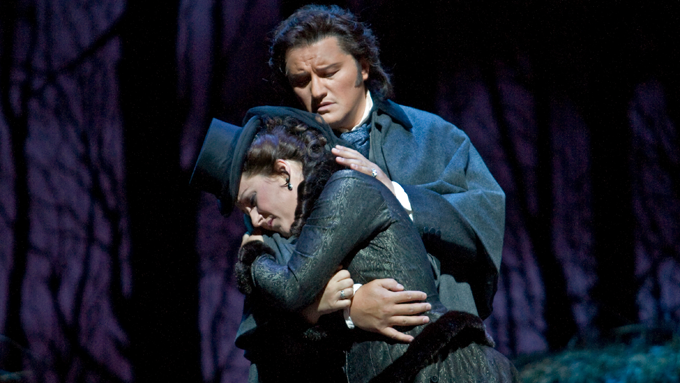
Lucia di Lammermoor

Lucia di Lammermoor

Now this is one to get genuinely excited about. Some of my favorite highlights for this final season under general director David Gockley:

–U.S. debut of director Calixto Bieito with his post-Franco-set Carmen

–double bill of Gordon Getty’s Usher House and Claude Debussy’s La Chute de la Maison Usher

–the David McVicar production of Meistersinger

–Jiří Bělohlávek conducting Janáček’s Jenůfa

–new Lucia di Lammermoor production to be directed by Michael Cavanagh

–Stephanie Blythe and Gerald Finley in Sweeney Todd

–return of Verdi’s seldom-seen Luisa Miller

The full complete release is here (pdf).

Filed under: music news, San Francisco Opera

Seattle Opera Announces New Season

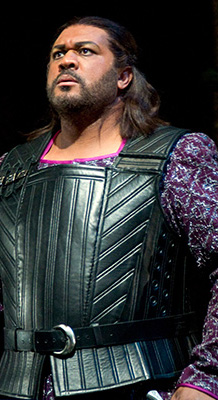
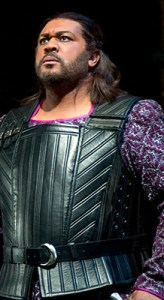
Gordon Hawkins as  Nabucco

Gordon Hawkins as Nabucco

Seattle Opera has recently taken to releasing its Big News about the coming season on New Year’s Day. So here it is: the first season showing the imprint of new General Director Aidan Lang.

There’s a welcome return to five full-scale productions — along with a brief sixth offering, in the form of two performances of a new commission titled An American Dream.

Overall the lineup hews to long-established patterns, but with some more daring choices on the theatrical side. I’m especially delighted to see his fellow stage director Christopher Alden in the lineup for Dutchman after an absurdly long absence from the Seattle stage. And eager to experience Lang’s own work as a director (Mozart’s The Marriage of Figaro).

Here’s the full press release:

Company Presents First Season of Aidan Lang’s Vision
Year-Round Opera Returns in Seattle

SEATTLE—It’s a new era at Seattle Opera. The company today announced its 2015/16 season, the first to be presented by General Director Aidan Lang, and a return to full-year programming with a total of six operas, including new productions and a world premiere. Under Lang’s leadership, the company hopes to serve the community through the magic of theater and music in McCaw Hall, and in learning and engagement programs across the Pacific Northwest.

“We are excited to offer a season that is so varied, both in terms of repertoire and presentation style,” Lang said. “In addition to a world premiere, we have in Nabucco and Mary Stuart two great, highly dramatic works that have never before been seen in Seattle. And it is especially pleasing to maintain our Wagnerian credentials with a compelling, new-to-Seattle production of The Flying Dutchman. I know our audiences are in for a thrilling ride.”

The 2015/16 season includes two company premieres: Nabucco (Verdi) and Mary Stuart (Donizetti); a world premiere: An American Dream (composed by Jack Perla with libretto by Jessica Murphy Moo) conceived from the company’s community storytelling initiative, the Belonging(s) Project; and new-to-the-company productions of The Marriage of Figaro (Mozart), The Pearl Fishers (Bizet) and The Flying Dutchman (Wagner). In addition to mainstage performances, programs that serve the community are at the heart of Lang’s vision. In the 2015/16 season, Seattle Opera launches the Flight project, a multi-year series of programs and events that includes the commission of a trilogy of new operas for family audiences and in-school performances. Flight is modeled on the three-year Our Earth project, which to-date has served 31,893 people in more than 158 performances.

The mainstage season kicks off in August 2015 with a new production of an opera that’s never before been presented in Seattle: Nabucco, Verdi’s first masterpiece. The power and grandeur of the Old Testament story will come alive with innovative staging designed to bring the audience right into the action and closer to the music, notably the famous chorus “Va, pensiero.” Gordon Hawkins returns in Verdi’s first great baritone role, the King of Babylon. Mary Elizabeth Williams takes on the challenge of his fearsome daughter, Abigaille. Christian Van Horn makes his Seattle debut as Zaccaria, the High Priest. Russell Thomas returns as Ismaele, and Jamie Barton makes her Seattle Opera debut as Fenena. Italian conductor Carlo Montanaro returns following Verdi’s Attila (2012) and more recently, The Consul (2014). François Racine, who won Seattle Opera’s Artist of the Year Award for directing the acclaimed Canadian Opera Company production of Bluebeard’s Castle and Erwartung (2009), returns to direct a new production with sets by Seattle Opera’s own Robert Schaub (The Magic Flute, 2011); projections by Robert Bonniol, MODE Studios; and costumes by Ginette Grenier.

Running concurrently with Nabucco in August is the world premiere of An American Dream—an opera based on real stories from the Pacific Northwest. The heartbreak of World War II binds strangers together after a Japanese American family is forcibly removed from where they live on an island in Puget Sound, and the new residents slowly piece together the history of their home. Morgan Smith (Seattle Opera Young Artists Program graduate) returns to create the role of Jim, an American soldier married to Eva, a German Jew who has fled the Nazis and moved to the Pacific Northwest. Making their Seattle Opera debuts are D’Ana Lombard as Eva and, as the Japanese American family, Nina Yoshida Nelsen (Hiroko Kimura), Adam Lau (Makoto Kimura), and Hae Ji Chang (Setsuko Kimura). Conductor Judith Yan makes her Seattle Opera debut. Peter Kazaras, longtime Seattle Opera director, singer and former head of the company’s Young Artists Program, returns to direct following The Consul.

An American Dream is inspired by stories from Seattle Opera’s Belonging(s) Project (seattleopera.org/belongings),­ a community storytelling initiative where participants were asked to consider: “If you had to leave your home today and couldn’t return, what would you want to take with you? Why is that object, that memory, or that connection to your past so important?”

The simultaneous presentation of An American Dream with Nabucco is in itself a compelling artistic choice, and a deliberate pairing by the company’s general director.

“Every now and then in life, things suddenly fall neatly into place; and so it was with An American Dream,” Lang said. “The workshop process of An American Dream revealed an unexpected resonance with one of the key themes of Nabucco, which we had already planned. So we jumped at the opportunity to present the two works in parallel. In attending both operas, our audiences will inevitably have an even richer human experience than they would by seeing each piece in isolation.”

Next, Bizet’s hypnotic love story The Pearl Fishers heats up the fall. Internationally beloved designer Zandra Rhodes returns following her Artist of the Year Award costuming Seattle Opera’s The Magic Flute (2011) to create a grand vision of exotic splendor and vibrant color with her sets and costumes. Maureen McKay, a Seattle Opera Young Artists Program graduate who has gone on to impressive achievements in Europe, makes her mainstage debut as the beautiful priestess Leïla. John Tessier and Brett Polegato return to sing the two men who love her, Nadir and Zurga. Jonathan Lemalu makes his Seattle Opera debut as Nourabad. Both stage director Andrew Sinclair and conductor Emmanuel Joel-Hornak make their Seattle Opera debuts.

During the holiday season, Seattle Opera’s Education Department will deepen its collaborative partnership with Seattle Symphony. The Youth Opera Chorus will again perform with the symphony for its holiday concert on December 15, 2015 at Benaroya Hall. Additionally, the two companies are introducing a new pilot program: an in-school partnership between Opera Time (musical storytelling that fosters literacy for kindergarten-second grade) and Link Up: Seattle Symphony. Link Up allows third-fifth graders the opportunity to “join the orchestra” in a highly participatory program in which they learn to sing and play recorder in the classroom, and perform with the symphony from their seats.

Then, in the new year, Seattle Opera presents The Marriage of Figaro, Mozart’s endlessly enjoyable comedy of manners. General Director Aidan Lang returns to stage directing to mount his own production, which The New Zealand Herald called “engrossing, astute and unmissable.” Chinese bass-baritone Shenyang makes his Seattle Opera debut as Figaro, partnered by Nuccia Focile as Susanna. Morgan Smith returns as Count Almaviva, and Bernarda Bobro debuts as his forgiving wife. In the other cast, Aubrey Allicock as Figaro weds Talise Trevigne as Susanna. The ensemble also features Arthur Woodley, Steven Cole, Karin Mushegain, and Seattle Opera Young Artist alumni Caitlin Lynch, Elizabeth Pojanowski, and Deborah Nansteel. Gary Thor Wedow returns following Don Giovanni (2014) to conduct.

A Seattle Opera premiere, Mary Stuart takes the stage next in February 2016. Based on Friedrich Schiller’s brilliant play, Mary Stuart dramatizes the battle of titanic wills between Queen Elizabeth I of England and her Catholic cousin Mary Stuart Queen of Scotland. In extravagant period costumes, these two iconic royals clash in a haunting story of jealousy, pity, doubt, menace, exaltation and remorse. Christine Rice and Joyce El-Khoury share the honors as Donizetti’s doomed queen, with Mary Elizabeth Williams and Keri Alkema as Queen Elizabeth I, her hated rival. Baritones Weston Hurt and Michael Todd Simpson appear as the scheming courtiers Talbot and Cecil. Carlo Montanaro is at the podium and Kevin Newbury makes his Seattle Opera debut as director.

Finally, the company concludes the season doing what it does best—Wagner! In May 2016, several of Seattle’s favorite Wagnerians return to sing The Flying Dutchman, a tale of a cursed sea captain who can be redeemed only by true love. Greer Grimsley and Alfred Walker return as the Dutchman; Alwyn Mellor and Wendy Bryn Harmer sing Senta, who will break the doomed mariner’s curse. Nikolai Schukoff and David Danholt (winner of the 2014 International Wagner Competition) sing Erik, and Daniel Sumegi returns as Daland. A new production for Seattle audiences, this compelling and stylish show from the Canadian Opera Company brings together a visionary creative team in director Christopher Alden, set/costume designer Allen Moyer, and lighting designer Anne Militello. Sebastian Lang-Lessing, who made his Seattle Opera debut during the company’s 50th Anniversary Celebration in August 2014, returns to the podium.

Inspired by the fate of the Dutchman, as well as the plight of the Israelites in Nabucco, Seattle Opera and the University of Washington College of Arts and Sciences will launch the first in an annual series of programs, performances, and events that will explore the theme of exile in the 2015/6 season. Together, with experts from a variety of disciplines in history, philosophy, literature, and the performing arts, audiences will extend and enhance their performance experience through multiple perspectives on historical and contemporary representations of exile. Programming will be offered in conjunction with performances of Wagner’s work in May 2016.

Filed under: music news, Seattle Opera

R.I.P., Lorin Maazel (1930-2014)

Early into this year we lost one of the greatest musicians of our era with the death of Claudio Abbado. Today brings the sad news of Lorin Maazel’s sudden passing. These were the great conductors I grew up with, so another stark reminder of how quickly that world is fading away.

I recall a very engaging conversation with Maestro Maazel some years ago about his thoughts on Richard Strauss. (Unfortunately the interview is no longer online and I don’t have the file handy so can’t post it for the time being at least.)

Here are a few of the immediate critical reactions:

Maazel was a musical titan who ruled at the podium with a cool, penetrating technical brilliance. This made him a divisive figure through his career, particularly since he didn’t suffer fools lightly…

Anne Midgette

Mr. Maazel was a study in contradictions, and he evoked strong feelings — favorable and otherwise — from musicians, administrators, critics and audiences.
[…]
He was revered for the precision of his baton technique, and for his prodigious memory — he rarely used a score in performances — but when he was at his most interpretively idiosyncratic, he used his powers to distend phrases and reconfigure familiar balances in the service of an unusual inner vision.

Allan Kozinn

Some reactions from the Twittersphere:
Esa-Pekka Salonen: “Thank you for many unforgettable experiences, Maestro. You had many huge fans among colleagues. I for one certainly.”

Robert Lind: “Rest in peace Lorin Maazel! I remember well when I sang Beethoven’s Ninth Symphony with you a few years ago!”

Matthew Worth: “RIP, Maestro. You gave me one of my first professional jobs after conservatory. Thank you for your faith and nurture.”

And from a 2011 profile in The Guardian by Nicholas Wroe, when Maazel was in London to conduct the Philharmonia in Mahler:

“To be honest I don’t look back with great satisfaction at all the various people I’ve been over the decades,” [Maazel] says. “In fact I often shake my head in dismay at the immaturity and puerile view of life and have the greatest compassion for young people who are going through these same stages. But hopefully you mature and you get smarter, in life and in music. If you sharpen your mind and become open to new ideas you become less enclosed in the ghetto of your fanaticisms.”

He says his relationship with the Mahler symphonies has been lifelong education, “and the place where you learn is on the job. I’m not sure I could listen to my early recordings with the Vienna Philharmonic today. Not because they would be wrong or bad, but the maturing and learning process only progresses inch by inch over the years so this lifetime of interaction with the music now feels part of a much larger experience.

In fact it feels more akin to jumping out of a window and seeing your life pass before your eyes, and I now find myself delivering a performance, simultaneously, both in retrospect and in the present moment. Of course I’m very familiar with interacting with masterpieces, but the emotions engendered by the music are leaving me overwhelmed at the end of the performance. And I’m not the sort of person who is accustomed to being overwhelmed.”

Filed under: conductors, music news

RIP Julius Rudel (1921-2014)

Remembering the conductor Julius Rudel, one of the personalities who shaped my love of opera as I was first discovering what the art was all about.

Mr. Rudel died on Thursday at the age of 93 in his home in Manhattan. How sad he was able to witness the death of New York City Opera, the company he did so much to transform into a significant force in the opera world.

From the New York Times obituary:

His company never rivaled the proud Met, with its world-class stars and grand stage productions. Nor was it meant to. But Mr. Rudel won international acclaim with innovative programming. It included premieres of many American operas, high-quality Broadway musicals, Gilbert and Sullivan romps and contemporary European musical dramas, besides the classical repertory of Mozart, Puccini and Verdi, often remastered into English and given novel production twists.

Filed under: conductors, music news, opera

The League of American Orchestras in Seattle

League

Seattle really is the place to be when it comes to envisioning the future of the American orchestra. The future, as in: not another whine-fest of grumpy old men (or ill-informed hipster “observers”) bewailing “the death of classical music,” but the future as a challenge to rethink the “binaries” that shackle the art, that limit how we conceive the culture of performance.

That’s the message enticingly floated by flutist extraordinaire, new music advocate, innovative entrepreneur, and MacArthur genius Claire Chase, who gave the keynote speech for this year’s edition of the League of American Orchestras Conference: “Critical Questions, Countless Solutions.”

The 2014 Conference has just gotten under way, and the choice of Seattle is especially fortuitous. The Seattle Symphony under Ludovic Morlot is gaining wider recognition as an engine for smart orchestral innovation. Their major commission of music by John Luther Adams won this year’s Pulitzer Prize in Music. And the Symphony did something more than hit a home run with its Carnegie Hall performance last month, which inspired Alex Ross to write (and League President and CEO Jesse Rosen to quote during his presentation yesterday at Benaroya Hall): “When conductor, players, and administrators are of one mind, an orchestra can become a singularly vital beast.”

The opening session got a nice launch with a brief concert by the Seattle Youth Symphony Orchestra under Stephen Rodgers Radcliffe: Joshua Roman contributed the solo cello part to Aaron Jay Kernis’s Dreamsongs for Cello and Orchestra, which was followed by a Wagnerian excerpt (Dawn and Siegfried’s Rhine Journey). Deborah Rutter, incoming new President of the Kennedy Center (and a major force in making this concert hall a reality back in the 1990s), gave a heartfelt and quite moving tribute speech to Wayne S. Brown. Brown then appeared onstage to accept the League’s prestigious Golden Baton Award.

Ending the afternoon was a duo session by Joshua Roman and Gabriel Prokofiev (performing the latter’s Cello Multitracks, which mixes live acoustic playing with “electronica” to effect a cello nonet). Claire Chase introduced herself with a superb performance of a piece she says changed her life: Edgard Varèse’s Density 21.5.

Note the prominence of non-orchestral music here. It might seem odd for the opening session of an orchestral conference, but the point seemed to be that the standard model of full-scale orchestral performances can benefit from a flexible context of solo and chamber playing, a dialogue with other forms of music-making.

Chase waxed on about her hero Varèse’s pronouncement that “music, which should pulsate with life, needs new means of expression.” There were a lot of heady suggestions drawing on her experiences spearheading the contemporary music ensemble ICE, but this was primarily a mood setter. Some will say it’s just another variant of the standard pep talk self-congratulation. One friend and colleague points out that you can’t just leap-frog past ingrained traditions of performance, not to mention the nitty-gritty of musicians’ contracts that are in place, to will new models into being.

At the other extreme, the promise of “countless solutions” can, after all, lead nowhere: if there are too many options, how is any to have a lasting, meaningful impact? But what I heard in Chase’s remarks was a provocative invitation to do more than daydream about a promising future. Let’s see what concrete suggestions emerge from the next few days of sessions, brainstorming, and conversation.

–Thomas May

Filed under: American music, music news, new music, orchestras

Seattle’s Night at Carnegie

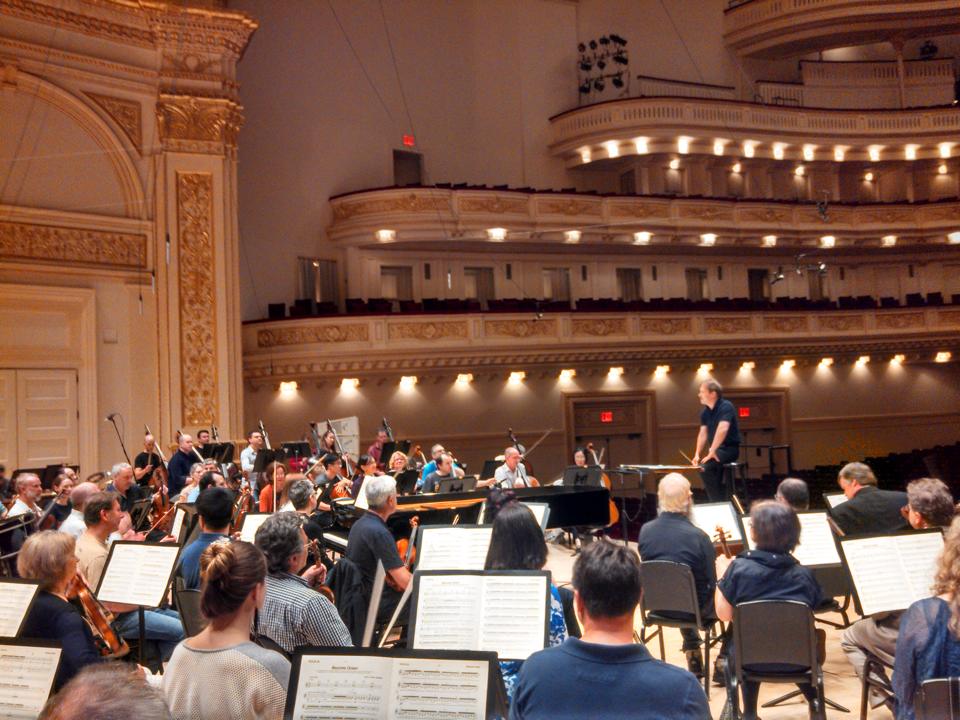
Ludovic Morlot and the Seattle Symphony in rehearsal at Carnegie Hall

Ludovic Morlot and the Seattle Symphony in rehearsal at Carnegie Hall

I’m still processing the experience of the Seattle Symphony’s concert Tuesday evening at Carnegie Hall — part of this week’s Spring for Music series, which will sadly constitute the final chapter of that worthy festival’s history.

By now the program itself is as familiar as a friend. I heard the second half twice in Seattle, some rehearsal sessions, and the entire program last Friday during the SSO’s epic “preview” evening of the Carnegie adventure for Seattle audiences. But Tuesday included an extra dimension of excitement: the New York premiere of Become Ocean, the reactions of major critics in a world music center, and the unmistakeable ambience of Carnegie Hall itself. Even disregarding my obvious bias, this was received as a triumph for the amazing talent of the Seattle Symphony and its music director Ludovic Morlot.

Of course there’s always a substantial amount of guesswork and gut instinct to rely on when it comes to a new composition. Most premieres tend to be somewhere in the vast “middle” range of quality and potential durability, but it’s certainly all too easy to get it wrong, to err in the direction of fatuous dismissal or foolhardy hyperbole. I know I’ve been guilty of both.

So it’s all the more thrilling when instinct kicks in early on in a first encounter with a piece — as it did for me and the John Luther Adams — and you sense that this might be an even greater achievement than you could have reasonably expected. On both occasions I was able to share the experience with trained musician friends who reaffirmed this “instinctual” response to Become Ocean. This time I found myself tuning in even more to an underlying sense of elegy in the music.

Certainly JLA’s big orchestral piece is at the furthest possible remove from any New Agey connotations or glib “environmental” message that some descriptions I’ve seen imply. (That’s not to deny or diminish the composer’s environmental commitment, which is not reducible to a bland gesture of political art.) Instead, this is challenging music, requiring a major effort from the listener while at the same time profoundly engaging the emotions. The days of either/or cliches like “tough” modernism versus “easy-listening” neo-Romanticism should be behind us.

Live stream of Become Ocean

There’s so much to say about this music and its effect, so much about its implications as a commission, that I’m working on a profile of John Luther Adams and Become Ocean. More on that when the time comes.

Meanwhile, the thoughtful dramaturgy of the program — combining JL Adams with Varèse and Debussy — was justly admired for its contrasts and cross-connections. Here’s a quick round-up of the critical coverage I’ve seen so far:

–Alex Ross, as usual, really gets it. He wrote the first substantial critique of Become Ocean after the world premiere last year in Seattle (which I had to miss). On Tuesday Alex found that “Carnegie’s mellow, resonance-rich space brought out the Wagnerian aspect of Become Ocean, favoring sonorities of strings and brass,” adding that from his position in the orchestral seats, “much of the score’s glittering detail was lost … “and the most delicate percussion effects disappeared as well.”

New York magazine’s Justin Davidson neatly summarized the piece’s overall effect: “Serenity comes tightly wrapped up with terror.” He points out that, while Become Ocean is “about boundless nature,”it’s an indoor piece, ravishingly traditional in the way it relies on walls and floor and ceiling to convert raw sound into the illusion of shimmering surfaces and the violent deep.”

–Tony Tommasini writes in The New York Times of how Adams extends the familiar idea of an “organic” composition that evolves “in a swirling mass of sound,” pushing it in “an uncompromising, courageous way.”

–On that score, I was puzzled as to why Martin Bernheimer, in his positive review, insists on labeling Become Ocean “an extended tone-poem.” Even the loose or distant mimesis traditionally associated with the Romantic notion of that genre is merely one level to which JLA alludes.

–At New York Classical Review, George Grella found the programming concept to be mere “window dressing for abstract music about form, structure, and time.” Fair enough, but I disagree with Grella’s assessment of the orchestra’s playing in the Debussy as “surprisingly thin and light.” It was, in my opinion, anything but — in fact, unusually, and unconventionally, muscular and finely articulated, very far from “idées reçues” of French “Impressionist” music.

–On Bachtrack, David Allen offers an interesting and lengthy reflection in which he quotes Gurnemanz’s famous, enigmatic aphorism “Here space becomes time” anent Become Ocean. (I’ve been thinking of another Parsifal reference that comes to mind when I listen to this music, from the Prelude.)

Incidentally, I notice all these critics are male and would love to see a female critic’s reaction to this music. I know my pianist friend Judith was impressed on her first hearing, aptly likening the experience to an extended encounter with a Rothko painting.

Update: this isn’t a review of the concert, but Corinna da Fonseca-Wollheim published a preview for The New York Times. There she writes that Become Ocean “submerges the listener in a swirling, churning wash of sound.”

Update No. 2: Just discovered that the world premiere of Become Ocean was covered for the local Seattle media by Melinda Bargreen. She didn’t much care for it:

But after the first 20 minutes or so, the musical ideas had pretty much run their course, and there were no further developments to justify sustaining the piece. (Some listeners in the balcony areas made a discreet but early retreat.) At least the music fell gratefully on the ear, delivering consonance rather than dissonance, and in its very length, “Become Ocean” evoked a sense of vast oceanic scale.

Interesting, too, to see some of the reader comments from back then:

“spiritdancer47,” mistaking the piece for a symphony, didn’t find much there there:

Having been a dancer for PNB, I am familiar with the extended time it takes for the orchestra in the pit to warm up. Listening to Adams’ symphony took me back to that time…and left me there. I would be one of the “early leavers.”

“proud2Bliberal” gave it more thought by trying to locate precedents:

“Become Ocean” was wonderful. It is the perfect piece for just putting your head back, closing your eyes and letting the sounds happen around you. It conveyed what it must feel like to be in Alaska near the ocean and the forests. The piece had a refreshing and genuine feeling, and somewhat of the personality of American experimentalists Charles Ives and Henry Cowell. Morlot was the perfect conductor for this work. Clearly the piece has its roots in Debussy’s “La Mer” and the ocean passages of “Pelleas.” As a French conductor, Morlot was able to conduct all of those “Debussyiste” sea rumblings (bruits, in French). It would be a great piece to have on a CD at home.

And I hope “vf” didn’t place a bet on this prediction:

“It would be unfortunate if the SSO took the Luther Adams piece to NYC, it would be a disaster, hope they reconsider. In comparison to the works of composers like Arvo Part or Phillip Glass Become Ocean is minor league at best.”

–(c)2014 Thomas May. All rights reserved.

Filed under: commissions, John Luther Adams, music news, Seattle Symphony

Musical Anhedonia

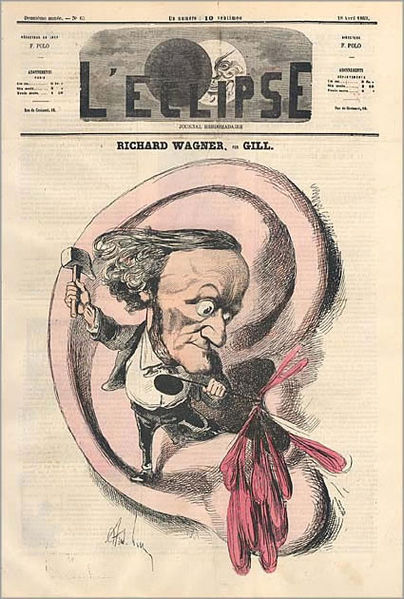
Wagner-caricature

You know that chilling moment when you try to introduce a friend to a piece of music you love — a piece of music that contains a little bit of the world’s meaning for you — and … nothing? That moment when it doesn’t just fail to register, but the other party has no interest in trying to figure out what turned you on in the first place?

This phenomenon can be shocking when you’re dealing with someone who normally does have some sort of musical response but who remains immune to the piece in question. I vividly recall trying to introduce an acquaintance years ago to the Heiliger Dankgesang from Beethoven’s Op. 132 — which is about as transcendent as music gets, as far as I know it — and being appalled by the evident reaction of boredom. For a moment, it felt like some sort of variant on the uncanny valley phenomenon.

I think we’ve all been there, but what I find truly unfathomable is an existence without music. Yet it turns out a new study whose results were just published in Current Biology suggests that music simply may not be as “universal” as we like to believe it is. A team of psychologists at the University of Barcelona found that possibly up to 5% (!) of the population cannot take pleasure in music — any music. Some people are simply, or rather, biologically, incapable of enjoying it, no matter how accessible we try to make the experience.

This is distinct from the well-known phenomenon of amusia and similar dysfunctions Oliver Sacks has described in Musicophilia. The Barcelona study also points out that the 30 student volunteers who participated — “healthy people with specific musical anhedonia” — “do not find music pleasurable, but enjoy other rewarding stimuli.”

From the abstract of the article (“Dissociation between Musical and Monetary Reward Responses in Specific Musical Anhedonia”):

Music has been present in all human cultures since prehistory, although it is not associated with any apparent biological advantages (such as food, sex, etc.) or utility value (such as money). Nevertheless, music is ranked among the highest sources of pleasure, and its important role in our society and culture has led to the assumption that the ability of music to induce pleasure is universal. However, this assumption has never been empirically tested.

In the present report, we identified a group of healthy individuals without depression or generalized anhedonia who showed reduced behavioral pleasure ratings and no autonomic responses to pleasurable music, despite having normal musical perception capacities. These persons showed preserved behavioral and physiological responses to monetary reward, indicating that the low sensitivity to music was not due to a global hypofunction of the reward network. These results point to the existence of specific musical anhedonia and suggest that there may be individual differences in access to the reward system.

Filed under: aesthetics, music news, musical research

Happy 300th, C.P.E. Bach

Carl Philipp Emanuel Bach

Carl Philipp Emanuel Bach

Today marks the 300th birthday of Johann Sebastian’s fifth child, the amazing Carl Philipp Emanuel. Born during papa’s Weimar period to his beloved first wife, Maria Barbara (who died six years later), C.P.E. occupies a fascinating position as a “transitional” figure. In other words, his creative work can’t be conveniently pigeonholed into the neat categories music historians use to wedge everything into a straightforward narrative.

Carl Philipp Emanuel is in the spotlight all year long, with all sorts of programs devoted to exploring his legacy. Last week, for instance, the Friends of the Berlin Philharmonic presented a special program featuring “an autobiographical monologue with music.” The actor Burghart Klaußner played the role of the composer to a script drawn from his letters and similar documents.

A great place to start exploring is the C.P.E.Bach — 300th Anniversary website. It includes a neatly illustrated biographical breakdown, an overview of life in the 18th century, a comprehensive catalogue of his prolific output, some audio samples, and more.

In a section on the reception of Carl Philipp Emanuel, the composer’s contemporary Christian Friedrich Daniel Schubart describes how he was considered a true original:

“Bach in Hamburg leads the clavierists as Klopstock leads the poets. He is epoch-making […]. Both his composition and his playing are inimitable.” A characteristic of Bach that still applies today. Countless composers of the late 18th century were imitating Haydn and Mozart, but no-one tried to imitate Bach. They would not have succeeded – his melody is expressive but seldom cantabile. The “Hamburg Bach” was denied having street boys whistle his tunes as they did Mozart’s. In any case, Bach considered himself the creator of demanding music and had little interest in serving the populace.

Filed under: Bach family, music news

Archive

Enter your email address to follow this blog and receive notifications of new posts by email.