MEMETERIA by Thomas May

Music & the Arts

Shedding Light on Dark Sisters

dark_sisters_1
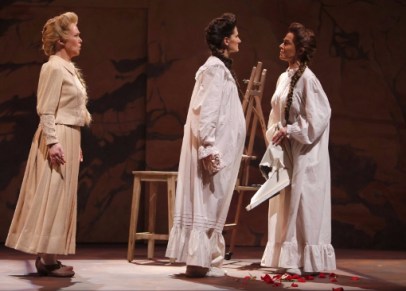
l to r: Melanie Krueger (Eliza), Eve-Lyn de la Haye (Zina), and Heather Pawsey (Presendia) Credit: (c) Tim Matheson


A new review for Musical America, in which I write about Vancouver Opera’s current production — the Canadian premiere — of the chamber opera Dark Sisters. (Content is behind a paywall.)

VANCOUVER, BC — Dark Sisters is the final new work Vancouver Opera will have presented before Canada’s second-largest opera company shifts from the full-season model currently underway to a festival one (in the spring of 2017).

This chamber opera by Nico Muhly and librettist Stephen Karam was first seen in New York in a 2011 production by the late lamented Gotham Chamber Opera and then at co-commissioner Opera Philadelphia in 2012, where a chorus of praise replaced the rather tepid initial reception

continue reading

Filed under: new opera, Nico Muhly, review

On the Agenda

Nico Muhly’s Dark Sisters, at Vancouver Opera:

Filed under: new opera, Nico Muhly

Hopscotch Opera

Hopscotch: A Mobile Opera for 24 Cars has become a phenomenon in Los Angeles.

Filed under: music news, new opera

Moby-Dick’s Operatic Rendering

head.moby

Los Angeles Opera is about to give the LA premiere of Moby-Dick, Jake Heggie and Gene Scheer’s operatic adaptation of the Melville classic. Here’s my essay for the program:

“It will be a strange sort of a book, tho’, I fear; blubber is blubber you know; tho’ you may get oil out of it, the poetry runs as hard as sap from a frozen maple tree…,” Herman Melville wrote in a letter on May 1, 1850, his first recorded reference to Moby-Dick. He would go on to transform the riveting adventure story from which the novel had been seeded into a metaphysical epic — just around the time that Richard Wagner began expanding his treatment of a mythic hero into an unprecedented four-part project, aka Ring cycle.

“Melville’s novel is mythical and timeless: that’s what makes it operatic,” says composer Jake Heggie. “But to make it work onstage, we had to find a way to make it very human and tangible.” And for Heggie and librettist Gene Scheer, crafting “the most famous book people claim they’ve read without reading it” into (just one) normal-length opera required an intensely collaborative effort that involved still more shifts of focus.

Heggie recalls being initially “terrified” by the audacious proposal to make an opera of Moby-Dick. The idea originated from the veteran playwright Terrence McNally, the librettist for Heggie’s debut opera, Dead Man Walking (2000) as well as the just-premiered, bel canto-styled Great Scott. “The only story I’m interested in doing is Moby-Dick,” McNally said when asked to participate in a commission from Dallas Opera in 2005 for a work to inaugurate the new opera house it was building.

Despite — or, more accurately, because of — his trepidation, Heggie soon found the idea irresistible. “As a composer it’s important for me to take on a new challenge that will keep me on edge. If I’m going to write an opera and invest years in it, it has to be a subject that stimulates me. With Moby-Dick I began to think, ‘I can do this, but I don’t know how I’m going to do this.’ Every day became a big guessing game.”

The composer also found himself reassured by his confidence in McNally’s theatrical instincts. The playwright proposed three essential premises that set the coordinates for the dramatic adaptation: the entire opera would take place at sea, Captain Ahab would be a heldentenor, and his cabin boy Pip would be cast as a pants role to introduce a female voice among the otherwise entirely male cast.

About a year into the commission, personal reasons forced McNally to withdraw, and Heggie turned to another seasoned man of the theater, the highly versatile writer and composer Gene Scheer. The two had collaborated on some other projects, and Scheer had already adapted another complex American epic for the medium of opera with his libretto for Tobias Picker’s An American Tragedy.

“The process became very organic for us,”says Scheer. “There was no linear sequence of first libretto, then music.” Indeed, when I met with the team over the summer for this interview, just after the world premiere of Cold Mountain — Scheer’s most recent operatic adaptation, set to music by Jennifer Higdon — the collaborative spirit came so naturally that they frequently completed or supplemented each other’s sentences.

“What makes our partnership operate so well,” Heggie explains, “is that both of us are really about the work. It’s not about our egos. We’re eager to shape the piece so it feels clear and fully formed and solid.” He adds that the same holds for the entire team who designed the look and staging of the show, which premiered in Dallas in April 2010 (director Leonard Foglia, set designer Robert Brill, and projection designer Elaine J. McCarthy, among others): “It’s important to remember that the success of the opera was a group effort.”

“Every opera is, but with these folks there was a sense that we were handing the baton back and forth to each other,” says Scheer. “I do believe the music is the marrow of the matter, but we all worked together to make sure everything here is about telling the story.”

In addition to jettisoning the early chapters that take place on land and keeping it all at sea, perhaps the most critical decision about how to retell Melville’s story was to change the novel’s narrator Ishmael into the character “Greenhorn” — which is to say, into an earlier, more innocent incarnation of this character, the only member of the Pequod’s crew who has never been on a whaling expedition before. The fundamental conceit is that the experiences Greenhorn encounters in the opera are what he will ultimately transform into a kind of “memoir” by writing Moby-Dick.

“We knew we couldn’t have the narrator as a character, so with this rookie Greenhorn it became an opera about the education of Ishmael,” according to Heggie. “The novel’s famous opening line would become the last line of the opera, and it would have to be earned.”

This line of thinking profoundly informed the opera’s dramatic and musical conception alike. A signature of the sound world Heggie has created for Moby-Dick is its tautness, its intense economy: variety is extracted from the ingenious manipulation of a network of leitmotivic ideas. And chief among these is a rising-then-falling four-note motif of elusive, shifting harmonies. This idea, heard right at the outset, is threaded obsessively throughout the score.

Heggie recalls the uncanny experience of composing the opera’s final page, when he suddenly realize that this motif was “spelling” the phrase Greenhorn sings to the unseen Captain Gardiner at the end: “Call me Ishmael.” “I didn’t know until the end that this is what these notes were saying all along.”

The function fulfilled by the narrator in the novel was meanwhile transferred to the orchestra. Says Heggie: “The orchestra itself is the character of the sea and the world that surrounds everyone on the Pequod. The hard part of any opera is finding what I call the musical universe that is specific to that piece. Once you find that sound world, the characters can emerge organically with their own identity. It feels of a piece so that the audience also feels as if they’re in that watery world that’s carrying them forward.”

The result is that Moby-Dick is the composer’s most intricately scored operatic score to date. This and the prominent motivic network — much more than the obsessive Ahab or the maritime setting — lend the opera its Wagnerian echoes, which are otherwise uncharacteristic for Heggie. Trained early in his career by the legendary Ernst Bacon (who also mentored Carlisle Floyd), Heggie is widely known as a gifted melodist. Yet the material of Moby-Dick led him to assimilate some unexpected influences: “I had probably been resisting all my life: Wagner and Philip Glass. That surprised me, but it felt right for this piece.” Other more usual suspects the composer mentions that get stirred up in his “creative crockpot” include Debussy, Leonard Bernstein, Stephen Sondheim (to whom the score is dedicated), and “the great movie scores i grew up loving.”

Both Heggie and Scheer agree that what really launched the project was a trip they made together to the Nantucket Whaling Museum, just after they’d finished working on their first full-length opera collaboration, Three Decembers (2008). “Being in that environment and walking those streets made it very real,” recalls Heggie. “We had dinner with [maritime historian and Melville champion] Nathaniel Philbrick, whose book about the event that inspired Melville [In the Heart of the Sea] made it so human.”

Scheer says the images they encountered of the specifics of life on a whaling expedition — the nocturnal rendering of the oil, the way the mastheads loomed up above the ships — immediately inspired some concrete ideas for the libretto, such as the duet between Greenhorn and Queequeg at the start of the second act.

His own growing obsession with the Melville source contributed incalculably to the libretto’s sense of authenticity. Re-reading the novel nearly a dozen times, Scher internalized its peculiar rhetoric and steely poetry. While virtually all of Ahab’s words are taken directly from Melville’s text, the libretto incorporates passages that are entirely new, but in the style of Moby-Dick. Heggie proudly points out that several Melville scholars have admitted being unable at times to unravel “which lines are from Moby-Dick and which from Gene. It’s a real testament to the quality of his work.”

But Moby-Dick was by no means all smooth sailing. After a six-month immersion in writing music, Heggie felt that “nothing was sticking” and jettisoned most of his sketches except for the music to Queequeg’s opening chant, the text for which Scheer had unearthed from an authentic Samoan source. His musical breakthrough arrived when he focused his attention on Ahab’s first-act aria “I leave a white and turbid wake” and finally found his way into the opera’s central, most complex character. “Ahab suddenly became real to me, and then I was able to go back to the beginning and write straight through.”

Scheer hit a brick wall of his own in the scene with Queequeg’s coffin in the second act. “I wrote so many versions of that scene — as a chorus, a duet for Pip — it was eight weeks of hell. There was a lot at stake, because we had to establish the coffin for the ending and to show the education of Greenhorn taking place. And then I met with Jake and Lenny [Foglia], who was so helpful acting as dramaturg and letting us bounce questions off him, and we cracked it together. I was able to write it then in one night.”

Winnowing Melville’s massive text into a feasible libretto hardly became a matter of mere “cutting.” In fact, Scheer savvily conflated events and characters (as in the rescue of Pip) and even invented scenes to reintroduce important themes from the opening chapters — most notably, the bonding and affection between Greenhorn and Queequeg, which represents this opera’s love story. As for the novel’s notorious excursions on the industry and techniques of cetology (and their allegorical implications), Scheer admits with bemusement that “the whaling stuff ended up becoming my favorite parts of the book.” He even found room for a reference to this material as a background to the initial private confrontation between Ahab and Starbuck in the first act.

“When most people hear the words ‘Moby Dick’ they think of the White Whale that bit off Captain Ahab’s leg — and of Ahab’s rage for revenge,” writes the Melville scholar Robert K. Wallace in his book Heggie and Scheer’s Moby-Dick: A Grand Opera for the 21st Century. “When most people see this opera, they will be equally concerned with Queequeg, Starbuck, Pip, and Greenhorn.”

One of the opera’s most prominent achievements is to create distinctive personalities, in real stage time, for each of its cast of seven principals. Scheer says he was motivated by his understanding of each of the characters as embodying “a different way of looking at the world. Ahab is maniacal, but he’s inspiring and brilliant and gets almost everyone on that ship to follow him. Starbuck brings a religious perspective, along with the rigidity of religion which is also part of the story. Stubb represents someone who laughs his way through life and Flask is a simple-minded person who doesn’t think so deeply. Queequeg is equally poised between all of these characters. And Greenhorn is culling through them all. Ultimately he admires Queequeg’s way of looking at the world because it has more validity and resonance for him.”

Heggie continues the analysis: “Starbuck is the conscience, while Queequeg is the heart and soul, the spiritual center of the ship. Pip is the tragedy and the youthful optimism that gets quashed. He represents the future.”

Narratively speaking, transforming Moby-Dick into an opera involved a kind of creative reverse engineering to make the adventure story from which Melville had taken off front and center. At the same time, the original novel features passages imbued with a heightened, “operatic” intensity or even allude directly to music. By incorporating these into their treatment, Heggie and Scheer ensure that the opera’s streamlined narrative is by no means “lightweight” but rather richly textured.

“The subtlety comes in many forms,” says Scheer, “but it comes principally in the music. Not to underemphasize the importance of the structure and the words, but in the end the music provides a direct way of communicating that is different and wonderful.”

Filed under: essay, Jake Heggie, librettists, Los Angeles Opera, Melville, new opera

Cold Mountain Almost Reaches the Top

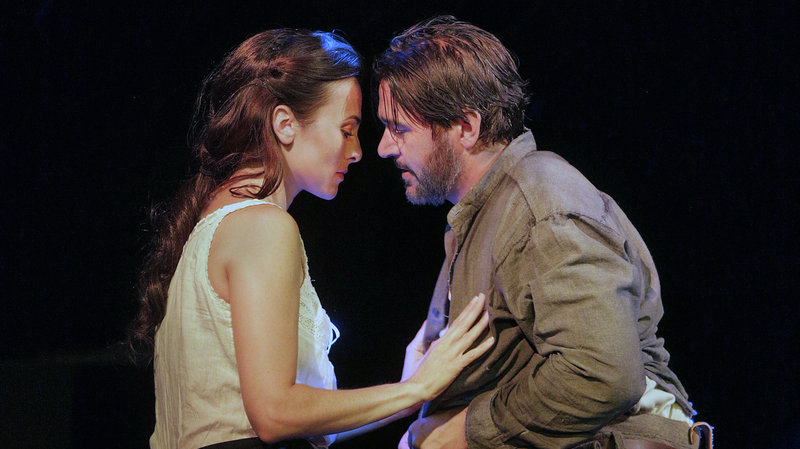
Isabel Leonard (Ada) and Nathan Gunn (Inman); photo by Ken Howard/courtesy of Santa Fe Opera

Isabel Leonard (Ada) and Nathan Gunn (Inman); photo by
Ken Howard/courtesy of Santa Fe Opera

The world premiere of the opera Cold Mountain by composer Jennifer Higdon and librettist Gene Scheer took place this past Saturday at Santa Fe Opera. My review has now been posted on Musical America. I can only give a brief snippet of the review here, which is behind Musical America‘s paywall:

SANTA FE — The event that’s been generating the biggest buzz this summer at Santa Fe Opera is Cold Mountain, which received its world premiere over the weekend. For Jennifer Higdon’s debut opera, set to veteran librettist Gene Scheer’s adaptation of the much-acclaimed Charles Frazier novel, the company has assembled a thrilling cast of principals and a first-rate production team.

continue reading

Filed under: Jennifer Higdon, librettists, new opera, review, Santa Fe Opera

A Double-Bill in Aspen

The Aspen Music Festival is giving the first fully staged performances of two one-act operas tomorrow: a fascinating double bill of The Classical Style (Steven Stucky’s debut opera to a libretto by Jeremy Denk) and The Cows of Apollo (the work of Christopher Theofanidis and playwright William Hoffman, the librettist for The Ghosts of Versailles). Aspen’s Music Director Robert Spano conducts the productions, which are being staged by Edward Berkeley.

My essay introducing the two operas can be found here.

Filed under: Aspen Music Festival, Christopher Theofanidis, essay, new opera, Steven Stucky

Glass on Galileo

A few years ago I was delighted to find Portland Opera’s young artist program presenting Galileo by Philip Glass and headed down to see the production. Here’s the review I wrote:

Here’s something that happens once in a blue moon in our fair Northwest: a chance to see an opera by an iconic contemporary composer in a production being recorded for said composer’s own label. The icon in question is Philip Glass, whose 2001 chamber opera Galileo Galilei just opened [April 2012] in a brand-new staging by Portland Opera that also represents the work’s West Coast premiere.

Though Galileo confounds expectations in its relatively lightweight approach to the fraught topic of science and religion, the production offers an engaging and often refreshingly poetic entrée into Glass’s special brand of music theater.

Presented as the main annual production showcasing the company’s emerging artists, this actually marks Portland Opera’s second outing with a Philip Glass opera. When PO presented Orphée in 2009 (part of Glass’s “Cocteau trilogy,” in a production imported from Glimmerglass Opera), it inspired hands-on involvement from the composer. The result was memorialized in the company’s first-ever commercial recording. The Galileo release to be edited from PO’s live performances will likewise be the first recording of that opera.

continue reading

Filed under: new opera, Philip Glass, Portland Opera

Déjà Vu

Two Women by Marco Tutino

Two Women by Marco Tutino


San Francisco Opera’s world premiere last night of Two Women by the Italian composer Marco Tutino raises interesting and important issues about making opera today. I intend to get into this more substantially after dealing with some crushing deadlines….

Joshua Kosman’s extensive review expertly nails the key problems with this opera, as well as its larger aesthetic implications:

But Tutino — along with General Director David Gockley, who commissioned the work from him on the recommendation of Music Director Nicola Luisotti — has also taken this opportunity to mount a rather forceful esthetic argument. In its strongest form, the claim is that the history of 20th century music has been a nightmare that we need to wake up from, and that the path to redemption lies in a wholesale return to the ancient traditions.
[…]
Ultimately, such pleasures as “Two Women” can provide are the comfortable pleasures of familiarity. The piece is nominally new, yet it feels like a long-lost and not as successful cousin to “Tosca” or “Cavalleria rusticana.”

Anne Midgette dissects the failings of Two Women in her insightful Washington Post review:

Two Women” maintains a near-constant level of melodramatic musical intensity….But the opera neglects to flesh out any of these characters, and this robs the surging score of much of the effect it’s trying so earnestly to convey. When the figures are one-dimensional, it’s hard to get involved.
[…]
It’ s important not to lose sight of the bigger picture in the case of “Two Women,” as well. This opera may be a dud, but it is much better to try new opera than stick to the overly familiar.

UPDATE [19 June 2015]
Some more thoughts on Two Women. Having the opportunity to see SF Opera’s current production of Berlioz’s The Trojans probably intensified my negative reaction to Tutino’s new opera, since the plight of women under the stress of wartime is a theme shared by both. The magnificent Berlioz production, featuring a first-rate cast, a compelling vision from stage director David McVicar, and some of the best work I’ve ever heard from Donald Runnicles and the SFO orchestra, was a genuine privilege to experience.

The multiple rape scenes in Two Women, by contrast, come across essentially as part of “the plot”: moments that crudely intend to push buttons and elicit reactions without the libretto or the music doing the work needed to make them effective. The result is something closer to tabloid journalism.

Much of the attention has been focused on the shortcomings of Tutino’s score, but I think the poorly crafted libretto is even weaker, betraying signs of decision-by-committee. It’s easy to see how the intention was to elicit emotional reactions similar to Puccini’s “E lucevan le stelle” or “Addio fiorito asil.” Yet the libretto treats these like a paint-by-numbers project rather than allow them to emerge organically from the dramatic moment: so much so that, for example, the “flame-flower” image symbolizing the fragile love blossoming in winter between Michele and Cesira becomes risibly manipulative. (At one point I found myself playing the “Let’s spot the Tosca game as if I were watching an operatic a Where’s Waldo.)

There’s even a scene of uneasy humor at the start of the second act — you can imagine the meeting where someone said, “We need some comic relief!” — which draws clumsily on Puccini’s scherzando, satirical moments (think of the Sacristan in Tosca). As the weasely informant Sciortino betrays Michele, his mother scurries nervously about, promising to satisfy her guests with a tasty home-cooked meal. And as with quite a few other passages of the score, the music just vamps away, trying to tell us how we should react to the clumsy dramaturgy.

I’ve only rarely experienced a world premiere where the critical near-consensus seemed so obvious and immediately apparent. Two Women doesn’t express or elucidate the emotions meant to be triggered by the drama: it tells the audience what those emotions should be by mimicking over-familiar parallel moments from Puccini and other verismo classics, with a dash of generalized film score vocabulary and other bits and pieces from the repertoire.

When I was first seriously discovering music as a teenager, I had the temerity to claim I could be a composer because I was able to produce music in the style of composers I admired. Thankfully the scales fell from my eyes pretty soon and I realized the arrogance of this mistake. Which isn’t to say all music should be “original.” I don’t buy into the modernist fallacy of radical originality either. But I believe there is a fundamental difference between shameless imitation to manipulate an audience’s comfort zone and genuine creativity.

I additionally want to make clear that this is NOT about the choice of a “conservative” style. Samuel Barber long since proved that writing in a conservative tonal idiom is hardly incompatible both with original musical ideas and having something genuine and honest to say. So any attempt to champion Two Women as an embrace of the audience forsaken by 20th-century composers is, frankly, a red herring and overlooks the fatal shortcomings of a manipulative, derivative opera.

Despite the failure of both libretto and score, SF Opera has gone out of its way to present Two Women with excellent production values, assembling an impressive cast. Anna Caterina Antonacci (who also sings Cassandra in The Trojans on her “free” nights) is the linchpin as the courageous, spirited Cesira – a dynamo of acting and vocal passion.

If only the opera actually delineated any of its characters in depth! And given Tutino’s failure to explore the relationship between the actual two women in question – mother Cesira and her daughter Rosetta – the considerable talents of Sarah Shafer in the latter role are lamentably underused. Still, Shafer movingly conveys the final stages of Rosetta’s transformation following the violence and trauma she has endured.

Dmitri Pittas brings his ardent tenor to the pedestrian music he is given as the fearless idealist Michele. Mark Delavan has to play a cardboard baddie as the rapist/collaborator/fascist/betrayer/liar etc. etc. Giovanni. He does sing well. (Another critique: Tutino’s libretto, which was co-written with Fabio Ceresa and “adapted from a script by Luca Rossi,” absurdly whitewashes the historical role of the Italians and their relationship to Hitler’s Germany in WWII. Characters like Giovanni and Sciortino are presented as the “bad apples” among an otherwise terrified and subjugated populace in this turning-point year of the war of 1943. Yeah, right….)

Nicola Luisotti conducts with a palpable belief in the score, somehow rendering its gestures with an actual sense of passion. (Tutino turns out to be a skilled orchestrator, even if he leans too heavily in one scene on xylophone-drum sonorities.) The production gains a lot from director Francesca Zambello’s attentive eye and sense for pacing. She makes the most of what she can from this predictable dramaturgy, and Peter Davison’s sets work beautifully, integrating film projections of scenery and historical footage. Is it any surprise that these documentary images of people uprooted, refugees fleeing the bombing of their cities, are far more moving than the “new” opera in which they’re embedded?

Filed under: aesthetics, music criticism, new opera, San Francisco Opera

After Life: Music of Remembrance Premieres New Opera

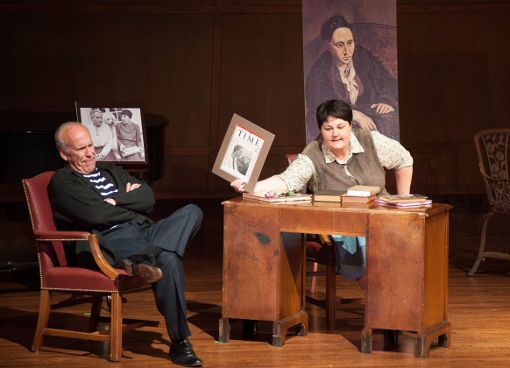
Robert Orth (Picasso) and Catherine Cook (Gertrude Stein); (c) Michael Beaton

Robert Orth (Picasso) and Catherine Cook (Gertrude Stein); (c) Michael Beaton

Just posted on Bachtrack, my latest review is of the world premiere of After Life by Seattle’s Music of Remembrance:

“Questions remember me,” sings the unnamed girl in After Life, the one-act opera by composer Tom Cipullo and librettist David Mason that received its world première on Monday evening in Seattle. Rounded up by the Nazis and sent from her orphanage in a French village to a concentration camp, the girl sings to us from the ‘other side’, the voice of a life stolen by the Holocaust. She knows she has been forgotten – yet the girl’s poignant questions make her presence indelible as she encounters the spirits of Gertrude Stein and Pablo Picasso in the afterlife: two famous figures who survived the war while also living in France.

continue reading

Filed under: Holocaust, Music of Remembrance, new opera, review

Archive

Enter your email address to follow this blog and receive notifications of new posts by email.