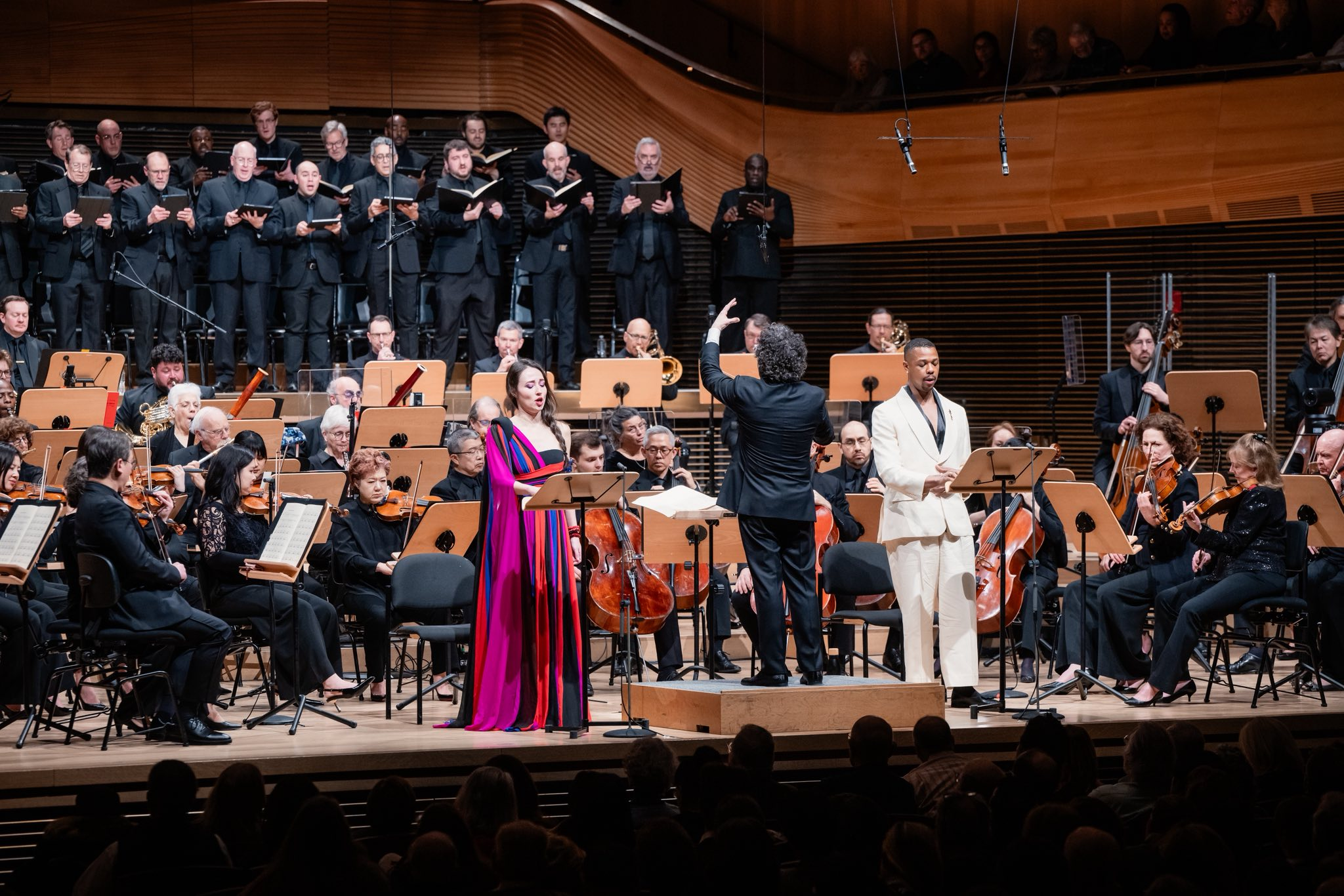
The New York Philharmonic has been on quite a roll with Gustavo Dudamel: after last week’s The People United Will Never Be Defeated! variations-extravaganza comes another major commission this week: David Lang’s the wealth of nations – based on TheWealth of Nations – yes, that one, which turns out to be surprisingly fertile ground for a massive choral/orchestral piece.
David Lang approaches music as a tool for understanding how people are connected — emotionally and collectively — even in places where we don’t expect music to go. Across his career, he has returned repeatedly to large-scale, text-driven works that place individual voices within a wider civic frame, exploring moral, social, and political questions without prescribing answers. Rather than treat music as an abstract system, Lang has used it as a means of examining how societies organize themselves — and what gets smoothe
Thomas Adès conducting the New York Philharmonic, with soprano Anna Dennis; photo credit: Chris Lee
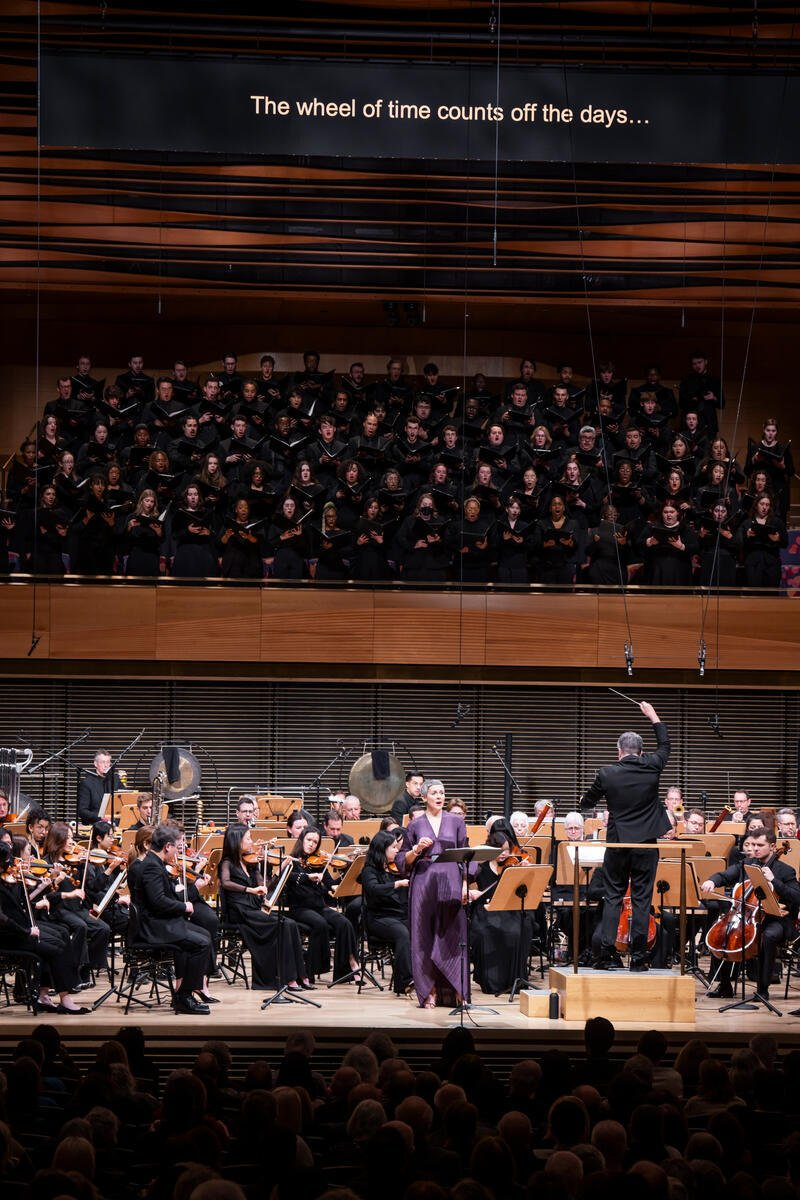
Last week’s New York Philharmonic program under Thomas Adès, anchored in the newly expanded version of his America: A Prophecy, was one of the most thought-provoking, unusual, and compelling programs I’ve encountered in ages. My review for Musical America (sorry for the paywall):
NEW YORK—Thomas Adès was 28 when the New York Philharmonic first programmed his music on a major subscription concert. America: A Prophecy was commissioned as part of a series marking the threshold of a new millennium and received its premiere in November 1999 under Kurt Masur. At last week’s concerts, a new, expanded version of America anchored the program, this time with Adès himself on the podium. …
I had the honor of writing the program note for this week’s performances of Philip Glass’s Symphony Np. 11 by the New York Philharmonic, with Gustavo Dudamel conducting:
It wasn’t until he was 54 that Philip Glass began writing symphonies. With Symphony No. 1 in 1992, he opened up a new creative frontier that has remained an essential part of his work ever since….
Pierre Boulez NY Phil Shelby White & Leon Levy Digital Archives
My Playbillfeature on the NY Philharmonic’s homage to its former music director as the music world marks the 100th anniversary of the birth of Pierre Boulez in 2025:
In March 1969 Pierre Boulez — then 43 — made his New York Philharmonic debut conducting a month of concerts. The engagement, which included a much-discussed performance of Stravinsky’s The Rite of Spring, quickly resolved the question of who would succeed Leonard Bernstein as Music Director. A mere three months later came the announcement officially appointing Boulez to the post… continue
Aaron Zigman’s Émigré is a 90-minute oratorio that tells the story of refugees finding a home and community in Shanghai; the libretto is by Mark Campbell. On Friday 17 November, Long Yu and the Shanghai Symphony Orchestra, along with musicians from the New York Philharmonic, will give the world premiere at the Jaguar Shanghai Symphony Hall.
In the late 1930s, Jewish refugees escaping Nazi Germany found a home and a community in Shanghai, China — one of only two countries in the world that would accept them. While Shanghai had previously served as a haven for Jews escaping persecution, the many refugees who fled to the city directly after Kristallnacht arrived on the shores of a country affected by the occupation of Japan and the atrocities of the Nanjing Massacre committed less than a year before.
This moment in history is the backdrop of Émigré, an oratorio in two acts that dramatizes the experiences of two Jewish brothers who arrive in Shanghai as refugees in 1938. As the young men navigate their new life, bonds are formed between the Jewish and Shanghainese communities that test the social boundaries and traditional ideas of both. Émigré reaches its tragic conclusion in a love story that mirrors the larger world, its message emerges: that our survival as a race depends on diverse communities learning to embrace our shared humanity. See detailed synopsis below.)
Commissioned by Long Yu, the Shanghai Symphony Orchestra, and the New York Philharmonic, Émigré calls for nearly 150 musicians, including members of the Shanghai Symphony Orchestra, New York Philharmonic, New York Philharmonic Chorus, and Lanzhou Concert Hall Choir, as well as seven soloists. The solo parts will be sung by Matthew White, Arnold Livingston Geis, Huiling Zhu, Meigui Zhang, Shenyang, Diana Newman, and Andrew Dwan. The Shanghai Symphony Orchestra and Long Yu will also record the oratorio for Deutsche Grammophon, with a release date scheduled in 2024. The New York Philharmonic will give the US premiere of Émigréon 29 February 2024.
Long Yu, Music Director of the Shanghai Symphony Orchestra, said: “Émigré will shed light on humanity and provide a valuable lesson to us through the immense kindness and tolerance this city once released in history. From working on the draft idea to finally premiering the work this week, this new production has been carefully crafted over four years. We have musicians of different races and beliefs gathered in Shanghai to collaborate on the stage, and the piece will be performed by other orchestras in years to come, further conveying this message of love and hope to the world. This is the power of art.”
Aaron Zigman is a classically-trained American composer who has written scores for films and TV shows including The Notebook, Wakefield, Bridge to Terabithia, and the Sex & The City franchise whilst also writing, arranging and producing songs for top recording artists such as Ray Charles, Sting, Tina Turner, Seal, and more. Zigman has also composed a number of chamber, orchestral, and vocal works. His -award-winning Tango Manos has been touring the world with pianist Jean-Yves Thibaudet.
Mark Campbell is a Pulitzer Prize-winning librettist who has created 40 opera librettos alongside lyrics for 7 musicals and the text for 9 song cycles and 4 oratorios. The (R)evolution of Steve Jobs, an opera featuring libretto by Campbell, received a 2018 GRAMMY Award for Best Opera Recording.
Synopsis of Émigré
Act One
Two brothers—Josef and Otto Bader—have escaped Nazi Germany in 1938 and arrive at Shanghai harbour on a ship with other Jewish refugees. They express their sorrow at having to suddenly leave their parents and their homeland but find hope as they approach the city that has welcomed them. Josef, a medical doctor, urges Otto, a rabbinical student, to look ahead to their new life in Shanghai.
Several weeks later, Josef seeks to expand his knowledge of Eastern medicine and visits Wei Song’s herbal medicine shop where he meets two sisters, Lina and Li Song. Josef and Lina immediately feel an attraction to each other, but their flirtation is interrupted by the sudden entrance of Wei, the sisters’ father, who has been attacked by soldiers. Wei rails against the devastating effects of the Japanese occupation of his beloved Shanghai.
Yaakov, a rabbi and Josef and Otto’s uncle, leads a class, including Otto, in a lesson at the yeshiva. After the lesson is done, Tovah, a woman who volunteers at the yeshiva, engages in a conversation with Otto. Otto reveals his anguish at the disappearance of his parents in Germany. Tovah invites him to the Jewish Relief Fund dance and attempts to cheer him by musing on what the world might be like if women were allowed to be in power.
A few months later, while lighting candles at Longhua Temple, Lina and Josef discover parallels between their lives and cultures, deepening their relationship. Otto and Tovah attend the Jewish Relief Dance when Josef and Lina enter as a couple. Wei enters looking for his daughter and both he and Otto assail them for crossing cultural lines. Tovah, Lina and Josef counter their attack by asking for tolerance. As the argument escalates, Japanese soldiers enter the dance hall and announce that members of the Jewish community are to move to the Hongkew District in Shanghai.
Act Two
As Tovah, Otto and Yaakov move from the yeshiva and Lina and Josef look for a place to take them in, all affirm their need to hold on to hope. Josef and Lina visit the Song household and Josef asks Wei for his daughter’s hand in marriage. Wei angrily refuses and Josef leaves. Lina ardently expresses her love for Josef, then defies her father and runs after her fiancé.
Josef and Line are married and attempt to return to the Song home, but Wei shuts them out. Li implores her father to reconsider and both she and Wei go outside to search for Lina. Not long after, Josef and Lina appeal to Otto and Yaakov to shelter them at the yeshiva, but they refuse. After they leave, Tovah argues with Otto and runs into the street. A bomb explodes.
Several months later, Otto mourns the death of Tovah and Wei laments that of Li, both of whom died in the bombing. With Josef, Lina and Yaakov, they vow to preserve the memory of the two women and live in hope again.
This birthday week for Steve Reich also brings his latest world premiere. I had the honor of writing the program note for Jacob’s Ladder. The New York Philharmonic and Synergy Vocals will perform the new work at this week’s concerts, which also include Leif Ove Andsnes in Beethoven’s “Emperor” Concerto and Schubert’s “Unfinished” Symphony. (Notes can be accessed via link next to program listing here.)
Jaap van Zweden and the New York Philharmonic at Bravo! Vail. (Photo by Tom Cohen for Bravo! Vail Music Festival)
This summer I was able to visit the Bravo! Vail Music Festival in the heart of Colorado during the New York Philharmonic’s residency. Here’s my report for Classical Voice North America:
VAIL, Colo. — More than one-and-a-half miles above sea level, there’s a special tang to the music. Or perhaps it’s a side-effect of the serene backdrop of wooded slopes, alpine flowers, and spectacular cloud formations. Whatever the reason, the fading A minor chord that closes the lid on Mahler’s Sixth Symphony reverberated with a peculiar blend of shell-shocked dread and exuberant release.
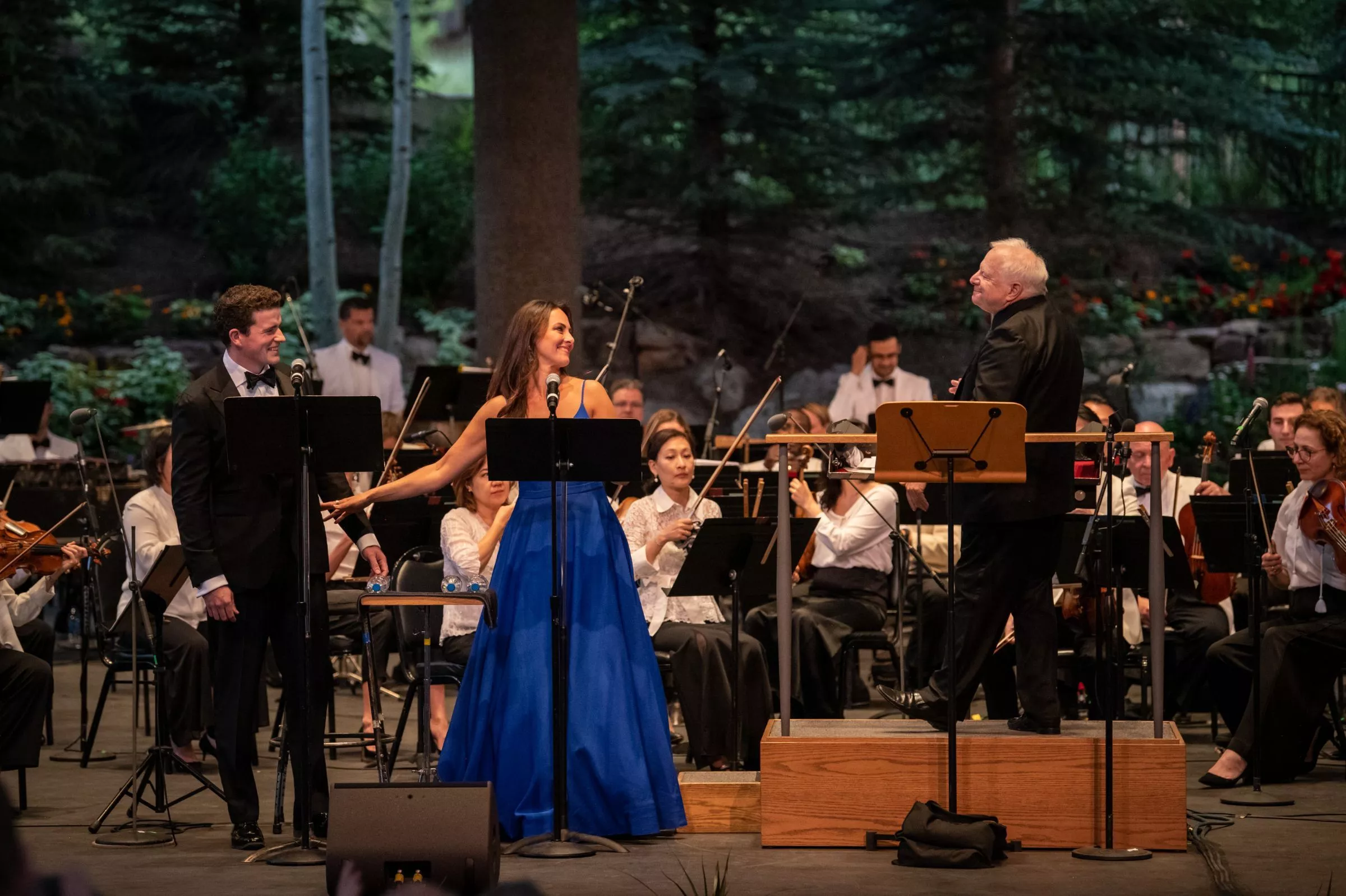
Emmett O’Hanlon, Isabel Leonard, Leonard Slatkin; photo (c)Carly Finke
Here’s my report on the New York Philharmonic’s closing orchestral concert of the 2022 Bravo Vail Music Festival:
One of four orchestras appearing at Bravo! Vail this summer, the New York Philharmonic brought along six different programmes, the first four of which were led by music director Jaap van Zweden – including a cathartic Mahler Sixth. Leonard Slatkin took over the reins for the remaining two programmes in the open-air main venue: an all-Tchaikovsky evening and this concluding concert, “A Sondheim Celebration”….
This evening at 7pm EST, the Met Museum hosts the digital premiere of The Mother of Us All by Virgil Thomson to Gertrude Stein’s libretto about Susan B. Anthony and the women’s suffrage movement.
The production, which was filmed during live performances at the Met’s sculpture court in the American Wing in February, is a collaboration between Juilliard and the New York Philharmonic (and part of the latter’s ongoing Project 19 initiative.
Watch the premiere on Facebook, YouTube, or at the bottom of the Met’s page here.
Louisa Proske, the production’s brilliant director, offers an introduction here:
For his recent pair of programs guest conducting the New York Philharmonic over the past two weeks, Semyon Bychkov has made a point of combining familiar repertoire with new discoveries. At the end of April, it was a Brahms symphony with the American premiere of Thomas Larcher’s Symphony no. 2 (Kenotaph), a response to the tragedy of refugees who have drowned in the Mediterranean. The Russian returned to the podium for a second program that placed Strauss’s Ein Heldenleben side-by-side with a piece that might as well have been a premiere: the last time the NY Phil performed the Concerto for Two Pianos and Orchestra (Op.88a) by Max Bruch was in 1917.






 MEMETERIA by Thomas May