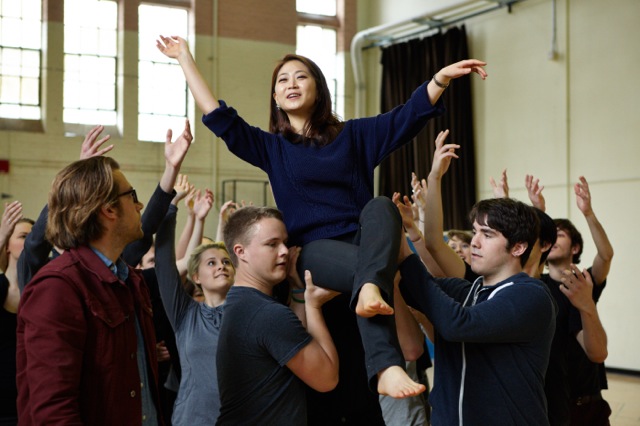
Director James Darrah rehearsing Semele, with Haeran Hong as the title heroine; photo by Steve Korn
Music lovers in the Seattle area will not want to miss this weekend’s performances of Semele, a joint effort by Pacific MusicWorks and the University of Washington School of Music.
I was lucky to be able to attend one of the rehearsals, where I found myself spellbound by the flow of ideas and inspired rapport between director James Darrah and the cast — all this without a stage or costumes and only harpsichord accompaniment. Semele is a late Handel work (1743) that never fit comfortably into the era’s expectations for either opera or oratorio, but Darrah and company are treating it as the liveliest brand of music theater, full of humor, wit, enchantment, and (literally and figuratively) epiphany.
It’s easy enough to imagine the musical and theatrical potential Handel saw in this material, retooling a libretto more than 30 years old — it includes the work of Alexander Pope — which itself retells the classical myth of Semele and Zeus/Jupiter. The human Semele has a fateful love affair with none other than the king of the gods, triggering the jealousy of his wife. Juno’s plan to avenge herself results in the destruction of Semele as a mortal woman but leads to the birth of Dionysus/Bacchus — a boon for humanity.
Handel knew how to carve into the meat of the mythic matter with this story of human aspirations for the impossible, of divine vulnerability to human emotion, of the power of irrepressible desire. A century later, Wagner noted the archetypal aspects of the tale and its similarities to Elsa’s ill-fated questioning of Lohengrin in another human-meets-transcendent encounter. (Another variant is found in Apuleius’s marvelously elaborate narrative of Cupid and Psyche.)
Seattle has tended to be a Handel-deprived zone for far too long, but Stephen Stubbs — the visionary artistic director of Pacific MusicWorks — is changing the playing field with his musically and theatrically stimulating advocacy of early and baroque composers. An internationally acclaimed musical director and lutenist, Stubbs marries the energies of his early music expertise with an appreciation of cutting-edge stage direction and interdisciplinary artistic creativity.
And his choice of the Los Angeles-based director and visual artist James Darrah bodes well. (Darrah has worked with the likes of Peter Sellars and John Adams, and among his upcoming projects is a collaboration with Michael Tilson Thomas next month for the San Francisco Symphony’s semi-staged production of Peter Grimes.)
During the rehearsal I saw, Darrah was coaching the appealing cast of young artists singing the chorus into how to develop into a major character in their own right rather than a passive, fly-on-the-wall musical presence. The chorus became a visible and dynamic extension of the power play among Semele, Juno, and Jupiter. And far from purveying an arbitrary “concept,” Darrah showed with his sensitivity to the subtexts of Handel’s melody and counterpoint that he commands an intimate understanding of the score and of the way Handel constructs his narrative arc.
It should be fascinating to compare the final results of performance with what will happen on the Seattle Opera stage next February-March, when the director Tomer Zvulun returns for a mainstage production of Semele. Meanwhile, Stubbs is spearheading experiments in smaller-scale productions involving partnerships between different organizations and even with companies across the Northwest — all of which promises to enliven the ecology of Seattle’s art scene, for early music and contemporary composers alike.
If you go: Pacific MusicWorks and the University of Washington School of Music present Handel’s Semele Friday and Saturday, May 16 and 17, at 7:30 pm and Sunday, May 18, at 2:00 pm at UW’s Meany Hall. (Sunday’s matinee performance is presented by the student cover cast.) Tickets at 206.543.4880 or 1.800.859.5342 or here.
(c) 2014 Thomas May All rights reserved.
The Los Angeles Philharmonic is now presenting its 2014 edition of the Minimalist Jukebox Festival, curated by Creative Chair John Adams. I’m especially excited about the offering for Thursday, 17 April: the Rome section from the CIVIL warS, a Robert Wilson-Philip Glass collaboration. Here’s the essay I wrote for the LA Phil’s program:
Is it too far-fetched to compare Einstein on the Beach’s seismic effect with that of The Rite of Spring? At least in terms of the prospects for contemporary opera in America — in a moribund condition at the time — Einstein’s U.S. premiere in 1976 was a game-changer. And in the context of Minimalism itself, this groundbreaking collaboration between Philip Glass and Robert Wilson opened up a new world of possibilities for a composer who, as Glass has often repeated, up to that point had never dreamed of writing opera.
By the time of his second collaboration with Wilson on the CIVIL warS project, Glass had taken up the “conventional” rhetoric of opera — which is to say operatically trained voices, chorus, and full orchestra — and translated this into his unique style and idiom.
Glass himself considers Einstein to be both his first opera and an end point — the culmination of a long period of experimentation in abstract, instrumental forms with what is now generally regarded as “hard-core” Minimalist processes. This inaugural collaboration with Wilson was followed by Satyagraha, his first work written for an actual opera company (Netherlands Opera). Glass then undertook Akhnaten, completing his trilogy of “portrait operas” based on iconic figures in the period when he was working on the CIVIL warS.
The work we hear on tonight’s program therefore represents another important early step in cultivating a medium on which Glass has concentrated, with incredible productivity, up until the present. It is in opera that “Glass found a medium in which he could put his newly developed language to expressive use,” as the critic Allan Kozinn observed as far back as 1986. His turn “from abstract composition to representational music” has not kept Glass from continuing to write such abstract instrumental works as symphonies, concertos, and quartets, but the collaboration with Wilson in particular left a decisive mark on Glass’s conception of Minimalist language.
This language itself, it should be noted, was in its Glassian dialect initially rooted in “representational” projects from the composer’s early Paris years, when he made pivotal encounters with Indian music and the theater of Samuel Beckett. Through these projects Glass became fascinated by theatrical and musical sensibilities that posited an alternative to Western conventions of narrative linear time and space. Glass apparently first happened upon the work of Robert Wilson via the 12-hour-long The Life and Times of Joseph Stalin, which the Brooklyn Academy of Music presented in 1973.
That encounter had the effect of an epiphany. “I understood then, as I feel I have ever since, [Wilson’s] sense of theatrical time, space, and movement,” Glass has remarked. The composer once characterized the sense of time in his own music as existing outside “colloquial time,” with the result that audiences tend to perceive this music “as extended time, or loss of time, or no sense of time whatsoever.”
In Einstein Glass had his first opportunity to match his musical constructions to the vision of the maverick director from Texas. Wilson abandoned the business career intended by his father to instead take up a life in the performing arts, evolving his enormously influential brand of theater in New York City’s avant-garde downtown scene of the 1960s.
Through his idiosyncratic collages of surreal, dreamlike elements, stylized stage movement and gesture, and associative rather than plot-driven content, Wilson created a modernist counterpart to the Wagnerian Gesamtkunstwerk — only this is a “total work of art” that, unlike Wagner’s, reflects the intersecting visions of its collaborators rather than the vision of a single artist.
And, as Glass has emphasized over the years, its meaning is outside the control of the creators. Figuring out the relation of his own music to the words and images of the entire theatrical experience (or film, in the case of his collaborations with the director Godfrey Reggio) thus requires the active participation of the audience to be completed. “Early on in my work in the theater, I was encouraged to leave what I call a ‘space’ between the image and the music. In fact, it is precisely that space which is required so that members of the audience have the necessary perspective or distance to create their own individual meanings.”
Even in a cantata-like concert performance lacking the hallucinatory visuals that originally accompanied the full staged version, the Rome section (a Prologue and three scenes), affords the audience fascinating examples of this “intertextual” space, which might be contrasted to a more straightforwardly expressive “translation” of text and feelings into musical content.
The libretto prepared by Wilson and his collaborator Maita di Niscemi, for example, wasn’t intended merely to be “set” to music. Wilson had already constructed a multilayered verbal and visual text lacking only the musical layer. Glass’s contribution thus represented the final creative stage. He carpentered his score to align precisely with the timings from a pre-recorded read-through of the text as a stage play (though with the words delivered at an abnormally but operatically “true” slow pace).
All of this was meanwhile intended as the part of a still larger whole titled the CIVIL warS: a tree is best measured when it is down, to be performed in Los Angeles to celebrate the international spirit of the Olympics held here in 1984. Wilson began with a characteristically elliptical take on the American Civil War — in particular, Matthew Brady’s haunting contemporary photographs — and imagined a world historical juxtaposition of images and associations from antiquity to the Space Age. These riff on themes of war and peace, nation and family, civil and internalized struggle and enlightenment.
The peculiar typography of the title draws attention to a “struggle” between upper and lowercase letters as well as to the plurality of this phenomenon. “Civil Wars” also happens to be the customary translation of one of Julius Caesar’s writings. The subtitle quotes from Carl Sandburg’s canonical biography of Abraham Lincoln, for whom Wilson devised an unforgettable visual of a figure who is eventuality “struck down” (a singer suspended in a 16-foot-high harness, draped with a long black coat and sporting a stovepipe hat).
Never lacking for ambition, Wilson intended to stage a day-long ceremonial opera featuring composers, writers, and performers from around the world. Glass was one of several composers invited to contribute music for a different section of the vast five-act opus. The sections which were completed took their names from the locations of their separate premieres: hence the Rome section, envisioned as the final, fifth act of the CIVIL warS, was independently commissioned and staged (in March 1984) by the Opera di Roma. Glass also wrote the music for the Cologne section (scenes from Acts 1, 3, and 4), while David Byrne created connective pieces to link the scenes, known as The Knee Plays or the Minneapolis section.
At the last minute, the LA Olympic Arts Festival pulled the plug and canceled its plans to fund the complete staging. One of the commentators in Katharina Otto-Bernstein’s 2006 documentary Absolute Wilson observes that the director has since regarded this decision as the single greatest disappointment of his career. The Rome section, like the others, was thus left as a torso that has been occasionally performed on its own.
There is no story to synopsize. Wilson and di Nascemi’s libretto is largely a collage, an assemblage of texts from letters of the American Civil War period, ancient tragedies by Seneca for the Roman connection (in the original Latin and translated into Italian), and stream-of-consciousness word poems by Wilson himself, recited by a male and a female narrator. (On the Nonesuch recording, these parts are taken by Wilson and Laurie Anderson.)
It is for you, gentle listener, to generate what you will from the text’s recombination of historical, iconic, symbolic, and seemingly “automatic” elements. Figures we expect to see from the American Civil War — Abraham and Mary Lincoln and Robert F. Lee (who reappear in Glass’s more recent 2007 work for San Francisco Opera, Appomattox) share this dreamscape with the (French-born) leader of the Italian Risorgimento, Giuseppe Garibaldi, Hercules and Alcmene (the hero’s mother), and mythic Hopi characters, the “Earth Mother” and “Snow Owl.”
Glass’s very first notes, an ominously descending bass, happen to echo a similar gesture at the beginning of Einstein. But the original commission by Rome Opera — in the land where opera was born — led Glass to reflect on the power of the human voice itself and its central role in this medium. Whereas Einstein had featured relatively little singing, the Rome score is cast for huge, dramatically projected voices, with especially demanding high parts for the soprano and tenor soloists.
At the same time, Glass resorts to a Wagnerian sweep of orchestral sonorousness over which these voices float, as well as recurrent motivic ideas such as the brief trumpet call pervading the Prologue. Oscillation between major and minor provides the fulcrum for Glass’s idiosyncratic slant on tonality. The orchestral writing features primary-color effects, with fresh twists on conventional instrumental “imagery” such as military brass and drums or the floating arpeggios of bel canto accompaniment.
Indigenously American congregational hymn singing also informs some of the choral writing (Scene B), and elsewhere references to nineteenth-century Romanticism (Verdi and Tchaikovsky) color the choral and solo parts as well as the orchestral interludes. Creating a panorama of alternately turbulent and elegiac soundscapes, Glass recontextualizes familiar imagery in a way that’s reminiscent of Wilson’s process. Musically, the result is akin to the opera’s mingling of history and myth, of artifact and dream.
Alex Ross has provided this translation of Peter Sellars’s tribute to the visionary director Gerard Mortier, who died on 8 March in Brussels:
Gerard Mortier was a mercurial operatic visionary who transformed the art form—not with a particular production or body of work, but with an attitude. Wherever Gerard was and whatever he was doing, you knew it would be exciting. His imprimatur guaranteed challenge, engagement, pleasure, and the kind of adventure informed and made possible by profound conviction and deep connoisseurship.
None of us who knew and worked with Gerard will ever be the same. His visionary, always practical, and constantly generous presence enlivened each conversation, each rehearsal, each project. Perhaps more amazingly, many of Gerard’s rivals, critics, and adversaries will never be the same either. They also did what they did and are doing what they are doing in response to Gerard’s vision, leadership, and permanent challenge. Gerard’s particular brilliance is to be equally vital and ultimately influential to his friends and to his enemies.
Gerard’s rare gift was his sense of the delicate alchemy of collaboration. Most of us have met some of the most important artistic partners of our lives courtesy of Gerard’s inspired insight and at Gerard’s elegant invitation. The results could be seen and heard on stage, but many of Gerard’s commitments and innovations remained backstage.
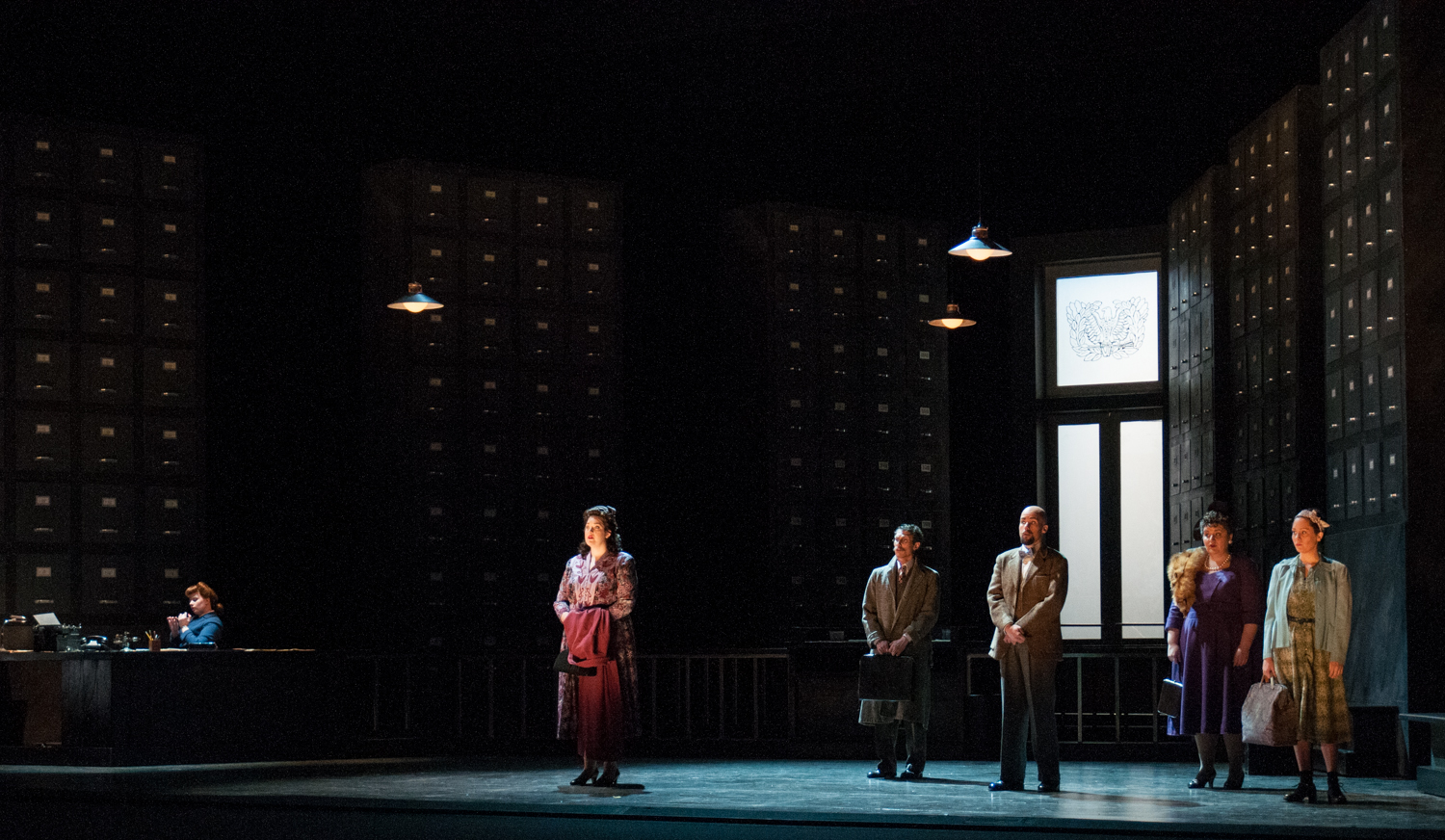
Menotti’s The Consul at Seattle Opera; photo by Elise Bakketun
Here’s my City Arts preview of the production of Gin Carlo Menotti’s The Consul, opening this weekend at Seattle Opera:
It may seem odd for an opera company to be cagey about revealing the ending of a work written more than a half-century ago. But Seattle Opera is holding the cards very tight to its chest when it comes to The Consul by Gian Carlo Menotti. Seattle Opera’s production, which opens this weekend, marks the company’s first staging of the work and will certainly be the first live experience of it for many in the audience. Premiered in March 1950, The Consul enjoyed a flash of glory when it transferred to a Broadway theatre that year, playing for some 286 performances.
Set in a grey, unidentified totalitarian state in the middle of the 20th century, The Consul revolves around the plight of Magda Sorel and her husband John, a dissident who is forced, shortly after the opera begins, to go into hiding as an enemy of the state. Magda desperately attempts to negotiate the dehumanizing bureaucracy of the state Consulate to arrange for legal emigration.
There are obvious tinges of Kafka and other poets of modern alienation as Magda repeatedly tries to satisfy the baffling documentation requirements demanded by the Consul’s office. The secret police stalk her, closing in on her husband’s whereabouts. In the final scene, after they arrest John at the Consul’s office, “it comes down to whether the secretary will break the rules and do the right thing…” Or at least that’s how the cliffhanger synopsis on Seattle Opera’s website describes the ending.
Quite happy to see Tom Adès take the Best Opera Grammy for The Tempest. I had the opportunity to write this essay for the Met when the production staged by Robert Lepage first appeared there:
When The Tempest opened at London’s Royal Opera House in February 2004, the anticipation couldn’t have been more intense. Composer Thomas Adès—only 32 at the time—had already been thrust into the international spotlight in the previous decade and found himself having to live up to recurrent comparisons with his similarly precocious compatriot and predecessor Benjamin Britten. Despite all this pressure, the overwhelming, almost unanimous response to Adès’s second opera seemed to confirm the parallels. “Only time will tell whether the first night of The Tempest in 2004 was a moment to set alongside the first night of Peter Grimes in 1945 in the history of British music,” wrote The Guardian the day after the occasion. “But it felt that way in the theatre.”
Time has proved that the initial verdicts weren’t idle hyperbole. The Tempest belongs to that rare group of contemporary operas whose critical acclaim is matched by the ultimate practical test of stage-worthiness. In fact, The Tempest—still less than a decade old—can already boast an astonishing track record of five different productions: the original Covent Garden staging (which was revived in 2007 and recorded for EMI’s award-winning CD), the American premiere at Santa Fe Opera in 2006, two separate productions in Germany, and now the opera’s premiere at the Met, which promises to be among the highlights of the new season.
Robert Lepage’s staging is a co-production of the Met, Opéra de Québec, and the Vienna Staatsoper and will also feature Adès (pronounced AH-diss) making his company debut as conductor. Reprising his performance as Prospero is baritone Simon Keenlyside, whose combined vocal and physical presence were widely admired as ideally suited to the role he created at the Royal Opera House.
The once-obligatory references to Britten became a kind of shorthand for English critics eager to spell out the high expectations pinned on Adès. In fact, he is an artist whose voice is unmistakably and audaciously original. Many gifted young composers demonstrate an eclectic, anxiety-free facility when it comes to claiming elements from the musical past for their own creative tool kit, but what was especially striking about Adès, while he was still just in his twenties, was the uncanny confidence with which he forged a rich, complex, allusive language with a coherence all its own.
Even more, before the millennium Adès had already found exciting ways to develop his flair for formal, abstract structures, vivid orchestration, and spirited detail while also demonstrating a compelling theatrical instinct. His range was apparent, whether in writing for a large Mahlerian orchestra (the symphonic Asyla, commissioned for the Berlin Philharmonic, for example) or in his first work for the stage, the chamber opera Powder Her Face (1995).
The latter, which used the scandalous story of an aristocrat’s fall from grace to ironically turn the mirror back on a tabloid-saturated culture, also revealed Adès’s extraordinary feel for portraying characters in music. With the far vaster canvas of The Tempest, he progressed to a mature mastery of his art, taming the often volatile energy found in his youthful scores into a sustained, emotionally gripping arc.
Shakespeare’s beloved final romance, remarks Adès, “is famously full of references to music, while the intangibility of some of its characters has always inspired music.” Purcell, Tchaikovsky, Sibelius, and Berio are just a few of the many composers who have fallen sway to its spell; even Mozart, near the end of his life, may have contemplated turning The Tempest into an opera. Yet instead of finding himself daunted by the weight of associations bound up with the source material—above all by the sheer power and poetry of Shakespeare’s language—Adès discovered a fresh approach to “translating” the Bard’s vision into opera.
The composer collaborated closely with librettist Meredith Oakes, an Australian-born playwright and poet whose talent for evoking traditional poetic patterns through “a very specific, archaistic style” felt particularly appropriate. Oakes distilled the original verse into pithy, condensed couplets that echo the play’s most famous passages in eminently singable phrases—instead of competing with them. Many of the couplets take the form of half-rhymes or slant-rhymes that acquire an extra charge by being ever so slightly off. The result, Adès says, “is a translation of Shakespeare into modern English, to be all the more faithful and concentrate the drama.”
Yet the three-act opera remains remarkably true to the arc of Shakespeare’s story and the spirit of his characters, while at the same time opening up the creative space necessary for Adès to add the unique perspective of his musical imagination. “I want it to be The Tempest. I want it to be Shakespeare and to bring that vision into the opera house as faithfully as possible,” the composer points out. “We actually started further away from the play than we ended up but found ourselves going back to Shakespeare’s structure much more.” But to achieve such fidelity—as opposed to a pale imitation—Adès and Oakes determined early on that they needed to swerve away from dogged, literal re-creation.
The most striking shift involves the opera’s conception of Prospero, the former Duke of Milan who, in the back story, has been usurped by his brother Antonio and shipwrecked on an island with his young daughter, Miranda. Prospero’s desire for vengeance is more pointed in the opera, as is his related assertion of control over the island’s indigenous creatures—Ariel and Caliban—and over Miranda’s emerging emotional autonomy as she falls in love with Ferdinand, his enemy’s son.
The libretto provided Adès with clearer “musical emotions” that motivate the dynamics of enslavement and liberation in the story as well as the transforming power of love and compassion. The real turning point, observes the composer, comes when Ariel tells Prospero that the suffering he has caused his enemies to endure would soften Ariel’s own heart if he were human. “And it’s the moment when Prospero realizes he’s gone too far and has to stop.”
Lepage, familiar to Met audiences for his stagings of Berlioz’s The Damnation of Faust and Wagner’s Ring cycle, praises the opera for capturing the “magic” of what is often considered the playwright’s final artistic testament. Not surprisingly for this wizard of theatrical illusion, the figure of Prospero has long fascinated Lepage, who has directed numerous productions of Shakespeare’s play. Each time he returns to it, he uncovers new insights. For his own concept of the opera, Lepage has expanded its aura of magic into a metaphor for artistic performance itself, envisioning Prospero as an 18th-century impresario of La Scala, the opera house in Milan, which he has recreated on the island of his banishment as a reminder of home.
“In those days, La Scala was a very magical place to set operas because it had all of the new state-of-the-art machinery,” Lepage explains. “The beach where everybody is marooned is actually a stage that’s been planted there and constructed by Prospero.” Lepage adds that each of the three acts presents a different perspective—from the stage itself, from the auditorium, and what goes on behind and off stage—to encompass this “opera-within-an-opera house.”
Members of his creative team will be making their Met debuts: Jasmine Catudal designed the sets, and the costumes are by Kym Barrett (known for her collaborations with Baz Luhrmann and her work on The Matrix films). The overall look will marry a sense of the island’s “native, aboriginal culture” with the Italian Baroque sensibility imported by the European interlopers.
Lepage’s mastery of both traditional stagecraft and its most up-to-date technological forms provides an ideal complement to the composer’s unique fusion of a classic play with a contemporary vision of opera. In his musical characterizations of the five leads, for example, Adès developed wonderfully effective alternatives to the vocal type casting that might have tempted a less-imaginative composer. While Ariel, a male character played by a soprano, sings in a stratospheric tessitura (frequently perching on Ds, Es, and Fs above high C, even reaching to G), “this isn’t a way of expressing high emotion and shouldn’t feel like the top of the singer’s range. That’s where she lives.”
Ariel is an elemental force of nature who—in another alteration of the original source—sings the final airborne phrase and becomes the wind again. Her island counterpart, the “monster” Caliban, is depicted not as a “lumpen, earthy brute” with a bass voice but is a lyrical tenor. “He’s often described in the play as being like an eel or a fish, and I suddenly thought he could be more like one of those exotic, wonderful voices from the East, with a weird elegance. And of course he is an aristocrat, not only in his own mind,” says Adès, who gives Caliban one of the most radiantly beautiful passages in the score: his aria reassuring the shipwrecked newcomers not to fear the island’s “noises.”
As for Prospero, the composer created a fully dimensional baritone role (with shades of Verdi’s and Wagner’s authoritarian father figures) who nevertheless defies the stereotype of the wise old sage. Adès was especially inspired by crafting the role for Keenlyside. “Simon’s a terrifically physical performer who projects youth. In a way, it’s that characterization, as much as the extraordinary voice, that was on my mind. I don’t think of Prospero as an old man. This is the only play of Shakespeare which observes the classical unities of happening in one place, in one day. When Prospero meditates on the evanescence of life, my feeling is actually it’s not that he does that every day and has been doing it for years and he’s an old bore. It’s that he’s just realizing it at that exact moment. That’s the first time he’s thought this.”
While Adès writes for the voice with great character, his score is also distinguished by its symphonic intricacy and architecture. This quality provides the opera with a richly satisfying cohesion and unity. Adès achieves this not through conventional leitmotif technique but by expertly manipulating his uniquely evocative harmonic language. He explains: “The music has its own internal logic of relationships; it doesn’t just do what it wants to do because the characters suddenly decide to go somewhere. It’s a tissue that’s woven in, so that everything is related in the music, and all the elements create a view of the world that’s whole, a sphere.”
Anne Schwanewilms as the Empress, Torsten Kerl as the Emperor, and Scott Weber as the Falcon; photo by Ken Howard
I’m still ruminating on the recent peak experience I had at the Metropolitan Opera: this season’s revival of Richard Strauss’s Die Frau ohne Schatten, directed by the late Herbert Wernicke (which I had missed when it was unveiled in 2001).
The world of Strauss and Hofmannsthal has long felt very familiar to me, but there’s no question that Frau emits a strangeness that veer perilously toward the overly precious or the downright obscure if all its elements aren’t carefully balanced.
But when they are – as they were for this overall superb production – the rewards defy comparison with just about any other opera experience I can summon. Frau doesn’t merely reaffirm the excellence of opera as an art form: it suggests an entirely new dimension of operatic possibility rarely hinted at even by many acknowledged masterpieces.
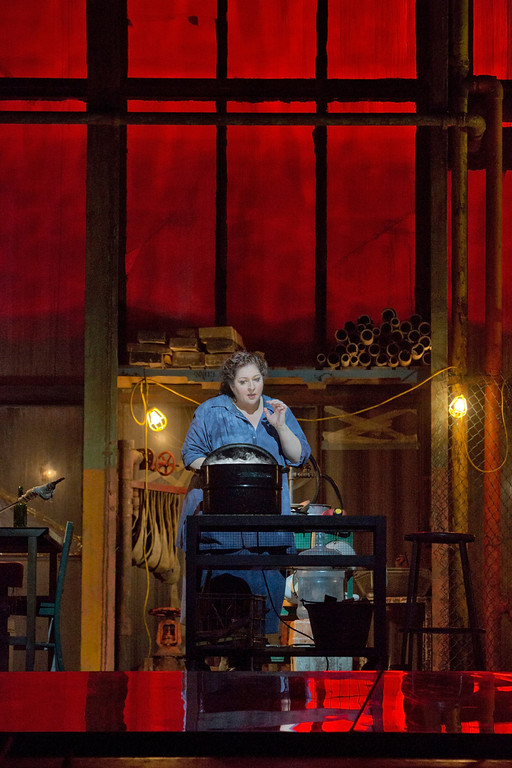
Christine Goerke as the Dyer’s Wife; photo by Ken Howard
Not everything is perfect in the Met’s production, not all the questions this phantasmagoria of Hofmannsthal and Strauss leaves you wrestling with get answered, or even clarified as questions (are they even meant to?). Some of these are mundane, some of key relevance to the opera’s meaning: Why do we occasionally see the Empress’s shadow (or were those reflections?)? Why are Barak and Keikobad the only characters with names? Why does Keikobad relent in a Sarastro-like reversal of the way he’s been introduced to us? What really drives the Nurse? And on and on….
Here’s a little collage from some of the more interesting reviews of the recent revival:
Herbert Wernicke’s 2001 production, now revived and revised, is a fine, gaudy bit of stagework. The walls of mirror for the magical realm, enhanced by projections, doubles, torches and the Met’s underappreciated stage elevator (absolutely silent as the four- or five-story set slithers back and forth, in and out, up and down!) make a dandy backdrop for multidimensional show, and the mirrors conceal inopportune shadows until the story is ready to receive them. The seamless flow of stage-high trickery in Act III should tickle any theatrical fancy.
Wernicke’s Met production is a great success, and actually lives up to the music’s energy and atmosphere…The design—all by Wernicke—is the primary attraction. The world of the Empress, Emperor, and Nurse is a mirrored box, whose transformations are seen in various dramatic flickering lighting effects. In contrast to this glamour, the Dyer’s house is in a gritty sewer or subway, located below the box and connected by a fire escape staircase…The upper level is timeless and mythic, the lower contemporary and realistic…
The upper level is timeless and mythic, the lower contemporary and realistic (Act 1 ends with the dyer Barak poignantly staring into an open refrigerator). The implication is vaguely Marxist: the Empress (surrounded by narcissistic mirrors) is exploiting the literal underclass, for whom she gradually learns compassion. The finale is Brechtian–or lieto fine-ian—with the lighting scaffold descending to reveal the stage mechanism and the singers addressing the audience directly. Since the music does not follow suit in any way, I found this gesture a little ineffective, but overall this is a very strong and convincing production.
[Frau] represents the Met at its peak: Every element melds into an overwhelming artistic experience. It’s how you dream opera ought to be. The Woman without a Shadow even feels like a dream or rather a nightmare one might have dozing off while cramming for a final exam on Advanced Jungian Analysis….
In an interview published at the time of the production’s premiere, [Wernicke] declared, “The shiny, mysterious realm of spirits and the poor, low-class world of the Dyer, Barak—that’s just like New York’s lofty Central Park West apartments, in their harsh contrast to the underworld of poor people and outcasts and the subways, where the homeless fight over leftovers with the rats.”
Christine Goerke as the Dyer’s wife) and Johan Reuter as Barak; photo by Ken Howard
In Wernicke’s concept, the Emperor and Empress rule over an ethereal plane represented on the stage by a mirrored tunnel. It is remarkable how much is accomplished here using only scrims and lighting (it’s hard to remember a time when computer projections weren’t the industry standard). In the mirror-world, the various characters have strongly evocative auras that light up the set. The stunning pink-and-blue diffusion that accompanied the Empress’s first entrance gave the audience a sense of what life might be like on the inside of a jellyfish.
When the time comes to journey into the mortal realm, the entire set rises up to reveal a dreary warehouse that serves as the dyer Barak’s home and workplace. The contrast between the two settings is striking—where the upper plane is blindingly radiant but physically spare, the dyer’s workshop is fully and realistically furnished but lit only by overhead factory lights.
It began – and ended – in 2001. Herbert Wernicke startled the basically conservative Met with an astonishingly progressive production of Richard Strauss’s magnificently bloated Die Frau ohne Schatten. He actually made theatrical sense of Hugo von Hofmannsthal’s high-minded, hopelessly convoluted libretto.
Serving as his own designer and lighting magician, Wernicke played the spiritual scenes in a surreal hall of mirrors. For the mundane episodes, he created a contemporary milieu resembling an industrial warehouse. For the ultimate resolution, he introduced neo-Brechtian imagery. He dealt in revelations at all levels.
I tracked down a full program (in German only) from Robert Carsen’s production for the Wiener Staatsoper, which is brimming with information and fascinating essays.
Meanwhile, Krzysztof Warlikowski’s production of Frau for Bayerische Staatsoper will be streamed live this coming Sunday (December 1), starting at 6 pm CET. Be careful: this is heavily addictive stuff.
Lawrence Brownlee as Almaviva in Barber, one of his signature roles; photo by Ken Howard
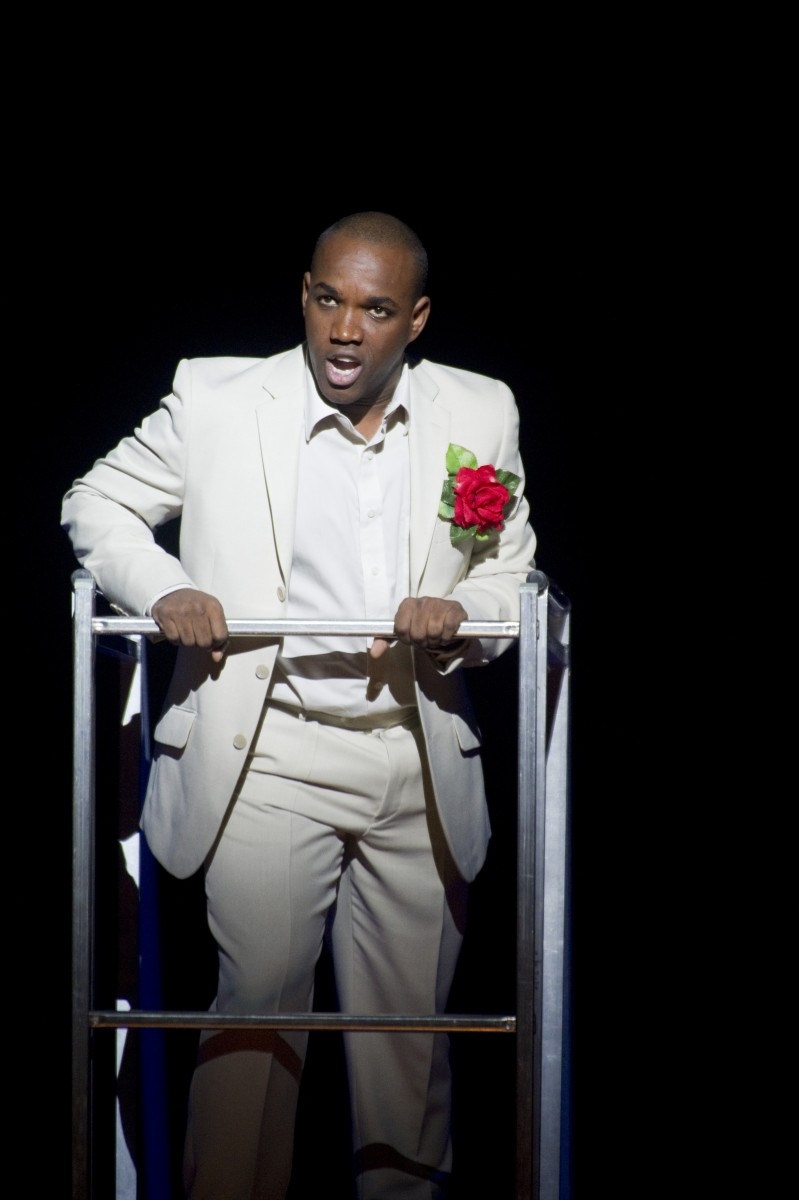
The marvelously gifted tenor Lawrence Brownlee makes his Los Angeles Opera debut as Tamino this coming weekend in the Barrie Kosky production of The Magic Flute. Here’s a profile I recently wrote about Larry for Seattle Opera, where he appeared last month as Tonio in The Daughter of the Regiment:
Nowadays no American tenor is more in demand than Lawrence Brownlee when it comes to the bel canto repertoire. And it’s easy to imagine the impression Brownlee’s voice—with its signature combination of sweetness, warmth, and flexibility—would have made on Gaetano Donizetti, or any of the bel canto composers. With their elegant melodies and deeply felt emotions, they were writing, it seems, specifically to Brownlee’s strengths, and he has proved that he has the versatility to excel in the distinctive styles developed by each member of bel canto’s famous triumvirate: Donizetti, Bellini, and Rossini.
“People always tell me I sound like an old-school singer,” Brownlee remarks, “but that’s not something I consciously try to do. That’s just the way my voice is made and constructed, so it naturally fits this repertoire…. I think of myself simply as a bel canto tenor.”
Larry offstage; photo by Derek Blanks
The star tenor is speaking by phone from a hotel room in Berlin during a rare day off in late summer, before heading to Palermo to sing Rossini. His next stop: Seattle, to sing Tonio in The Daughter of the Regiment. Anyone who meets Larry Brownlee in person can attest to the down-to-earth, uncontrived modesty that likewise comes naturally to this son of the rustbelt city of Youngstown, Ohio.
While Brownlee’s international reputation is particularly associated with his interpretations of Rossini, Seattle audiences have had the opportunity to hear and see him put his stamp on major roles by Bellini and Donizetti as well.
Brownlee made his mainstage debut at Seattle Opera in 2002 in the opera buffaDon Pasquale as Ernesto, singing another of Donizetti’s lovestruck comic heroes. And his uncompromising rendition of the high-wire vocal line assigned to the male protagonist Arturo in Bellini’s I puritani in 2007—including a full-on F above high C, not falsetto—now belongs to company legend. This coming spring Brownlee will sing the role at the Met for the first time.
“You can’t even find that on records!” says General Director Speight Jenkins, whose capacious memory-archive of a lifetime of performances can rekindle the live excitement of those Bellini nights apparently at will.
Yet what’s really impressive here—as in Brownlee’s taking on the notorious “Everest” of nine high C’s his character Tonio must sing early on in The Daughter of the Regiment—isn’t just the technical ability to produce these notes with such reliable accuracy. That’s simply the starting point. The accuracy is one thing, Jenkins points out, “but rarely do you hear the beauty of those upper tones.”
“To be able to sing Tonio’s nine high C’s always amazes people, but that’s what the voice Donizetti was writing for is supposed to do,” explains the tenor, director, and teacher Peter Kazaras, who shares the stage with Brownlee in Daughter playing the haughty Duchess of Krackenthorp in drag in Seattle Opera’s production. “The reason people were so awed when Pavarotti did it [in his career-defining performance at the Met in 1972] is that he was a lyric tenor, not the light, leggiero tenor these roles were conceived for. There are a few people who can sing this kind of repertoire, but what sets Larry apart is that he sings it and the voice is actually beautiful.”
Brownlee as Tonio in the Met’s Daughter of the Regiment; photo by Ken Howard
Jenkins, renowned for his ability to recognize the potential in young singers with startling accuracy, remembers the thrilling experience of hearing Brownlee in a rehearsal room back in his days in the company’s Young Artists Program, which he joined in 2000. It became immediately clear to Jenkins that the tenor (at the time only in his late 20s) could have a major international career.
“So many things happened for me as a result of going to Seattle early on,” Brownlee says. “I do consider Seattle my home away from home. Speight opened up a lot of doors for me and really invested in my career. Seattle Opera has given me a chance to do such a range of roles, from traditional productions to modern things like [Daniel Catán’s] Florencia en el Amazonas.”
Brownlee with Renée Fleming in Rossini’s Armida at the Met; photo by Ken Howard
To this day, Brownlee—himself a very young-looking 40—thinks of Seattle Opera as a place that attracts a vibrant young audience. When he was here, he became especially attuned to the presence of a young audience the company fosters through its BRAVO! Club and innovative social media networks. “I’ve gotten a chance to interact with them quite a bit, and many of those people I still keep in touch with via Facebook. They knew me before I started to do other high-profile things like singing opposite Renée Fleming [in Rossini’s Armida at the Met] and they really care about me.”
The Seattle production of Daughter presents the opportunity for a family reunion of sorts. Peter Kazaras had directed Brownlee in the 2011 The Barber of Seville, and Sarah Coburn, as Marie in Daughter, once again plays the object of Brownlee’s determined love. The two also appeared together in the Seattle Opera Young Artists Program’s La Cenerentola in 2002 and in the 2011 Barber, with Brownlee singing his signature role as Rossini’s Count Almaviva.
“I feel honored and blessed each time I have the opportunity to sing with Larry,” says Coburn. “I have also come to consider him a good friend and mentor. He has given me fantastic advice many times and has the added perspective of work-family balance. He understands the challenges of family life, especially in light of constant travel.”
Brownless and Coburn as Tonio and Marie in Daughter at Seattle Opera; photo by Elise Bakketun
As a husband and father of two small children (Zoe and Caleb), Brownlee says family life “keeps me grounded. I love my job and am grateful to have the chance to perform, but my family makes me realize that it’s not all about that—everything else is relative.”
“This isn’t an easy business—I don’t know how people did it before Skype. My wife, Kendra, and I spend hours together with our Skype turned on, just to be able to share in the unsaid things of daily life.” Brownlee registers his excitement about being able to have the whole family in Seattle for Daughter, along with an extended circle of relatives.
Brownlee, who grew up with six siblings in a tight-knit working-class family, doesn’t hesitate to single out the central role they play in his life. He loves to quote pieces of homespun wisdom from his father, a retired GM auto factory worker and army veteran: “Like him, I’m a ‘glass half-full’ guy, and I’ve learned from him to worry about the things you can control: things like my weight, or how musical and expressive I can be as a performer.”
Brownlee in Rossini’s L’italiana in Algeri at the Opéra de Paris
Brownlee’s positive attitude helped him bypass what he was told by some would pose serious stumbling blocks. Though no longer so blatantly tainted by racism as it once was, the mostly-white opera world can still throw up less explicit barriers to African-American performers. Brownlee, who appears incapable of harboring grudges, refuses to dwell on the fact that he was told by some that his ethnicity would keep him from being cast in leading roles. Concerns were similarly expressed that the tenor’s stature—at 5 feet six inches—would inevitably hamper his career, no matter how extraordinary were the gifts he had to offer as a performer.
Thankfully, Brownlee refused to listen to any nay-saying. Seattle provided his first platform, and it was from this region that he was selected one of the winners—along with Sarah Coburn—of the Metropolitan Opera National Council Auditions. Only a year later, when he made his professional stage debut, he was invited to perform at La Scala, and his career kept accelerating, with major European bookings filling out more and more of his calendar.
Brownlee prefers to focus on his gratitude to all those who have inspired him on his path: from courageous pioneers like the tenor George Shirley, who paved the way for Brownlee’s generation —and whom Brownlee reveres as one of his mentors—to the colleagues he regularly refers to as if they’re all part of an extended family.
Here in Seattle, Maestro Yves Abel is also pleased about this chance to reunite with Brownlee, whom he has conducted in Europe and at the Met’s well-known current production of Daughter (relocated to World War One). “Larry is a superlative artist, extremely musical and sensitive, with an innate and varied sense of style, excellent language skills, and a doll to get along with.”
Certainly Brownlee left indelible memories of his last venture in Seattle. Along with the ravishing vocalism of that Barber production, it amply demonstrated the tenor’s considerable comic talents—his turn as Rosina’s music teacher incognito ranks as the most hilarious I’ve yet seen—and his capacity to bring out a character’s essence.
“When I was directing him as Almaviva,” says Kazaras, “I was developing a carefully choreographed language all the way through the piece for each character, and I knew I could get Larry to use his talent as an accomplished salsa dancer.” Playing on one of the Italian phrases for his type of voice (tenore di grazie), Kazaras continues, “With Larry, the watch word is graceful. He is graceful in his singing, in his stage presence, and in his life.”
But Tonio in Daughter—a role Brownlee has performed at the Met, and in Cincinnati and Hamburg—is a different kind of person from Count Almaviva. How does Brownlee strive to make such a simple comic character come to life onstage? “The most important thing is to make him come across as sincere and heartfelt. Of course, everyone thinks of the high C’s in ‘Ah, mes amis!’ when he’s on top of the world. But you have to be able to show his real pain and disappointment as well.”
“A lot of people may not realize the more difficult aria is actually the second one—‘Pour me rapprocher de Marie’—where Tonio tells the Marquise what Marie means to him. You really have to think about musicality and phrasing here and make sure not to blow it all on the first aria. I hope it will be so beautiful that people will almost forget ‘Ah, mes amis!’—but I don’t want them quite to forget it completely!”
Brownlee and Joyce Castle (Marquise) in Daughter at Seattle Opera; photo by Elise Bakketu
Inevitably, Brownlee’s approach to these roles is compared to that of his almost-exact contemporary, the Peruvian tenor Juan Diego Flórez. (On YouTube you can easily find a video juxtaposing clips of Brownlee, Flórez, Pavarotti, and Alfredo Kraus singing Tonio, while heated discussions over their relative merits transpire on numerous blogs and listservs.) But when he mentions Flórez, it’s impossible to imagine one of the old-fashioned singer rivalries playing out. “Juan Diego is a friend. I also think he’s a great artist, and we have mutual respect for what each other does.”
Later this season Brownlee will be back in Europe to sing Donizetti at the Vienna Staatsoper (Nemorino in L’elisir) and Rossini in Munich (for Il turco and Cenerentola). His newest recording, Spiritual Sketches, meanwhile represents an entirely different direction that he hopes to pursue further. A set of ten arrangements of traditional spirituals for voice and piano by one of Brownlee’s friends, this latest release reveals what will sound like a whole new dimension to the tenor’s art to those who know him as a bel canto expert. Yet here Brownlee looks back affectionately to his musical beginnings, recalling his boyhood singing in the church gospel choir with his family.
On the heels of his Seattle engagement, Brownlee will be making both his role and company debuts as Prince Tamino at Los Angeles Opera in the Suzanne Andrade-Barrie Kosky production of The Magic Flute, described by The Guardian as “a perfect mixture of … silent films, the cabaret of the Weimar Republic, David Lynch, and the brothers Grimm.”
“It’s my first professional role in German,” says Brownlee, “and I also hope I have some more Mozart in my future. It’s nice to do that in addition to the Italian bel canto. The goal is to continue to grow as an artist. Hopefully I’m still at the beginning of my journey and will try to keep getting better and enjoy the ride.”
In honor of today’s live HD broadcast of Tosca from the Met, I decided to gather some of the critical reactions to the controversial production by Swiss director Luc Bondy when it was first introduced as the season opener in 2009.
[T]he booing, if a little unfair, was understandable… Mr. Bondy had scoured the work, it seemed, looking for every pretense to flesh out, literally, the eroticism of the lovers and the lecherous kinkiness of Scarpia. ..Mr. Bondy seems to be after mood, intensity and emotion, not logic. And some of the acting that he draws from his cast is intricate and involving…[He] probably wanted to rid his Tosca of stock clichés, yet his heavy-handed ideas are just as hackneyed.
Bondy certainly tried to clear away the layers of encrustation from the opera, rather like a restorer trying to clear the varnish from a painting. The problem was that he didn’t always seem to have a vision of the strong underlying image he was trying to reveal. His modus operandi seemed to be to get rid of all of the Tosca traditions and start afresh, but “afresh” often involved gestures every bit as gratuitous as the ones he was trying to replace…The strongest guiding hand of the evening was James Levine in the pit, who generally offered a reminder that this opera’s music can indeed still be fresh, vital and (in a couple of solo spots in particular) absolutely ravishing.
By all means, then, let’s have a new Tosca. But it needs to be good. And this is not…. [Bondy] has failed to find a clear angle on Tosca, and instead delivered an uneven, muddled, weirdly dull production that interferes fatally with the working of Puccini’s perfect contraption…The major gaffe of the night comes after Tosca kills Scarpia, when, according to the libretto, she places candles by his side and a crucifix on his chest. ..[S]omething should happen during the thirty-bar postlude that Puccini composed for the ritual. Here…Tosca murders, then dithers…While there is nobility in an ambitious failure, there is no glory in ineptitude.
There was some egregious silliness to the Bondy version, which no doubt goes some way to explain the cat calls… In act two Scarpia is being pleasured by a courtesan kneeling between his legs, a wholly gratuitous addition to Puccini’s portrayal of an evil torturer who exudes suppressed sexuality in any case.Those incongruities aside, the puzzling thing about the audience reaction last night was that in most other regards the Bondy production is striking by how safe it is, how little risk-taking and how traditional.
Bondy has stripped the piece of specificity and replaced it with a grim collection of non-locales and coarse interpolations…Though Bondy has never worked at the Met before, his fashionable Euro-minimalism has become something of a house style: dim light, blank walls, black costumes, and dour abstraction….I hope the Met’s Peter Gelb is already trying to figure out how soon he can scrap this staging.
Abetted by his designer, Richard Peduzzi, Bondy has turned Puccini’s sleazy masterpiece into sterile melodrama with raunchy trimmings…A different directorial gimmick cheapens the ending of each act…Bad timing, bad ideas.
Ligeti’s Le Grand Macabre presented by the New York Philharmonic in 2010; (c) Chris Lee 2010
My new feature for Symphony magazine’s Fall 2013 issue is available online now:
Total immersion: that was the radical brand of opera Richard Wagner hoped to inaugurate at Bayreuth. To enhance its effect, he famously made the “invisible orchestra” an integral part of his design. Yet the overall ideal of intensified theatrical illusion remained frustratingly out of reach, hampered by the limitations of the stage technology of the time. Cosima Wagner reported her husband’s sardonic joke in the aftermath of his deep disappointment over the first complete Ring: “Now that I’ve created the invisible orchestra, I’d like to invent the invisible stage!”
The concert hall has meanwhile long provided an appealing milieu in which to experience opera with another kind of immediacy—one that focuses on the musical dimension of this most collaborative of the arts and, far from disguising the orchestra, features it as the central character. And recent innovations that involve this format for presenting opera are even helping, in some cases, to redefine the orchestra’s institutional identity and sense of mission. A new era of co-productions involving artists from other disciplines, the choice of thematically meaningful repertory, marketing centered around concerts that include a visual and theatrical element as a special “event” of the season: all these are different facets of how opera in the concert hall has evolved in recent seasons.
The links between some of America’s most venerable orchestral institutions and opera are deeply rooted, whether in concert presentations (Frederick Stock’s legendary Tristan with the Chicago Symphony Orchestra in 1935 and Dimitri Mitropoulos’s programming of complete operas with the New York Philharmonic in the 1950s) or in full productions actually in the opera house, such as the U.S. premiere of Wozzeck in 1931, which featured the Philadelphia Orchestra under Stokowski.













 MEMETERIA by Thomas May