MEMETERIA by Thomas May

Music & the Arts

A Nose Job That Works

Study for The Nose by Wm Kentridge; photo by Nick Heavican

Study for The Nose by Wm Kentridge; photo by Nick Heavican

I met with an interesting group today for the Met’s HD simulcast of The Nose. A few of us recalled and shared our impressions of the Return of Ulysses production by Stephen Stubbs’ Pacific MusicWorks, which featured the unforgettable work of director William Kentridge and the Handspring Puppet Company of South Africa.

The excellence of Kentridge’s Shostakovich production – originating in 2010 and the Met’s first staging of The Nose – comes from his approach to the opera’s absurdism. Together with his first-rate design team, Kentridge gives full scope to this example of Shostakovich’s unbridled imagination, refusing to settle for a merely surreal comic tone.

With the opera’s massive cast and complex array of minor parts, Kentridge could have all too easily overwhelmed us with visual distractions, yet the many layers he adds to the narrative – the acres of newsprint reconfigured as collage, the animated film segments showing the separate “life” enjoyed by the autonomous Nose, and the urban chaos of early-Bolshevik Petersburg/Leningrad – all cohere and enhance the opera’s effectiveness.

Nikolai Gogol’s 1836 short story about the hapless assessor Platon Kuzmich Kovalyov – who wakes up after getting a shave from his aggressive barber to discover his nose has gone missing – predates Kafka’s The Metamorphosis by more than three-quarters of a century. (Along with its Kafka reference, Philip Roth’s The Breast reverses Gogol’s conceit into synecdoche.)

Like the German playwright Georg Büchner (Woyzeck dates from the same time), Gogol inspired a modernist opera in the following century. Berg’s take on his source became an instant classic, while Shostakovich’s disappeared for decades. Kentridge in turn makes this fascinating score, which soon after its premiere staging in 1930 fell into oblivion, come alive for the 21st century. (What other operas involve a declaration of independence by body parts? I can only think of Poulenc’s Les mamelles de Tirésias, with its breasts-turned-to-balloons that float away from the fed-up Thérèse – but she celebrates her sex change.)

This ranks among the finest new productions the Met has ventured under Peter Gelb’s tenure. What an illuminating discovery this score is for anyone whose familiarity with Shostakovich is limited to the Fifth Symphony or even the great string quartets. The incendiary brilliance of the young artist – he had already made a splash with his First Symphony at age 19 – is almost frightening. Sheer invention abounds in every corner of the orchestra, including innovative writing for percussion, along with a declamatory setting of the text that carries Mussorgsky’s ideas of natural musical speech rhythm forward – Shostakovich isn’t afraid of dispensing with the comforts of mere melody.

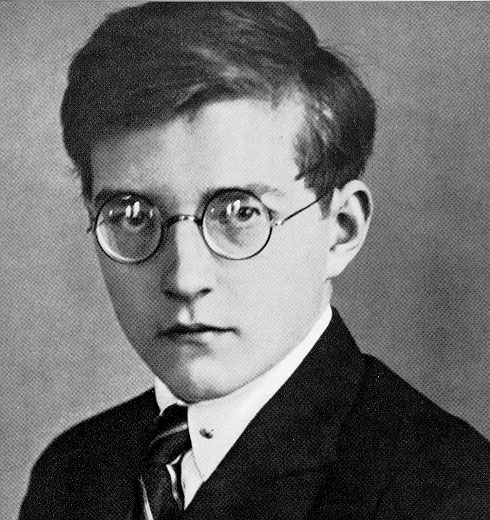
Young Shostakovich

Young Shostakovich

It all drives home how much the art of opera lost as the result of the dreadful turning point in Shostakovich’s career, when his next opera was denounced by Stalin’s culture police six years after The Nose came and went. My colleague Roger Downey, a superb critic and an expert in opera and theater, wondered how Shostakovich would have developed if he hadn’t been forced to bend to the strictures of Socialist Realism. The Nose contains so many intriguing what-ifs in that regard.

One quibble with the production – or perhaps with the structure of the opera itself: up to the end of the second act, the story follows Kovalyov’s desperate quest for his nose-gone-rogue clearly enough. (A wonderful idea was to provide ad hoc “entr’acte” music by having the orchestra improvise on the ritual of tuning.) So what’s all the business with the police and the train station in the third act? Why do they suddenly turn on the Nose and subdue it? Of course the absurdism is only strengthened by playing the narrative logic “straight,” but here it just becomes confusing.

The Nose of course demands to be read as an allegory – whether of the gullibility of us readers (Gogol), or of social hierarchy and the indifference of government bureaucracy (not so interesting), or of the inner division we feel as creative individuals (Kentridge’s take).

It occurred to me, especially from our current perspective, that The Nose could also be viewed as an allegory for the tension in early Modernism between the purist objective of autonomy (the abstract ideal) and the mongrel forms of the avant-garde imagination. Shostakovich himself emphasized the centrality of collaboration in this opera, its status as music theater and not “pure” music – precisely the strengths of Kentridge’s production.

In a recent review of Jacques Rancière’s Aisthesis, Hal Foster evaluates the French philosopher’s model of three “regimes” of art in the Western tradition. He points out that the new stylistic freedom permitted by the “aesthetic regime” – in which “the image is no longer the codified expression of a thought or feeling” (Rancière) – doesn’t require a contradiction between Modernist abstraction and the Dadaist/Surrealist “mission to reconnect art and life” in Rancière’s model: “the aesthetic regime is precisely this dialectic of modernist purity and avant-garde worldliness.”

Filed under: aesthetics, Metropolitan Opera, opera

Hell, Paradise, and Parody

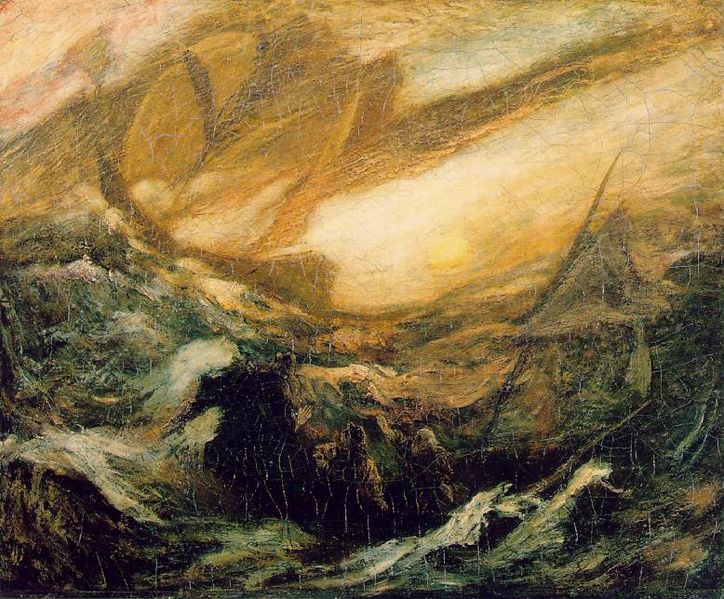
The Flying Dutchman by Albert Pinkham Ryder (c. 1896)

The Flying Dutchman by Albert Pinkham Ryder (c. 1896)

Here’s a piece I wrote for San Francisco Opera’s new production of The Flying Dutchman – a look into Wagner’s attraction to the source material he used for his breakthrough opera:

“…[T]he faithful woman hurls herself into the sea and the curse on the Flying Dutchman is lifted, he is redeemed, and we see the ghostly ship sinking to the bottom of the sea. The moral of this piece, for women, is that they should beware of marrying a Flying Dutchman; and we men should draw from it the lesson that women, at best, will be our undoing.”

It might not be unreasonable to assume this quotation comes from a critic hostile to Wagner. Or perhaps it represents a merry ribbing of the unintended absurdities that never seem far from the surface in his operas, a la Anna Russell? (“The scene opens in the River Rhine. IN it.”) Yet this sardonic wink at the climactic scene of The Flying Dutchman is actually taken from the chief source Wagner used for the opera in which, as consensus has it, he began to realize his authentic voice for the first time.

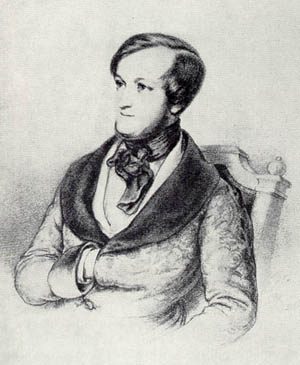
Richard Wagner: drawing by Julius Ernst Benedikt Kietz, 1840-1842

Richard Wagner: drawing by Julius Ernst Benedikt Kietz, 1840-1842

That source is “The Fable of the Flying Dutchman,” an episode contained within the longer unfinished novel Aus den Memoiren des Herren von Schabelewopski (From the Memoirs of Herr von Schnabelewopski), which was published in late 1833— eight years before Wagner composed the bulk of his opera. Its author is the great German–Jewish writer Heinrich Heine (1797–1856), and his narrator recounts this story as the plot of a play he has witnessed; his retelling of what he sees onstage moreover embeds an erotically titillating episode involving a seductive fellow audience member (her sexually loose behavior making her a kind of anti-Senta).

Heinrich Heine: portrait by Moritz Daniel Oppenheim

Heinrich Heine: portrait by Moritz Daniel Oppenheim

Heine here applies his celebrated genius for irony to the tale of the wretched mariner whose defiant pride has doomed him to sail forever on a phantom ship. (In both Heine and Wagner, “the Flying Dutchman” refers not to the protagonist, who is unnamed, but to his doomed ship.) Heine’s bathetic parody of Romantic pathos was so effective precisely on account of the popularity of this relatively modern variant of an ageless legend (a principle that can still be seen operating in the success of films like the Pirates of the Caribbean franchise). The meme of the Cursed Sailor and his crew likely took shape as European empires expanded their maritime trade activities. While it had made the leap from oral folk tale to literature only recently, the culture was already saturated with this meme when Heine added his cynical depiction of “Mrs. Flying Dutchman”—already by 1826 the London playwright Edward Fitzball could score a hit with a partially farcical, over-the-top melodramatic treatment of this material.

Everyone loves a good ghost story, of course, and Shakespeare and Stephen King alike know how to captivate their audiences with a chilling yarn that can simultaneously provide entrée into something more profound. But the Dutchman motif proved especially alluring in the emerging era of Romanticism. From poets such as Samuel Taylor Coleridge (The Rime of the Ancient Mariner) and Thomas Moore to popular German storytellers of the early nineteenth century, it quickly made a trans-Atlantic crossing and became a theme frequently encountered in American letters. Examples include the writings of Washington Irving, James Fenimore Cooper, and Edgar Allan Poe (both the short story “MS. Found in a Bottle” and The Narrative of Arthur Gordon Pym introduce Poe’s own fascinating twists on this material).

The Flying Dutchman, published in Collier’s Weekly, December 8, 1900 (oil on canvas), by Howard Pyle (1853–1911)

The Flying Dutchman, published in Collier’s Weekly, December 8, 1900 (oil on canvas),
by Howard Pyle (1853–1911)

The Dutchman’s eerie fate gratified a craving for tales of supernatural crime and punishment that also found expression in the work of several of Wagner’s predecessors: most notably, the German Romantic operas of Carl Maria von Weber and Heinrich Marschner (who composed one on a faddish vampire story) and Giacomo Meyerbeer’s early French grand opera Robert le Diable.

Nor was Wagner without precedent in recognizing in his cursed protagonist a resonant metaphor for deeper existential questions. The Gothic sense of alienation from ordinary society that is key to Wagner’s portrayal of the Dutchman taps into related currents of darker Romantic angst about modernity—as seen, for example, in Lord Byron’s world-weary anti-hero Manfred and Mary Wollstonecraft Shelley’s precocious novel Frankenstein, or, The Modern Prometheus. In addition, as Dieter Borchmeyer remarks in Drama and the World of Richard Wagner, the Dutchman of lore can be viewed as “a symbol of the hubristic spirit of discovery that transgressed the boundaries of knowledge and experience” dictated by religion” and “is thus the maritime equivalent of Faust.”

Frontispiece to Frankenstein by Mary Shelley (revised edition from 1831 of the novel first published in 1818)

Frontispiece to Frankenstein by Mary Shelley (revised edition from 1831 of the novel first published in 1818)

It’s not by coincidence that during his exile in Paris, Wagner abandoned work on a Goethe-inspired Faust Symphony not long before embarking on The Flying Dutchman. (He later published what he had completed as an independent concert overture.) The composer himself analyzed this move toward “the specificity of the drama” as a liberation “from the mists of instrumental music.”

Wagner’s intense attraction to the Dutchman legend can hardly be explained as an attempt to exploit a topic made fashionable by popular culture. In fact, hot on the heels of his first commercial success with Rienzi, the more artistically adventurous Flying Dutchman initially earned a lukewarm reception (there were only four performances of the original Dresden production).

Another angle from which to consider the tale’s grip on the composer’s imagination, according to Joachim Köhler’s controversial biography Richard Wagner: The Last of the Titans, is arguably an inner need to exorcize “the traumatic experiences of horror and the fear of ghosts that kept him awake at night”—terrors that in Köhler’s portrayal had been imprinted on him as a sensitive child. And in a fascinating essay on The Flying Dutchman in the context of the operatic genres of its time, Wagner expert Thomas Grey writes that the composer turned the “melodramatic” claptrap associated with the story—“with its mysterious portraits, invisible voices, ersatz folk ballads, and sentimental ‘romances’”—into “an allegory of Romantic alienation, love, and redemption.” In doing so, “Wagner was aiming to rehabilitate this ailing branch [the “homely genre” of German Romantic opera] of his artistic patrimony.”

Last scene from the Dresden premiere production: Leipziger Illustrierte Zeitung, 3 January 1843

Last scene from the Dresden premiere production: Leipziger Illustrierte Zeitung, 3 January 1843

Yet what drew Wagner so compulsively to the satirical version of the legend set forth by the notoriously anti-Romantic Heine, whose ironic posture he simply stripped away? Heine, in fact, exercised a far-ranging influence on Wagner’s future career. The aspiring young artist had been befriended by the poet, a fellow exile in Paris who welcomed him into his circle (and quite possibly even helped Wagner polish his French prose in the scenario he prepared for submission to the Paris Opera). Köhler points out that “virtually all the mythological themes that were to be associated with Wagner’s name were already touched on” in Heine’s writings (such as the Grail legends, the tale of Tristan and Isolde, the riding Valkyries, and Tannhäuser’s excursion into the forbidden Venusberg). And in his earlier autobiographical accounts, Wagner credited Heine for giving him “all I needed to adapt the [Dutchman] legend and use it as an operatic subject”—though Wagner’s metastasizing anti-Semitism likely underlay his later suppression of any reference to his debt to Heine.

“One must be able to joke about the most sublime of things,” declared Wagner (as reported by his wife Cosima in her diaries). Borchmeyer adds that “as early as 1840 [before he had even completed his Dutchman libretto] he had written French parodies of Senta’s Ballad and the Sailors’ Chorus, showing how tragic themes immediately evoked parodic associations in his imagination.” (When you get down to it, “The Ride of the Valkyries” is not such a great distance from vaudeville.) By way of making sense of Wagner’s transformation of the satirical source he discovered in Heine into a primal existential drama, Borchmeyer suggests that “the subject has reacquired its former tragic seriousness, having lived through the experience of its own comic negation…which explains why, in turn, Wagner’s music dramas have repeatedly invited writers to parody them.”

(c)Thomas May. All rights reserved.

Filed under: opera, Wagner

Will Get Fooled Again: Verdi’s Humanist Farewell

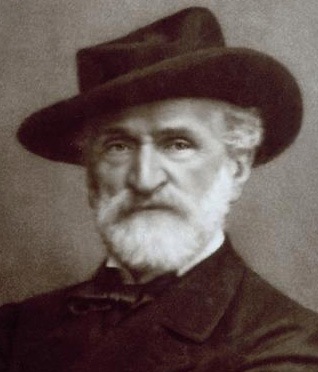
Giuseppe Verdi

Giuseppe Verdi

At least we know Giuseppe Verdi was a Libra. But no one knows for sure whether his actual birthday 200 years ago was October 9 or 10 — and why shouldn’t he get two birthdays in this year celebrating his legacy?

For my own little tribute, here’s an essay I just wrote for Los Angeles Opera’s upcoming production of Falstaff:

Whoever laughs last, laughs best—or, in the more elegant formulation by Arrigo Boito, author of Falstaff’s libretto: Ma ride ben chi ride / La risata finale. And in more than half a century of writing for the stage, Verdi has the last laugh with the ultimate joke: a fugue, that emblem of a fuddy-duddy, old-fashioned, academic, Teutonic sensibility, a virtual non-sequitur vis-à-vis the Italian operatic tradition he had inherited.

Yet the fugal capstone to Falstaff is a perfect and ingenious choice, theatrically and musically. After Sir John has been punked and had his drubbings, he’s the one who leads off the fugal chain reaction, as the entire ensemble joins to celebrate our shared humanity. Itamar Moses’ 2005 play Bach at Leipzig attempted to dramatize the fugue’s inherent theatricality—the way it wrests reconciliation from entanglement—but Verdi’s merry pranksters buoyantly sail free of any regrets, proving the power of his art to set the world right (at least for the illusory moments until the house lights come back on). Jester and jest become one. The rigorous form morphs into a bubbly champagne, ending with the orchestra’s zippy final chords. If Verdi alludes to the choral setting-things-straight culmination of Don Giovanni, he also seems to hint at the clear blue skies of Mozart’s “Jupiter” Symphony—albeit his is a punch-drunk Jove.

continue reading

Filed under: opera, Verdi

Truth and Beauty

Met opening night 23 Sep  2013

(Met Instagram image of opening night: chandeliers and the crowd on plaza)

Tonight kicks off the new season at the Metropolitan Opera. Here’s my feature for the opening production — one of my favorite operas — Tchaikovsky’s Eugene Onegin:

Scenarios of unrequited love are the stock-in-trade of opera composers, but with Eugene Onegin Tchaikovsky achieved something far beyond another varia-
tion on an all-too-familiar theme. For Deborah Warner, the opera offers “a complete portrait of the human condition, viewed through the frame of the young approaching
life and love for the first time.”


(Letter Scene, Act I: Anna Netrebko in rehearsal for opening)

continue reading

Filed under: Metropolitan Opera, opera

Tales of King

Claiborne_med_racette
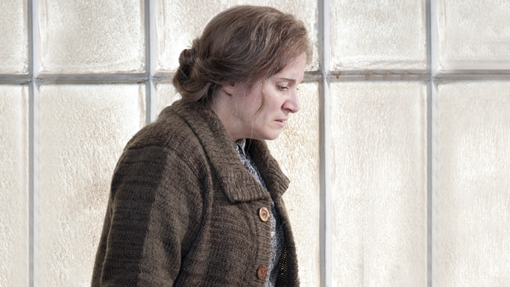
Patricia Racette as Dolores Claiborne; photo by Scott Wall

Dolores Claiborne the new opera by composer Tobias Picker and librettist-poet J.D. McClatchy, opens in just a week at San Francisco Opera. I recently interviewed Picker and McClatchy about their collaboration for my latest SF Opera feature:

The story really matters. That premise may seem self-evident, but there’s a long-standing cliché, at least as far as opera is concerned, that the story is what you have to put up with to get to the music—never mind that Verdi and Puccini obsessed over their choice of subject matter and tormented their librettists whenever it was time to consider a new project for the stage. One of the happy side effects triggered by the American Renaissance in opera that’s been unfolding for the past two to three decades has been to puncture the silly notion that the story is, at best, incidental to the experience.

“For me,” asserts Tobias Picker, “opera is about telling stories in music.”

Read the whole thing here

Filed under: composers, literature, new music, opera

A Fiery, Flaming Symphony

Sergei_Prokofiev_02
(Prokofiev c. 1918.)

My new essay on Sergei Prokofiev’s fantastic and way-underplayed Third Symphony is now up on San Francisco Symphony‘s web site for the program Michael Tilson Thomas is conducting next week. Thank you, MTT, for championing this work!

Music depicting the ravings of demonic possession, eroticized spiritualism (or spiritualized eroticism), medieval witchcraft and sorcery, and a convent of nuns whipped into mass hysteria—no, it’s not the score to a Stephen King film but a work that has a decent claim to being Sergei Prokofiev’s operatic masterpiece: The Fiery Angel (Ognenniy angel in Russian). A labor of love—and great frustration—The Fiery Angel also served as the source for his Third Symphony (even including much of its orchestration). Prokofiev wrote that he considered the latter “to be one of my best compositions.”

continue reading…

Filed under: composers, opera, program notes, symphonies

Hearing the Light: The Music of Tristan

Tristan-Isolde
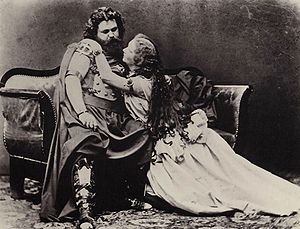
(Ludwig and Malvina Schnorr von Carolsfeld in original production as Tristan and Isolde)

A new piece on Tristan und Isolde I just wrote for Washington National Opera’s upcoming production:

Even setting a myth of the beginning and end of the cosmos to music (aka the Ring) wasn’t enough for Richard Wagner. The legend of Tristan and Isolde began to crowd Wagner’s creative imagination thanks to a potent combination of factors in his private and artistic life.

After deconstructing the conventions of the commercially popular musical styles that reigned in opera houses of the time, Wagner had built a Valhalla-like fortress of theory to work out the ideas he was struggling to replace these conventions with, and these he began to apply in practice by composing the Ring. Yet Wagner’s subsequent discovery of the pessimistic philosophy of Arthur Schopenhauer (1788-1860) profoundly altered his attitude toward the purpose of art itself.

The Ring and its musical world originally sprang forth from a basically optimistic world view that placed its faith in the possibility of revolutionary utopia. Viewing the world through the lens of Schopenhauer caused Wagner to regard this as a naïve illusion. On one level, Tristan and Isolde turns the archetypal scenario of the love triangle into a symbol for the unquenchable force of desire in all its forms, which is the root of suffering for Schopenhauer. Apart from Wagner’s fascination with the philosopher’s metaphysical ideas, however, he was naturally attracted to the position of supreme value Schopenhauer reserved for music. It was Schopenhauer’s conviction that music alone can give us immediate access to this stark truth underlying the deceptive “real world” of appearances.

Tristan-Runnicles

In the Ring (up to this point), music had more or less been ascribed a role subordinate to the unified amalgam of score, script, myth, and staging. But  Wagner found a matchless vehicle with which to explore his changed perspective in Tristan’s story of extreme desire and its frustration—the love potion is merely another symbol for the release of what’s inherent in Tristan’s and Isolde’s natures. Setting it to music provided Wagner with the opportunity to create an unprecedented sound world evoking the human condition of restless desire, the mirage of blissful satisfaction, and, ultimately, a kind of transcendent awareness. The music isn’t there merely to “accompany” the moods of the drama: it provides the very foundation for what we see happening onstage. As Wagner later put it, the actual drama is “a visible image of the music”—a “deed of music made visible.”

Wagner had made one enormous leap in his musical language when, after a silence of about five years, he figured out how to set the Ring in motion with the remarkable Prelude to Das Rheingold, where the music swims about for minutes in the same key: Minimalism more than a century ahead of its time. But if the Ring proclaimed revolution, the Prelude to Tristan and Isolde seemed like all-out anarchy, immersing listeners into a disorienting soundscape where the familiar compass points no longer had any bearing.

Ironically, still another reason Wagner had determined to delay the Ring and write Tristan was purely practical: he hoped to make money with what he believed would be an easy-to-produce opera (compared, at least, to the Ring). But the originality and complexity of Tristan’s score, and the cruel demands on its two lead singers, doomed attempts to get it performed for several years, until the composer’s powerful new patron King Ludwig entered the scene and provided the financial backing for adequate rehearsals.

Tristan-FORBIS-AND-GRIMSLEY

Even professional musicians of the era found themselves perplexed by the daring harmonic language Wagner develops here. Its essential character is crystallized in the very first bars of the Prelude: the cellos pose a series of “questions,” their line of descending half-steps “answered” by enigmatic harmony and a similarly ascending phrase in the woodwinds. Yet even these responses are left unresolved—and are in turn followed by tense silences. The music coils forward, full of vibrant, insatiable yearning, but even the climax it reaches seems frustrated—and, to cite the composer’s own description, “the heart sinks back unconscious, back into languishing desire…”

The paradigm of Western tonal music familiar in Wagner’s era (and in pop music today) relied on reassuringly recognizable patterns of tension and release, with a beginning, middle, and end. These patterns play out both in the short term (a phrase of music) and in larger structures (a movement). Tristan’s music supplants this with states of tension that generate more tension. The whole process suggests a condition of tormented, unappeasable longing, with the horizon maddeningly just out of reach.

Instead of a collection of tunes we can look forward to once the curtain rises, the Prelude embodies a microcosm of Tristan’s musical vocabulary and grammar.  Its opening gestures proliferate in countless ways across the span of the opera—until that initially ambiguous “response” is finally allowed to fully resolve on what Richard Strauss once described as “the most beautifully orchestrated B major chord in the whole history of music.”

Tristan-zambello
From the 1998 Seattle Opera production directed by Francesca Zambello

The score of Tristan adapts the advanced musical principles Wagner had been honing in the Ring to its new context. Rather than independent, self-enclosed musical units (arias, quartets, choruses, and the like), each act unfolds as one continuous progression of musical thought. In general, conventional opera relied on tried-and-true forms and familiar, one-size-fits-all harmonic progressions which could apply to any of a number of interchangeable dramatic situations. In Tristan and Isolde Wagner spins out an organic form corresponding uniquely to the particular set-up, crisis, and resolution that make up the dramatic content of each act. Even more, that dramatic content is radically simplified and internalized (in contrast to the epic Ring). This opens up a space for Wagner’s music to trace the states of desire, suffering, and, ultimately, compassion which both Isolde and Tristan experience.

The opera’s large-scale musical and dramatic structure demonstrates a beautifully symmetrical balance, despite the impression of unleashed, formless “dissonance” (in the sense of unresolved musical tension) that the Prelude can still make even on experienced contemporary ears. The first act centers around a portrayal of Isolde in her anger and confusion: she draws Tristan into her fateful sphere before they cross an unexpected threshold together by drinking the love potion. The second act prepares for and leads away from an enormously extended love duet, with its proto-Impressionist, exquisite blends of orchestral color, in which the lovers merge their identities and yield to the intoxication of desire (notice the erotic frenzy conveyed by Wagner’s overlapping vocal parts). With the third act, Wagner shifts the focus to Tristan and his pain. After he dies—to the same strain he sang when overtaken by the potion in act one—Isolde completes the journey Tristan had undertaken in solitude.

Tristan-Titian
Titian’s Assumption of the Virgin in the Frari in Venice, which Wagner is said to have associated with Isolde’s ecstasy.

But Isolde complements her lover’s desolate vision of the emptiness of desire with a rapturous embrace of oblivion in the scene which concludes the opera (widely known as her Liebestod, or “Love-Death,” though Wagner used that term for the Prelude and referred to this scene as “Isolde’s Transfiguration”). This seals the opera with what musicologist Susan McClary calls “a feminine ending.” McClary quotes a personal exchange with the composer Virgil Thomson where the latter described the Liebestod as Isolde “hang[ing] around to demand one last orgasm of her own.”

Radical harmonic innovation is the most-celebrated dimension of Tristan and Isolde’s score, but Wagner employs all his resources to evoke the extreme states his characters undergo. In the third act, for example, Tristan’s delirious visions are underscored by changes in meter and powerfully syncopated rhythms. Another important device that recurs in some form in each act is the intrusion of the everyday world—for the lovers, the “false world” of day and illusion. From the strains of the sailor’s song opening the first act, Wagner abruptly shifts to Isolde’s point of view. The act late ends with the jubilant sounds of brass and chorus in solid C major to signal the ship’s arrival at its destination, ironically juxtaposed against the music of dangerous ecstasy for the lovers. In the second act Wagner vividly paints the external world of King Marke’s hunting party dissolving—the overlapping horns replaced by burbling clarinets—as Isolde becomes lost in her impatient vigil. And the shepherd’s merry piping in act three acquires a surreal quality as the backdrop for Tristan’s fevered hallucinations.

Tristan and Isolde, the early-20th-century music critic Paul Bekker went so far as to declare, is an opera on whose stage “walk sounds, not people.” Part of Wagner’s genius in this epochal work was to dissolve the boundaries between music and drama, orchestra and singers, tones and words, to an extent even he couldn’t have imagined when starting on the Ring—or when he first mentioned the idea he had for a new opera based on the legendary lovers: “the simplest but most full-blooded musical conception.”

Filed under: opera, Wagner

Burning Down the House: Seattle’s Götterdämmerung

Image
Richard Paul Fink (Alberich) and Daniel Sumegi (Hagen); photo ©Alan Alabastro

Talk about a buildup: I can’t think of any other work of art, let alone opera, that stokes our sense of anticipation with such prolonged intensity as the Ring’s grand finale. The whole shebang came about, after all, because Wagner wanted to fortify the emotional payoff of what became Götterdämmerung.

Providing the back stories leading up to his depiction of Siegfried’s downfall and Brünnhilde’s final enlightenment isn’t the only thing the first three Ring operas are supposed to do. They’re meant to give these events a dramatic and musical weight that’s only possible if the audience is persuaded to commit itself over the Ring’s vast scale. And that’s what ultimately can make the cycle feel so “cosmic” – not its mythic congeries of mermaids, gods, giants, dwarves, et al.

On Friday night Seattle Opera arrived at the conclusion of its signature Ring – the first of three cycles being given in this Wagner bicentennial year, as well as in the final season of general director Speight Jenkins’ long tenure.

Which is to say, there’s an additional layer of significance to this Ring for Seattle audiences and for the impressive percentage of non-local fans who’ve made the pilgrimage from afar for what may be their last chance to see this production.

I’ve found this round of the Seattle Ring immensely satisfying as a whole. For those who have had the fortune to see earlier iterations since it was unveiled in 2001, this latest encounter delivers a special cumulative effect of its own by way of comparison with the previous versions. An important factor here is the readjustment of the chemistry of the performing forces, with both a conductor and key members of the cast new to the production.
Die Walkure
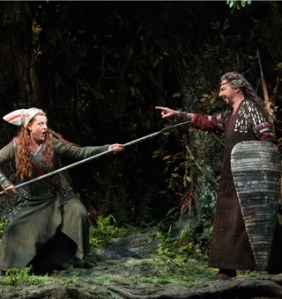
Die Walküre: Alwyn Mellor (Brünnhilde), Greer Grimsley (Wotan); photo ©Elise Bakketun

One of these is the British soprano Alwyn Mellor, whose portrayal of Brünnhilde in Die Walküre had the dramatic range to match her enthralling vocal presence. It’s been said that the Ring contains three Brünnhildes, but already in this opera Mellor homed in on different layers of her character beyond the exuberant war cry that first introduces her – above all in the Death Annunciation scene, where she learns compassion from the doomed Wälsung twins, but also in the bewilderment displayed in her last confrontation with Wotan. More than ever before, I was riveted by the “gulf of misunderstanding” that tragically separates her from the “warfather” god – but that will set her on the path to her own liberation.

Unfortunately Mellor fell prey to an ailment and had to bow out of the rest of the cycle. If Lori Phillips, the cover for Brünnhilde, saved the night with her passionate and well-acted performance in Siegfried’s final scene, her ability to step in the spotlight at the last-minute for the brutal demands of Götterdämmerung was little short of miraculous. Both the “continuation” of her love duet on the rock with Siegfried and Brünnhilde’s scene with Waltraute were highlights of the evening. Given the circumstances, it’s hard to fault Phillips for being less convincing in her character’s volatile transformation in the second act. There was a further loss of emotional complexity in the Immolation Scene, where the toll on her upper range became most apparent.

Götterdämmerung 2013
Götterdämmerung: Stefan Vinke (Siegfried), Daniel Sumegi (Hagen), and Markus Brück (Gunther); photo ©Alan Alabastro

I suspect this sudden change in the partner he had rehearsed with most closely may account, in part at least, for a less satisfying rendition of the mature Siegfried by the German tenor Stefan Winke (also new to the production) than the young hero he had managed to make so compelling two nights before.

But another part of the “Siegfried problem” is beyond any individual performer’s control. Let’s face it: Wagner’s actual presentation of Siegfried in Götterdämmerung is deeply flawed. No sooner does Brünnhilde send him off to perform great “new deeds” than he is duped by Hagen and the scheming Gibichungs. He’s not only passive but (rather like Wotan) perfectly willing to compromise himself morally – and this on his own accord – to get what he wants (Gutrune); and like Mime, he fails to learn what he needs to know when he has the chance to from the Rhinedaughters.

Stefan Vinke in Siegfried’s “Forging Song”

At any rate, Vinke’s singing still produced thrills (including a daringly sustained high C in his response to the hunting party soon before his death). But apart from his eerily shaded voice as he sang from within a cave to Gunther’s onstage lip-syncing for the abduction of Brünnhilde, there was far less variety of phrasing than Wednesday night; Vinke tended toward a more one-size-fits-all projection and, most problematically for me, failed to convey the sense of Siegfried’s sudden, harrowing realization of what has been lost in his final, “undrugged” recall of Brünnhilde before he dies.

Still, the massive prelude-plus-first act (nearly comparable in length to the whole of Rheingold) was among the most memorable segments of the cycle. It almost seemed to play out in one sustained arc of thoroughly riveting theater.
Götterdämmerung 2013
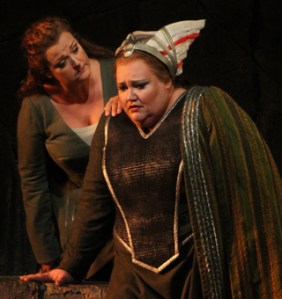
Götterdämmerung: Alwyn Mellor (Brünnhilde) and Stephanie Blythe (Waltraute); photo ©Alan Alabastro

Stephanie Blythe’s contributions to the Seattle Ring are pretty much exaggeration-proof. As Fricka in the first two operas, her complex but loving relationship with the excellent Greer Grimsley’s Wotan have been a defining feature of director Stephen Wadsworth’s interpretation since it premiered. As if that weren’t enough, her sculptural phrasing and vocal phrasing also added texture and atmosphere to the Norns (joined by Luretta Bybee and Margaret Jane Wray, who delivered such a moving Sieglinde). And Blythe’s Waltraute, with its “preview” of the Immolation Scene summing-up, actually eclipsed the latter on this occasion. Particularly in this staging, it is this scene that represents the point of no return (rather than the Rhinedaughters’ last-ditch plea later in act three).

I was also extremely pleased with newcomer Wendy Bryn Harmer. She’d also appeared as one of the Valkyries and as a distraught Freia (a great addition to the roster of gods, as was the demigod partially responsible for her plight, Loge, given a mesmerizing performance by Mark Schowalter). Her Gutrune for once had some depth rather than being a mere pawn – uncannily reminiscent of Sieglinde as the victim of a hostile men’s world, but also pathetically desperate at her chance for love, even if it’s cheating, with Siegfried. But to my taste, fellow Seattle Ring newbie Markus Brück remained too constrained by the passivity of his character as the ineffectual Gibichung ruler Gunther.

Die Walkure
Götterdämmerung: Daniel Sumegi (Hagen) and the Vassals; photo ©Elise Bakketun

Making up for this – and grounding a sense of the “real world” power struggle into which Siegfried blithely blunders – was Daniel Sumegi’s Hagen, in a portrayal of spine-chilling menace and cold-blooded calculation. So weighty is the evil this Hagen incubates (manifested with peals of darkly rolling vocal thunder) that even he appears troubled by its implications, as we see in another highly successful scene: the dream-encounter with Alberich. As one of the leading exponents of the latter singing today, Richard Paul Fink has been intensifying his spiteful phrasing and physical acting to such a point that you worry a little he won’t be able to snap out of character.

Yet after this scene and the superb first act, I did feel a kind of dwindling, anti-climactic effect, above all in the conclusion of the cycle. The visual staging of the post-Immolation cataclysm – is there a more impossible design challenge in the theater? – has at least arrived at a reasonably effective compromise (which, for the sake of those still intending to see it, I won’t give away here).

I’ve decided this sense of anti-climax results from a mix of the Ring’s inherent weaknesses which Wagner was never able to sort out and specific choices of this production, compounded with things being thrown off balance owing to the last-minute unavailability of Mellor’s Brünnhilde.
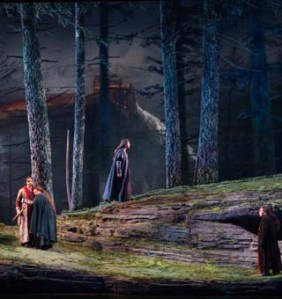
Die Walkure
Das Rheingold Markus Brück (Donner), Andrea Silvestrelli (Fasolt), Wendy Bryn Harmer (Freia), Greer Grimsley (Wotan), Stephanie Blythe (Fricka), Ric Furman (Froh), and Mark Schowalter (Loge); photo (c)Elise Bakketun

While the scenically realistic, Pacific Northwest-inspired look of the fabulous sets designed by Thomas Lynch is largely responsible for the moniker “green” Ring, Seattle Opera’s production isn’t really about imposing some sort of environmental concept. But those who refer to it as a “traditional” Ring are sorely mistaken. This notion has been kicking around because of the tastefully archaic aura of the late Martin Pakledinaz’s costumes or perhaps because of the plausibly mythical zone in which everything plays out (as opposed to, say, the rundown motel on Route 66 for Rheingold in the much-scorned new Bayreuth Ring directed by Frank Castorf).
Die Walkure
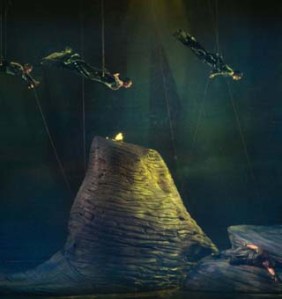
Das Rheingold: Jennifer Zetlan (Woglinde), Cecelia Hall (Wellgunde),Renée Tatum (Flosshilde), Richard Paul Fink (Alberich); photo (c)Elise Bakketun

Yet Seattle Opera’s Ring, too, is strongly rooted in a vivid directorial concept. The brilliance of director Stephen Wadsworth’s vision, which centers around an almost Chekhovian psychological realism, is that he has evolved this both from a deep knowledge of Wagner’s text (the combine of words and music, that is) and from obsessively detailed, prolonged rehearsals with the cast to ensure an organically coherent portrayal of the characters and their interactions.

Thus, as mentioned, there’s genuine love between Wotan and Fricka, which underscores the sense of personal tragedy in the god’s dilemma in Die Walküre and its fallout. This does of course mean giving precedence to some elements in the Wagnerian text and overlooking others (such as Wotan’s harsher persona as “war father”). It also means inserting things into the text that aren’t there in the first place so as to draw out an implication: we see Fricka suddenly appear for the hyperintense conclusion to act two of Die Walküre to greet Hunding, only to be dumbstruck when Wotan slays him (an effective and justifiable choice, I thought, to make us think of the future she, too, has to face; otherwise she simply disappears from the cycle after her earlier confrontation).

Die Walkure
Die Walküre: Stephanie Blythe (Fricka), Greer Grimsley (Wotan); photo (c)Elise Bakketun

Wadsworth’s essential approach is to humanize Wagner’s mythical characters and their behavior. This perspective pays its richest dividends in Die Walküre and Siegfried, which, for me, are the two most impressive successes of the Seattle Ring. In fact, often though we’re told that the Ring is a vast epic containing the history of the world, a significant proportion of the cycle (the middle two operas, more or less) actually centers around scenes of intimate dramatic communication between two characters. Wadsworth’s style and concept are ideally suited to these. His humanizing also touch goes a long way toward animating the expository stretches of Das Rheingold, with its much larger ensemble.

Wadsworth
Stephen Wadsworth in rehearsal

The Achilles heel seems to be in the crowd scenes of Götterdämmerung and in the old-fashioned, grand opera style “Lohengrinizing” (as G.B Shaw called it) that makes these parts of the last Ring opera sometimes seem such a throwback. There’s a lot of rustling about from the chorus of Vassals in the second act in response to Hagen’s summoning (where, musically, Wagner seems to nod), but it doesn’t convey the accumulation of menacing tension, the sense of a whole society on the verge of collapse despite the distractions of wedding celebration.

A similar situation lessens the impact of the third act. A comic turn in the Rhinedaughters’ reappearance at the top of the act which has them horsing around is presumably meant for relief, but that choice has always struck the wrong note for me. Wadsworth’s forte is evoking the intimate and personal, but the atmosphere of apocalypse remains absent in the scene of Siegfried’s murder and in the final scene. And it’s a problem that goes beyond this particular production, affecting many others. Wagner himself acknowledged the challenge when he suggested that all the knots are really worked out in what the final music tells us.
Turondot
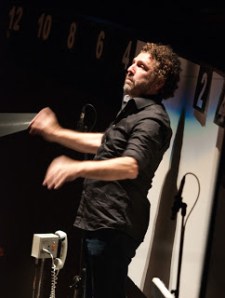
Maestro Asher Fisch

As the production’s new conductor, Asher Fisch (for whom Daniel Barenboim was an important mentor), proved to be a key asset in making this latest edition – neatly fine-tuned by Wadsworth in increasingly subtle ways – the most successful run since the premiere of Seattle’s Ring production in 2001. Fisch coaxed the most ear-catching collections of sounds and color from this orchestra that I’ve ever heard in their Ring playing.

There was some unevenness, to be sure: Siegfried’s Funeral March sounded inexplicably hollow, and moment after glorious moment of the final scene was thrown away, like an actor so afraid he’ll forget the words of a great Shakespeare monologue he rattles them off without trying to create an interpretation.

Overall, what Fisch sacrificed in sheer dramatic tension (not to mention Soltiesque playing to the gallery) through his often measured tempo choices was compensated by the continual unfolding of layers of the score that often lie buried. The woodwind writing in the last scene of Die Walküre, for instance, bloomed with breathtaking beauty, while Siegfried’s second act was shot through with almost psychedelic streaks of color – growling low brass and electrifying string figurations.

And for the most part Fisch succeeded in integrating the singers into the total fabric of sound and in contouring the ensemble to the dramatic dimension. (One strange quirk of Wadsworth’s stage direction, which posits the characters often “hearing” the music from the orchestra, has them react in stylized, silent-film-type gestures to musical accents.) The result made an incalculable contribution to the gathering theatrical effectiveness of the cycle as each evening progressed.

At the conclusion of this first of three cycles to be performed in August, Speight Jenkins briefly addressed the audience, calling attention to the incredible efforts of everyone involved in what he termed “the biggest collaboration there is in all art.” And he pointed out that this is the valedictory Ring under his long tenure with the company, which has been defined by its Ring productions. It’s hard to imagine a more moving or memorable way to leave the stage.

–Thomas May

Filed under: opera, review, Ring cycle, Seattle Opera, Wagner

O Tell Me the Truth about Love

Die Walkure

The renunciation of love is what spins the entire Ring cycle into dramatic motion – yet there’s precious little evidence of what love actually is in Das Rheingold (the preludial opera, as Wagner conceived it, with the three longer operas that follow constituting a trilogy on the model of ancient Greek tragedy).

What unfolds before us onstage (and in the pit) is, instead, a brutal cosmos in which rape, violent coercion, deception, and theft hold sway. Is Alberich really giving up all that much when he curses love to access the gold? You have to wonder, in a world where Freia, the goddess of love, is held as sexual ransom to pay for Valhalla per Wotan’s deal with the giants who constructed it.

So it’s not surprising that Die Walküre has always tended to be the most popular work of the cycle: love, and spring, and humanity all enter in with that miraculous first act – an act which, after all, is basically a digression from the main narrative line. And Wagner’s music warms up as well after Rheingold‘s abstractions and muscular assertions.

Die Walküre benefits especially from director Stephen Wadsworth’s obsessive attention to the nuances of character interactions in Seattle Opera’s Ring cycle. Sure, it’s easy to milk the audience’s sympathy for the Wälsung twins in their passion and plight – does anyone actually ever get worked up these days about the incest taboo? – but this production delineates with tremendous subtlety how love affects the gods: above all Wotan’s love for Fricka (hardly “traditionalist” but a directorial conceit, however persuasive), and how this love sets up inescapable conflicts with his love for his son and for Brünnhilde. Love, not its renunciation, is the source of his pain.

Whenever you grapple with the Ring, the mushy term “redemption by love” gets tossed around as predictably as the sun will set. But “love” – by which Wagner, in the Ring text’s early stages, clearly had physical, sexual expression in mind – is elusive and ultimately contradictory in the Ring cosmos. Its meaning is as slippery as the rocks at the bottom of the Rhine are to the frustrated, grasping Alberich when he tries to seize love like catching a fish.

On Monday night, when I heard Margaret Jane Wray pour out that glorious arc of melody [1:26] in the pivotal moment when the just-widowed Sieglinde suddenly learns she is pregnant with Siegfried, I was thinking of how this is a kind of reverse Annunciation scene: Brünnhilde bears the joyful news, but the music is Sieglinde’s as she praises the Valkyrie.

This is the music that has become so misleadingly tagged as the “redemption by love” theme when it is heard again at the very end of the Ring. And the words which are “imprinted” with this melody are “O hehrstes Wunder! Herrliche Maid!” (“O miracle most sublime! Glorious maiden!”).

In other words, as Sieglinde rejoices in this new hope, she glorifies Brünnhilde the virgin warrior. But the love the goddess maiden-turned-human lover experiences with Siegfried is what sets in motion the final tragedy, just as inevitably as Alberich’s theft of the gold as a substitute for love launched the cycle in the first place. So where has love gotten us?

(Image: Seattle Opera’s Die Walküre: Stuart Skelton (Siegmund), Greer Grimsley (Wotan).
Photo © Elise Bakketun.)

Filed under: opera, Ring cycle, Seattle Opera, Wagner
Into the Ring

Image

Seattle Opera’s famous “green” Ring production – celebrated for highlighting the prominent role nature plays in the cycle, but also for its psychological focus – returns this month for the fourth time since it first debuted in 2001. A particular highlight for me will be the contribution of Asher Fisch, who for the first time takes on the role of conductor of this production.

Among the things I’ve been reading to prepare, Nicholas Spice’s recent essay in the London Review of Books (“Is Wagner Bad for Us?”) is rich in food for thought:

Debussy said that it was ‘hard to imagine the state to which the strongest brain is reduced by listening for four nights to the Ring … It is worse than obsession. It is possession. You no longer belong to yourself.’ Returning from a Wagner performance in January 1917, Otto Klemperer said to his sister: ‘When I like Wagner, I do not like myself.’ I think one can go a step further and say that even disliking Wagner is not straightforward. There are many composers we may not particularly care for, but this poses no problem because we experience their music as separate from us, as other. They do not tamper with our sense of self. In possessing us, Wagner restricts our freedom to dislike him, since in disliking him, we can find that we end up disliking bits of ourselves. And this, after all is what he set out to achieve: he wanted his listener to abandon himself unresistingly to the work, so that he ‘involuntarily assimilates even what is most alien to his nature.’

(Image: Das Rheingold at Seattle Opera, Jennifer Zetlan (Woglinde), Cecelia Hall (Wellgunde),Renée Tatum (Flosshilde), Richard Paul Fink (Alberich). Photo © Elise Bakketun.)

Filed under: opera, Ring cycle, Seattle Opera, Wagner
Archive

Enter your email address to follow this blog and receive notifications of new posts by email.