Some thoughts on Seong-Jin Cho’s recent Seattle recital:
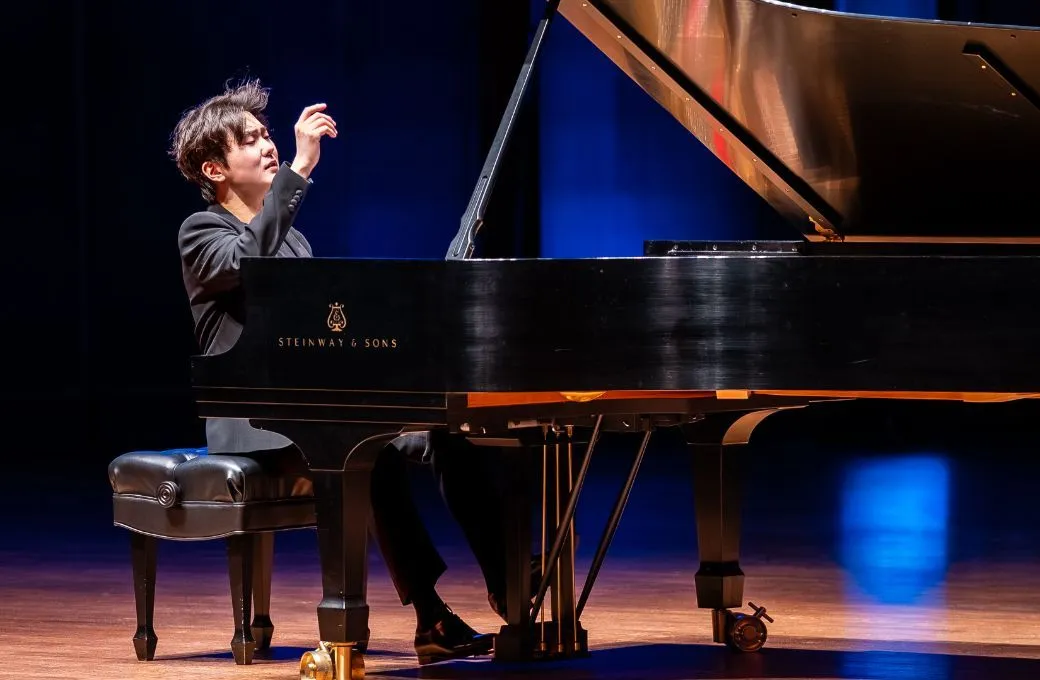
The self-effacing persona Seong-Jin Cho projected from the Benaroya Hall stage throughout his solo recital stood in striking contrast to his musical confidence – a confidence grounded not only in extraordinary technical security but in an evident willingness to take risks. Cho’s sense of interpretive freedom made itself felt from the outset, in a program that invited close attention and repaid it generously…
After a dazzling performance of Prokofiev’s Third Piano Concerto, the 29-year-old French Canadian was named 2025 Honens Gold Laureate in Calgary last night. She takes home CAD $100,000 and a three-year career-accelerator program valued at more than $500,000. She also swept up the Audience Choice Award (worth $5,000 CAD).
The final round featured all three finalists, each in a different concerto, with the Calgary Philharmonic Orchestra led by Elias Grandy.
Hearty applause as well for Silver Laureate Carter Johnson (29) and to Bronze Laureate Anastasia Vorotnaya (30) – and for all seven semifinalists who made this year’s Honens an inspiring, memorable festival. They included Ádám Balogh (28), Elia Cecino (24), Giorgio Lazzari (25), Sandro Nebieridze (24), Chaeyoung Park (28), Derek Wang (27), and Yuanfan Yang (28).
With performances this bold and individual, the Honens ideal of the “Complete Artist” feels alive and well.
The Isidore Quartet at Honens: Adrian Steele, Phoenix Avalon, Joshua McClendon and Devin Moore, with finalist Carter Johnson in the centre; photo: Jorge Gustavo Elias
–> Follow the final round and announcement of awards starting at 7pm MDT on the Honens livestream here.
For a string quartet, sharing the spotlight with fellow chamber musicians is second nature – but not usually in circumstances like this. The New York City-based Isidore Quartet took the stage last night (23 October) for the chamber-music final of the 2025 Honens International Piano Competition, held at the Jack Singer Concert Hall in the Werklund Centre, downtown Calgary, Alberta. ..
“You should always try to escape your own success,” Víkingur Ólafsson says. “Because that success so easily turns against you and limits you and your choices and what you want to do next” …
Christian Tetzlaff and Leif Ove Andsnes open the Pierre Boulez Saal season; photo: Peter Adamik
I reviewedopening night with Christian Tetzlaff and Leif Ove Andsnes at Berlin’s Pierre Boulez Saal for The Strad:
In his famously mischievous binary, Ned Rorem asserted that ‘the entire solar system is torn between two aesthetics: French and German’ – with the kicker: ‘If you agree with all this, you’re French. If you disagree, you’re German’. … continue
I spoke with the pianist Jan Lisiecki about his upcoming Beethoven concerto marathon with the Toronto Symphony:
Jan Lisiecki’s immersion in the piano concertos of Ludwig van Beethoven began right at the deep end. Rather than offer his interpretation of just one work, his very first recording of music by the German composer (which appeared in 2019) encompassed nothing less than a complete concerto cycle.
Yulianna Avdeeva‘s Sunday afternoon recital at Benaroya Hall seemed to be timed especially well: The New York Times published a story that day about the unexpected find of a waltz by Chopin. Her refined interpretations of that composer suggested how much remains open to discovery, even in the case of long-familiar pieces.
Avdeeva burst on the scene when, at the age of 25, she took the gold medal in the 2010 Chopin Competition (the first woman since Martha Argerich to have garnered the award). She recently released Chopin: Voyage, an album focused on late works that he composed while surrounded by nature, which the Moscow-born pianist recorded in the idyllic setting of Tippet Rise Art Center in Montana. She performs widely across Europe but still seems to be something of a well-kept secret in the US. On the basis of Sunday’s performance, I certainly hope that changes.
Though for years they lived just a few minutes away from each other by foot in Paris, Chopin and Liszt inhabit such strikingly different worlds that it was fascinating to find them juxtaposed on Avdeeva’s program, with one half devoted to each composer.
She began with Chopin, lingering on the first note as she launched into the Op. 30 Mazurkas, as if preparing to whisk us away from ordinary life. In his 1851 biography of Chopin (likely co-written with his Polish mistress, Princess Carolyne von Sayn-Wittgenstein), Liszt ascribes to Chopin’s mazurkas “the most delicate, tender, and evanescent shades,” evoking impressions that are “purely personal, always individualized and divided.”
Each of the four mazurkas in the Op. 30 set, which Avdeeva played without breaks, indeed seemed to be a separate microcosm rather than another elaboration on a type. Her management of micro-transitions, of the slightest fluctuation of mood, was especially impressive. Even in the more assertive No. 3 in D-flat, an inner melancholy shaded the echoing phrases.
Avdeeva maintained a spirit of improvisation while executing compelling and clearly thought-out ideas about each piece with breathtaking precision.
The Op. 60 Barcarolle in F-sharp major suggested an idealized singer in a state of ecstasy – a melody beyond human reach yet fallible with emotion, as far as could be from mechanical virtuosity.
Avdeeva spun out the sense of mystery and enigmatic wandering that makes the Op. 45 Prelude in C-sharp minor so beguiling, while the Scherzo No. 3 (in the same key) abounded in well-judged contrasts and textural control.
It was above all in the Andante spianato and Grande Polonaise brillante, Op. 22, that Avdeeva revealed new facets. Her Chopin involves such complex, meticulously articulated gradations of weight and light that you realize how much variety lives within a single miniature – not just Schumann’s “cannons buried in flowers” in the case of Op. 22, but an entire epic encompassing heroic adventures and bravely intimate confessions. Rhythmic and dynamic nuances are a special forte with this pianist, who is equally subtle in she staging of rubato and crescendo.
Avdeeva then turned from Chopin’s lyric poetry to the mystical, tormented Romanticism of his far longer-lived peer, Franz Liszt – and showed that she had a great deal to say on that score as well. Her combination of two late-period, avant-garde works from 1885 with the B minor Sonata – all played seamlessly, as if transcribing a single brooding meditation by the robed, solitary Abbé – proved intriguing.
On the one hand, with the Bagatelle sans tonalité and Unstern! – Sinistre, the difference and distance from Chopin could not have been more pronounced. Avdeeva seemed to depict a stark search for threads of meaning amid Liszt’s harmonic vagaries, stalled by abysses of silence. The effect was utterly mesmerizing.
When she arrived at the B minor Sonata, Avdeeva drew on the full arsenal of her stupendous technique to portray an intense psychic drama. The Benaroya Steinway resounded with the most thunderous playing of the afternoon, but Avdeeva also relished Liszt’s celestial harmonies and gossamer ornaments, articulating with a scintillating transparency that recalled Chopin – and what Liszt admired in Chopin’s playing. Her two encores once again confronted the two personalities, offering prismatic accounts of Chopin’s Op. 42 Waltz in A-flat major and the Concert Paraphrase Liszt made from Rigoletto.
My review of Yuja Wang’s recital at Benaroya Hall last Friday evening has been posted here:
It would be facile to suggest that the program Yuja Wang chose for her North American tour this spring was intended to display her astounding versatility – a versatility that is merely one manifestation of the artist’s virtuoso showmanship….
Wrapping up a rich and lively weekend of music in Seattle, Víkingur Ólafsson paid a visit to Benaroya Hall on Sunday afternoon May 4 for a program solely devoted to J.S. Bach’s “Keyboard exercise, consisting of an ARIA with diverse variations for a harpsichord with two manuals” — or, as posterity knows the work, theGoldberg Variations.
Seattle was the latest stop on the Icelandic pianist’s current world tour of the work, which comprises no fewer than 88 concerts, in homage to the number of keys on the modern piano (quite a few more than the 54 keys of Bartolomeo Cristofori’s original “gravicembalo” or the 60-something keys Bach was used to when playing one of his harpsichords).
As Ólafsson explained to the culture journalist Paul Hodgins, the fact that he turned 40 this year inspired him to think up “thinking that I wanted to have a “a different kind of touring season. I thought, ‘What if I do a whole world tour with the Goldberg Variations and challenge myself, hopefully to keep renewing myself and finding … new truth in this work — do 88 variations on these 30 variations and try to try to find something unique each night?’” In reality, demand has been so high that Ólafsson has ended up extending the number up into the 90s.
But once the Seattle audience had settled into place — an impressively large gathering for a solo recital on a Sunday afternoon — and the boyish-looking Ólafsson strolled out onto the lonely stage, it was as if he were confronting his awe at this colossal monument for the first time.
Nothing could have been further removed from the routine or predictable. Even though the basic outlines of his interpretation of the Goldbergs are available from the DG recording he released last October — coming in at about 74 minutes total — he radiated such presence and intensity in this live performance that he gave the impression he had only just arrived at his understanding of the work and its interconnections.
Indeed, it would be fascinating to compile the pianist’s observations throughout his odyssey, following each performance, of what struck him as unique or different in that particular iteration, in that specific exchange with the audience.
At the same time, the signatures of Ólafsson’s style were there, presented with compelling grace and concentration. His first statement of the Aria was like gifting a troubled world with an object of pellucid, crystalline beauty, each note value and ornament having its raison d’être. Throughout, Ólafsson chose subtle rather than flamboyant alterations in the repeats — variations of the variations — that heightened the sense of mindful attention his performance encouraged.
But there was no dearth of drama, signaled already by the leap into Variation 1, following the mood carefully established by his phrasing of the Aria: an abrupt intrusion of velocity that audibly took the breath of some in the audience. As if to say that the peaceful quietus mimicked by the final cadence of the Aria’s return in its first statement was an illusion, now the business of living begins, the whirlwind of experience.
I could single out numerous specific reactions and associations set loose by each station on Ólafsson’s journey — that overused metaphor for music-in-action, virtually impossible to avoid in this case. His way of slowly dialing up the weight of a bass line on its return, the exuberant, life-affirming trills of Variation 14, the shock of the first turn to a full variation in the minor in No. 15, itself dwarfed by the seemingly inextricable situation of tragedy in the Adagio Variation No. 25 — Wanda Landowska’s famous “black pearl” — which, in Ólafsson’s hands, fell just short of ten minutes by the clock but seemed an eternity of wandering in a labyrinth of grief.
I’m well aware of the critiques of Ólafsson — not a few of which seem to make a great deal out of the non-musical topic of the photo essay accompanying the DG recording, with its mannered poses and hand displays waiting for a contemporary Rodin to sculpt. It’s no surprise that Bach’s 1741 masterpiece provokes such intense and contradictory responses and defenses. This is a work that reminds us of what is really at stake when music matters.
For my part, I failed to see Ólafsson’s choices as a display of self-indulgence or arbitrary exaggeration. Instead, I was won over by his ability to encompass so many shades of emotion and states of being while deploying the most extraordinary technique. I relished his deeply songful legato lines and transformation of toccata display into unfettered joy. With his magician-like hand-crossing and suspended right-hand gestures, the visual dimension also fascinated. My only question, not even necessarily a quibble, was the degree to which Ólafsson seemed to rely on the pedal for his legato bliss and tonal mixings.
The Quodlibet was vigorous and hearty, but instead of leading to the moment of final reassurance, the Aria’s return came shrouded in melancholy or even a touch of disbelief — is this all our experience amounts to? Unlike Marx’s notion of recurrence a second time as “farce,” Ólafsson’s has spoken of the Aria’s comeback as a tragic moment: “And that’s what (we feel) collectively when we have that moment together. The aria comes back, and then we lose it again. It’s one of the most tragic moments in music. Not because the music sounds so tragic, but because we feel our own impending death. It is going on without us.”
photo (c) Carlin Ma
Yet there is optimism in the endurance of Bach’s own work, which the Thomas Cantor described as “composed for connoisseurs, for the refreshment of their spirits.” Ólafsson, in his essay accompanying the album, resorts to the metaphor of “a grand oak tree, no less magnificent, but somehow organic, living and vibrant, its forms both responsive and regenerative, its leaves constantly unfurling to produce musical oxygen for its admirers through some metaphysical, time-bending photosynthesis.”
At the end of it all, Ólafsson acknowledged the several rounds of applause with self-effacing sincerity, pointing gratefully to the Steinway. With no apparent depletion of the energy with which he had first beelined his way there an hour and a quarter before, he explained why an encore simply wasn’t in the works (though I’ve seen reports of an occasional encore offered in other venues on this tour): “There’s already an encore built into the Goldbergs, with the repeat of the Aria. And if I played that again, I’d have to continue with the first variation, and the second, and … We’d still be here for awhile….”
Ólafsson also mentioned how happy he was to be in Seattle, since it have him a chance to reunite with a former classmate at Juilliard who had been a source of inspiration: Seattle Symphony concertmaster Noah Geller.
A couple days before, on Friday evening (May 2), Geller had been in the spotlight as the curator and featured artist of the SSO program Noah Geller’s Playlist — the last in a new series this season that has also featured such artists as Mahani Teave and Conrad Tao.
Noah Geller with the Seattle Symphony and conductor Sunny Xia; photo (c) Brandon Patoc
Played without intermission and with SSO reduced to a chamber size ensemble, the concert was filled with delights from start to finish — and offered yet more music of Bach. Geller was joined by principal second violinist Elisa Barston as co-soloist in Bach’s Double Violin Concerto in D minor, BWV 1043 — which Geller characterized as “the happiest that D minor has ever been made to sound.” The highlight of their account was the lyrically urgent Largo (in F major), while the fast outer movements flowed with overlapping waves of energy.
If Bach creates the illusion of a unified mega-instrument from the two soloists — Geller and Barston playing off each other with stylishly expressive flourishes — the great sonatas and partitas fashion a mirage of plurality from the solo instrument. Geller later played as an encore a heartfelt, deeply touching account of the Andante from Bach’s Sonata No. 2 in A minor for solo violin.
It followed his marvelously satisfying interpretation of the last and most-popular of Mozart’s canonical violin concertos, K. 219 in A major. SSO assistant conductor Sunny Xia elegantly guided the sonic balance. Geller seemed to be revisiting the hallucination of an idyll that had been imagined by his first, quasi-“slow motion” appearance in the opening movement, free this time to ponder its meaning at ecstatic length and singing high above the ensemble voices with sweet but never syrupy tone. He showed swashbuckling virtuosity in particular in the speedy section of the curiously constructed Rondeau finale. The entire piece emanated personality and multifaceted charm.
Composer Samuel Carl Adams; photo (c) Brandon Patoc
Between the two repertoire items, Geller selected a new piece by the composer Samuel Carl Adams. Hailing from Berkeley (where his famous father, John Adams, resides), Adams is of late a locally based artist, having moved to Seattle with wife Helen Kim, SSO associate concertmaster. Composed in 2018, Movements (for us and them) is composed for string orchestra with a concertino string quartet (Geller did not perform here).
It was an inspired choice, juxtaposing the shifting textural currents of Bach’s concerto grosso format and Mozart’s solo concerto plot with a richly reimagined drama of single and collective voices. A composer whose textural innovations are matched by a solid understanding of architecture and long-range form, Adams found inspiration in the Italian writer and journalist Italo Calvino’s Six Memos for the New Millennium (planned as part of the Charles Eliot Norton Lectures at Harvard). Movements pulsates with exciting rhythmic layering and polyphonic bounty, reflecting the composer’s desire to explore “cooperation and fluidity” in musical terms.
Simon Trpčeski with Seattle Symphony; photo (c) Carlin Ma
My review of the SSO’s latest program has been posted:
Any suspicions that the best-loved piano concerto in the repertoire might sound routine or stale were dispelled from the outset in this performance by Simon Trpčeski, by turns majestic, heaven-storming, intimate, dreamy and terpsichorean. The Macedonian pianist immediately warmed to the orchestra and audience, bringing an intensity of focus and purpose to his interpretation. …





 MEMETERIA by Thomas May