A major loss for the music world: Maurizio Pollini, one of the genuinely era-defining pianists of the past half-century, has died at 82. Pollini was especially beloved at Lucerne Festival. I count his interpretations among my most meaningful musical experiences.
In the Washington Post, Tim Page writes: “For other listeners, Mr. Pollini was simply one of the greatest artists of his time, a musician who offered pristinely clear, clean, linear, and proportionate playing, yet found fresh and unexpected beauties in anything he took on.”
Page quotes Pierre Boulez’s portrayal of Pollini for the New York Times in 1993. “He does not say very much, but he thinks quite a lot,” Boulez said. “I find him very concentrated on what he is doing. He goes into depth in the music, and is not superficial, and his attitude as a musician is exactly his attitude as a man. He is as interesting as anyone could be.”
David Allen, in the New York Times, writes that Pollini “was that rare pianist who compelled listeners to think deeply. He was an artist of rigor and reserve whose staunch assurance, uncompromising directness and steadfast dedication to his ideals were evidence of what his colleague Daniel Barenboim called ‘a very high ethical regard of music.'”
Allen also summarizes the naysayers: “Pollini was long a subject of controversy. Detractors heard only cold objectivity, accusing him of being too distant, too efficient or too unyielding when compared with the great characters of the piano…” He points out that, in spite of the controversy Pollini aroused, the consensus emerged that he embodied “the definition of what it meant to be a modernist pianist, or at least what it meant to play the piano in a contemporary way.”
For the opening concert of the 11th edition of Musicus Society Hong Kong’s Musicus Fest, the talented young musicians of the Musicus Soloists Hong Kong joined with pianist Louis Lortie to perform a thoughtfully curated program of Nordic composers. My review:
With the inauguration of Musicus Fest in 2013, Hong Kong’s Musicus Society began translating its ideals of cross-cultural and intergenerational collaboration into the reality of performance in a festival atmosphere….
Mahani Teave, shown here at a Harriman-Jewell Series recital, will appear at Benaroya Hall Oct. 14 with the Seattle Symphony. (Courtesy of the Harriman-Jewell Series)
I’ve been fascinated — and moved — by Mahani Teave’s story since first writing about her two years ago (link to my New York Times story here). The pianist from Rapa Nui is now in the middle of her inaugural North American tour and comes to Seattle this weekend.
Unlike the rest of her tour, which has been focused on solo recitals, this stop involves a piano concerto and marks Teave’s debut with the Seattle Symphony. She will perform Mozart’s D minor Piano Concerto, K. 466, with SSO assistant conductor Sunny Xia on the podium, on 14 October at 7.30pm at Benaroya Hall. Teave will also play two new solo works inspired by Rapa Nui musical tradition. The other orchestral pieces include Aaron Jay Kernis’s Elegy and Juhi Bansal’s Songs from the Deep.
Igor Levit takes a break rehearsing Busoni’s one-of-a-kind Piano Concerto with San Francisco Symphony
“Because it’s there” might not provide sufficient motivation to motivate the rewiring and firing of countless synapses necessary to tackle the wild behemoth that is Ferruccio Busoni’s Piano Concerto. Nor to organize the expanded orchestra plus choir of low voices that adds to the expense for a program decidedly unfamiliar to most audiences.
But it’s exactly the sort of challenge to appeal to Igor Levit and Esa-Pekka Salonen, who are both avowed fans of Busoni’s anomalous contribution to the piano concerto repertoire. Because of schedule conflicts, I was able only to experience their interpretation in the dress rehearsal on Thursday morning before the first performance that evening of this week’s subscription concerts. (Additional performances are on Saturday evening (24 June) and Sunday afternoon (25 June) — if you happen to be in the Bay Area, I can’t recommend this rarity highly enough. Do not miss!
Because of Busoni’s idiosyncratic fusion of German and Italian influences, I tend to think of Busoni as a character invented by Thomas Mann. His work suggests a Faustian striving to synthesize the contrapuntal complexity of Bach with classical grace, the stern discipline of the North with the fantasy and insatiable curiosity of Da Vinci — like Bach, one of his key inspirations. (Did the music-obsessed Thomas Mann in fact actually encounter Busoni in concert in his guise as a powerhouse pianist? What did he think of Busoni’s own treatment of Faust in his remarkable opera — for which the composer penned his own libretto — which premiered in Dresden in 1925?)
There’s even a Faustian aspect to the Piano Concerto — not only (and most obviously) in its choral apotheosis, but in its bold motley of crazy contrasts. The piece plays with Romantic clichés of diabolical, indeed possessed, virtuosity but also draws from the poetic tenderness of Chopin, the rigor of Brahms, the mysteries of Bayreuth, the kaleidoscopic soundscapes of Busoni’s contemporary, Mahler (who led the world premiere of his gorgeous Berceuse élégiaque on his final concert in New York in 1911) — only to veer into cartoonish Rossini-land, with some seasonings from Italian folk song.
Busoni composed his Piano Concerto from 1901 to 1904 and played the solo part in the world premiere on 10 November 1904 with the Berlin Philharmonic under Karl Muck (Busoni had settled in Berlin a decade before. –earlier in 1904, incidentally, he had undertaken a concert tour of the US). As James Keller points out in his program note, the composer described the work-in-progress in a letter to his wife with this commentary, accompanied by a sketch:
The enclosed drawing is crude and clumsy, but not ridiculous. . . . It is the idea of my piano concerto in one picture and it is represented by architecture, landscape, and symbolism. The three buildings are the first, third, and fifth movements. In between come the two “lively” ones, Scherzo and Tarantella: the first represented by a miraculous flower and birds, freaks of nature; the second by Vesuvius and cypress trees. The sun rises over the entrance; a seal is fastened to the door of the building. The winged being right at the end is taken from Oehlenschläger’s chorus and represents mysticism in nature.
One of the big challenges for a conductor is how to make all these elements cohere. But Salonen is clearly not only at home with Busoni’s overarching architectural concept of the 75-minute, five-movement score, but understands how to make the transitions between episodes that on the surface seem almost arbitrary — while at the same time relishing the delight and astonishment they bring. Even with a requisite intermission interpolated before the choral finale during the dress rehearsal, the Piano Concerto’s ability to draw us into a world of its own was apparent.
As for the piano soloist, Busoni has created a genuinely Shakespeare-sized role. Levit has made it his own. I was surprised to learn that he actually first took it on at the age of 18. At Davies Hall, he occasionally flexed and sipped from his water bottles and seemed surprisingly at ease — this was, after all, just hours before opening night — but remained intensely focused on the minutest detail.
The opening movement was magisterial, the stuff of great oratory, but Levit could tame his gigantic sound on a dime to produce wondrously hushed arpeggios that seemed a portal to another universe. The enormous, complex, multi-movement central movement fascinated me the most — above all, Busoni’s ability to transform the simplest, most mundane of gestures into a solemn utopia of lofty poetry. It inspired Levit’s signature depth of thoughtful concentration (the dagger-eyes he shot as some careless cell phone noise intruded were beyond deadly), which comes across on his recordings but really needs to be experienced live.
The piece frequently brought to mind a compact opera filled with interludes and comic relief, particularly in the madcap frenzy of the fourth-movement tarantella — really, an immense satire of the idea of the tarantella that approaches postmodern irony. Busoni in fact conceived writing a music drama based on the Danish poet and playwright Adam Oehlenschläger’s play Aladdin, or the Wonderful Lamp from 1805 but decided to set an extract titled “Hymn to Allah” as the choral movement that concludes the Piano Concerto.
Summing up his admiration of Busoni, Levit remarked in a recent interview with the New York Times: “Busoni has always been one of those role models I never met, in a way like an idol figure, regarding the way he thought and especially wrote about music, his utopian idea about what free music actually is, his idea about what the creator’s job is, which is to set up your own rules and not follow the rules of others. As a composer, as a pianist, as a thinker, teacher, we are speaking here of one of the most incredible minds of at least the 20th century. He was this larger-than-life figure, and I think it’s a larger-than-life piano concerto.”
To quote Busoni’s credo as formulated in his Sketch of a New Aesthetic of Music from 1907: “Music was born free and to win freedom is its destiny.”
Text from Adam Oehlenschläger’s Aladdin
V. Cantico
Die Felsensäulen fangen an tief und leise zu ertönen
Hebt zu der ewigen Kraft eure Herzen; Fühlet euch Allah nah’, schaut seine Tat! Wechseln im Erdenlicht Freuden und Schmerzen; Ruhig hier stehen die Pfeiler der Welt. Tausend und Tausend und abermals tausende Jahre so ruhig wie jetzt in der Kraft, Blitzen gediegen mit Glanz und mit Festigkeit, Die Unverwüstlichkeit stellen sie dar.
Herzen erglüheten, Herzen erkalteten, Spielend umwechselten Leben und Tod. Aber in ruhigen Harren sie dehnten sich Herrlich, kräftiglich, früh so wie spät. Hebt zu der ewigen Kraft eure Herzen Fühlet euch Allah nah’, schaut seine Tat! Vollends belebet ist jetzo die tote Welt. Preisend die Göttlichkeit, schweigt das Gedicht!
Translation by Noam Cook:
Low and Soft the Stone Columns Begin to Resound
Raise up your hearts to the eternal force; sense the closeness of Allah, behold his deeds! Joy and grief alternate in earthly light; while the pillars of the world stand in repose. Thousands upon thousands upon thousands of years, as calm in their force as now, flash sedately by with radiance and steadiness, representing the irrepressible.
Hearts glowed, hearts grew cold, playfully life and death alternate. Yet waiting quietly they persist blissfully, forcefully, both early and late. Raise up your hearts to the eternal force sense the closeness of Allah, behold his deeds! Now the inanimate world is enlivened fully. Praising the divine, the poem is silent!
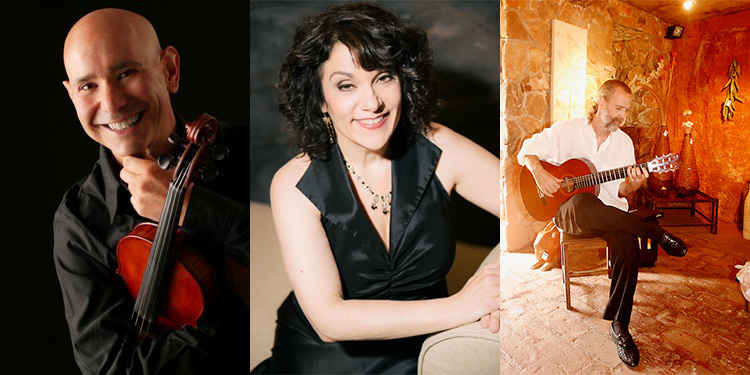
left to right: Hal Grossman, Judith Cohen, and David Burgess
Pianist Judith Cohen, a Steinway artist and one of Seattle’s musical treasures, presents her latest program as longtime Artistic Director of The Governor’s Chamber Music Series. Titled Small Plates: Tasty Musical Tapas from around the World, the concert features Cohen at the keyboard with colleagues David Burgess on guitar and Hal Grossman on violin and will be presented in Bellevue this weekend before the Governor’s Mansion performance in Olympia.
The Bellevue performance begins at 7.30 on May 13 at Resonance Events in Bellevue. Tickets here.
You can also experience this program in the beautiful setting of the Governor’s Mansion in Olympia on Monday, May 15, at 6.45 pm. Tickets here.
ABOUT THE ARTISTS
Judith Cohen made her European recital debut in 2002, performing two solo recitals in Budapest, Hungary, and since then has returned three times for concert tours of Hungary. She has performed solo recitals in Mexico, under the sponsorship of the Instituto Nacional de Bellas Artes. Critic Robert Somerlott of the Mexico City News hailed her as “an artist of unusual talent who captivated the audience with both her musicianship and stage presence.” She has performed solo and chamber music recitals throughout the Pacific Northwest, in Massachusetts, New York, Florida, Kentucky and Texas. She has also been presented in solo recitals by the Dame Myra Hess Recital Series in both Chicago and Los Angeles, and by the Florence Conservatory of Music in Italy.
Violinist Hal Grossman has been hailed by critics for his “tremendous virtuosic technique” and “outstanding artistic sense”. As concerto soloist, he has appeared with American, European, and Canadian orchestras including the Rochester Phil Harmonica, the North Carolina Symphony, Polish Symphonette, the Illinois Lima, Guelph, and Battle Creek Symphonies. He was the Grand Award Winner of the Lima Young Artist Competition and Silver Medalist of the International Stulberg Competition. Mr. Grossman also received First Prize Awards at the prestigious International Cleveland Quartet Competition and the National Fischoff Chamber Music Competition. He has performed for the Royal Highnesses, Prince Charles and Princess Diana in his New York debut at Carnegie Hall.
Classical guitarist David Burgess studied music at Mexico City’s Estudio de Arte Guitarrìstico under the noted Argentine guitarist Manuel López Ramos, subsequently landing a full scholarship to study in Italy with Oscar Ghiglia. An occasional pupil of Andrés Segovia throughout the mid-’80s, Burgess also took top honors in the Andrés Segovia Fellowship Competition in New York City, and placed first in the Mexico City’s Ponce International Competition, Toronto’s Guitar ’81 competition and Munich’s 31st International Music Competition. A onetime instructor at the University of Washington and the Cornish Institute of the Arts, in time Burgess settled in New York City, releasing his solo debut Silver Nuggets and Fool’s Gold.
The Governor’s Mansion Foundation, with more than 200 members, is an all-volunteer, non-profit, non-partisan organization, that honors the historical and cultural importance of the Washington State Governor’s Mansion by maintaining and enhancing furnishings and art for the public rooms of the Mansion, educating the public about the Mansion and its history, and advocating on its behalf. GMF is not affiliated with the Governor or the Governor’s office. For more information on GMF go to www.wagovmansion.org.
The Houston-based chamber music and jazz presenter DACAMERA is offering a holiday gift of Chopin performed by one of the leading interpreters of his music, the Grammy Award-winning Garrick Ohlsson. Listen to his Chopin recital, which opened DAMERA’s season, as a free stream for two weeks, available herewith registration.
As a gesture of solidarity and to support humanitarian aid to Ukraine, the Grammy-winning, Ukrainian-American pianist Nadia Shpachenko has released the album Invasion: Music and Art for Ukraine. The title work, composed for for piano, alto saxophone, horn, trombone, timpani, snare drum, and mandolin, represents the response to the war of her longtime collaborator and Pulitzer Prize winner Lewis Spratlan.
Invasion was composed for Shpachenko at the beginning of the invasion (the period 24 February–13 March 2022). The rest of the album features world premiere recordings of other works by Spratlan for solo piano. “These pieces reflect on the human experience, often finding solace and inspiration in nature and music of the past,” notes the press release from Reference Recordings. “Wonderer, a major piece that closes the album, connects in its character to the current experience of many Ukrainian people, especially those displaced by the war. The hero, searching through the unknown, overcoming pain, and reminiscing about things past, triumphs at the end.”
100% of the proceeds go to benefit Ukrainian people affected by war.
The incredible João Carlos Martins — a genuine cultural hero — celebrates the 60th anniversary of his debut at Carnegie Hall this evening at 7pm ET. He will lead NOVUS NY in a program combining Bach with music by the Brazilian composers Heitor Villa-Lobos and André Mehmari.
One of the great Bach interpreters at the keyboard, Martins shifted to conducting when it became no longer possible to continue his career as a concert pianist as a result of injuries and the condition of focal dystonia (which also affected the late Leon Fleisher). You can read in much greater detail here about the musician’s epic struggles and the love of music that has kept him going.
I had the honor of writing the program notes for his Carnegie Hall concert, which will present the following program:
J.S. Bach: Brandenburg Concertos 1 and 3 “Jesu, Joy of Man’s Desiring” from the Cantata Herz und Mund und Tat und Leben BWV 147 (arranged by Heitor Fujinami)
HeitorVilla-Lobos Prelúdio from Bachianas BrasileirasNo. 4 W264 – 424
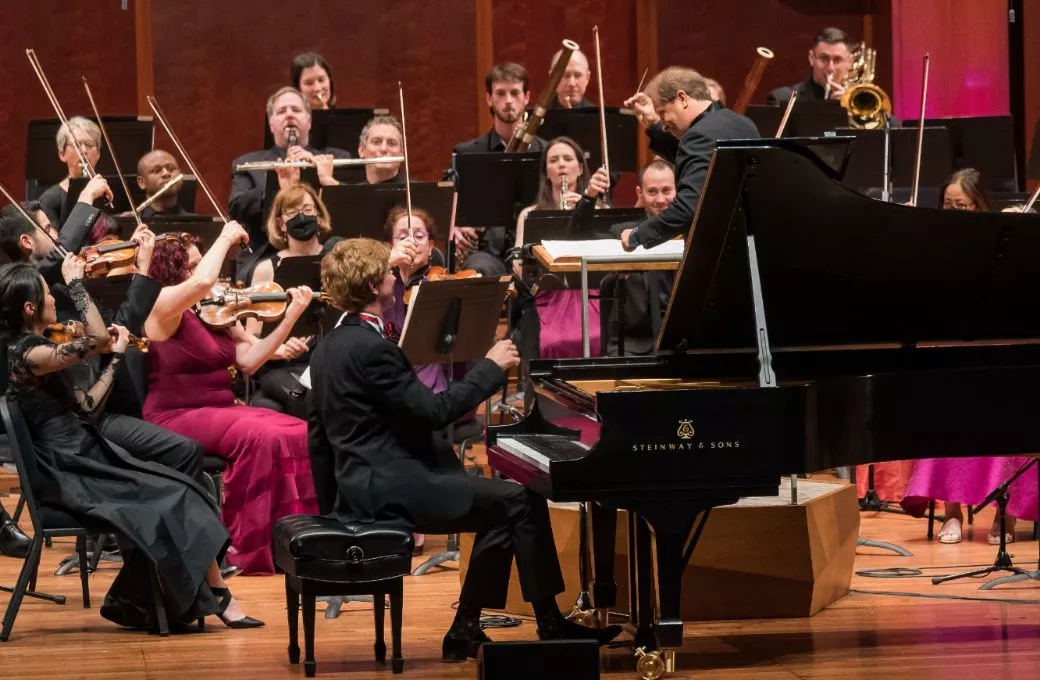
Ludovic Morlot conducting the Seattle Symphony with soloist Jan Lisiecki in Grieg’s Piano Concerto; image (c) Brandon Patoc
Several times during Seattle Symphony’s concert last night, it felt like a time machine had whisked us back a few years to the Ludovic Morlot era. The orchestra reunited with its former music director last weekend on opening night and is continuing the collaboration for the first full concert of the season’s subscription series. And they’ve managed to reactivate something of the chemistry that made their first seasons together so exciting.
You could sense it in the joyful enthusiasm with which they brought to life the opening piece, Tidalwave Kitchen, by Gabriella Smith. For the second time in a row this month, Morlot and the SSO launched a concert with music by a young woman composer inspired by the West Coast’s natural beauty — last Saturday, it was the world premiere of PNW native Angelique Poteat’s Breathe, Come Together, Embrace. So far as I know, Tidalwave Kitchen marked the first time the SSO has performed music by Smith, who hails from Berkeley and was mentored early on by John Adams.
In a short introduction onstage, the talented young composer remarked that it was in this piece that she first had the reassurance of arriving at her own voice. Smith wrote it a decade ago, prompted during her student years on the East Coast by intense homesickness for the “beautiful and dramatic landscape of the Northern California coast” where she’d grown up.
Smith elaborates in her composer’s note on the memories of that landscape that inspired her: “hikes shrouded in fog, tide pooling on the rocky beaches, and sitting by the Pacific listening to the hallucinatory sounds of the ocean, the keening gulls, pounding surf, sizzling of sand and sea foam, drifting in and out of fog and clarity, order and randomness, reality and imagination.”
The resulting music paints no pretty postcard but is an immersive, sensory-rich orchestral fantasia, unpredictable yet persuasive in its wildly dramatic mood swings. Smith seems to want to embrace the world the way a Mahler born into the 21st century might have set out to do so, using post-Minimalist devices to power up and take flight.
Fragments of a stable melody (or hymn?) want to coalesce at several points but remain shrouded by the almost-psychedelic haze of Smith’s timbral palette. A raucously festive outburst arrives at the climax, but its brash exuberance spills over into something vaguely ominously manic and then subsides.
Over the summer, Morlot conducted the San Francisco Symphony in Tidalwave Kitchen, and he elicited palpable excitement from the SSO. It’s one thing to possess the keen musical imagination on display in this music, but Smith also shows a remarkable technical command of the resources of an orchestra, making the piece especially apt as a concert curtain raiser. I hope we get to hear more of her music in Benaroya Hall.
Morlot will conduct his new orchestra (the Barcelona Symphony) in another piece by Smith later in October. Incidentally: this sought-after composer will be on the panel for the New York Times Events-sponsored seminar A New Climate exploring collective responses to climate change (October 12 in San Francisco).
Raucous, fiery energy likewise abounded in Jan Lisiecki’s account of the competitive folk dancing that drives the finale of Grieg’s Piano Concerto. Returning to the Benaroya stage following his inspired contribution to the opening night concert, Lisiecki approached the familiar concerto from an almost dizzying plenitude of perspectives.
His variety of tonal colors was spellbinding: the thunderous chords of the massive first movement cadenza thrilled with power and accuracy, while the plaintive trains of the Adagio breathed the poetry of Lisiecki’s most personally inflected Chopin. It was especially nice to hear his rendition of Chopin’s posthumously published Nocturne in C minor as an encore, where he distilled that poetry to its most concentrated essence. I was also struck by the quality of his partnership with Morlot and the orchestra as he responded to the phrasings of individual players, such as the idyllic interlude flutist Jeffrey Barker shaped in the finale.
The extreme pianissimos Lisiecki drew out of the Steinway foreshadowed the drama whipped up in the second half of the program. Morlot led the SSO in Tchaikovsky’s PathétiqueSymphony back in 2014 (when it was similarly paired with new music — a piano concerto by Alexander Raskatov). Eight years on, to my ears there is no doubt that his understanding of this music has deepened and darkened. His command of the larger span of Tchaikovsky’s design has strengthened as well.
The opening lamentation — expressively phrased by bassoonist Luke Fieweger, in one of several outstanding cameos from across the SSO’s ranks — set the terms of the drama as effectively as a memorable establishing shot by a seasoned director. Morlot outlined the long first movement’s disparate sections with a clarity that underscored the emotional polarities of Tchaikovsky’s enigmatic final symphony.
However, I found something lacking in the middle movements. The tricky meter of the second movement waltz came off sounding slack, even a bit sloppy, while the swaggering march in the third movement needed a tighter rein to wield its full irony. But Morlot inspired the most moving playing of the evening in the Requiem-like finale, building by subtraction so that the pitiless subsidence of Tchaikovsky’s conclusion overwhelmed with its negation.
The program will be repeated Friday and Saturday.
Review (c) 2022 by Thomas May. All rights reserved.
Jan Lisiecki, Ludovic Morlot and the Seattle Symphony; image (c) Brandon Patoc
My review of this weekend’s opening night concert:
Mixing the familiar with some discoveries, the Seattle Symphony offered a pleasingly varied program to open its new season. The event also brought an element of reassurance by evoking welcome memories of a more stable era as former music director Ludovic Morlot reunited with the orchestra…




 MEMETERIA by Thomas May