
Remarkable work by Ilan Rechtman. I need to find out more about him.
Filed under: miscellaneous, piano

January 9, 2018 • 11:58 am 1
Remarkable work by Ilan Rechtman. I need to find out more about him.
Filed under: miscellaneous, piano
October 13, 2017 • 2:26 pm Comments Off on Sibelius at the Piano
“For one thing — and, given the era, it was no small achievement — Sibelius never wrote against the grain of the keyboard. At its best, his style partook of that spare, bleak, motivically stingy counterpoint that nobody south of the Baltic ever seems to write.” –Glenn Gould
November 18, 2016 • 10:51 am Comments Off on Lucerne’s Piano Festival
The third and final installment of Lucerne Festival’s 2016 programming is the Piano Festival. It starts on Saturday (19 November), with Grigory Sokolov in a Mozart-Schumann recital. And he’s playing one of the pianistic holy of holies, Schumann’s Op. 17.
Filed under: Lucerne Festival, piano, Schumann, Uncategorized
February 29, 2016 • 8:16 am Comments Off on Five Not-So-Easy Pieces: Prokofiev at BAM

New York, NY – Feb. 24, 2016 — The Mariinsky Orchestra, lead by conductor Valery Gergiev, performs Prokofiev’s Piano Concerto No. 3: Daniil Trifonov soloist, at BAM’s Howard Gilman Opera House. (credit: Robert Altman)
My review of Folk, Form, and Fire: The Prokofiev Piano Concertos — Prokofiev marathon with Gergiev and the Mariinsky Orchestra — has now been posted on Musical America (behind a paywall):
The Mariinsky Theater and its director Valery Gergiev launched their recent five-day residency at BAM February 24 with an ambitious orchestral program comprising the five piano concertos of Prokofiev. Trading the windswept rain … »Read
February 12, 2016 • 1:48 pm Comments Off on The Seattle Symphony’s Electrifying Eroica

Ludovic Morlot
The title of my review is actually only part of the story of last night’s performance by the Seattle Symphony and Ludovic Morlot. The program — which I recommend highly as one of the highlights of the season to date — will be repeated Saturday and Sunday. The Beethoven alone would be enough to justify my enthusiasm, but let me get to the other parts of the story first.
Also worth the price of admission is the chance to hear the mellifluously named French pianist Jean-Efflam Bavouzet in Bartók’s Third Piano Concerto and the relatively rare Three Places in New England of Charles Ives.
I suspect some of the remarkably palpable energy the players manifested last night has to do with a sense of anticipation regarding the 2016 Grammy Awards coming up Monday: the SSO nabbed three nominations for the second volume of their ongoing Henri Dutilleux series on the in-house label (including for Best Orchestral Performance).
What was particularly striking in the Ives — deeply challenging pieces, despite the sudden appearance of fragments of folk Americana that momentarily give the illusion of familiar reference points — was the refinement of detail within the most opaque, thickly laden textures of this score. The boisterous energy Morlot summoned for the famous clashing marches of the second place (“Putnams’ Camp”) was all the more startling on account of that refinement — a trait that reminded me of how the conductor searches for the right detail, le ton juste, inside one of Dutilleux’s intricately wrought orchestral canvases.
It was fascinating to hear the Ives so soon after last week’s rendition of Luciano Berio’s Sinfonia. You couldn’t help comparing the method of intrusive quotations, unprepared and free-associative, and wonder at the American maverick angle that leavened Berio’s European avant-gardism. Both composers resort to a collage aesthetic that seeks to replicate the complexity and porousness of musical memory — free of irony and mind games.
Indeed, at times Morlot elicited a curious innocence and tenderness from Ives’s decidedly unsentimental memory-soundscapes. Those qualities also came to mind in the Bartók concerto. On the surface this piece can almost be read as a kind of regression or longing for simpler procedures, a revocation of the composer’s Modernist street cred.
But Bavouzet’s enchanting, subtle interpretation had a cleanness of focus that suggested a mature master taking stock and paring away the inessential. Bartók knew he was dying when he composed the Third Concerto, and in this score the musical past returns not by way of collage and quotation but as acts of allusive, loving homage (above all to Bach and Beethoven — and of course to the rich loam of folk culture that Bartók accessed in a way so unlike the Romantics).
This was especially effective in the profoundly stirring central movement (“Adagio religioso”), where the pianist gave exquisite weight and voicing to Bartók’s harmonies and crisp, wonder-evoking articulation to the birdsong. Bavouzet — who had an opportunity to study with the pianist who premiered this work, György Sándor — projected winning charm along with a clear sense of purpose in the outer movements.
He returned for a most unusual encore (playing, incidentally, the new Steinway recently purchased for the SSO): three of the Notations by a 19-year-old Pierre Boulez, composed right around the time Bartók was working on his final concerto. Bavouzet played with Zen-like presence, or like a curator displaying a set of particularly rich gems, holding them up to glisten and sparkle in the light. This week’s concerts are being dedicated to the memory of the late Boulez.
So on to the Third Symphony of Beethoven. Morlot chose this work for his very first subscription concert after stepping to the podium as the SSO’s music director in September 2011 (pairing it on that occasion, curiously enough, with Dutilleux and a Frank Zappa piece Boulez himself had conducted).
Certain aspects echoed what lingers in my memory from that performance: above all, the historically informed performance touches that conferred a certain athletic fleetness and sharper focus. These were even more apparent — and more paradoxically “radical” in brushing aside the dust from overfamiliar passages — without determining every contour of the conductor’s approach.
I’d say that’s evidence of an increased confidence and interpretive vision Morlot is bringing to this score. The hammer blow chords at the end of the first movement’s exposition, for example, were genuinely shocking, while the use of a solo string quartet to voice one of the variation passages in the introductory section of the finale underscored the idea that textural transformations are just as crucial to Beethoven’s thinking as the thematic/harmonic ones that usually command attention.
Above all, the sheer energy of collaborating with the SSO on moment-by-moment decisions in the score gave this performance the stamp of authenticity that really matters, resulting in an electrifying Eroica. Not all those decisions worked: some of the rhythmic articulations of the Funeral March were sloppy, and the volcanic whirlwind that should launch Beethoven’s extraordinary finale (is there anything about the Eroica that isn’t extraordinary?) sounded curiously listless. But Morlot and the SSO sustained an edge-of-your-seat intensity across the work’s epic span, liberating it from any trace of the routine.
And Morlot inspired much fine, indeed heroic, solo work from the players, including Mary Lynch’s achingly expressive oboe solos (a key leitmotif of the Eroica) in the Funeral March and Jeff Fair’s fearless, flawless spotlights in the famously fear-inducing trio of the Scherzo.
Really, what more can you ask of a symphony program?
–(c)2016 Thomas May. All rights reserved.
Filed under: Bartók, Beethoven, Ludovic Morlot, pianists, piano, Pierre Boulez, review, Seattle Symphony
September 21, 2015 • 4:18 pm Comments Off on Still Fresh: Morlot and the Seattle Symphony Embark on a New Season

SSO: Opening Night Gala with Ludovic Morlot and Piano Competition winner Kevin Ahfat. Credit: Brandon Patoc Photography
I imagine some people are doing a double take when they realize Ludovic Morlot has just started his fifth season helming the Seattle Symphony. Well, it is hard to believe we’re almost a decade into his tenure: his approach to me feels as fresh as ever. But with the added benefit of confidence accruing. (Here’s another double take: this is the orchestra’s 113th season.)
Saturday evening’s season opener certainly had several Morlot trademarks: a lovely pairing of American and French composers that showed off the health and vigor of the musicians, along with a like-minded peer in the guest artist for the second half.
The performances also overturned a couple of pesky clichés. One is the matter of non-native-born Americans supposedly having a hard time with getting across an authentic feel for the “American” sound — meaning in this context primarily the jazz-inflected rhythms of such popular 20th-century composers as Leonard Bernstein.
Morlot was perfectly at home in the Overture to Wonderful Town and inspired a deliciously stylish reading from the players, complementing Bernstein’s warm lyricism with brash joie de vivre. Instead of over-emphasizing them, Morlot let Lenny’s meter shifts propel the music with an elegantly giddy, light-as-air verve.
The artistic high point came with the orchestral suite Copland fashioned from his original chamber-orchestra score for Appalachian Spring. Here was a touching example of Morlot’s fresh perspective. My reaction was similar to what I felt when he gave us the same composer’s Lincoln Portrait for the concert opener in 2012.
Copland’s suite sounded as if it were being sung in a single tender breath. The performance featured another Morlot trademark: mindful, deftly balanced timbral blending and well-judged phrasing that allowed a particular gesture to reverberate with maximal impact (as right after the final tutti variant of the “Simple Gifts” tune). The result made this music sound so much richer and affecting than you might expect from an aging chestnut. Contributions from the winds were particularly lovely, including guest clarinetist Frank Kowalsky.*
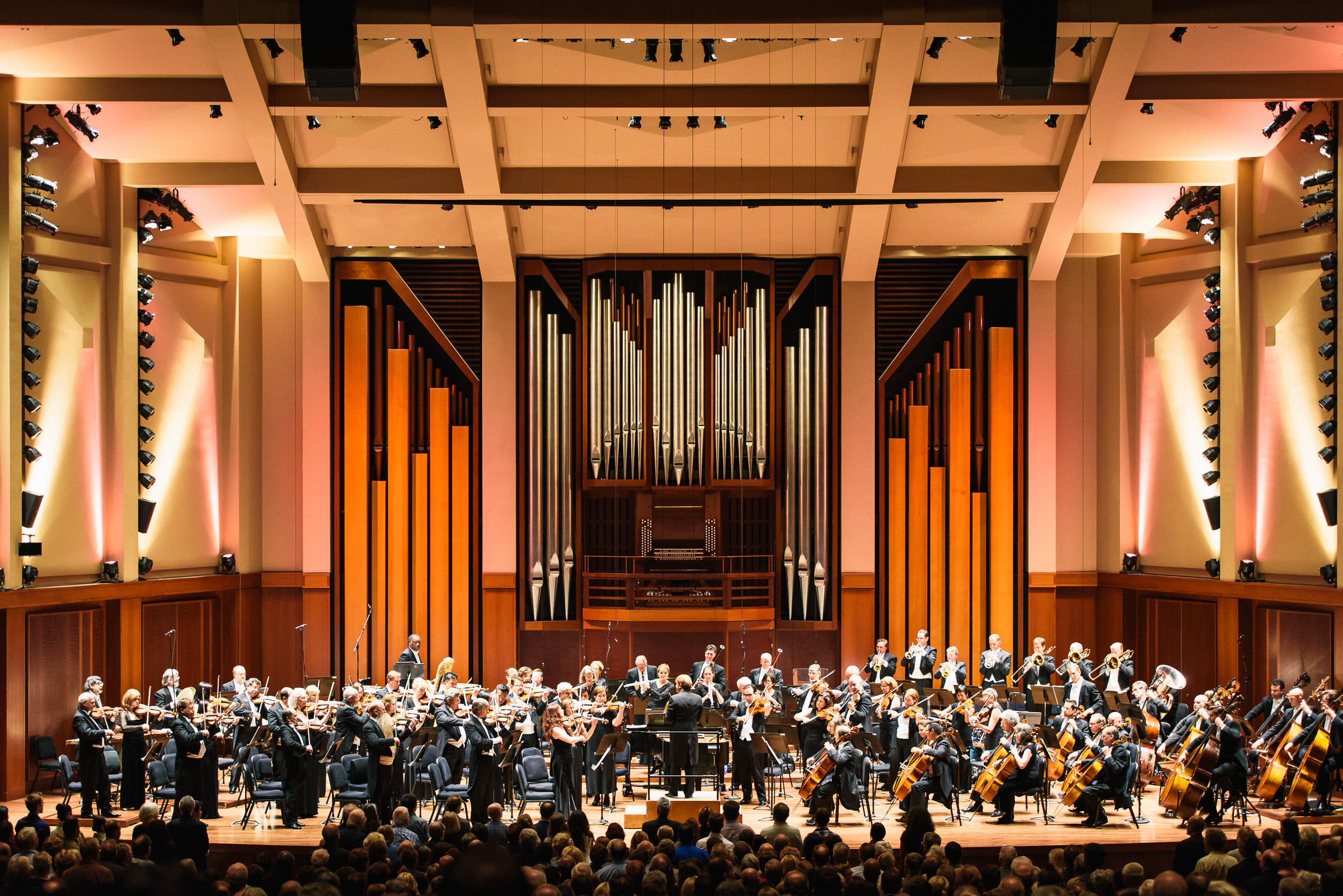
Opening Night Gala Credit: Brandon Patoc Photography
The piano dominated the rest of the program. I have mixed feelings about the prominence given to guest artists at a symphony orchestra’s opening concert: it often seems to decenter the musicians we should be celebrating and enjoying, making them secondary as the spotlight is turned over to a “star.” (And, yes, I get the necessity of this to stir up donor interest and create buzz.**)
But Jean-Yves Thibaudet was the perfect choice to fill the star role. Not only are he and Morlot natural artistic partners: he plays with the orchestra with genuine empathy and give-and-take. In addition to which, Thibaudet will be coming back several times this season in his role as artist in residence with the SSO.
So it was a treat to hear them join together for the fifth of Camille Saint-Saëns’s piano concertos, also known as “the Egyptian.” (Saint-Saëns wrote it while staying in Luxor and also alludes to music he heard in Egypt.) The second cliché that got overturned: the formula that composer X writes difficult music for the soloist whose “virtuosity is not an end in itself, but a vehicle for [fill in the blank with some “higher” purpose].”
Well, not so much in the Saint-Saëns. The virtuosity called for is often over the top, a vestige of the composer’s Lisztian side, and many stretches are exactly for the sake of virtuosity, period. But what fun when played by an artist of such refined taste and intelligence. Thibaudet truly dazzled and charmed, even eliciting a note of dreamy mystery in the Andante, with spirited collaboration from the orchestra.
The concerto was prefaced by the Danse Bacchanale from Saint-Saëns’s opera Samson et Dalila, extending the “Orientalist” theme (and pinpointing one source of Hollywood’s musical orientalism). Much of it is wonderfully trashy, sequence upon sequence, but Morlot had a way of making it sound better than it is.
The piano figured in the middle of the first half as well, when the young Canadian-born Kevin Ahfat took to the keyboard to play the final movement from Samuel Barber’s Piano Concerto. Ahfat had just been announced as the winner of the Seattle Symphony’s inaugural Piano Competition. Along with a $10,000 cash prize, the victory nets him a future performance with the SSO next season.
I had to miss the competition itself, so this was my first time hearing Mr. Ahfat, but he instantly made a powerful impression. I liked the choice of the too-seldom-heard Barber, and though this movement really exhibited only one side of his artistry — a very extroverted, showy side — his playing brimmed with personality and flair. If he can just grow out of the Juilliard mode of exhibitionistic technique-centrism…
To close the concert, Morlot pulled a shtick a la Itzhak Perlman, having Thibaudet come out (joined by Ahfat on another keyboard) for a pretend audition as they embarked on a humorously awkward account of “Les Pianistes” from Saint-Saëns’s Le carnaval des animaux, bringing the curtain down with the finale to the same suite.
*Although the “official” Seattle press has ignored this news, principal clarinetist Ben Lulich has been appointed “new acting principal clarinet” of the Cleveland Orchestra but will perform at some of the SSO’s concerts this season (where he’s technically on leave for the season).
**According to an SSO Tweet, $785,000 was raised for education and mentoring at the post-concert gala:
–(C)2015 Thomas May. All rights reserved.
Filed under: Ludovic Morlot, piano, review, Seattle Symphony
June 24, 2015 • 8:58 am Comments Off on Terry Riley at 80, on 20 Fingers
“That’s the sort of thing that’s always interested me: things where you can’t quite figure out what you are hearing,” says Terry Riley — and the maverick composer’s curiosity hasn’t abated a bit over the years.
Today Terry Riley has reached the milestone age of 80. “In addition to his artistic legacy — a long and varied creative record that includes some of the most notable works in the history of minimalism and post-minimalism — Riley must hold some kind of record as the happiest and least stress-afflicted musician now working,” writes Joshua Kosman in his recent profile.
A new release from the piano duo ZOFO offers an intriguing perspective on the work of this Minimalist pioneer (who played jazz piano early in his career).
Eva-Maria Zimmermann and Keisuke Nakagoshi — the pianists who comprise ZOFO (decoded as a visual pun for “20” plus “fingered orchestra”) — started their collaboration with a performance of “Cinco de Mayo” from The Heaven Ladder, Book 5, a collection of the native Californian’s pieces for piano-four-hands originally commissioned by Sarah Cahill.
“There is nothing quite like hearing the full eight octaves of a piano sounding in all its orchestral richness,” according to Riley. “ZOFO realizes the full potential of four-hand playing. They think and play as if guided by a Universal mind.”
Riley was so impressed by what ZOFO had done with “Cinco de Mayo” that he encouraged them to take on the rest of his four-hand piano oeuvre, which consists of the four other piece in The Heaven Ladder, Book 5: “Etude from the Old Country,” “Jaztine,” “Tango Doble Ladiado,” and “Waltz for Charismas.”
To expand this body of work into a full-length CD, Nakagoshi made arrangements of two additional pieces, consulting and collaborating with the composer: “G String” and “Half-Wolf Dances Mad in Moonlight” (both string quartets). Zimmermann meanwhile made a four-hand arrangement of “Simone’s Lullaby,” a solo piece from Book 7 of The Heaven Ladder originally written for Gloria Cheng. ZOFO commissioned Riley to write a short additional piece, “Praying Mantis Rag.”
Regarding the role of improvisation in Riley’s aesthetic, Zimmermann says: “For me to see Terry perform also played a big role in how I approached this recording session. He is so totally free when he performs, improvising over his own ideas. It’s so much about the moment and the essence of the music. This is so healthy for me as a perfectionist….”
Filed under: American music, anniversary, CD review, piano
September 20, 2014 • 4:51 pm Comments Off on Seattle Symphony’s Dvořák-Fest Begins

Daniil Trifonov: (c) Dario Acosta
My review of the Seattle Season’s opening concert of the season — including pianist Daniil Trifonov’s spectacular SSO debut — is now live on Bachtrack:
Music by Antonín Dvořák was included on Ludovoc Morlot’s first-ever programme leading the Seattle Symphony, which took place in October 2009. At the time – two years before coming on board as music director – Morlot was a visiting conductor, and he offered the barest sampling of his thoughts on Dvořák (three of the Legends).
Filed under: conductors, piano, review, Seattle Symphony
September 17, 2014 • 8:50 am 1
The remarkable American composer George Walker started out his career with the intention of becoming a concert pianist, but the racism of the era hampered those plans.
And more’s the pity, given the evidence captured on Albany Records’ ongoing series of releases of Walker as composer and performer.
Here are some more YouTube uploads where you can sample Walker’s artistry at the keyboard:
Chopin: Polonaise in A-Flat Major, Op. 53:
Robert Schumann: Fantasia in C, Op. 17- First Movement:
March 22, 2014 • 1:52 pm Comments Off on Richard Goode Vibrations
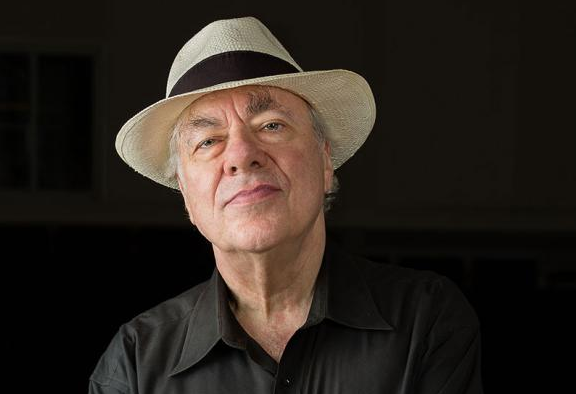
Richard Goode
Can there be any better therapy than to spend an evening with Richard Goode in recital? I mean therapy here not as some kind of temporary balm but as a restorative of a sense of musical health. Mr. Goode’s playing, for me, is able to reaffirm the essential values that make music such an indispensable part of life.
It’s admittedly hard not to wander into Ye Realme of Hyperbole when attempting to convey just what it is that makes Mr. Goode’s pianism so damn appealing. But after two blissful hours of listening to Mr. Goode at Meany Hall — his program this week was part of the University of Washington’s World Series and followed — I emerged invigorated and more alert to the unique qualities as well as the originality of the three composers Mr. Goode juxtaposed in his recital.
His program framed the early Romanticism of Robert Schumann’s Op. 6 Davidsbündlertänze (1837) with two examples from the early 20th century: selections from Leoš Janáček’s cycle On an Overgrown Path (published in 1911) and the first book of Claude Debussy’s Préludes (1910). All three call for innovative approaches to keyboard sonority and form alike.
Mr. Goode’s musicianship proves so enthralling in large part thanks to the sense of conviction undergirding his interpretations. Now 70, Mr. Goode plays with all the intensity of someone eager to share the miracles of a new composer he’s freshly discovered, whose code he’s just cracked. There was never even a hint of “getting through” this or that thorny passage using tricks worked out decades ago. Of lazy habits or complacent readings I could detect not a trace.
And that means being unafraid to push in surprising directions (particularly in the Schumann) so as to risk a certain emphasis or refine a structural insight. The curious thing is that Mr. Goode’s fearlessness isn’t reckless or arrogant — on the contrary, it’s simultaneously reassuring. I repeatedly enjoyed the illusion of being treated to a private performance in a salon, with the pianist showing off something exciting he couldn’t keep from sharing.
So in the Schumann, for example — he played the entire 18-piece cycle from memory — Mr. Goode emphasized the fantastical contrasts of Schumann’s bipolar alter egos. His remarkable feel for dynamics allowed for maximal, shocking antitheses: heaven-storming attacks followed a second later by eerie, muffled scamperings. Here was composition as the art of non-transition: rather than smooth over the rapid shifts of thought, Mr. Goode sought out the emotional logic within Schumann’s mercurial, wildly roaming imagination.
But Mr. Goode avoiding invoking the cliché of the “unstable” Schumann, as if this music foreshadows his mental breakdown. This he accomplished largely by digging in to the pockets of humor which abound in Schumann’s score.
The more serenely lyrical dances, meanwhile, carried over echoes of the calm, knowing simplicity that radiates from the Janácek with which the program opened. Mr. Goode chose four pieces from the first book of On an Overgrown Path. I felt fortunate to be hearing these, performed by this particular pianist, so soon after experiencing Peter Brook’s The Suit at Seattle Rep.
Janácek’s pared-down lines and poignant, clutter-free harmonies suddenly seemed to share a kinship with Brook’s enigmatic clarity. Through the briefest of gestures — the mere wisp of an interval as ostinato, for example — Mr. Goode’s sensitive reading conveyed all the compressed density of meaning of a Webern score.
When Mr. Goode returned for the program’s second half, I admit wondering how he could possibly elicit a connection between the Debussy and what we’d previously heard. His Schumann was clearly forward looking, far ahead of his time, while his Janácek breathed nostalgia free of sentimentality with its elegiac, backward glances.
Soon it became clear that the connection was in Debussy’s own startling contrasts — spread out though they are over far larger scales — and in those evanescent, painterly gestures of a measure or two that suddenly illuminate an entire prelude. The spangle of notes at the keyboard’s uppermost extremity which ends Les collines d’Anacapri, for instance, glittered with an almost psychedelic vividness. And with La fille aux cheveux de lin, Janácek’s unfeigned simplicity was again recalled.
I found much of Mr. Goode’s Debussy refreshingly unconventional. In lieu of the intensely sensual, “sonorous poetry” you often hear in accounts of the Préludes, Mr. Goode showed off the solid construction of Debussy’s thinking with rhythmic acuity and clearly articulated voicings (his pedal technique is superb). Humor, again, was given its due, along with the proto-jazz elements that Debussy annexes to his vocabulary.
–(c)2014 Thomas May. All rights reserved.
 Arts & Culture Stories from NPR
 MEMETERIA by Thomas May