Edward Mendelson’s new essay “The Secret Auden” in the New York Review of Books is a provocative read. The literary executor of the Auden estate and an authority long familiar to Audenites, Mendelson reveals some of the poet’s best-kept secrets.
Not tabloid secrets, not the gossipy stuff. Auden’s “secret life” lay hidden “because he would have been ashamed to have been praised for it.” Mendelson starts by touchingly recounting several instances of the poet’s under-the-radar generosity to war orphans, prisoners, people in need. And “when he felt obliged to stand on principle on some literary or moral issue,” writes Mendelson,”he did so without calling attention to himself” — in contrast to Robert Lowell, “whose political protests seemed to him more egocentric than effective.”
A potent example Mendelson adduces: Auden’s preface to his co-translation of Dag Hammarskjöld’s diary reflections, Markings, implicitly referred to the UN Secretary General’s closeted sexuality — in gently diplomatic terms — and prompted objections from the Hammarskjöld estate before he published it. At the time, it was widely believed that Auden would win the Nobel Prize, but he refused to revise his copy. Mendelson notes that he “ignored the hint, and seems to have mentioned the incident only once, when he went to dinner with his friend Lincoln Kirstein the same evening and said, ‘There goes the Nobel Prize.’ The prize went to Jean-Paul Sartre, who refused it.”
So why did Auden in later years cultivate a curmudgeonly, cantankerous image precisely when he was at his most generous? “In part,” suggests Mendelson, “he was reacting against his own early fame as the literary hero of the English left … Far from imagining that artists were superior to anyone else, he had seen in himself that artists have their own special temptations toward power and cruelty and their own special skills at masking their impulses from themselves.”
From this tendency toward keeping his good deeds secret, Mendelson draws out far deeper implications about moral self-awareness and the crucial debates of modernity:
One of many forms this argument takes is a dispute over the meaning of the great totalitarian evils of the twentieth century: whether they reveal something about all of humanity or only about the uniquely evil leaders, cultures, and nations that committed them. For Auden, those evils made manifest the kinds of evil that were potential in everyone.
How familiar and easy is that Manichean division of the universe into good and evil. Auden, though, “was less interested in the obvious distinction between a responsible citizen and an evil dictator than he was in the more difficult question of what the citizen and dictator had in common, how the citizen’s moral and psychological failures helped the dictator to succeed.”
In his own poetry and essays, Auden loves to play with binaries in a different — and humanely metaphorical — way:
Much of his work dramatizes a distinction between gentle-minded Arcadians, who dream of an innocent past where everyone could do as they wanted without harming anyone else, and stern-minded Utopians, who fantasize, and sometimes try to build, an ideal future in which all will act as they should. He identified himself as an Arcadian, but he never imagined that Utopians, no matter how much he disliked being around them, were solely to blame for public and private injustice, and he always reminded himself that Arcadians were not as innocent as they thought.
Pages from one of Emily Dickinson’s small poetry booklet “fascicles”
So just how many of the dear, withering Muses are supposed to be on death row? Of course the meme of The Death of Classical Music (TM) gets periodic play.
And poetry? The art that is inseparable from language itself, the very signature of our humanity? There’s no lack of doomsayers claiming with a straight face — and hoping to boost hits in the process — that poetry “is about as useful as the clavichord.”
One common denominator in this litany of obits: the relentlessly short-sighted, quick-fix worldview of contemporary capitalism.
“Poetry is dead by capitalism’s standards – it is not an obvious moneymaking venture, despite traceable employment and readings’ payoffs via the academy – and that emboldens some folks limited by capitalist blinders to herald poetry’s last breath,” writes Amy King, co-editor of the PEN Poetry Series, in a worthwhile new essay for the Boston Review: “Threat Level: Poetry.”
And talk about blinders: “The naysayers of poetry’s vastness seem to be primarily fueled by declaring poetry’s defeat or impotence instead of engaging in the more difficult work of creating beyond what they know.” King continues:
“The limits of my language are the limits of my world” is not Wittgenstein’s defeatist end; it is his challenge to set out boldly and with curiosity to expand and explore through the language we think through. He didn’t stop with the “Tractatus Logico-Philosophicus” where that statement appeared; it was his first of many books, such as the “Philosophical Investigations,”that explicated his theory of “language-games” and complexly broadened his considerations of language use overall.
What a lazy, pretentious approach to think we’ve located our limits and can now only recycle and shuffle what’s been said before as cut-and-paste, as the Conceptual poets would have it, or by squeezing words into forms without any sense of language’s expansiveness or trust in the person using it, as traditional formalists would claim.
[…]
Further, the writers of poetry’s obituaries are aligning themselves with a capitalism that is patriarchal by default: it is more beneficial to divide and conquer or imperialistically claim, in sound-byte fashion, than to identify and envision beyond perceived limitations or some institutionalized formulaic trend.
I especially admire Amy King’s eloquent manifesto for what poetry can do:
Poetry is as large as language. Just as language pushes its limits, poets can make connections where connections are frowned upon. We might engage with our intuition or emotion or even that mysterious and popularly denounced “spiritual” part of ourselves. We can juxtapose the arbitrary with the arbitrary and invoke a maddening sense of the reality we’ve inherited. We can move from our depression or fleece a corrupt order with a vision of existence that incites responses varying from the call to question to the responsive insurrectionary. We can also highlight the beautiful-ugly among us that everyday language would insist is either one or the other.
This week’s National Symphony program features Paul Hindemith’s beautiful When lilacs last in the dooryard bloom’d: A Requiem for those we love in a program conducted by Christoph Eschenbach. This was one of the favorite works of Robert Shaw, who commissioned Hindemith’s remarkable setting of Walt Whitman’s eulogy for Lincoln. Here’s the essay I wrote for the NSO program (which opens with Joshua Bell in the Mendelssohn Violin Concerto — hence the lede):
A descendant of one of Mendelssohn’s cousins, Arnold Mendelssohn, turned out to be the first composition teacher of another precociously gifted musician, Paul Hindemith (1895-1963), who was born in Hanau (near Goethe’s city of Frankfurt). Hindemith came of age during a period of violent, revolutionary change in the early 20th century – the years that gave birth to modernism in its many forms. In the 1920s, Hindemith caused one scandal after another with his stage works and was considered a rebellious upstart who flirted with the avant-garde.
Like Shostakovich vis-à-vis Stalin, Hindemith managed to incur the personal displeasure of Hitler. The latter’s unyielding loathing of Hindemith was set in stone after seeing a scene from the satirical 1929 opera Neues vom Tage (“News of the Day”) featuring a “nude” soprano (actually, in a flesh-colored stocking) as she sings in the bathtub. Though he wasn’t Jewish, Hindemith gained a place of honor among the “degenerates” singled out by leading Nazis, who regarded him as “spiritually non-Aryan” and banned his music. The situation was actually more convoluted, however, with some pro-Hindemith voices among the hierarchy.
Hindemith may have hoped to influence cultural policy by finding a way to remain in Germany – in hindsight, his failure to express vociferous dissent from within the Third Reich has been criticized – but the situation grew intolerable and Hindemith, together with his wife (who was partially Jewish), emigrated first to Switzerland and then to the United States, where he influenced a new generation during his 13-year tenure teaching at Yale. When Lilacs Last in the Dooryard Bloom’d ranks as the most significant creative legacy of this American period – Hindemith and his wife became U.S. citizens in 1946, the year of its premiere, although they returned to Europe in 1953 – and was acclaimed “a work of genius” by the legendary critic Paul Hume, writing of a performance at the National Cathedral in 1960.
Portrait of Walt Whitman by Thomas Eakins, dated 1887-88
“It is probable,” the great conductor Robert Shaw once declared, “that no foreign-born composer has made such a direct and healthy contribution to American music as Paul Hindemith.” Shaw was in fact the prime mover behind When lilacs last in the dooryard bloom’d, which he commissioned for what was then known as his Collegiate Chorale in the winter of 1945. Shaw led the world premiere in New York on May 14, 1946 (featuring a young George London as the male soloist), and he championed the work for the rest of his career; according to Michael Steinberg, Shaw treasured Hindemith’s dedication of the score to him “as perhaps the most significant honor of his professional life.”
The immediate occasion that prompted Lilacs was the sudden death in office of President Franklin Delano Roosevelt in April 1945 – 80 years after the assassination of Abraham Lincoln had plunged the nation into a period of prolonged mourning and soul-searching, the artistic fruit of which was one of Walt Whitman’s (1819-1892) most extraordinary poems. Hindemith had actually begun to cultivate a fascination with Whitman’s poetry long before: as far back as 1919 he had composed three “hymns from Whitman” (for baritone and piano, in German), including a setting of “Sing on, there in the swamp” (the fifth vocal section in Lilacs).
In his book New World Symphonies, Jack Sullivan reports that “Shaw initially took this single song to Hindemith, who had reworked it in 1943, with the proposal that it be used as a memorial to Roosevelt. Hindemith’s admiration for both President and poet was so great, however, that he responded, ‘No, we should do the whole thing.’ A two-minute song became an hour-long New World Requiem, an American epic set to European forms, including a sinfonia, a chorale, marches with trios, double fugues, arias, choruses, motets, fanfares, and much else.”
To undertake “the whole thing” entailed setting a text of 208 lines comprising more than 2200 words, arranged by the poet in 20 sections. In one of his commentaries, Robert Shaw refers to the “technical virtuosity” of setting such a lengthy text meaningfully within a musical span lasting about an hour (without, that is, resorting to “dry recitative”). He contrasts the first 20 minutes of Bach’s B minor Mass, which sets just three words, with the roughly 900 words Hindemith sets in the first 20 minutes of his work: “And these are words not lightly tossed into the composition heap. They are Walt Whitman words, burdened with emotional ponderosity and ponderability.”
By 1865, Whitman had already gathered a collection of poems inspired by his experiences nursing the wounded and dying in Washington, D.C., which he titled Drum-Taps (an excerpt from which can be seen engraved at the Q St. entrance to the DuPont Circle Metro station). Within weeks of Lincoln’s assassination at Ford’s Theater on Good Friday in 1865, Whitman had completed a new addition to this, When lilacs last in the dooryard bloom’d (a “dooryard” refers to a yard adjacent to the door of a house). That poem was published in the Sequel to Drum-Taps by the D.C.-based Gibson Brothers.
Whitman weaves a complex network of imagery together to fashion the deeply moving reflections of his Lincoln elegy. He mines the evocative power of three dominant symbols, which recur but with ever-changing connotations throughout the poem: lilacs, the “Western star” (i.e., Venus), and the “gray-brown” wood thrush. The specific occasion of Lincoln’s death (the President is never referred to by name) and the spectacle of “the silent sea of faces” grieving as the coffin passes give way to further meditations on the cycle of mourning and the artist’s task. Whitman builds to a larger vision of loss and life’s journey, drawing on images from nature and American civilization alike. The poem reaches a climax with its epiphany of the “death carol” and compassion for the war dead, ending with an affirmation of “retrievements out of the night” and the work of memory.
When lilacs last in the dooryard bloom’d moreover incorporates much musical imagery (above all, references to “song”). Not surprisingly, it has appealed to a remarkable variety of composers, including Roger Sessions, George Crumb, George Walker (whose Lilacs won the Pulitzer Prize in 1996 and whose recent composition will be featured later this season in an NSO premiere), and, most recently, Jennifer Higdon. For his setting, Hindemith translates Whitman’s poetic elegy into a kind of combined oratorio-requiem, with the subtitle A Requiem “For Those We Love.”
Matthew Brady’s photograph of Whitman
Hindemith always maintained a deep and also practical respect for musical tradition, despite his earlier reputation as a shocker (which by this time, in any case, had long since been overwritten by his image as an éminence grise). His emphasis on pragmatism might be seen as one manifestation of a general cultural rejection of Romanticism – including the cult of art for art’s sake and the idealized notion that musical inspiration should not be sullied by the contingencies of everyday reality. And Hindemith was also hearkening back to a pre-Romantic ethic of music as a craft to be plied. He had an affinity for Baroque counterpoint and other technical tricks of the trade, all of which are in evidence in the score of Lilacs (including his profound admiration of J.S. Bach).
Implicit in his division into arias, duets, choruses, arioso, and the like are references to Bach’s Passions. Aficionados of the St. Matthew Passion will recognize echoes in his use of particular instrumental timbres, meters, and even emotional pacing. And another, later model is also evident: Brahms’s A German Requiem, with its male and female soloists and symphonic use of orchestra. The Kurt Weill expert Kim Kowalke has pointed out that Hindemith originally considered using An American Requiem as his subtitle, thus drawing attention to the parallels with Brahms in a way that “seems to mirror the composer’s ambivalence about his own national identity at this crucial point in his career.”
Yet a further layer is encoded by the phrase Hindemith did choose: A Requiem “For Those We Love.” Kowalke’s research led to the discovery that the instrumental hymn that occurs in section 8 (a quotation of an Episcopal hymn in which that phrase occurs) was known to the composer to be based on a Jewish liturgical melody, thus conferring what musicologist Richard Taruskin describes as “a specifically post-Holocaust resonance.” Together, writes Philip Coleman-Hull, the music and the poetry of Hindemith’s Requiem “intertwine in a reciprocal relationship, so that the ‘Americanness’ of Whitman’s poetry infuses Hindemith’s musical response, and the music, in turn, illuminates Whitman’s text.”
That illumination of the pre-existing text indeed involves a good number of European imports – including the massive double fugue (i.e., fugue based on two different themes) in which section 7 culminates. Robert Shaw, in conjunction with his mentor, Julius Herford, incisively parsed the 11 sections into which Hindemith divides his Lilacs into a larger architectural scheme of four movements as follows. The purely instrumental Prelude establishes the fundamental key of C-sharp minor – first in the bass, against which the pregnant motif A-C-F-E is heard (each of whose notes defines key tonality governing the larger structures to follow). The first movement extends through section 3, ending with the choral march and a canon between solo baritone and orchestra.
Sections 4-7 comprise the second movement in Shaw’s analysis, in which Whitman’s poem depicts “the stage of receiving knowledge, the first understanding.” Hindemith’s tonal scheme shifts to A minor and culminates in the E minor/major double fugue. There is a darkening in the C minor beginning the third movement (sections 8-9) as the poet “moves from the state of receiving knowledge, with its shock and its ecstasy of tribute, to the state of possessing knowledge.” Following the duet between mezzo, who is closely associated with the bird’s voice, and the baritone, the Death Carol (in F minor) ends with a passacaglia at “Approach, strong deliveress.”
There follows “the panorama of death” in the fourth movement (sections 10-11), with the baritone evoking a terrifying vision of war. Hindemith’s counterpoint channels something of the restless, sardonic energy of a march Weimar era-style, while an off-stage bugle quotes Taps. The baritone also initiates the finale of Lilacs (section 11), where Whitman and Hindemith join hands to stage a sense of reconciliation, gathering together the poem’s principal symbols in the final chorus. In his one emendation to the poem, Hindemith has the soloists intone the opening line once again in a subdued monotone. The reiteration of the fundamental C-sharp minor underscores the convergence of journey and cycle.
The quietness of the ending makes perfect emotional sense for Shaw, who sums up Hindemith’s Lilacs as “a hymn for those he loved. It has nothing to do with proclamations of national mourning, the public beating of breasts, but with quiet private grief and a lonely broken heart.”
I think I mentioned elsewhere that I’ve started growing tired of “best-of-the-year” lists. Not that I don’t appreciate taking stock of a certain period — I’m actually kind of obsessive about that — but I’ve lately been finding those lists too arbitrary in the way they try to shoe-horn a whole year of experiences into some sort of hierarchy. Anyway, I always end up discovering that excellent things get left out, while trend-think makes undeserving ones crop up to annoy me.
So I won’t give in to this tiresome ritual, with all its problematic meritocracy.* And as the year ends and a new one approaches with its illusion of offering a blank slate, I prefer to focus not on perfection achieved but on the tortuous route toward it. Here are a couple of inspiring examples of the fight against settling for something that’s good but not good enough. Instead of pristine blank slates, let’s consider the crabbed, crossed-out traces of an inner battle to wrest a chaos of ideas into something that will work. It’s the principle of starting with something that’s maybe even unremarkable and then pressing on against the odds to squeeze some sort of beauty or meaning from it. Over and over, facing constant confusion and frustration.
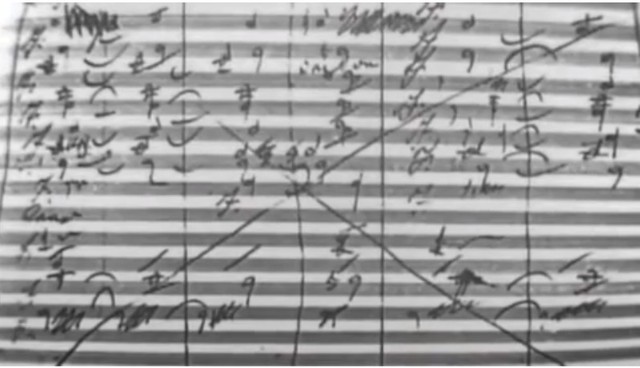
I suppose Beethoven is the most-obvious example of what I’m referring to. To me what’s especially encouraging about the stories of his compulsion to get things right, working them over and over, is that we can see Beethoven sometimes starting out with some really mundane stuff.
In his study of the Missa solemnis (a current preoccupation), Roger Fiske quotes from Beethoven’s first attempts to work out the theme of the Credo: “No one need be surprised that Beethoven’s sketches for the start of the Credo verge on the inept; his preliminary sketches often do. He seems to have needed to write down something which (to us) looks totally unpromising before he could find what he wanted.”
Leonard Bernstein even used the convoluted sketches for the Fifth Symphony to dramatize his point about Beethoven’s aesthetic struggle to write music that somehow seems “inevitable”:
Beethoven’s manuscript [in contrast to the gorgeous, flowing chirography of Stravinsky’s Symphony in Three Movements] looks kike a bloody record of a tremendous inner battle. Before he began to write this wild-looking score, he had for three years been filling notebooks with sketches….And so he tried a third ending, and this one worked…[H]e had to struggle and agonize before he realized so apparently simple a thing: that the trouble with his first ending was not that it was too short, but that it was not short enough. Thus he arrived at the third ending, which is as right as rain….
Imagine a whole lifetime of this struggle, movement after movement, symphony after symphony, sonata after quartet after concerto. Always probing and rejecting in his dedication to perfection, to the principle of inevitability….
[I]t leaves us at the finish with the feeling that something is right in the world, that something checks throughout, something that follows its own laws consistently, something we can trust, that will never let us down.
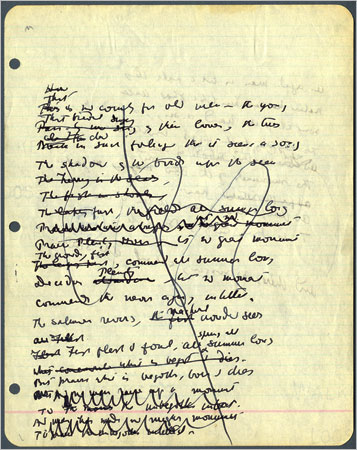
And there’s the example of William Butler Yeats, as Curtis Bradford (Yeats at Work) shows in his intriguing study of the poet toiling over drafts in his bound notebooks. The final version of “Sailing to Byzantium” encompasses a very small percentage of the lines Yeats wrote down in his first draft. The amazing (in every sense) opening line of “Leda and the Swan” — “A sudden blow: the great wings beating still” — started as “Now can the swooping Godhead have his will” or “The swooping godhead is half hovering still” (Yeats initially wanted to title it “Annunciation”).
Draft of a page from Yeats’s “Sailing to Byzantium”
“The Choice” (1932)
The intellect of man is forced to choose
perfection of the life, or of the work,
And if it take the second must refuse
A heavenly mansion, raging in the dark.
When all that story’s finished, what’s the news?
In luck or out the toil has left its mark:
That old perplexity an empty purse,
Or the day’s vanity, the night’s remorse.
–William Butler Yeats
Thanks to all for visiting my blog. I wish you all a happy and productive new year and hope you’ll continue to visit and share your thoughts.
*OK, now I’m going to go ahead and cheat and slip in a reference to these as absolutely unforgettable experiences I was privileged to enjoy in 2013: the Adams/Sellars Gospel According to the Other Mary in LA; Lucerne Festival AND Seattle Opera Rings; Morlot conducting Messiaen’s Turangalîla; Diaghilev and the Ballets Russes at the National Gallery; Mark Rylance and the RSC’s Richard III and Twelfth Night; the Richard Diebenkorn retrospective at the de Young Museum; SF Symphony concert of Tom Adès, Mendelssohn, Stravinsky, with Pablo Heras-Casado; Azeotrope Theatre’s Gruesome Playground Injuries (Seattle); Gregory Maqoma’s Exit/Exist; the Met’s Dialogues, Giulio Cesare, The Nose, and Frau; and The Good Person of Szechuan at the Public.
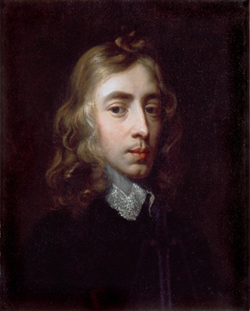
In honor of John Milton’s 405th birthday today, the New Republic pulled out this paean to the poet by Allen Tate, dating from October 1931. Tate uses the occasion of the first complete Milton edition – a project undertaken by Columbia University – to address “the place of poetic fiction in the modern mind.” Tate argues that Milton can serve as an important measure:
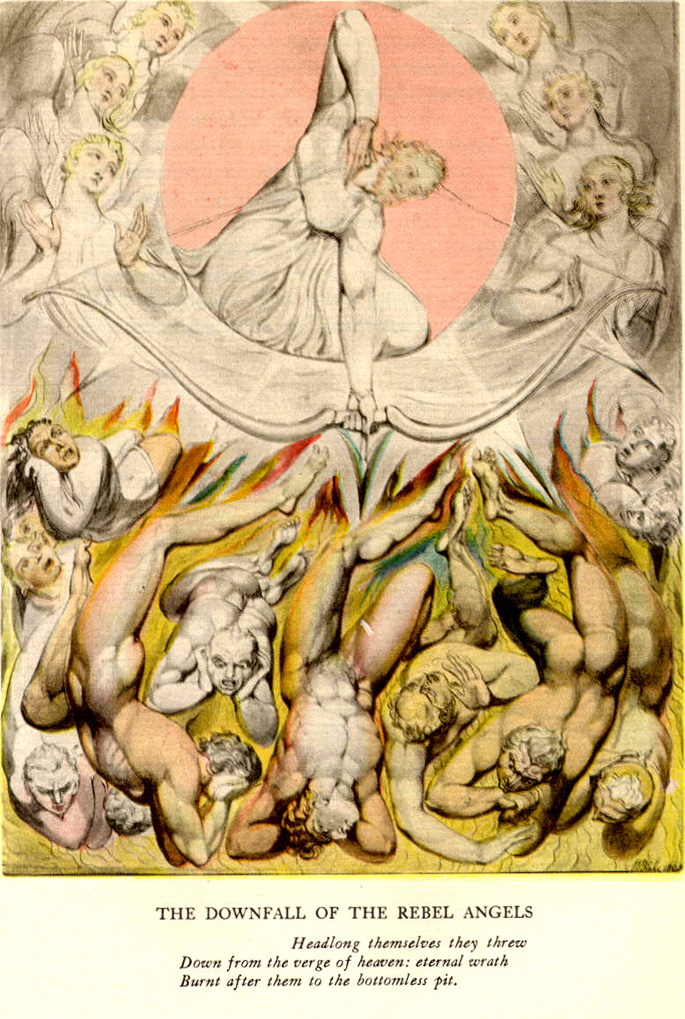
Milton does not ask us to believe his heavenly fictions in any sense that he did not believe them; Lucifer needs the same quality of belief as “old Damcetas.” He does ask us to exercise as much philosophical insight, passively, as he actively puts into his poetry. His philosophy is neither right nor wrong; it is comprehensive. It covers and puts in its philosophical place the modern shortsightedness that we shortsightedly call the revolution of the human mind, which is said to have made Milton’s poetry obsolete.
There has never been a revolution of the mind: There are only styles in fiction. Milton’s fiction is not in our style, and it seems inadequate to the solution of our problems. It is not diverting; it has no personality. We do not like it because it lacks these modern features; because it is creative in the purest sense. I think it was [Thomas] Warton who said that “Lycidas” was the absolute test of the sense of poetry; it still is. It is well to have one fixed criterion, for there is no abstract formula under the glassy cool translucent wave.
Meanwhile, in an essay for the London Review of Books last spring, a skeptical Colin Burrow pondered the “unanswered” question: “How is it possible to like Milton?”:
There is certainly a great deal to dislike. Most people would think of him as an overlearned poet who combines labyrinthine syntax with a wide range of moral and intellectual vices. His views on sex and women, for example, were mostly gruesome….Miltonophiles also have to overcome his regrettable tendency to present himself to the world as a prig.
[…]
The best place to begin to like Milton is with his volume of Poems both English and Latin (1645). This was described by its publisher Humphrey Moseley as ‘as true a Birth as the Muses have brought forth since our famous Spenser wrote’ when it appeared in what we now call January 1646….
Why is the retrospective volume of Poems the best place to start if you want to like Milton? The answer is that it shows not Milton turgidulus, or Milton the sage and serious defender of republican learning, or Milton the achieved polymath, or Milton the heretical crank. It shows Milton in the making. In this volume you can hear the swirl of literary influences running through his mind. At this point Milton is willing to ravish the senses rather than simply to suspect them.
[…]
Learning to hear how hard Milton is working in these early poems is a big part of learning not just how to like but (for me anyway) to love the cussed old so and so. I have talked metaphorically of his ‘editing’ together different poetic voices, but this is slightly more than a metaphor, since Milton was a compulsive tweaker and editor of his own writing. He needed to prod his own imagination on, and sometimes (rather like his keenest student, Wordsworth) he felt the need to tell it severely to back off.
Congratulations to Mary Szybist, who was chosen last week as winner of the National Book Award for Poetry for Incarnadine, her second book of poetry, cited by the NBA jury as a collection that “probes the nuances of love, loss, and the struggle for religious faith in a world that seems to argue against it” and “a religious book for nonbelievers, or a book of necessary doubts for the faithful.”
Shara Lessley interviewed Szybist for the National Book Foundation, asking her about her imaginative reconsideration of the Annunciation motif and her ability “to locate the Virgin Mother in so many unlikely places.” Szybist responded:
The poem that most haunted me while writing the book is W. B. Yeats’s “Leda and the Swan.” By emphasizing the terror of the event, the brutal indifference and power of the god, he suggested something about the character of the era that unfolded from it. It is with a nod to Yeats’s strange vision of history and his idea that every two thousand years the world’s temperament changes as the result of an encounter between human and divine that I am reflecting on the kinds of encounters happening around us. What counts as the sacred now? What kinds of encounters are we witnessing? And what are those encounters engendering? By offering a multitude of Annunciation possibilities, I wish to unsettle and, to some extent, take leave of the old story, even as I try to find new uses for it.
In an essay on Incarnadine and the work of the poet Charles Wright, Lisa Russ Spaar writes:
Smart, unflinching, beautiful, the poems in Incarnadine embrace the paradoxes of love: love of being beheld, of being beholden, of being “done unto,” and of what it means to care for what we make of what we are given, or not given, of what it means to “see annunciations everywhere,” in disasters, tragedies, moments of grace and miracle….
In “To Gabriela at the Donkey Sanctuary,” Szybist writes, “It’s not enough to say the heart wants what it wants.” Maybe not. But readers can be grateful to Wright and Szybist (two “solitaries…calling”) for believing that the world, with its hard news, its complicated incarnations, is nonetheless “made of more than all its stupid, stubborn, small refusals.” Among that “more” is the work of these two important and soul-nourishing poets.
You can find a recent podcast about Szybist’s “On Wanting to Tell [] about a Girl Eating Fish Eyes” here.
In “Reading the Difficult: A new critique of the New Criticism” – an article in this month’s Poetry magazine – Peter Quartermain reflects on the confounding “simplicity” of the kinds of poems that the New Critics disdained. With all their armory of explication de texte, interpretive analysis, and scansion exercises, they were at a loss when confronted with poems that don’t “care whether you are puzzled or not” but simply exist as “an event, and you can join it, take part in, or not.”
Especially in the case of the short poems of William Carlos Williams, there is an “implacability in the language that resists both paraphrase and explication. The language is so spare, the details so sparse, the statement so stubbornly there before the reader, uncompromising, that the reader’s knowledge cannot intervene, cannot interfere with the poem; indeed it renders that knowledge irrelevant, the poem open.”
Quartermain goes on to discuss the paradox of poets who “demand that we respond to the poem, to the language of the poem, as a what is, a thereness, a something outside.”
They ask us to recognize in the poem’s facticity what Giorgio Agamben calls the irreparable: “that things are just as they are, in this or that mode, consigned without remedy to their way of being.” Yet once we have read the poem, indeed as we read it, it inescapably moves within us, is within us, and in this the poem is like the world in which we move, which moves us, and is in us whether we are conscious of that or not. Our condition in language, our condition as language animals, is irremediable, irreparable. It is beyond “repair,” and doesn’t permit (presuming we want it) the perfect reading [the New Critics] sought, in which we all acquiesce and are of one mind, “completely” understanding one another. We are inside and outside at the same time, irreparably.
This opens up a rich perspective for thinking about the Modernist preoccupation with originality, with making it new (“Kinder, schafft Neues!”) – and not just in poetry, but in theater, music, the visual arts. Each of the poets Quartermain considers “posits language as a condition of the human, as constitutive of it, constitutive of meaning and hence necessarily of experience, inextricably part and parcel of apperception and conduct and understanding. Language is not, then, a means, nor is it, certainly, a precondition.”
And the poem? Maurice Blanchot, perhaps echoing Celan, thinks that the poem comes from that inexpressible place before words, from that gap between what might be the world and what might be words for what we find. Perhaps the poem comes from that odd cusp between the two sides of language, the outside and the inside that, mostly unknowingly, we inhabit. What is clear is that the poem brings into being what it says, and does not know ahead of time.
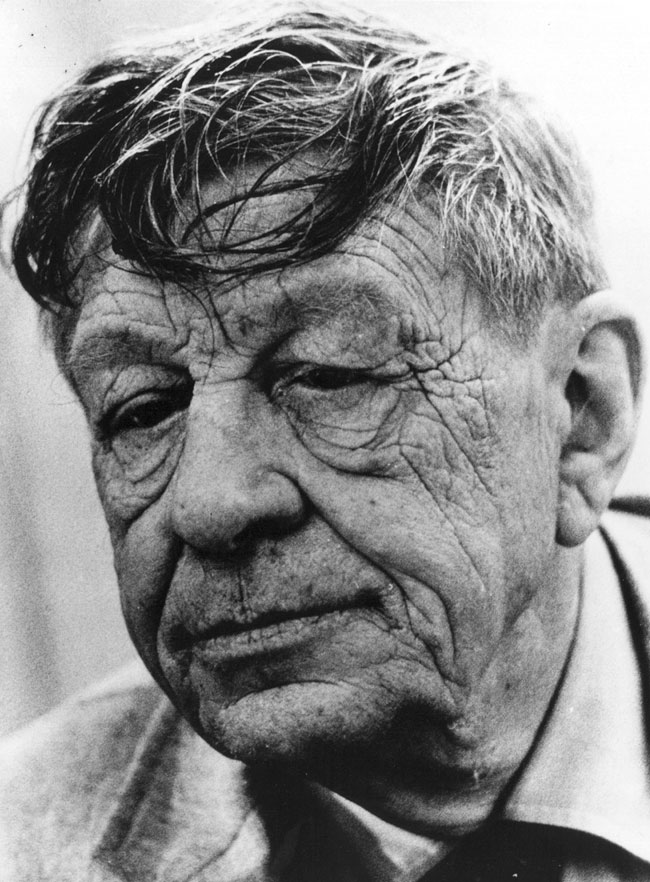
“My face looks like a wedding cake left out in the rain.”
Last month marked four decades since W.H. Auden died (he was only 66). How has he managed to retain that oracular hold over us, to continue to play the role of prophet? Auden himself abjured the myth that attached to his earliest work, the poems that first made him a celebrity. He later pointed out the foolishness of the fake choice – “we must love one another or die” – and steeled himself against the Siren sway of poetry’s utopian promise, even as he embraced other utopias.
How unforgettably Auden bids farewell to the image of the vatic poet in his elegy to W.B. Yeats, while recognizing the pressure of posterity to forge its own meaning from what the poet has left behind: “The words of a dead man/Are modified in the guts of the living.”
Jess Cotton considers Auden’s strange holding power despite the wild swerves of tone and style in the later work:
Auden tried on styles like hats, finding only a couple too trivial to salvage. His poetic inventiveness and intellectual restlessness invites reels of criticism; though that is not to say that anything goes. The words of a poem are not the sum of its parts; and Auden’s poetry rarely yields its meaning quite as easily as its perfectly light verse would suggest. In fact, one of the masterful tricks of his poetry is that it’s quite often saying the opposite of what the reader has decided to hear. Ever alive to the limitations— and fundamental frivolity—of art, Auden’s greatness lies in believing at once in the power of art to enchant, while allowing irony to do its duty.
Can Auden really have it both ways? Irony but also enchantment in the Age of Anxiety?
This self-consciousness that “poetry makes nothing happen” doesn’t necessarily undercut the magic; in fact, he suggests, it may be one of magic’s expedients. Both “Stop all the clocks” and “September I, 1939,” are written in pastiche mode—the former to show precisely what happens when lines are taken out of context; the latter, far from the call to arms it is often taken for, salutes a rootless, ironic mode of being. As he writes of Yeats’ afterlife, Auden’s poetry is forever “Modified in the guts of the living;” its meaning distilled and rendered to fit the occasion. But poetry is mainly sound—the meanings will only take you so far; and to have sounded, in poetry, the tones of the age, is no small feat. To still sound them today, 40 years after his death, is surely a great one.
Poetry’s ties with romance are ageless, but nowadays the connection tends to evoke sappy clichés and, at worst, Hallmark card-style confections. So why not add some panache by filling your quiver with lines from the great poets?
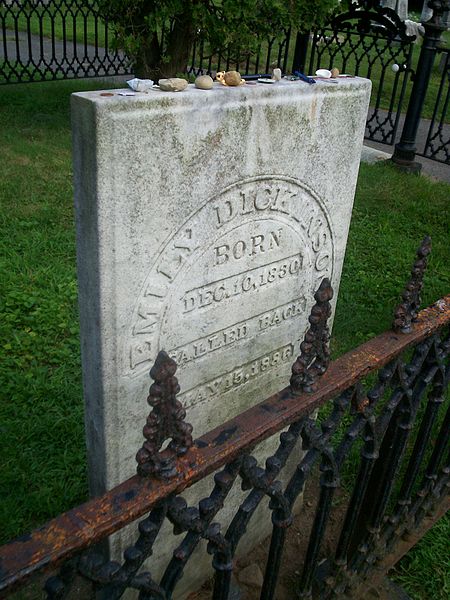
Or maybe not… Over at The Hairpin, Lizzy Straus recently compiled a list of first lines from Emily Dickinson poems not likely to be very useful as pickup lines. These especially should probably be excluded from your speed-dating repertoire:
144 – I never hear the word “Escape”
260 – I’m nobody! Who are you?
303 – Alone I cannot be
332 – Doubt me! My dim companion!
336 – Before I got my eye put out
339 – I like a look of agony
407 – One need not be a chamber to be haunted
456 – A prison gets to be a friend
591 – I heard a fly buzz when I died
1050 – I am afraid to own a body
1649 – Back from the cordial grave I drag thee
But then, what about that epitome of the love poem, the Shakespearean sonnet? Would these lines from the Bard do any better than Emily Dickinson’s?
As fast as thou shalt wane, so fast thou grow’st
Thy glass will show thee how thy beauties wear
I grant thou wert not married to my Muse
Whilst I thy babe chase thee afar behind
Sin of self-love possesseth all mine eye
In faith I do not love thee with mine eyes
(Percy Byssshe Shelley, portrait by Alfred Clint, 1819)
Nowadays the received wisdom seems to follow the Oscar Wilde line — literally, that is, without his archness — that “all art is quite useless.” Especially when the art in question is poetry and, even more, music. This alleged uselessness is then either trumpeted as a glorious thing — a refuge from the brutal world of commerce — or turned into a weapon to arm Philistines (“uselessness” abused).
A recent example of the former strategy is the poet and scholar Meena Alexander’s musing, in an address to the Yale Political Union last April, that poetry stands apart from the everyday world of historical reality: “The poem is an invention that exists in spite of history. Most of the forces in our ordinary lives as we live them now conspire against the making of a poem.”
Noah Berlatsky challenges Alexander by arguing that the whole issue of worrying about whether poetry in the abstract is “useless” is a detour: it arises from the “myth of an essential poetry, poetry that is important because of what it is, rather than because of what it says.”
When poets or writers have been persecuted, it’s generally not because of some abstract contradiction between tyranny and poetry. It’s because the persecuted poets said specific things the tyrants didn’t want to hear….
It’s long past time, therefore, that we stopped asking “What Use Is Poetry?” and started asking, “What Use Is This Poem?” In some cases, maybe, we’ll find uses we didn’t know existed. And in many cases, we’ll can respond, “none; this poem—not poetry as a whole, but this poem—is useless. Away with it, and let it bother us no more.”






 MEMETERIA by Thomas May