PostClassical Ensemble continues its Amazing Grace New Year’s tradition on Monday, 13 January, with a chamber program saluting the music of Native American composer Jerod Impichchaachaaha’ Tate. The concert takes place at 7:30 pm ET at the Kennedy Center’s Terrace Theater.
“This annual event celebrates the universal expression of the human spirit through music, inviting a living composer to curate a concert designed to uplift and inspire,” says PCE artistic director Angel Gil-Ordóñez.
The program includes Tate’s Chokfi’ for strings and percussion; selections from his rhapsodic Standing Bear: A Ponca Indian Cantata (performed by baritone Javier Arrey); Hymn and Spider Brings Fire from Lowak Shoppala’ (Fire and Light), a work expressing Tate’s Chickasaw heritage through music, to texts by poet Linda Hogan. The concert will also feature the Larghetto from Prokofiev’s Symphony no. 1 (“Classical”) and Samuel Barber’s Knoxville: Summer of 1915 (performed by Mvskoke soprano Kirsten C. Kunkle). tickets here
André Mehmari, Angel Gil-Ordóñez, and the PostClassical Ensemble
This year marks the 200th anniversary of diplomatic relations between the United States and Brazil. To celebrate the bicentennial, Postclassical Ensemble (PCE) will showcase two centuries of music from South America on 19 and 20 November at the Kennedy Center’s Terrace Theater.
The program ranges from the earliest known works by composers native to Brazil to a world premiere commission by pianist-composer André Mehmari. Curator Flávio Chamis (a composer, conductor, and educator) and guest artists Lucas Ashby (percussion), Tatjana Mead Chamis (viola), and Elin Melgarejo (vocalist) join Mehmari and artistic director and conductor Ángel Gil-Ordóñez for this panoramic view of Brazilian concert music.
“The program includes a tempestuous classical overture by José Maurício Nunes, the modern and US premiere of Francisco Mignone’s Quadros Amazônicos (an orchestral suite based on myths from the Amazon), Heitor Villa-Lobos’s Bachiana Brasileiras no. 4, a set of popular Brazilian songs performed by DC’s Elin Melgarejo, and chamber music featuring Latin GRAMMY-nominated violist Tatjana Mead Chamis.”
Related free events:
Thursday,November 14 at 6pm: PCE Prelude, a free conversation at Georgetown University (and live-streamed) previewing the concerts. (Registration required)
(SOLD OUT) Friday, November 15, at 12:30pm: guest artist André Mehmari gives a free performance as part of Georgetown University’s Friday Music Series. (Registration required)
PROGRAM:
Legends of Brazil: A Musical Celebration for 200 Years of Friendship
Tue. Nov. 19, 2024 7:30p.m
Wed. Nov. 20, 2024 7:30p.m
Terrace Theater | The Kennedy Center | 2700 F St NW, Washington, DC
Presented without intermission
Flávio Chamis, guest curator
Lucas Ashby, percussion
Tatjana Mead Chamis, viola
André Mehmari, piano and composer
Elin Melgarejo, vocalist
PostClassical Ensemble conducted by Angel Gil-Ordóñez
Zequinha de Abreu arr. Jamberê Cerqueira: Tico-Tico no Fubá Padre José Maurício Nunes Garcia: Zemira André Mehmari: Sonata for Viola
Francisco Mignone: Selection from Tres Valsas Brasileiras Francisco Mignone: Saci and Caapora from Quadros Amazônicos Brazilian popular songs arranged for voice and chamber orchestra: Odeón, One Note Samba, Labrinto, Samba em Preludio
Heitor Villa-Lobos: Preludio from Bachiana Brasileiras no. 4
André Mehmari: Rag Chorado. A Celebratory Humoreske (world premiere work for piano and orchestra)
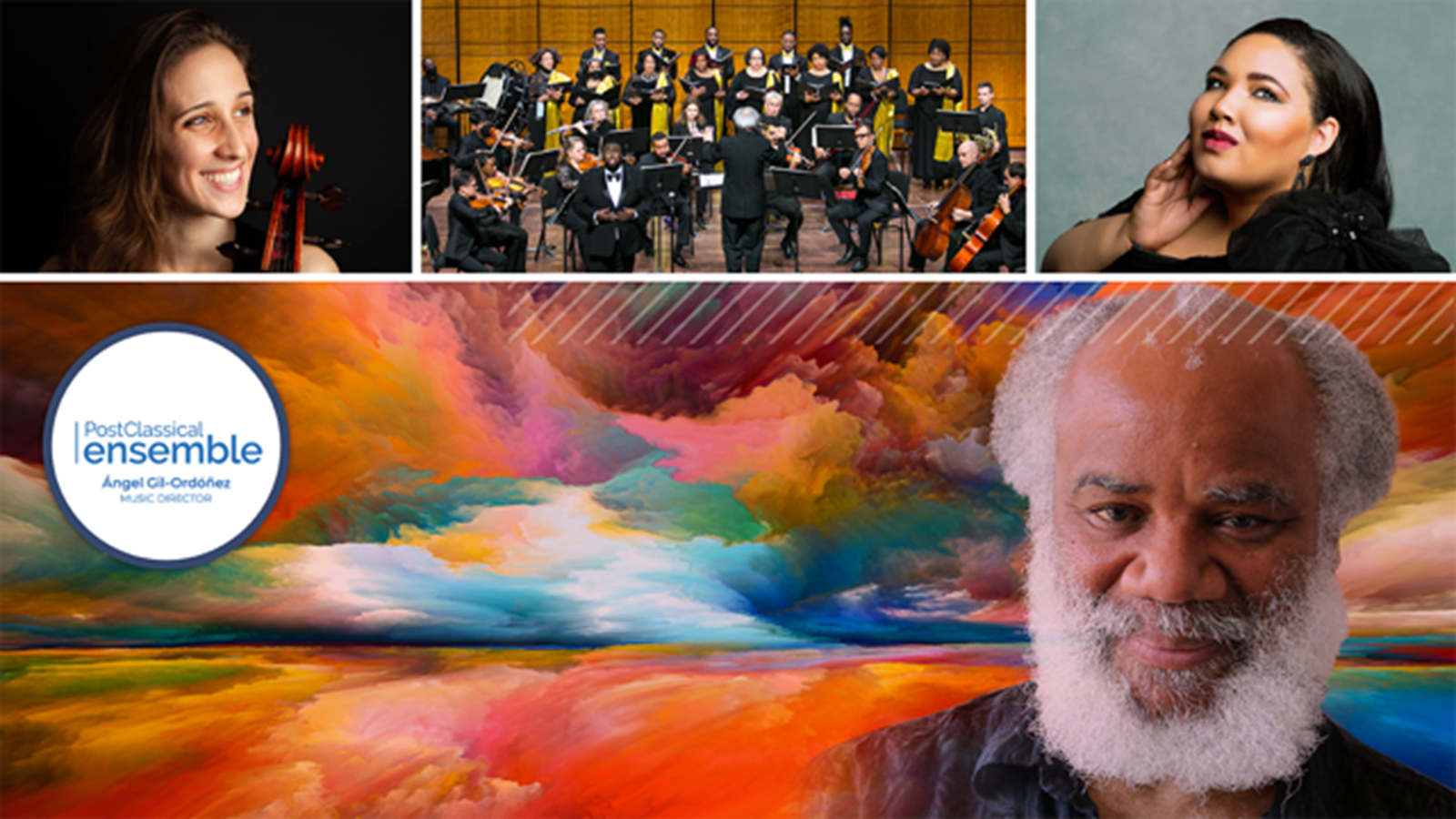
PostClassical Ensemble begins the new year with Amazing Grace, a program centered around Jeffrey Mumford’s cello of radiances blossoming in expanding air in its Washington, D.C., premiere. The concert, which music director Angel Gil-Ordóñez will conduct on 10 January 2024 at 7.30 pm at the Kennedy Center Terrace Theater, presents Annie Jacobs-Perkins as the soloist and will also include music by John Newton, George Walker, Margaret Bonds, Gustav Mahler, Gabriel Fauré, and Luciano Berio. Mumford, who also serves as guest curator, will receive PCE’s American Roots Artist Award for his outstanding contributions to American music.
Amazing Grace: In Paradisum
Wednesday, January 10 2024, 7:30pm
Terrace Theater | The Kennedy Center | 2700 F St NW, Washington, DC
Presented without intermission
Jeffrey Mumford, guest curator
Annie Jacobs-Perkins, cello
Katerina Burton, soprano
CAAPA Chorale
Andre Leonard, piano
PostClassical Ensemble conducted by Angel Gil-Ordóñez
PROGRAM:
John Newton: Amazing Grace
George Walker: O Praise the Lord
George Walker: Stars
George Walker: Lyric for Strings
Jeffery Mumford: of radiances blossoming in expanding air (DC premiere)
Gustav Mahler: 4th Symphony. 4th Movement, The Heavenly Life
PostClassical Ensemble (PCE) begins its 20th-anniversary season on 16 November at the Kennedy Center’s Terrace Theater with a concert titledBouncing off the Walls: Music and Architecture. Exploring the complex relation between these two art forms, the program will juxtapose music written for particular buildings with early-20th-century Modernist efforts to reduce both forms to their elemental materials. Tickets here.
Beginning with Beethoven’s Consecration of the House Overture, written to celebrate a newly remodeled theater and opera house in Vienna, the concert includes music by Gabrieli composed for the Basilica of San Marco in Venice; the “palindrome” minuet from Haydn’s Symphony No. 47 in G from 1772, Anton Webern’s Five Pieces for Orchestra, and Rossini’s William Tell Overture “reassembled to maximize the acoustic possibilities of The Kennedy Center Terrace Theater.”
Projections of hand-drawn architectural sketches by Centennial Medal winner Hany Hassan FAIA will accompany the music, which PCE music director Angel Gil-Ordóñez will conduct. Guest curator and cultural critic Philip Kennicott will offer commentary on the relationship between music and architecture.
Here’s an excerpt from an interview between Gil-Ordóñez and Kennicott:
Philip, you’ve written about both music and architecture; can you talk about how you see the two as interrelated?
PK: I started with the vocabulary they share. Words like harmony and dissonance, form, structure and ornamentation, make sense to both musicians and architects. There’s been a long history of assuming that because music and architecture are both dependent on mathematics and ideas of proportion, and because they also share a language, that they must be fundamentally connected. Think of that famous line by Goethe everyone loves to quote: Architecture is frozen music. I love the poetry of that thought and it will be our starting point for the concert. But then we’re going to move on and try to look a little more deeply about both the similarities and the differences between these two realms of creativity. Consider this obvious difference: A badly constructed piece of music may be boring, or annoying or forgettable, but a badly built building can fall down and kill people. So, clearly, there are some distinctions to be made.
Cultural historian Joseph Horowitz considers the case of the Mexican composer Silvestre Revueltas (1899-1939) in his latest piece for NPR. According to Horowitz, Revueltas was not only “Mexico’s greatest composer but the supreme political composer of concert music produced in our Western hemisphere.”
A related project of Horowitz’s PostClassical Ensemble endeavor is the world premiere recording of the complete soundtrack Revueltas wrote for the 1935 film Redes, conducted by Angel Gil-Ordonez.
This new film from PostClassical Ensemble’s More than Music Project explores Aaron Copland’s far left activism — including a rare performance of his prize-winning workers’ song “Into the Streets, May First,” with its call “Up with the sickle and the hammer!”
Notes Joseph Horowitz of PCE, “It’s all eerily pertinent today, this saga of an iconic American composer jostled by Populist currents on the far left, then the far right – and finally retreating from the fray.”
Among the film’s participants are the American historians: Michael Kazin (on populism) and Joseph McCartin (on the Red Scare). The soundtrack includes excerpts from PCE’s Naxos DVD of The City (1939), which Horowitz regards as “Copland’s highest achievement as a film composer, and the least-known consequential music that he composed.”
Aaron Copland, he concludes, “somewhat resembles ‘a cork in a stream,’ buffeted by political and social currents — a saga that raises many questions, including: What is the fate of the arts in the United States?”
An index to the 75-minute film:
10:14 – Copland on that Communist picnic
11:48 – Copland on workers’ songs
12:34 – “Into the Streets, May First” sung by Lisa Vroman and William Sharp
16:37 – Copland on Hollywood film music (with some Korngold to listen to)
20:00 – Excerpts from The City
39:20 – Joseph McCartin on the Red Scare
44:34 – Joe McCarthy and Roy Cohn grill Copland
58:25 – Music historian Beth Levy on Copland’s quest for musical identity
1:04:32 – Michael Kazin on Copland and the Popular Front
1:06:30 – Horowitz’s summing up — a “cork in a stream” – with comparisons to Charles Ives and George Gershwin: composers with deeper roots
1:12:54 – The last word goes to pianist Benjamin Pasternack, recalling an illuminating meeting with Aaron Copland at Tanglewood.
aThe latest production from PostClassical Ensemble explores a side of Bernard Herrmann that is scarcely acknowledged today. Herrmann is best known for his chilling score to Psycho and six other Alfred Hitchcock films, as well as his collaborations with Orson Welles. But he started out as a conductor at CBS, becoming music director of the pioneering Columbia Workshop.
As a significant contributor to the medium of radio drama, Herrmann in 1944 composed music for Whitman, a drama focusing on Leaves of Grass. The half-hour show was produced by Norman Corwin with a contemporary aim: to boost morale back at home during the Second World War. Those were the days when millions of Americans tuned in to radio drama — in this case, a drama about a poet, with a first-rate, fresh score as accompaniment.
Angel Gil-Ordonez conducts the ensemble and William Sharp as the poet in this newly restored version of Whitman released on Naxos. In conjunction with the release, PCE has also produced the documentary Beyond Psycho– The Musical Genius of Bernard Herrmann. The film features commentary by Joseph Horowitz (who regards Hermann as “the most underrated 20th-century American composer”), Gil-Ordonez, Karen Karbiener (a Whitman scholar), Murray Horwitz (an expert on radio drama), Dorothy Herrmann (the composer’s daughter), and Alex Ross.
Lorenzo Candelaria – Dean, Blair School of Music, Vanderbilt University
Gregorio Luke – Lecturer and author, specialist in Mexican Art and Culture
Ana Lara – Composer, Mexico City
Ix-Nic Iruegas – Executive Director, Mexican Cultural Institute, Embassy of Mexico
(47 minutes)
This second clip provides the historical context of Mexican cultural by John Tutino – Historian, Georgetown University (11 minutes).
Additional resources related to this chat:
Film:
To purchase PCE’s acclaimed Naxos DVD of Redes, with Revueltas’s soundtrack newly recorded by PostClassical Ensemble, click here: https://Naxos.lnk.to/2110372ID
Books:
Ix-Nic Iruegas, Executive Director of the Mexican Cultural Institute, recommended two books by one of Mexico’s most outstanding authors: Sergio Pitol: The Art of Flight (Deep Vellum Publishing, 2015); and The Magician from Vienna (Deep Vellum Publishing, 2017).
The latest installment in the PostClassical Ensemble’s (PCE) More than Music series takes up the issue of political art, with a focus on the landmark 1936 film Redes — and its powerful score by Silvestre Revueltas.
Some of the questions to be explored in PCE’s Zoom discussion on 2 September at 6.30pm EST: How did the Mexican Revolution galvanize political muralists and composers? Why was Mexico more hospitable to political art than the US? What’s the pertinence of political art today?
The Zoom-chat will feature Gregorio Luke’s presentations on Diego Rivera and the Mexican muralists, plus commentary by composer Ana Lara and by historians Roberto Kolb, John Tutino, and Lorenzo Candelaria, and Ix-Nic Iruegas Peon of the Mexican Cultural Institute. Registration is free: simply sign up here.
From Joseph Horowitz’s blog post “’Redes’ Lives! — The Iconic Film of the Mexican Revolution and What It Says to Us Today”:
“It’s a pity that Silvestre Revueltas is not at least as well known as Rivera. I would unhesitatingly call him the supreme political composer of concert and film music produced in the Americas. His music combines ideology with personal understanding…Revueltas’s peak achievements include his singularly arresting score for the film Redes (1936), in which impoverished Mexican fisherman unite to storm the bastions of power.”
More from Joe Horowitz:
On “The Artist and the State” in Mexico (where political art has greatly mattered) and the U.S. (where the artist remains an outsider):
UPDATE: Here’s a link to the Zoom panel talk referenced below.
The Great Depression has been repeatedly invoked of late as we try to gauge the enormous impact of the current pandemic and the related economic crisis. But in the 1930s, Americans had a government in place that recognized the importance of the arts through the Works Progress Administration. These programs employed massive numbers of artists, writers, musicians, actors, dancers, and photographers.
On 5 July, together with Naxos and The American Interest, PostClassical Ensemble (PCE) presents the next installment in its More than Music series: Behrouz Jamali’s documentary on The Plow that Broke the Plains (1936), which focuses on the Dust Bowl, and The River (1938), a modern ode to the role played by the Mississippi River. With scores by Virgil Thomson, both were the first-ever films created by the federal government for commercial release (i.e., not merely informational or educational films). Both champion a distinctly anti-Hollywood aesthetic.
There will be a follow-up Zoom chat on 9 July at 3pm EST. A panel will explore government funding for the arts during the pandemic: conductor Angel Gil-Ordóñez, PCE Executive Producer Joseph Horowitz, historian David Woolner, and film historians Neil Lerner and George Stoney. Also on the agenda is a discussion of how Roosevelt’s New Deal addressed issues of race in the era of Jim Crow. To register, click here.
Following up on my post from the beginning of the month, here’s a distillation of PostClassical Ensemble’s 10 June zoom chat titled “Porgy and Bess Roundtable: What’s It About and Who’s Singing It?”
The panelists include George Shirley, the first African-American tenor to sing lead roles at the Metropolitan Opera, the bass-baritone Kevin Deas, one of the leading Porgys on today’s scene, Conrad Osborne, an expert in opera in performance, will also join in, and PCE founder Joseph Horowitz, with Bill McGlaughlin hosting. They also sample some historic Porgy recordings.



 MEMETERIA by Thomas May