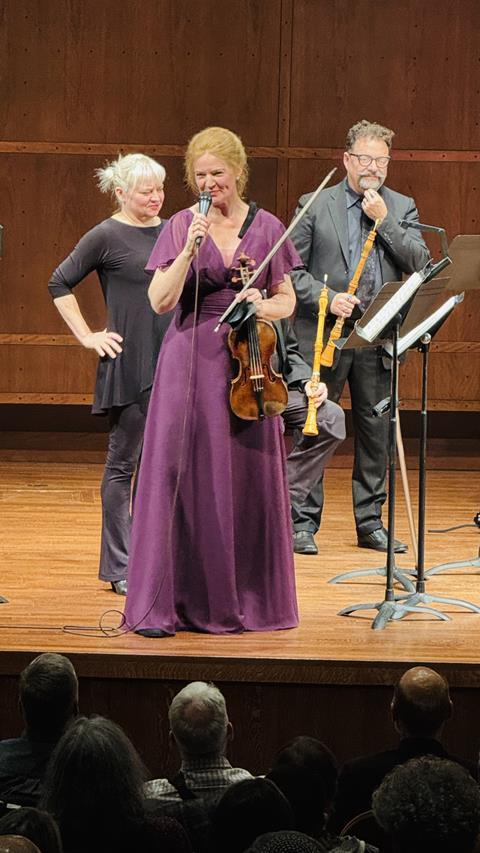
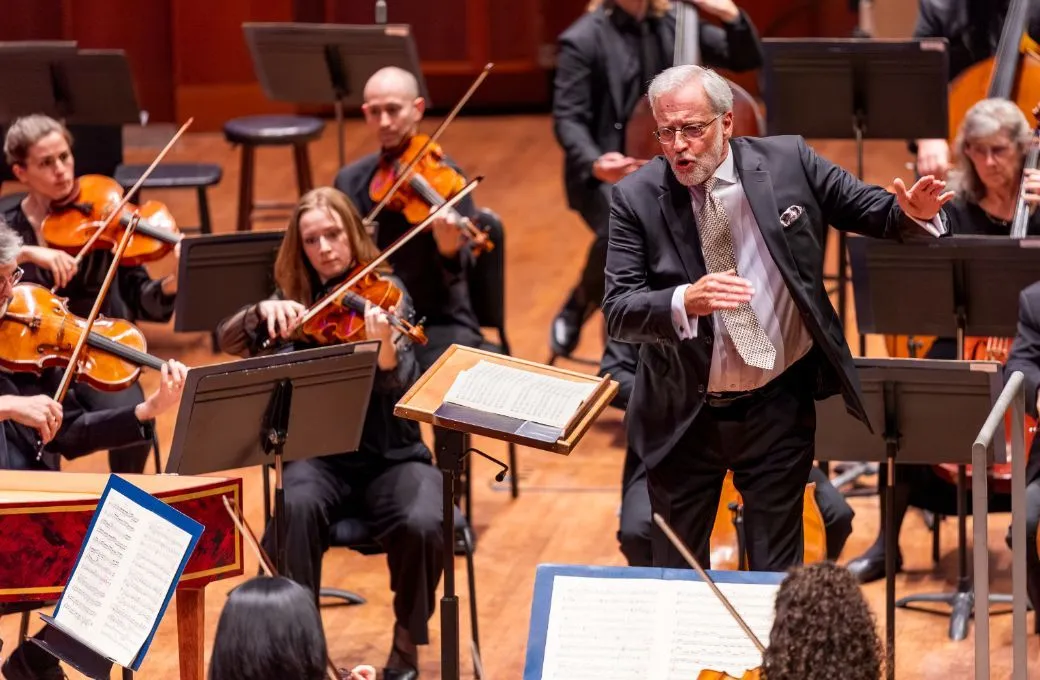
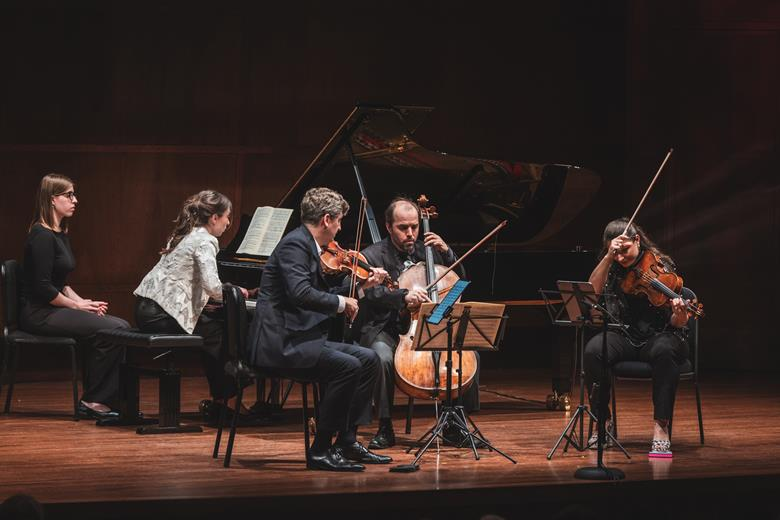
The Seattle Chamber Music Society has not only emerged from the pandemic slump stronger than ever but seems to have hit on a golden formula. The opening concert of its month-long 2025 Summer Festival attracted a devoted audience to fill downtown’s 536-seat Nordstrom Recital Hall to near capacity – even before the concert officially began…
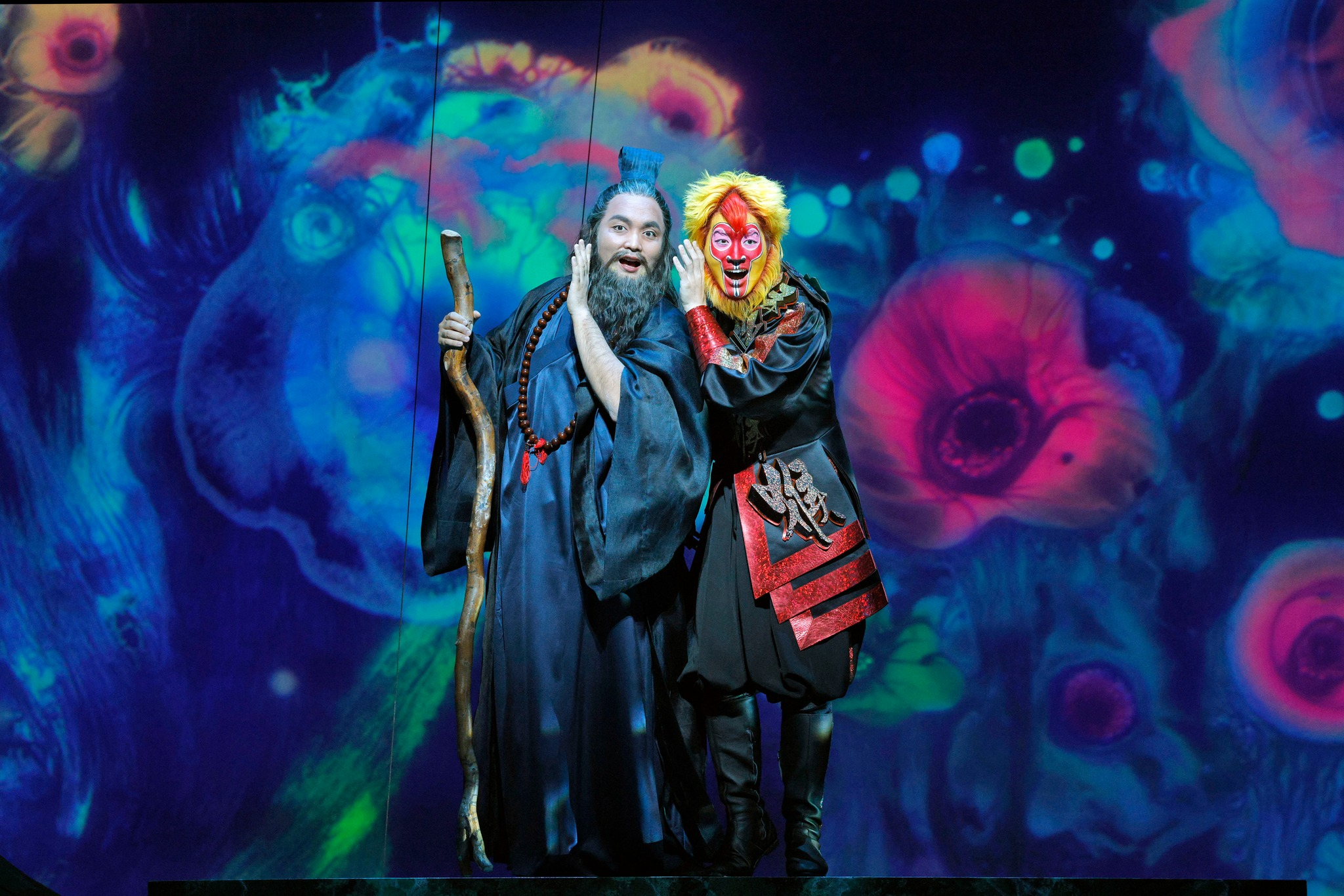
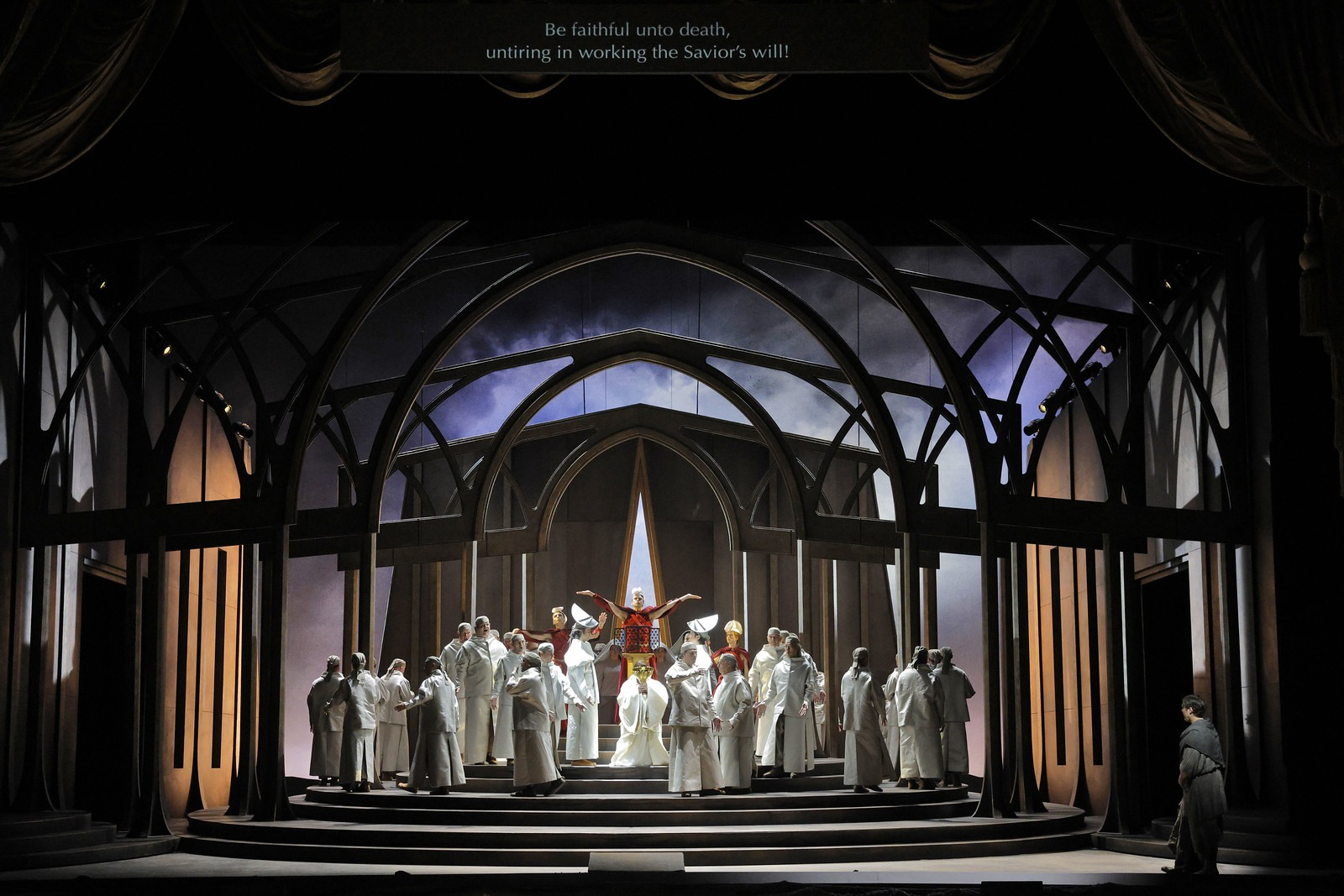
Since its founding in 1923, San Francisco Opera has maintained a love story of its own with La Bohème. The company actually opened with a performance of the beloved classic, cementing its identity with Puccini’s story of young love and youthful illusions. One thing this summer’s revival makes clear: when done persuasively, La Bohème seems immune to aging, undiminished in its emotional pull.
John Caird’s production, which originated in 2012 and first arrived at the War Memorial Opera House in 2014, with a revival in 2017, was presented as part of this summer’s shorter-than-usual season alongside a gripping interpretation of another great opera by a youthful artist in the process of making pivotal discoveries about what opera can do: Idomeneo, by the 20-something Mozart. In this revival of Caird’s original staging by Katherine M. Carter, the chemistry between the two main couples and among their circle of close friends gained a dramatic clarity that was believable.
A visual metaphor for the intensity of their dreams and idealism emerges in designer David Farley’s sets, which seem filtered through the imagination of the painter Marcello – as if memory itself were the canvas. Instead of a cosy view of the Parisian skyline, the distinctly crowded and cluttered garret is framed by panels that seem to be his own creation, works in progress. In the crowd scene at Momus, the wintry city is populated by still more painted façades that verge on abstraction, Cubistally tilted as if to hint at the transformation of experiences recollected from a distance, as they become stylized, mythologized. While also nodding to the aesthetic of Toulouse-Lautrec and the Belle Époque, the visual world inhabited by this Bohème wasat times almost dreamlike, even surreal.
Puccini’s achievement in this opera, bolstered by his collaboration with librettists Luigi Illica and Giuseppe Giacosa, gains traction from the varying manifestations of community among these young people: the cramped garret coming alive with roughhousing banter and energy and the glittering Café Momus brimming with a chaotic joy and sense of possibility against all the odds.
Much has been written about La Bohème as an opera of Romantic nostalgia, but this production underscores its deeper structure as a work of memory. Puccini’s savvy recapitulation of musical material – most movingly in the final act’s return to the music of Mimì and Rodolfo’s first meeting – carried incalculable expressive weight in Ramón Tebar’s sensitively detailed conducting, a highlight of the production. With his fine ear for balance and unwavering attention to the colors and harmonic richness of Puccini’s score, he had the orchestra paint in layered brushstrokes of timbre, shaping phrases with warmth and elasticity.
I heard the “alternate” cast on June 18. As Rodolfo, tenor Evan LeRoy Johnson made a welcome impression with his hefty, burnished tone and grounded stage presence. His rapport with Australian soprano Nicole Car as Mimì allowed him to trace an arc from self-conscious artist to grief-stricken lover. Car, in turn, conveyed Mimì’s innocence and vulnerability without reducing her to frailty. Even in the character’s earliest moments, there was a quiet self-awareness beneath the surface. Car uncovered more psychological nuance than is often seen in the third-act encounter with Rodolfo, singing with radiant control across the range. Her resonant low notes lent unexpected weight to a role sometimes misconstrued as a passive victim.
Filling in for the originally announced Will Liverman, baritone Lucas Meachem sang Marcello for the full run, bringing the painter to life with vocal vitality and a sharply etched dramatic immediacy through telling details, like his hint of jaded disdain when he first interacts with Mimì at Momus. He emerged as the opera’s emotional linchpin, bridging the bohemians’ slapstick and the lovers’ tragedy. His scenes with Rodolfo had the ease of real camaraderie – and rivalry.
As Musetta, soprano Brittany Renee lit up the stage with a performance abounding in vocal charisma and larger-than-life presence that also amplified the somewhat underworked Toulouse-Lautrec angle. Her “Quando me’n vo’” was anything but coquettish posturing but a declaration of unapologetic vitality. At the same time, she allowed a genuine compassion for Mimì to emerge with affecting sincerity in the deathbed watch.
There was much to enjoy in the detailed work of the companions as well. Bogdan Talos made a dignified and ultimately touching Colline, keeping a mostly detached air until the death scene released a surge of directness. His “Vecchia zimarra” felt like an intimate farewell to youth itself. Another highlight of the production was Samuel Kidd’s vividly observed portrayal of Schaunard (the one actual musician among these Bohemians), especially in his gleefully morbid story of how a dead parrot brought a windfall – a comic moment that, like so much in Bohème, holds a tragic echo in hindsight. Dale Travis brought seasoned comedic timing to his dual character roles as the landlord Benoit and sugar daddy Alcindoro. The SF Girls and Boys Choruses added charm to the Café Momus scene.
But what gave this performance its distinctive character was the sensitive, detailed conducting of Ramón Tebar. The Spanish conductor proved a superb collaborator – very much a singers’ conductor – with an ear for balance and a painter’s attention to color. He brought out the harp’s glitter, the dark undertow of strings beneath bright melodies, and the often-overlooked harmonic richness of Puccini’s score.
As Larry Rothe insightfully writes in his beautiful program essay, Rodolfo, in retrospect, is not a novice in love but an artist transformed by a singular experience: “He hears himself pleading his case to Mimì in a new voice, honest and unguarded … Mimì, as Rodolfo recalls her, will always illuminate the memory of those rough days … those days that, for all their hardship, will always bear the tender ache suggested in that pivotal rising and falling fourth [of Rodolfo’s motif].”
That “tender ache” lingered well after Rodolfo’s cries of despair in this wonderful revival, reminding us not just of the pain of loss, but of how art redeems it – by turning memory into music.
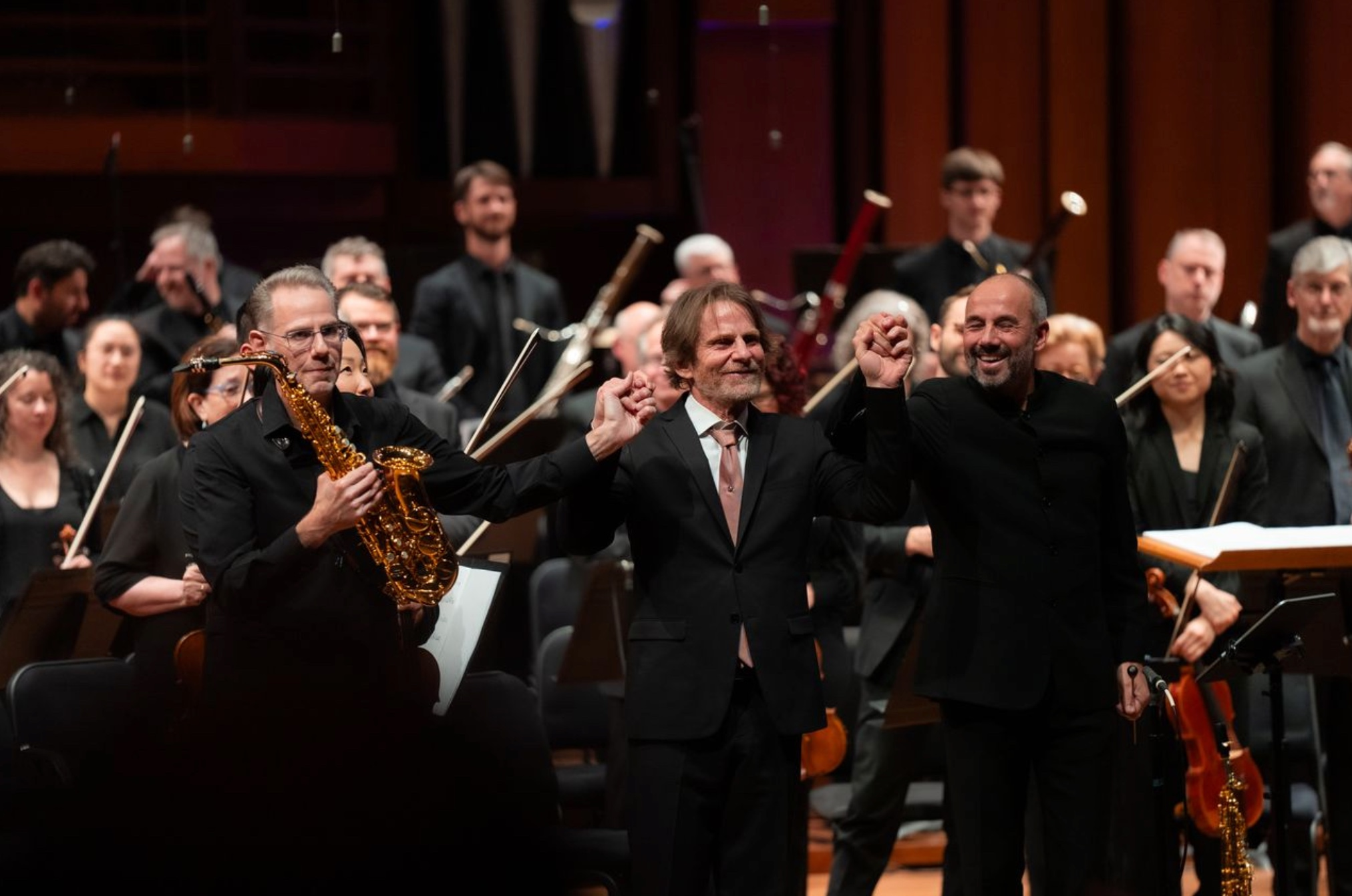
Ludovic Morlot conducts the Seattle Symphony, with soloist Demarre McGill
With Seattle Symphony on the cusp of a new chapter – music director designate Xian Zhang takes the reins in September – this season-closing program offered a vivid snapshot of the ensemble’s artistic breadth. …
Esa-Pekka Salonen with San Francisco Symphony; photo (c)Brandon Patoc
I was fortunate to have a chance to make it to Esa-Pekka Salonen’s very final performance of his San Francisco Symphony tenure – a program of Mahler 2.
Dover Quartet: Joel Link, Bryan Lee, Camden Shaw, Julianne Lee; photo: Jorge Gustavo Elias
My review for The Strad of this past weekend’s Dover Quartet performance, presented by Seattle Chamber Music Society:
On a glorious spring Sunday in Seattle, the Dover Quartet drew a full house to the 536-seat Nordstrom Recital Hall for a splendid afternoon concert – no small feat given the lure of sunshine and blue skies on a holiday weekend. Notably, the audience included a sizable contingent of younger listeners – a testament to the Seattle Chamber Music Society’s outreach efforts and to the appeal of this Signature Series concert, which closed the organisation’s inter-season extension between its winter and summer festivals. continue
Chapeau to Karen P. Thomas and Seattle Pro Musica, whose various sub-ensembles sang sublimely and with luminous grace in last night’s season finale program – and to Nathan Chan, the eloquent cello soloist in Caroline Shaw’s “Its motion keeps,” Roxanna Panufnik’s “All shall be well,” and Thomas’s own “The world is charged,” a striking new work for cello and choir that closed a radiant evening in the warmth of St James Cathedral.
So many signature Pro Musica moments in this gorgeous program — from the perfectly contoured phrasing of Biebl’s beloved “Ave Maria” and the subtle rhythmic lilt of Shaw to a wrenching account of Herbert Howells’s Requiem, an a cappella expression of private grief laid bare. Britten’s inspired Auden setting in “Hymn to Saint Cecilia” found clarity and proportion in Thomas’s lucid direction.
Thomas also revealed her compositional eloquence in “The world is charged” – an imaginative and affecting setting of Gerard Manley Hopkins’s “God’s Grandeur,” which grapples with modern humanity’s estrangement from the natural world. I admired her musical evocation of Hopkins’s dense syntax and imagery, and of the quiet hope for renewal that pulses through the poem.
Tan Dun conducting Seattle Symphony, with harpist Xavier de Maistre; photo (c) James Holt / The Seattle Symphony.
A concert built around the artistry of composer, conductor, and cultural connector Tan Dun offers no shortage of conceptual fascination. This week’s concerts mark his turn to the Seattle Symphony podium after a memorable debut here two and a half years ago, when he led his monumental Buddha Passion.
Raised in a remote village in China’s Hunan province and shaped equally by Western classical forms and ancient Chinese traditions, Tan – who since 1986 has been based in the US – brings a theatrical imagination and a deep sense of ritual to the concert stage. He framed last night’s program with a pair of short but intensely colorful works by two early 20th-century composers he admires, serving as explosive preludes to two large-scale pieces from his own catalog.
A vivid reading of Manuel de Falla’s Ritual Fire Dance, from his 1915 ballet El amor brujo, crackled with rhythmic energy and flared with instrumental color, setting one element against another as water came into protracted focus in the ensuing Concerto for Water Percussion and Orchestra, composed by Tan in 1998 and dedicated to Tōru Takemitsu.
Tan draws out music’s ritual origins in intriguing ways. Percussionist Yuri Yamashita not only performed the solo part but dominated much of the piece with an almost shamanistic stage presence – from the way she mindfully released droplets from her fingers to the immersive sound world she conjured using bowls of wood or glass, as well as gongs dipped mesmerically into one of two large water bowls over which she presided.
At some moments she even softly vocalized, as if engaged in a conjuring. Enhancing the theatrical experience were three video screens suspended above the orchestra –- one large at center and two smaller flanking it – which projected close-up footage of the bowls and the rippling water, inviting the audience into the tactile, elemental, organic world of the piece.
The orchestra functioned as a kind of elemental chorus, not so much a counterpart as a kaleidoscopic resonator. Specific voices occasionally emerged from the fabric – most memorably in a luminous duet between Yamashita and principal cellist Efe Baltacıgil, whose tone seemed to bloom out of the water’s surface. A long, improvisatory cadenza captivated with its focus on the physicality of sound.
Still, the Water Concerto’s meditative pacing and episodic structure began to feel diffuse over the span of the piece – though whether this observation reflects a Western bias about form or a real imbalance in proportions is a fair question. In any case, this was a welcome opportunity to hear the work in live performance.
After intermission came a brisk, glittering account of Stravinsky’s Feu d’artifice (Fireworks), a four-minute burst of orchestral color dating from a little before the young Russian’s leap to international fame with The Firebird.
To this taste, the highlight of the program was Nu Shu: The Secret Songs of Women – a 13-part multimedia concerto that unfolded with greater emotional clarity and formal cohesion than the Water Concerto. Nu Shu originated as a commission for a harp concerto from the Philadelphia Orchestra but, inspired by Tan’s immersive research into a little-known linguistic and social tradition from his native Hunan Province, grew into a sui generis fusion of concerto, orchestral narrative, and ethnomusicological-sociological documentary.
The “secret songs” in question have to do with the vanishing Nüshu tradition — a secret, invented language once used by women in rural Hunan to communicate among themselves in calligraphy and through chanting and song. Tan painstakingly researched the small community of remaining Nüshu speakers, capturing their voices and stories in multiple videos.
Nu Shu unfolds in 13 short video portraits created by the composer and his team – shown on the three screens above the stage – each anchored in the landscapes of the women’s daily lives and their stories of isolation and solidarity, which are shared from generation to generation.
For Tan, the harp represents “the most feminine of instruments,” writes Esteban Meneses in his excellent program note, and serves as “an intermediary between what the composer imagines as the future – the Western orchestra – and the past, represented by the microfilms.”
Xavier de Maistre was the eloquent soloist, playing a kind of bard who mediates these stories and showing remarkable dynamic and expressive range. Tan likewise assigns a crucial narrative role to the orchestra, which acted as a bridge translating memory into something shared and immediate.
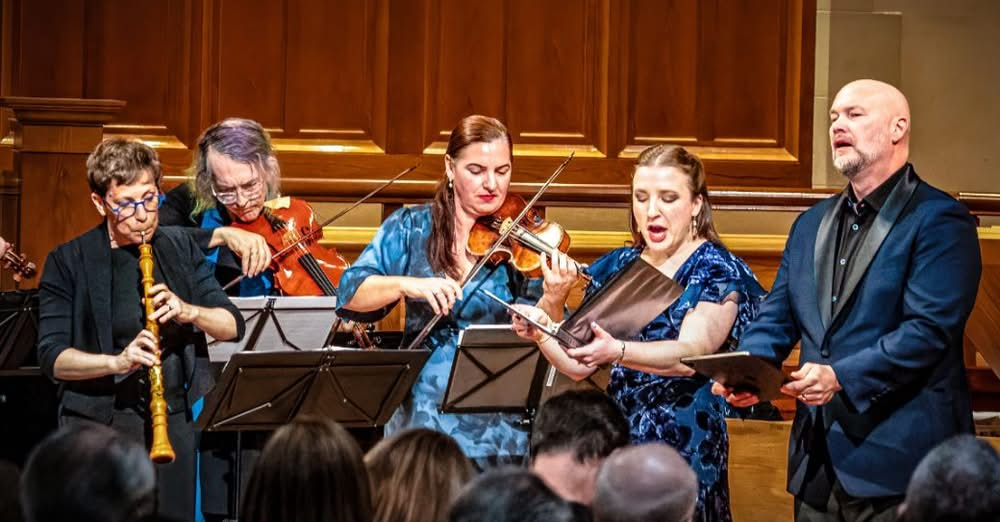
Associate Concertmaster Helen Kim conjures the seasons with Seattle Symphony colleagues. Photo: Jon Pendleton
My latest review for The Strad: Though the Seattle Symphony fielded a notably smaller ensemble for this week’s Baroque programme – some players are doubling in Seattle Opera’s Tosca, which opens on the weekend—the aesthetic impact was anything but modest…
Dalia Stasevska and Augustin Hadelich with Seattle Symphony; (c)Jorge Gustavo Elias
Dalia Stasevska has returned to guest conduct Seattle Symphony this week with a relatively brief but refreshing program. Thursday night’s performance offered plenty of dazzling energy, albeit a curious combination of early Prokofiev sandwiched between two vibrant Latin American works.
Alberto Ginastera’s Malambo from the 1941 ballet Estancia — music that put him on the international map – launched the concert with such kinetic force that it reminded me what a crime it is that his music remains so rarely programmed in the US. (Bravo to the Miró Quartet for recording the entire Ginastera string quartet cycle, forthcoming later this year as part of the ensemble’s 30th-anniversary celebrations.) Stasevska articulated the layered rhythms and boldly strident dissonances of Ginastera’s dance with razor-sharp clarity. Even at just a few minutes in duration, it left the audience breathless.
So did violin soloist Augustin Hadelich — though in a very different way. A Seattle favorite – he gave a deeply memorable account of the Britten Violin Concerto on his last stop with the orchestra two years ago – Hadelich brought his signature artistry Prokofiev’s precocious Violin Concerto No. 1.
From his first phrases, which open the concerto, Hadelich astonished with the sheer beauty of his sound, caressing Prokofiev’s melodic line as if entering into a dream. Phrasing glissandi with effortless sprezzatura, he brought a transportive intensity to his account that was never schmaltzy. Hadelich embraced the concerto’s oneiric, fairy-tale character with personal warmth. Stasevska created a more integrated, immersive orchestral blend by positioning the brass stage right and offered sensitive, fluid support.
Hadelich then delighted with an encore that nodded to the evening’s Latin American framing: his own arrangement of Carlos Gardel’s Por una Cabeza, proving, with wryly elegant melancholy, that it doesn’t always take two to tango.
The concert’s second half was devoted to Mexican composer Silvestre Revueltas’s La noche de los Mayas, a quasi-symphony fashioned from his score for the now-forgotten 1939 film of the same name, which uses a tragic love story to romanticize pre-Columbian Mayan culture. Stasevska underscored the piece’s rhythmic elan and churning colors, along with its touches of chaos a la Stravinsky Rite.
The musicians seemed to thoroughly enjoy giving their all to the score – whether in the weighty brass chords evoking solemn ancient rituals, the mixed meter and collective revelry of a nighttime fiesta, or a touching Mayan serenade duet for flute and percussion.
The last movement opened up into a tour de force spectacle for a massively expanded percussion section that calls for an orchestra-within-the-orchestra, complete with rattles, güiro, and conch shells. I came way impressed by Stasevska’s versatility—a world away from the Sibelius of her last Seattle appearance, and wholly in the spirit of the evening’s exuberance.
Xian Zhang, Seattle Symphony music director designate, conducts the Symphony in its “Holst: The Planets” program March 27. (James Holt / Seattle Symphony)
I reviewed Xian Zhang’s first concert with Seattle Symphony since being named music director designate :
With just a few gestures, Xian Zhang began conjuring a cosmos.
Returning to Benaroya Hall for her first full program since being named Seattle Symphony’s incoming music director, Zhang drew the nearly sold-out concert hall Thursday night into her orbit with her focused, magnetic conducting.