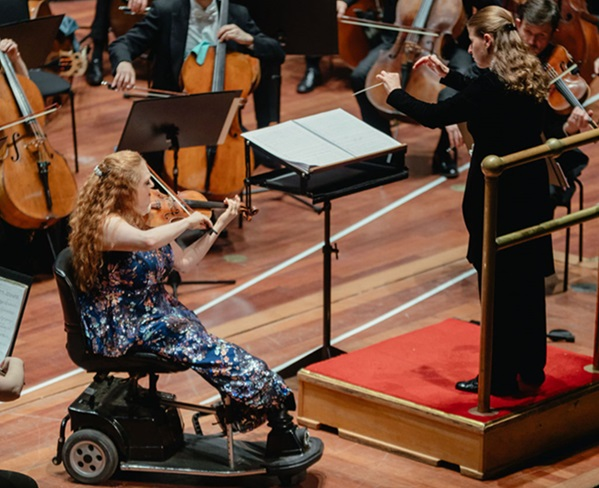
Randall Goosby, Christian Reif and the Seattle Symphony; photo (c)Brandon Patoc
While the search for a permanent music director continues, versatility has been in high demand at Seattle Symphony in recent seasons. Week after week, the musicians have had to adjust to the remarkably varied styles of a revolving door of guest conductors. But the latest visitor to the podium, the German conductor Christian Reif, brought the added challenge of a program calling for drastic shifts in style from one work to the next ….
Natalie Christa Rakes performed the roles of Elaine and the narrator in Steven Mackey’s ‘Memoir.’ (Photos by Carlin Ma)
SEATTLE — “Slipping into sepia” is Steven Mackey’s phrase for a composer’s process of signaling an act of memory. “Ostensibly odd musical grammar in the present tense can be understood as an artifact of the past tense when it accompanies a remembered event, like a film’s sepia hue telling us that the scene is meant to be a recollection,” he writes in his commentary on Mnemosyne’s Pool(2014), a symphonic saga that is paired with his violin concerto Beautiful Passing(2008)on the most recent recording of Mackey’s music….
Kevin John Edusei makes his Seattle Symphony debut conducting Widmann, Strauss, and Beethoven (with Steven Osborne in the Piano Concerto No. 5 in E-flat major); image (c) James Holt
An impressive Seattle Symphony conducting debut last night with Kevin John Edusei on the podium. Absolutely captivating account of Richard Strauss’s Ein Heldenleben, exquisitely tailored to give full weight to the more introspective moments — and reminding us that there’s even a touch of self-doubt in this score. The gorgeously shaped solos from concertmaster Noah Geller were especially thoughtful, while Jeff Fair and the horn section made a spectacular contribution. Overall I found this showcase of sonic theater more moving than usual in its effect.
Scottish pianist Steven Osborne emphasized poetry over heroics in Beethoven’s Emperor Concerto — sheer loveliness in the slow movement, where Edusei’s placement of the strings (basses and cellos to his left) enhanced the finely veiled sound. Osborne played the transition into the finale as if snapping out of a dream. The unannounced encore was apparently music of Keith Jarrett — an unexpected but beautiful choice.
A clever bit of Beethoven-related programming for the opener: German composer Jörg Widmann’s Conbrio, a deliciously paradoxical parody-of-pastiche that is serious and original, never actually quoting Beethoven yet evoking his personality at every turn through abstract gestures — as if trying to recuperate what it all once meant…. Two more chances to hear this excellent concert (Sat evening and Sunday matinee).
Conductor Kahchun Wong and Chorus master Joseph Crnko with Seattle Symphony and Chorale and soloists Katie Van Kooten, Sara Couden, Thomas Cooley, and Hadleigh Adams (left to right); image (c) Jorge Gustavo Elias
Seattle Symphony performed its very first concert on this day in 1903: 24 musicians conducted by Harry F. West (details in Greg Lange’s History Link article here).
Meanwhile, the 21st-century incarnation of SSO is ringing in the New Year with guest conductor Kahchun Wong at the helm in performances of Beethoven’s Ninth Symphony. Yes, it has become cliché to do the Ninth at year’s end, but last night’s opening performance for a very full house genuinely stood out as a memorable event — particularly in comparison with the disappointments of last year’s go.
The Singapore-born Wong conducted the entire score from memory, drawing on a fascinating and idiosyncratic repertoire of gestures to communicate with the musicians: sweeping, circular motions, painterly hand waving, finger wiggles, a variety of crouching positions and leaps. It was clear how deeply he has internalized this music, allowing him to keep it flowing on multiple tracks at once. Phrases had compelling, dramatic shape, while he kept the larger arc of each movement, and of the entire Ninth, continually in view. The thunderous dive into the first movement’s recapitulation, for example, was breathtaking — a rare instance where the shift to major sounds not triumphant but catastrophic.
Especially noteworthy: Wong’s astonishing sensitive to dynamics and ability to shape and blend the sound to such fine gradations. Crescendos in the first two movements in particular were extraordinarily effective and dramatic. For the Scherzo, he opted for a somewhat more-measured tempo in lieu of the infernal machine that is frequently whipped into operation, and he likewise steered clear of the speeded-up pacing that has become fashionable for the slow movement, making a proper differentiation between the Adagio and Andante double variations. Nothing extreme, just a thorough immersion in the musical thought and feeling itself. Again, Wong’s loving attention to details of texture — the gentle throb of the violas not as accompaniment but part of the Adagio’s first theme — added immeasurably to this interpretation.
Also in contrast to last year, the Seattle Symphony Chorale sounded much better prepared and present, producing waves of glorious sound, as well as genuine mystery in the section where Beethoven re-enacts Gregorian chant — though the unnecessary use of amplification was an unfortunate choice. The soloists — soprano Katie Van Kooten soprano, alto Sara Couden, tenor Thomas Cooley, baritone Hadleigh Adams — didn’t blend particularly well, though some individual contributions made a powerful impact (especially Cooley’s exhortation in the high-flying march variation).
In Wong’s reading, only the “terror fanfare” that initiates the finale disappointed as too restrained. But his understanding of this massive structure as a miniature drama came through resoundingly, making for the finest overall Ninth I’ve heard in several years. Nothing else shares this program, so the focus is entirely on Beethoven. Even if you think you’ve heard the Ninth enough times for now, this one is worth seeking out. Wong returns to conduct Mahler’s Third in April. And judging from this success, we may be seeing a good deal more of him ….
I reviewed the Tannhäuser production currently onstage at the Met:
Could there be something like a Tannhäuser ‘curse’? Wagner fretted until the end of his life about how to improve his first opera inspired by medieval German sources. Like a beckoning Venus, the work tempted him at various points in his life to return and tinker away at what he perceived as its imperfections. Wagner’s most significant revision, fashioned for his operatic debut in Paris in 1861, spurred the most humiliating fiasco of his mature career – not because of the ‘content’ but because of protests in part related to Napoleon III’s policies involving the Austrian Empire….
David Robertson led the Seattle Symphony; photo by Brandon Patoc
SEATTLE — So far this season, the Seattle Symphony has played under no fewer than seven conductors as part of its central masterworks subscription series. The musicians have shown remarkable flexibility in adapting to a dramatically varied range of podium styles and personalities for each program as the search for a permanent music director continues.
The European premiere of John Adams’s most recent opera at the Gran Teatre del Liceu in Barcelona marked the debut of soprano Julia Bullock in the role specifically written for her. I reviewed this remarkable production for Classical Voice North America:
BARCELONA — Though this is a city known for its proud celebration of culture, it still came as a delightful surprise to be greeted at the Barcelona-El Prat Airport by posters announcing the Gran Teatre del Liceu production of John Adams’Antony and Cleopatra.…
My review of Starlighter, the latest Brooklyn Rider release featuring the quartet’s collaboration with clarinetist/composer Kinan Azmeh, is in the November issue of Gramophone:
Ever since they formed nearly two decades ago, Brooklyn Rider have been reimagining the string quartet’s potential both in their playing style and in their devotion to new repertoire. …
I had the pleasure of covering the Royal Scottish National Orchestra’s latest concert in Edinburgh, which featured two guest artists in remarkable sync:
Although the most recent work on this weekend’s Royal Scottish National Orchestra programme dates from 1952, audiences are still just beginning to make its acquaintance. The ongoing reappraisal of the twentieth-century African American composer Florence Price would not be possible without the contributions of performers who have championed her music….
Bows (l to r): Georgia Mann, Pouyan Biglar, Iman Habibi, Jessika Kenney, Sharon Azrieli, Steven Mercurio, Zhongxi Wu, Rita Ueda and Naomi Sato (photo: Chris O’Donovan Photography)
Launched a little less than a decade ago, the Azrieli Music Prizes (AMP) have already grown to become Canada’s largest competition devoted to music composition. The biennial initiative has expanded to embrace an international scope and last weekend made its London debut at Cadogan Hall with a programme of all three prize-winning works from the 2022 rounds. Steven Mercurio, a member of the AMP Jewish Music jury, led the Philharmonia Orchestra and guest soloists.




 MEMETERIA by Thomas May