

The renunciation of love is what spins the entire Ring cycle into dramatic motion – yet there’s precious little evidence of what love actually is in Das Rheingold (the preludial opera, as Wagner conceived it, with the three longer operas that follow constituting a trilogy on the model of ancient Greek tragedy).
What unfolds before us onstage (and in the pit) is, instead, a brutal cosmos in which rape, violent coercion, deception, and theft hold sway. Is Alberich really giving up all that much when he curses love to access the gold? You have to wonder, in a world where Freia, the goddess of love, is held as sexual ransom to pay for Valhalla per Wotan’s deal with the giants who constructed it.
So it’s not surprising that Die Walküre has always tended to be the most popular work of the cycle: love, and spring, and humanity all enter in with that miraculous first act – an act which, after all, is basically a digression from the main narrative line. And Wagner’s music warms up as well after Rheingold‘s abstractions and muscular assertions.
Die Walküre benefits especially from director Stephen Wadsworth’s obsessive attention to the nuances of character interactions in Seattle Opera’s Ring cycle. Sure, it’s easy to milk the audience’s sympathy for the Wälsung twins in their passion and plight – does anyone actually ever get worked up these days about the incest taboo? – but this production delineates with tremendous subtlety how love affects the gods: above all Wotan’s love for Fricka (hardly “traditionalist” but a directorial conceit, however persuasive), and how this love sets up inescapable conflicts with his love for his son and for Brünnhilde. Love, not its renunciation, is the source of his pain.
Whenever you grapple with the Ring, the mushy term “redemption by love” gets tossed around as predictably as the sun will set. But “love” – by which Wagner, in the Ring text’s early stages, clearly had physical, sexual expression in mind – is elusive and ultimately contradictory in the Ring cosmos. Its meaning is as slippery as the rocks at the bottom of the Rhine are to the frustrated, grasping Alberich when he tries to seize love like catching a fish.
On Monday night, when I heard Margaret Jane Wray pour out that glorious arc of melody [1:26] in the pivotal moment when the just-widowed Sieglinde suddenly learns she is pregnant with Siegfried, I was thinking of how this is a kind of reverse Annunciation scene: Brünnhilde bears the joyful news, but the music is Sieglinde’s as she praises the Valkyrie.
This is the music that has become so misleadingly tagged as the “redemption by love” theme when it is heard again at the very end of the Ring. And the words which are “imprinted” with this melody are “O hehrstes Wunder! Herrliche Maid!” (“O miracle most sublime! Glorious maiden!”).
In other words, as Sieglinde rejoices in this new hope, she glorifies Brünnhilde the virgin warrior. But the love the goddess maiden-turned-human lover experiences with Siegfried is what sets in motion the final tragedy, just as inevitably as Alberich’s theft of the gold as a substitute for love launched the cycle in the first place. So where has love gotten us?
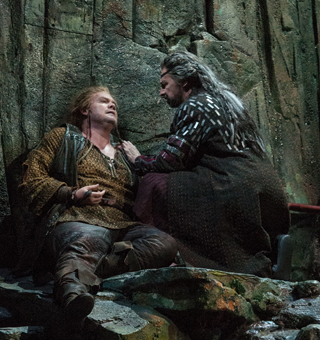
(Image: Seattle Opera’s Die Walküre: Stuart Skelton (Siegmund), Greer Grimsley (Wotan).
Photo © Elise Bakketun.)
Filed under: opera, Ring cycle, Seattle Opera, Wagner


 MEMETERIA by Thomas May