
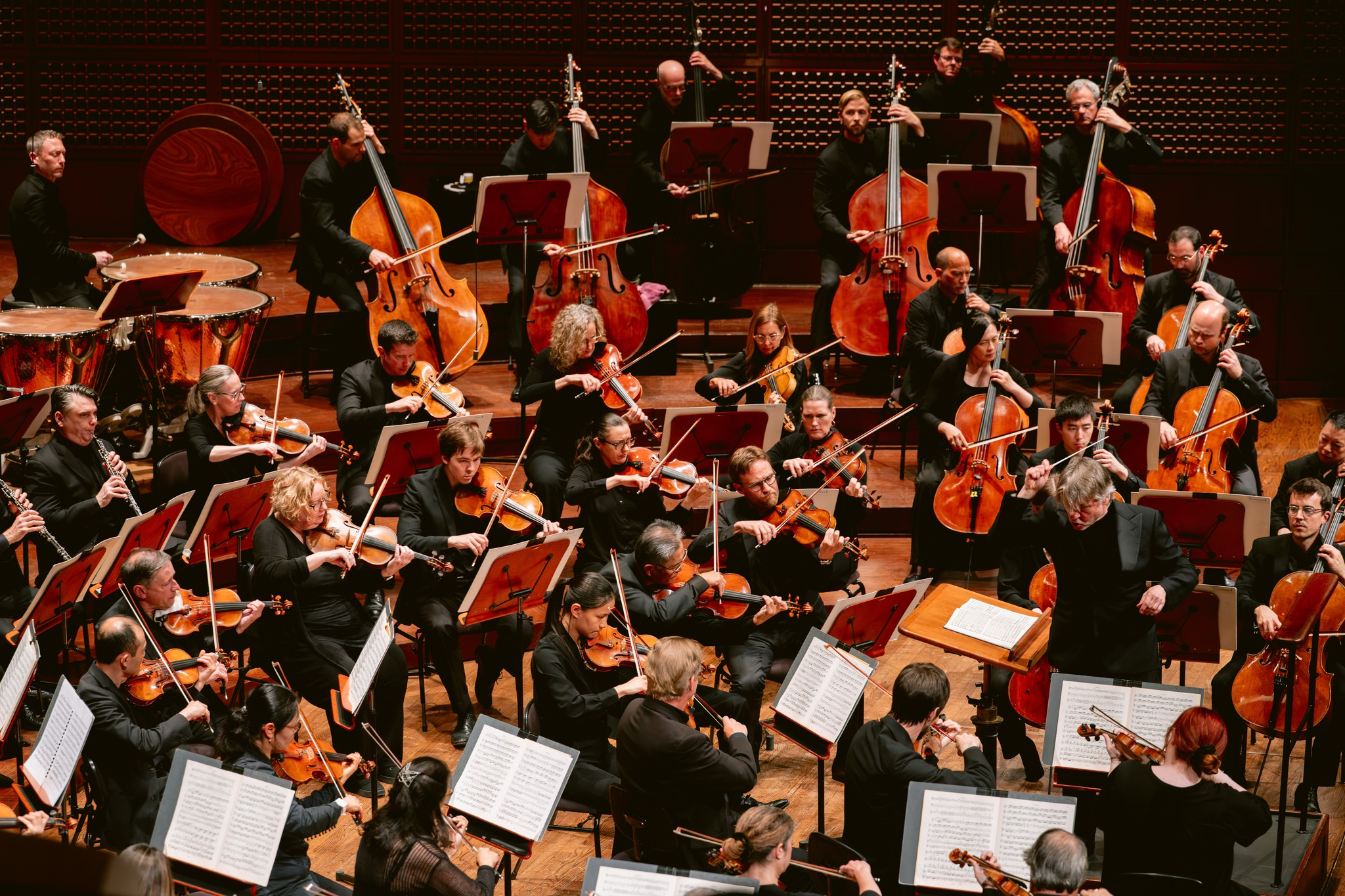
An especially memorable performance in 2025: Mahler’s Second with the San Francisco Symphony and Esa-Pekka Salonen, which concluded his tenure as the orchestra’s music director:
Filed under: Esa-Pekka Salonen, Mahler, review, San Francisco Symphony

December 30, 2025 • 10:51 am Comments Off on Esa-Pekka Salonen’s SF Symphony Farewell
An especially memorable performance in 2025: Mahler’s Second with the San Francisco Symphony and Esa-Pekka Salonen, which concluded his tenure as the orchestra’s music director:
Filed under: Esa-Pekka Salonen, Mahler, review, San Francisco Symphony
June 18, 2025 • 1:22 pm 2
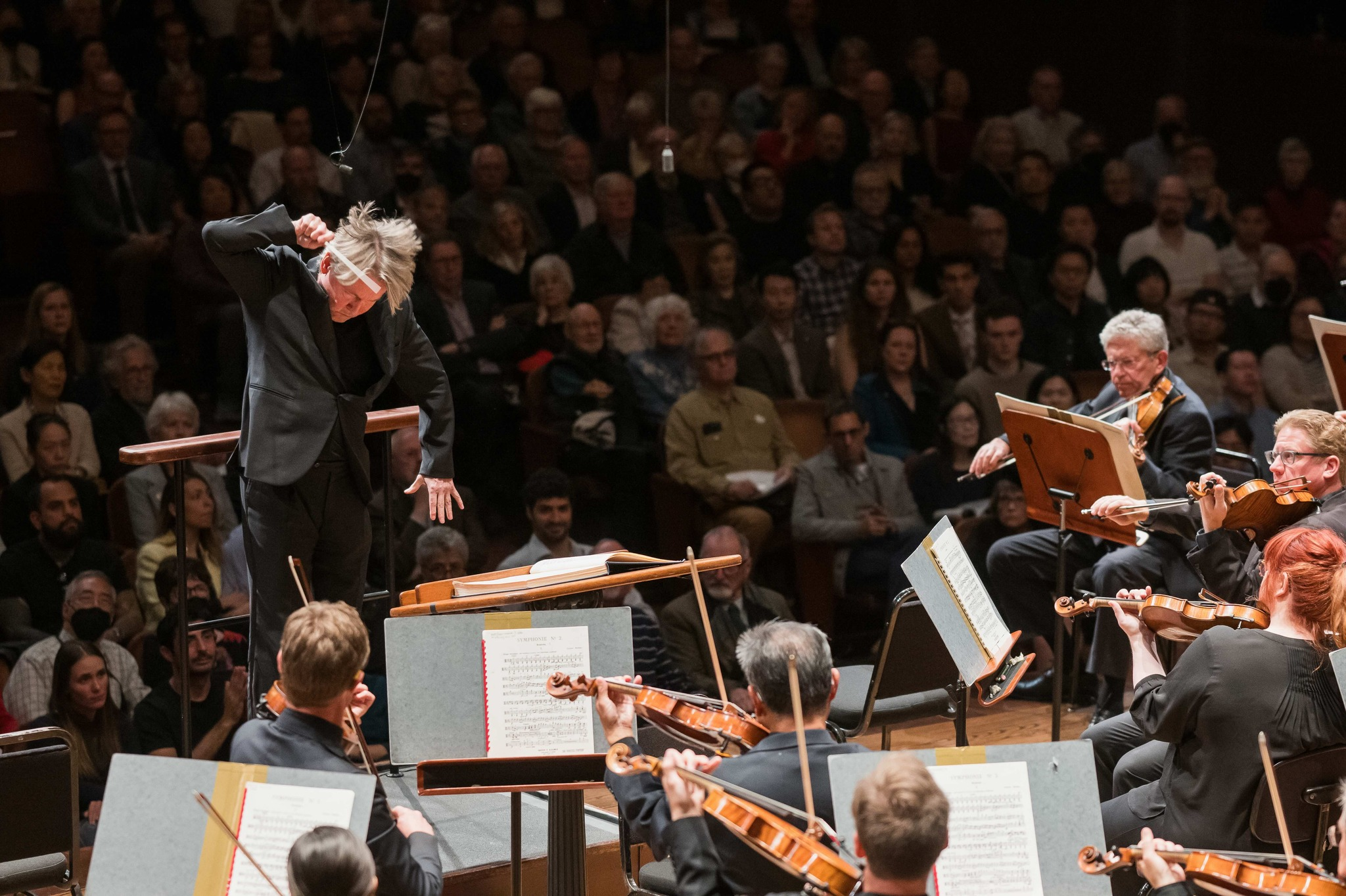
I was fortunate to have a chance to make it to Esa-Pekka Salonen’s very final performance of his San Francisco Symphony tenure – a program of Mahler 2.
Here’s my review for Musical America:
Filed under: Esa-Pekka Salonen, Musical America, review, San Francisco Symphony
May 19, 2025 • 12:09 pm Comments Off on Anna Thorvaldsdottir: Notes on a First Concerto

San Francisco Symphony just gave the world premiere of Before we fall, Anna Thorvaldsdottir’s new cello concerto for Johannes Moser, with Dalia Stasevska on the podium.
My behind-the-scenes feature on its creation is the current Strings magazine cover story.
Here’s Lisa Hirsch’s review for the San Francisco Chronicle:
“Thorvaldsdottir’s new cello concerto, Before We Fall, is a banger, sonically and intellectually, dense with ideas and meriting repeat hearings. It launches explosively, which is not an unusual strategy for a concerto, but don’t be misled. This isn’t a conventional soloist-versus-orchestra showdown….
continue
Filed under: Anna Thorvaldsdottir, cello, new music, San Francisco Symphony, Strings
October 16, 2024 • 3:55 pm Comments Off on Nietzschean Virtuosity: Salonen’s Cello Concerto

For The Strad, I interviewed San Francisco Symphony principal cellist Rainer Eudeikis about his upcoming performances of the Cello Concerto by his orchestra’s music director, Esa-Pekka Salonen:
Now in his third full season as the San Francisco Symphony’s principal cello, Rainer Eudeikis makes his solo debut with the orchestra on 18-20 October in a work by the orchestra’s music director, Esa-Pekka Salonen: the Cello Concerto written by the Finnish composer-conductor for Yo-Yo Ma, who gave the world premiere in 2017. …
Filed under: cellists, Esa-Pekka Salonen, San Francisco Symphony
October 6, 2023 • 12:22 pm 1
A rare opportunity to hear John Adams’s mammoth symphonic canvas on this weekend’s San Francisco Symphony program. Esa-Pekka Salonen, who led the Los Angeles Philharmonic in the world premiere in 1999, conducts. My program note here.
The program also includes the world premiere of Jesper Nordin’s Convergence, with violinist Pekka Kuusisto as the soloist.
Filed under: Esa-Pekka Salonen, John Adams, program notes, San Francisco Symphony
June 23, 2023 • 1:51 am Comments Off on Busoni’s Mountain of a Piano Concerto

“Because it’s there” might not provide sufficient motivation to motivate the rewiring and firing of countless synapses necessary to tackle the wild behemoth that is Ferruccio Busoni’s Piano Concerto. Nor to organize the expanded orchestra plus choir of low voices that adds to the expense for a program decidedly unfamiliar to most audiences.
But it’s exactly the sort of challenge to appeal to Igor Levit and Esa-Pekka Salonen, who are both avowed fans of Busoni’s anomalous contribution to the piano concerto repertoire. Because of schedule conflicts, I was able only to experience their interpretation in the dress rehearsal on Thursday morning before the first performance that evening of this week’s subscription concerts. (Additional performances are on Saturday evening (24 June) and Sunday afternoon (25 June) — if you happen to be in the Bay Area, I can’t recommend this rarity highly enough. Do not miss!
Because of Busoni’s idiosyncratic fusion of German and Italian influences, I tend to think of Busoni as a character invented by Thomas Mann. His work suggests a Faustian striving to synthesize the contrapuntal complexity of Bach with classical grace, the stern discipline of the North with the fantasy and insatiable curiosity of Da Vinci — like Bach, one of his key inspirations. (Did the music-obsessed Thomas Mann in fact actually encounter Busoni in concert in his guise as a powerhouse pianist? What did he think of Busoni’s own treatment of Faust in his remarkable opera — for which the composer penned his own libretto — which premiered in Dresden in 1925?)
There’s even a Faustian aspect to the Piano Concerto — not only (and most obviously) in its choral apotheosis, but in its bold motley of crazy contrasts. The piece plays with Romantic clichés of diabolical, indeed possessed, virtuosity but also draws from the poetic tenderness of Chopin, the rigor of Brahms, the mysteries of Bayreuth, the kaleidoscopic soundscapes of Busoni’s contemporary, Mahler (who led the world premiere of his gorgeous Berceuse élégiaque on his final concert in New York in 1911) — only to veer into cartoonish Rossini-land, with some seasonings from Italian folk song.
Busoni composed his Piano Concerto from 1901 to 1904 and played the solo part in the world premiere on 10 November 1904 with the Berlin Philharmonic under Karl Muck (Busoni had settled in Berlin a decade before. –earlier in 1904, incidentally, he had undertaken a concert tour of the US). As James Keller points out in his program note, the composer described the work-in-progress in a letter to his wife with this commentary, accompanied by a sketch:
The enclosed drawing is crude and clumsy, but not ridiculous. . . . It is the idea of my piano concerto in one picture and it is represented by architecture, landscape, and symbolism. The three buildings are the first, third, and fifth movements. In between come the two “lively” ones, Scherzo and Tarantella: the first represented by a miraculous flower and birds, freaks of nature; the second by Vesuvius and cypress trees. The sun rises over the entrance; a seal is fastened to the door of the building. The winged being right at the end is taken from Oehlenschläger’s chorus and represents mysticism in nature.

One of the big challenges for a conductor is how to make all these elements cohere. But Salonen is clearly not only at home with Busoni’s overarching architectural concept of the 75-minute, five-movement score, but understands how to make the transitions between episodes that on the surface seem almost arbitrary — while at the same time relishing the delight and astonishment they bring. Even with a requisite intermission interpolated before the choral finale during the dress rehearsal, the Piano Concerto’s ability to draw us into a world of its own was apparent.
As for the piano soloist, Busoni has created a genuinely Shakespeare-sized role. Levit has made it his own. I was surprised to learn that he actually first took it on at the age of 18. At Davies Hall, he occasionally flexed and sipped from his water bottles and seemed surprisingly at ease — this was, after all, just hours before opening night — but remained intensely focused on the minutest detail.
The opening movement was magisterial, the stuff of great oratory, but Levit could tame his gigantic sound on a dime to produce wondrously hushed arpeggios that seemed a portal to another universe. The enormous, complex, multi-movement central movement fascinated me the most — above all, Busoni’s ability to transform the simplest, most mundane of gestures into a solemn utopia of lofty poetry. It inspired Levit’s signature depth of thoughtful concentration (the dagger-eyes he shot as some careless cell phone noise intruded were beyond deadly), which comes across on his recordings but really needs to be experienced live.
The piece frequently brought to mind a compact opera filled with interludes and comic relief, particularly in the madcap frenzy of the fourth-movement tarantella — really, an immense satire of the idea of the tarantella that approaches postmodern irony. Busoni in fact conceived writing a music drama based on the Danish poet and playwright Adam Oehlenschläger’s play Aladdin, or the Wonderful Lamp from 1805 but decided to set an extract titled “Hymn to Allah” as the choral movement that concludes the Piano Concerto.
Summing up his admiration of Busoni, Levit remarked in a recent interview with the New York Times: “Busoni has always been one of those role models I never met, in a way like an idol figure, regarding the way he thought and especially wrote about music, his utopian idea about what free music actually is, his idea about what the creator’s job is, which is to set up your own rules and not follow the rules of others. As a composer, as a pianist, as a thinker, teacher, we are speaking here of one of the most incredible minds of at least the 20th century. He was this larger-than-life figure, and I think it’s a larger-than-life piano concerto.”
To quote Busoni’s credo as formulated in his Sketch of a New Aesthetic of Music from 1907: “Music was born free and to win freedom is its destiny.”
Text from Adam Oehlenschläger’s Aladdin
V. Cantico
Die Felsensäulen fangen an tief und leise zu ertönen
Hebt zu der ewigen Kraft eure Herzen;
Fühlet euch Allah nah’, schaut seine Tat!
Wechseln im Erdenlicht Freuden und Schmerzen;
Ruhig hier stehen die Pfeiler der Welt.
Tausend und Tausend und abermals tausende
Jahre so ruhig wie jetzt in der Kraft,
Blitzen gediegen mit Glanz und mit Festigkeit,
Die Unverwüstlichkeit stellen sie dar.
Herzen erglüheten, Herzen erkalteten,
Spielend umwechselten Leben und Tod.
Aber in ruhigen Harren sie dehnten sich
Herrlich, kräftiglich, früh so wie spät.
Hebt zu der ewigen Kraft eure Herzen
Fühlet euch Allah nah’, schaut seine Tat!
Vollends belebet ist jetzo die tote Welt.
Preisend die Göttlichkeit, schweigt das Gedicht!
Translation by Noam Cook:
Low and Soft the Stone Columns Begin to Resound
Raise up your hearts to the eternal force;
sense the closeness of Allah, behold his deeds!
Joy and grief alternate in earthly light;
while the pillars of the world stand in repose.
Thousands upon thousands upon thousands
of years, as calm in their force as now,
flash sedately by with radiance and steadiness,
representing the irrepressible.
Hearts glowed, hearts grew cold,
playfully life and death alternate.
Yet waiting quietly they persist
blissfully, forcefully, both early and late.
Raise up your hearts to the eternal force
sense the closeness of Allah, behold his deeds!
Now the inanimate world is enlivened fully.
Praising the divine, the poem is silent!
Filed under: Esa-Pekka Salonen, pianists, San Francisco Symphony
February 23, 2023 • 3:30 am Comments Off on Samuel Adams: No Such Spring
The profound impact that the pandemic has had on contemporary composition will undoubtedly continue to be felt for years. Samuel Adams points to an important shift in his own musical thinking exemplified by his new work No Such Spring, the world premiere of which Esa-Pekka Salonen is conducting in this week’s program with the San Francisco Symphony, with Conor Hanick as the piano soloist. Salonen will also conduct the symphony Anton Bruckner deemed his “boldest”: the Sixth. My program notes for No Such Spring can be found here.
Filed under: Anton Bruckner, commissions, Esa-Pekka Salonen, new music, Samuel Adams, San Francisco Symphony
June 23, 2022 • 3:27 pm 1
Quite looking forward to tonight’s San Francisco Symphony concert, conducted by Esa-Pekka Salonen, which brings John Adams’s most-recent piano concerto to Davies Hall. Vikingur Ólafsson is the soloist, and on the basis of this morning’s open rehearsal, this should be a performance to remember.
We had a good one in January with the Seattle Symphony and Jeremy Denk, Adams himself guest conducting.
The rest of the program includes a beautiful work by the late Steven Stucky, Radical Light (also an SFS premiere), and Sibelius’s Fifth Symphony.
Filed under: Esa-Pekka Salonen, John Adams, San Francisco Symphony
April 7, 2022 • 10:41 am Comments Off on John Corigliano’s Triathlon at San Francisco Symphony
In his programs this weekend with San Francisco Symphony, guest conductor Giancarlo Guerrero will lead the world premiere of Triathlon by John Corigliano. Now 84, the composer has contributed a major work to the saxophone repertoire in this concerto for the remarkable Tim McAllister. I had the privilege of writing the program note for this world premiere. The rest of the program presents music by Adolphus Hailstork, Antonio Estévez, and Astor Piazzolla.
Filed under: commissions, John Corigliano, program notes, San Francisco Symphony
March 29, 2022 • 2:27 pm Comments Off on San Francisco Symphony Announces 2022-23 Season
San Francisco Symphony today announced the program for its 2022-23 season. Lots of great stuff is lined up. Esa-Pekka Salonen’s third season with SFS promises world premieres of works by Samuel Adams, Magnus Lindberg, and winner of the 2021 Emerging Black Composers Project Trevor Weston, as well as the U.S. premieres of Daniel Kidane’s Precipice Dances and works by Danny Elfman and Outi Tarkiainen, along with the West Coast premiere of Julia Wolfe’s Her Story.
There will be a two-week theme focus in October on music involving “myth, magic, and horror,” including the suite from Béla Bartók’s The Miraculous Mandarin, Hector Berlioz’s Symphonie fantastique, HK Gruber’s Frankenstein!!, the suite from Bernard Herrmann’s Psycho, Franz Liszt’s Totentanz, and Modest Mussorgsky’s Night on Bald Mountain.
Some other highlights: Igor Levit will be Artist-in-Residence and will give a rare performance of Ferruccio Busoni’s wild, choral Piano Concerto. The orchestra will present Gabriel Kahane’s emergency shelter intake form, and Music Director Laureate Michael Tilson Thomas returns for four weeks of programs. The orchestra will tour in spring 2023 to Paris, Luxembourg, and Hamburg.
EPS and SFS are also undertaking a four-year partnership with Peter Sellars, launching in June 2022 with a staged production of Igor Stravinsky’s Oedipus Rex. Kaija Saariaho’s Adriana Mater comes in June 2023, and future seasons will present new Sellars-staged productions of Olivier Messiaen’s La Transfiguration de Notre Seigneur Jésus-Christ (2024) and Leoš Janáček’s The Cunning Little Vixen (2025), the latter featuring SFS featuring Collaborative Partner Julia Bullock.
States Salonen: “I don’t believe in the concept of canon, especially canon as something finished or immovable. If you look back at concert programs from 150 years ago, what then was understood as canon is very different from today. We don’t need the concept of canon as long as music is a dynamic thing that keeps changing, because we keep changing. There’s a tradition of these works we love and want to take care of, there’s a sort of gardener’s duty that we have. We have to take care of the old trees, but we also have to make sure that there’s new growth everywhere, because without the new growth the trees actually won’t survive. Ultimately, it’s all about relevance. Every day that goes by stretches the virtual rubber band between, say, us and Beethoven. And the fear of course is that one day we come to the point where it snaps, and we no longer feel that it’s relevant, which would be a catastrophe in a way because it’s wonderful. The only way to keep that relevance and connection is to make sure that there’s new music. There’s new growth, new composers, new artists who keep this art form alive and take it places that we cannot even imagine. That’s the most important thing—the surprise, the new directions. I want to be part of that process. That’s why we want to commission works from young composers and support new artists. We want to engage new performers and expand the horizons of what we do.”
You can see the full listing for the 2022-23 season here.
Filed under: Esa-Pekka Salonen, music news, Peter Sellars, San Francisco Symphony
 Arts & Culture Stories from NPR
 MEMETERIA by Thomas May