I had the fortune of spending an afternoon with the composer John Luther Adams in New York City last May, shortly after his Pulitzer Prize-winning orchestral work Become Ocean received its New York premiere at Carnegie Hall. (My article on this Seattle Symphony commission appears in the current issue of Listen magazine.)
And now the SSO’s recording with music director Ludovic Morlot has been released on Cantaloupe.
The spatial conception that informs JLA’s music really needs to be experienced in live performance, but you can get a decent impression of his aesthetic from the recording. This week NPR is making it available to listen to online for free.
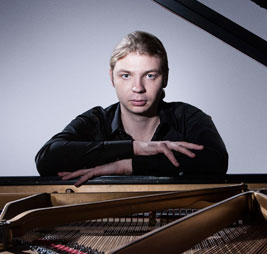
My review of the Seattle Season’s opening concert of the season — including pianist Daniil Trifonov’s spectacular SSO debut — is now live on Bachtrack:
Music by Antonín Dvořák was included on Ludovoc Morlot’s first-ever programme leading the Seattle Symphony, which took place in October 2009. At the time – two years before coming on board as music director – Morlot was a visiting conductor, and he offered the barest sampling of his thoughts on Dvořák (three of the Legends).
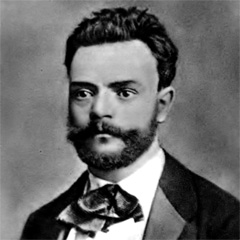
The Seattle Symphony’s new season is about to begin, and I’m especially looking forward to the upcoming Dvořák Festival. Here’s my recent preview for City Arts:
Antonín Dvorák wrote his two most popular pieces during his early 1890s stay in the United States—the “New World” Symphony and the Cello Concerto. Their heart-melting melodies, infectious and thrilling rhythmic ideas, and emotionally complex use of the orchestra make both works among the most beloved in the orchestral repertory.
Their mega-success made the Czech composer into a “two-hit” wonder. But they’re just the tip of the Dvorák iceberg.
My review of the Seattle Symphony’s final concert of the season:
The past few months have brought the ensemble far more exposure than usual (an appearance at Carnegie Hall, a concert for the League of American Orchestras, the launch of an in-house label): its appetite for new challenges seems unstoppable.
So it’s hardly surprising that music director Ludovic Morlot is concluding the current season with an all-out marathon of orchestral virtuosity. The program of Stravinsky’s three pre-First World War ballet scores for the Ballets Russes in their entirety lasts close to three hours and, out of necessity for the players, requires two intermissions. It drew what appeared to be a close-to-packed house.
No matter how well we think we know this music, the opportunity to hear the young Stravinsky’s three iconic ballets back to back is bound to prompt new perspectives. And Morlot’s deeply sensitive interpretation of the uncut, sumptuous score for The Firebird (1910) did precisely that – all the more so since, only two weeks before, he’d led the SSO in the complete Daphnis et Chloé, also for the Ballets Russes, which was premiered in 1912, the year between Petrushka (1911) and The Rite of Spring (1913).
Time to get in the mood for this weekend’s final subscription concerts of the Seattle Symphony’s season — and Ludovic Morlot has planned one hell of a program, with all three of Stravinsky’s blockbuster pre-WW I ballets.
I’m recalling the National Gallery of Art’s thought-provoking exhibition Diaghilev and the Ballets Russes, 1909–1929: When Art Danced with Music last fall. The show gave a dazzling overall impression of the many different areas of creativity that the wizard Serge Diaghilev somehow managed to draw together (not without a massive amount of drama): composers, writers, painters, sculptors, costume and set designers, lighting artists, researchers, propagandists, and naturally musicians and dancers.
Diaghilev’s brain itself must have been a Gesamtkunstwerk. This was the way to out-Wagner Wagner, and Stravinsky certainly intended to do that.
The exhibition also probed into future connections, the way these artists set currents in motion that would give birth to Cubism, Futurism, Dadaism, Surrealism.
The always-brilliant Philip Kennicott points out that “the legend of the Ballets Russes was always a bit better — and better tended — than the reality of what the troupe and its lead artists left behind.” He offers this handy summary of what the lasting impact of the Ballet Russes as a crucible of experiment:
In less than two decades’ time, one sees the invention of something so familiar we take it for granted, the free mixing of commercial entertainment and more traditional forms of art, the valorization of branding and fashion within the intellectual realms of culture, and the troubling, persistent and essential fracturing of art into style and substance.
And it’s important to realize how much of Diaghilev’s legend became linked to the power of celebrity:
Much of what is on display falls into the category of holy relics: Costumes worn by dancers who are legendary names; programs and photographs and publicity posters from tours of the company that are still spoken of in reverential terms by those who remember or knew someone who was there. Theater, including ballet, invites hero worship, and there are many objects in this exhibition that appeal to our celebrity pleasure receptors more than our artistic ones.
[…]
[T]hat’s the difference between performance and the plastic arts. The allure of the former is all about the moment, the luck of being present, the willful illusion that magic is happening. Diaghilev sold that dream, perhaps more effectively than any impresario before or since.
So the Seattle Symphony gave a special one-off concert last weekend, part of its Sonic Evolution series. The series — just one of the many ideas music director Ludovic Morlot inaugurated in his first season three years ago — is basically about connecting the orchestra with other musical genres spawned in the Seattle region.
For this latest edition of the series, a trio of young (or youngish) composers was commissioned to write original orchestral pieces responding in some way, with no strings, so to speak, to musical figures linked culturally or biographically with Seattle. There was the Portuguese Luís Tinoco; Du Yun, a Chinese-born composer based in New York; and Gabriel Prokofiev, who is, yes, the grandson of Sergey, who is based in London. (He’s the only one of seven Prokofiev grandchildren with a career in music.)
Composer Du Yun
Their new compositions drew loosely on source inspirations, respectively, from Bill Frisell (who lives in the region), Ray Charles (who made his first recording in Seattle, the town “where I got my start,” as Charles once said), and the hip-hop legend Sir Mix-A-Lot. The latter’s onstage performance, backed by the Seattle Symphony, is of course what grabbed the headlines.
A final segment of the program was given over to a local band called Pickwick; they performed three of their soul-infused songs to the accompaniment of the SSO, in arrangements by David Campbell (a Seattle native who’s done lots of work for film soundtracks).
Sure, the loaded concept of “crossover” has been responsible for many a dubious or at best misguided project. The standard critique runs something like this: if you present an orchestra playing versions of “pop music,” it dilutes the original into a sappy, watered-down product while making a mockery of the players’ musicianship. Neither constituency (the classical or pop audience) is likely to find the result appealing, so what you get is music that exists in a kitschy limbo, a no-man’s-land of pointless vulgarity.
All too often that actually is the case, as we all know from any number of dreadful PBS pledge promos. But — a big but — that kind of simplistic, pandering crossover doesn’t fairly describe what the Sonic Evolution project is after. And certainly not what actually happened on Friday night’s concert.
It’s been amusing to see how many commentators who weren’t actually there consider themselves entitled to pontificate. (And yes, there really is an “aura” aspect to these concerts that you can’t absorb via youtube osmosis.)
I’m referring mostly to the naysayers who conclude that such efforts spell the doom of civilization, but just as much to the hipster pundits who think everything else the Symphony does is irrelevant or that the pairing of Sir Mix-A-Lot and Morlot represents a rare moment of cultural credibility that you don’t get with business as usual.
Many seem to assume that the whole concert was about having the SSO play Sir Mix-A-Lot “covers” in a madcap attempt to fill the house and stir up media attention. Do they really think an entire season has been planned around busily orchestrated versions of pop music icons? That there’s going to be no more Brahms or Bach or Beethoven — or Dutilleux and Ravel, to mention the splendid program that also took place last week, one which happens to serve as a perfect example of the level of artistic excellence at which the SSO is playing these days?
In fact, Prokofiev crafted two orchestrations of hits by Sir Mix-A-Lot (“Posse on Broadway” and “Baby Got Back”), but his main event was a completely new composition titled Dial 1-900 Mix-A-Lot. In my opinion this was the most interesting music of the program, brimming with invention and a one-of-a-kind orchestral imagination. Among the challenges Prokofiev set himself was to deploy the full orchestra on its own terms, without resorting to boring cookie-cutter gestures and predictable sectional blocks. (Prokofiev discusses the process of working on this piece on his blog.)
Gabriel Prokofiev
Besides, you’ve got to admire a piece that prompts this in the program note (written by my friend Aaron Grad, also a composer): “A recurring four-note motive, for instance, traces the rhythm of the opening phrase from ‘Baby Got Back’: ‘I like big butts.'”
I also very much enjoyed Tinoco’s kaleidoscopically orchestrated ruminations in FrisLand, which he describes as “an imaginary voyage through an (also imaginary) sound-world inspired by Frisell’s music.” It was interesting to learn about the juxtaposition of Ray Charles with a bit of Buddhist folklore in Du Yun’s Hundred Heads, though I admit that the musical argument of her piece left me puzzled; here the fusion didn’t persuade me.
Luís Tinoco
What I did find cringeworthy about the concert, though I haven’t seen anyone else mention it, was the final set spotlighting Pickwick. I’m sure they’re eminently enjoyable on their own terms, in their usual setting. But this was the part that for me reeked of cheesy crossover. Why? The three songs were two much of a kind, but most of all because of the dreary paint-by-numbers arrangements that wasted the resource of the SSO, making it into a predictable jukebox of fizzing tremolo strings, etc. etc. No imagination.
So why have some people gotten so riled up over the orchestra sharing the stage with Sir Mix-A-Lot and a bevvy of eagerly dancing women? This was one part of the program, and the spirit overall seemed genuinely joyful; certainly the musicians appeared to be having fun with the playfulness of it.
No one can seriously believe this is the Trojan horse that will suddenly yield a concert hall full of converts to Bruckner. That’s not the intention anyway, and Bruckner will still be waiting there for those fortunate enough to discover what he has to offer. But it was exciting to realize that a significant portion of the audience had never once been inside the Benaroya Hall auditorium before. And they stayed and heard some “serious” concert music by worthwhile composers at work today; they also had a blast encountering very familiar music in an unusual context.
I admire the Seattle Symphony and Morlot’s willingness to take these kinds of risks. It’s not just about trying out gimmicks. They honestly are walking the talk, putting into action the themes that had just been discussed at this year’s League of American Orchestras Conference, which had wrapped up earlier that day in Seattle: the need to rethink how our orchestras can connect with their local audiences and how the concert experience itself can be innovated, can become an event that leaves a mark. That means being willing to stumble, to get parts wrong, even to have people question your sanity.
Talk about keeping the pressure on: Only last month the Seattle Symphony and music director Ludovic Morlot journeyed to Carnegie Hall for an unusually high-stakes concert and attracted a good deal of press coverage — not least because one of the works featured had just won the Pulitzer Prize in music (John Luther Adams’s Become Ocean, a Seattle Symphony commission). Thursday night’s all-French program meanwhile attracted special scrutiny from movers and shakers throughout the American orchestral scene.
This time the ensemble was playing on its home turf at Benaroya Hall, where it welcomed a sizable number of guests in town for the annual conference of the League of American Orchestras. Under the slogan “Critical Questions/Countless Solutions”, some 1,000 participants representing the breadth of America’s orchestral life had flocked to Seattle. Their mission: to brainstorm ways to engage audiences more meaningfully. Ideas ranged from more innovative concert formats and digital initiatives to suggestions for making orchestras “the heartbeats of our cities”, as Morlot put it.
Ludovic Morlot and the Seattle Symphony in rehearsal at Carnegie Hall
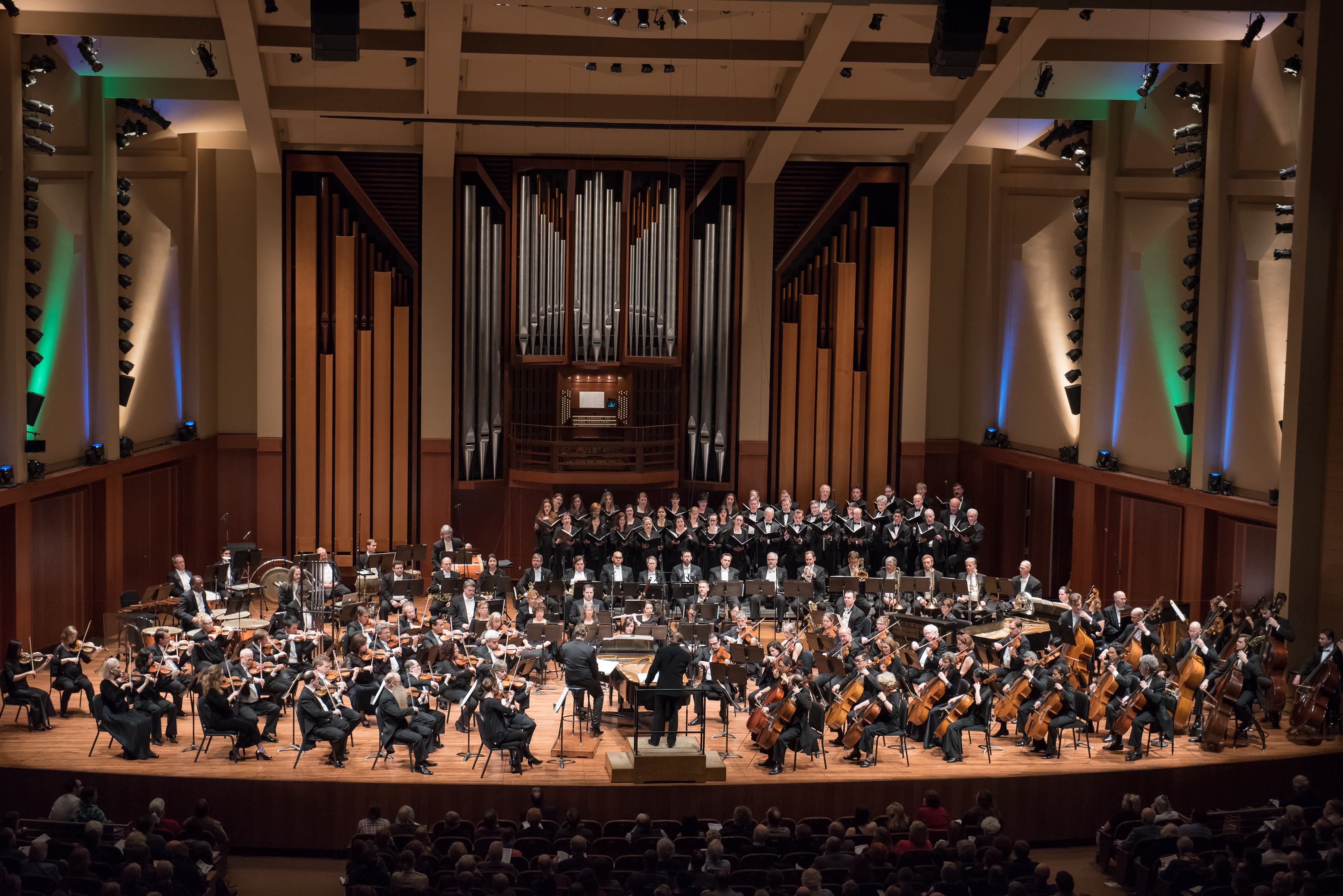
I’m still processing the experience of the Seattle Symphony’s concert Tuesday evening at Carnegie Hall — part of this week’s Spring for Music series, which will sadly constitute the final chapter of that worthy festival’s history.
By now the program itself is as familiar as a friend. I heard the second half twice in Seattle, some rehearsal sessions, and the entire program last Friday during the SSO’s epic “preview” evening of the Carnegie adventure for Seattle audiences. But Tuesday included an extra dimension of excitement: the New York premiere of Become Ocean, the reactions of major critics in a world music center, and the unmistakeable ambience of Carnegie Hall itself. Even disregarding my obvious bias, this was received as a triumph for the amazing talent of the Seattle Symphony and its music director Ludovic Morlot.
Of course there’s always a substantial amount of guesswork and gut instinct to rely on when it comes to a new composition. Most premieres tend to be somewhere in the vast “middle” range of quality and potential durability, but it’s certainly all too easy to get it wrong, to err in the direction of fatuous dismissal or foolhardy hyperbole. I know I’ve been guilty of both.
So it’s all the more thrilling when instinct kicks in early on in a first encounter with a piece — as it did for me and the John Luther Adams — and you sense that this might be an even greater achievement than you could have reasonably expected. On both occasions I was able to share the experience with trained musician friends who reaffirmed this “instinctual” response to Become Ocean. This time I found myself tuning in even more to an underlying sense of elegy in the music.
Certainly JLA’s big orchestral piece is at the furthest possible remove from any New Agey connotations or glib “environmental” message that some descriptions I’ve seen imply. (That’s not to deny or diminish the composer’s environmental commitment, which is not reducible to a bland gesture of political art.) Instead, this is challenging music, requiring a major effort from the listener while at the same time profoundly engaging the emotions. The days of either/or cliches like “tough” modernism versus “easy-listening” neo-Romanticism should be behind us.
There’s so much to say about this music and its effect, so much about its implications as a commission, that I’m working on a profile of John Luther Adams and Become Ocean. More on that when the time comes.
Meanwhile, the thoughtful dramaturgy of the program — combining JL Adams with Varèse and Debussy — was justly admired for its contrasts and cross-connections. Here’s a quick round-up of the critical coverage I’ve seen so far:
–Alex Ross, as usual, really gets it. He wrote the first substantial critique of Become Ocean after the world premiere last year in Seattle (which I had to miss). On Tuesday Alex found that “Carnegie’s mellow, resonance-rich space brought out the Wagnerian aspect of Become Ocean, favoring sonorities of strings and brass,” adding that from his position in the orchestral seats, “much of the score’s glittering detail was lost … “and the most delicate percussion effects disappeared as well.”
—New York magazine’s Justin Davidson neatly summarized the piece’s overall effect: “Serenity comes tightly wrapped up with terror.” He points out that, while Become Ocean is “about boundless nature,”it’s an indoor piece, ravishingly traditional in the way it relies on walls and floor and ceiling to convert raw sound into the illusion of shimmering surfaces and the violent deep.”
–Tony Tommasini writes in The New York Times of how Adams extends the familiar idea of an “organic” composition that evolves “in a swirling mass of sound,” pushing it in “an uncompromising, courageous way.”
–On that score, I was puzzled as to why Martin Bernheimer, in his positive review, insists on labeling Become Ocean “an extended tone-poem.” Even the loose or distant mimesis traditionally associated with the Romantic notion of that genre is merely one level to which JLA alludes.
–At New York Classical Review, George Grella found the programming concept to be mere “window dressing for abstract music about form, structure, and time.” Fair enough, but I disagree with Grella’s assessment of the orchestra’s playing in the Debussy as “surprisingly thin and light.” It was, in my opinion, anything but — in fact, unusually, and unconventionally, muscular and finely articulated, very far from “idées reçues” of French “Impressionist” music.
–On Bachtrack, David Allen offers an interesting and lengthy reflection in which he quotes Gurnemanz’s famous, enigmatic aphorism “Here space becomes time” anent Become Ocean. (I’ve been thinking of another Parsifal reference that comes to mind when I listen to this music, from the Prelude.)
Incidentally, I notice all these critics are male and would love to see a female critic’s reaction to this music. I know my pianist friend Judith was impressed on her first hearing, aptly likening the experience to an extended encounter with a Rothko painting.
Update: this isn’t a review of the concert, but Corinna da Fonseca-Wollheim published a preview for The New York Times. There she writes that Become Ocean “submerges the listener in a swirling, churning wash of sound.”
Update No. 2: Just discovered that the world premiere of Become Ocean was covered for the local Seattle media by Melinda Bargreen. She didn’t much care for it:
But after the first 20 minutes or so, the musical ideas had pretty much run their course, and there were no further developments to justify sustaining the piece. (Some listeners in the balcony areas made a discreet but early retreat.) At least the music fell gratefully on the ear, delivering consonance rather than dissonance, and in its very length, “Become Ocean” evoked a sense of vast oceanic scale.
Interesting, too, to see some of the reader comments from back then:
“spiritdancer47,” mistaking the piece for a symphony, didn’t find much there there:
Having been a dancer for PNB, I am familiar with the extended time it takes for the orchestra in the pit to warm up. Listening to Adams’ symphony took me back to that time…and left me there. I would be one of the “early leavers.”
“proud2Bliberal” gave it more thought by trying to locate precedents:
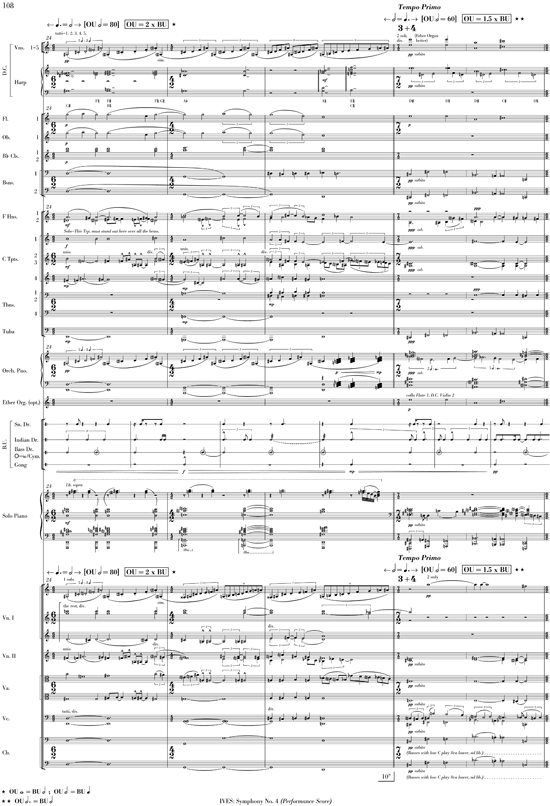
“Become Ocean” was wonderful. It is the perfect piece for just putting your head back, closing your eyes and letting the sounds happen around you. It conveyed what it must feel like to be in Alaska near the ocean and the forests. The piece had a refreshing and genuine feeling, and somewhat of the personality of American experimentalists Charles Ives and Henry Cowell. Morlot was the perfect conductor for this work. Clearly the piece has its roots in Debussy’s “La Mer” and the ocean passages of “Pelleas.” As a French conductor, Morlot was able to conduct all of those “Debussyiste” sea rumblings (bruits, in French). It would be a great piece to have on a CD at home.
And I hope “vf” didn’t place a bet on this prediction:
“It would be unfortunate if the SSO took the Luther Adams piece to NYC, it would be a disaster, hope they reconsider. In comparison to the works of composers like Arvo Part or Phillip Glass Become Ocean is minor league at best.”
My review of this week’s Seattle Symphony program, with guest conductor Stéphane Denève and pianist Paul Lewis, is now live on Bachtrack:
This week’s Seattle Symphony programme brings the third and last of the current season’s co-commissions — all of which are United States premières — with The Death of Oscar by James MacMillan. Music director Ludovic Morlot led the SSO in the previous two (Pascal Dusapin’s violin concerto Aufgang and Alexander Raskatov’s piano concerto Night Butterflies); for the MacMillan, Stéphane Denève, a champion of the composer since his tenure with the Royal Scottish National Orchestra, was on hand as guest conductor. Denève had also premièred The Death of Oscar in November in Stuttgart, where he currently helms the Stuttgart Radio Symphony Orchestra.
And the winner is … John Luther Adams. This is especially exciting news, since Ludovic Morlot and the Seattle Symphony will be taking Become Ocean, the large-scale work they recently commissioned from Mr. Adams, to Carnegie Hall next month as the centerpiece of their Spring for Music program.
The Pulitzer Prize citation states:
Awarded to “Become Ocean,” by John Luther Adams, premiered on June 20, 2013 by the Seattle Symphony, a haunting orchestral work that suggests a relentless tidal surge, evoking thoughts of melting polar ice and rising sea levels (Taiga Press/Theodore Front Musical Literature).
In his review of the world premiere last June for The New Yorker, Alex Ross memorably wrote:
Anyone who has gone down a stretch of road and then reversed course knows that a landscape does not look the same when viewed from opposite directions. One mystery of “Become Ocean” is how different the material often sounds during the second half of the [overall] palindrome [structure]. The section after the first climax is thick with minor chords, particularly in the brass. Somehow, as these chords loom again in the buildup to the final climax, they take on a heavier, more sorrowful air. There is a sense of unwinding, of subsiding, of dissolution… That a piece constructed with such fanatical rigor can convey such potent emotion is the greatest mystery of all.
In an interview from 2011 with Molly Sheridan of NewMusicBox, Mr. Adams explains that his music is “never about representation or reproduction” but about “authentic personal experience, about the primary experience of being there and paying attention.”
Music is not what I do; music is how I understand the world. I hope that if I find myself in a singular place: wilderness, urban, indoors, outdoors, real, imaginary—doesn’t matter—if I find myself in a real place, a true place, and I am paying attention, then maybe I hear something that becomes music. If that happens, then I hope the music floats away, takes on a life of its own, and becomes something else to you when you hear it. What I may have experienced, what I may have been reading, or looking at, or listening to, or thinking about when I was in that place working on the music really doesn’t matter. What matters is the music and how it touches you.