MEMETERIA by Thomas May

Music & the Arts

John Adams’s “Antony and Cleopatra” Arrives at the Met

Some thoughts on the Metropolitan Opera’s new production of Antony and Cleopatra by John Adams, published by Opera Now:

With its arrival on the stage of the Metropolitan Opera, Antony and Cleopatra reaches its most convincing form to date. John Adams’s newest opera has already had productions by co-commissioners San Francisco Opera (2022) and Barcelona’s Gran Teatre del Liceu (2023). As is customary with Adams, each outing has brought revisions — most conspicuously in trimming the score, a process he has continued for the Met version….

continue

Filed under: American opera, John Adams, Metropolitan Opera, Shakespeare

Antony & Cleopatra in Barcelona

The European premiere of John Adams’s most recent opera at the Gran Teatre del Liceu in Barcelona marked the debut of soprano Julia Bullock in the role specifically written for her. I reviewed this remarkable production for Classical Voice North America:

BARCELONA — Though this is a city known for its proud celebration of culture, it still came as a delightful surprise to be greeted at the Barcelona-El Prat Airport by posters announcing the Gran Teatre del Liceu production of John Adams’ Antony and Cleopatra.

continue

Filed under: American opera, John Adams, review, Shakespeare

John Adams’s Antony and Cleopatra

Antony and Cleopatra, the latest opera by John Adams, is receiving its world premiere this month at San Francisco Opera. Tomorrow is opening night and the start of the company’s centennial season.

Here’s a preview I wrote for Opera Now‘s September issue, in which the composer discusses his decision to set Shakespeare’s love tragedy.

[San Francisco Opera will livestream the performance of 18 September at 2pm PST. Tickets are $27.50.  
PLEASE PURCHASE YOUR LIVESTREAM TICKET AT LEAST 60 MINUTES PRIOR TO CURTAIN.]

Filed under: John Adams, San Francisco Opera, Shakespeare

Brett Dean’s Hamlet

Glyndebourne is now streaming on its YouTube channel Hamlet, the opera by composer Brett Dean and librettist Matthew Jocelyn, who uses only words from Shakespeare’s original text.

Commenting on the score, Erica Jeal writes: “Dean’s music is many-layered, full of long, clear vocal lines propelled by repeated rhythmic figures in the orchestra, and has moments of delicate beauty – string harmonics tiptoe around Barbara Hannigan’s Ophelia as we first see her mad – and the chorus whispers almost as much as it sings.”

Richard Bratby compares Jocelyn’s approach to the Shakespeare original with what Boito did for Verdi. Richard Morrison gave a powerful rave in The Times, with quite the lede: “Forget Cumberbatch. Forget even Gielgud. I haven’t seen a more physically vivid, emotionally affecting or psychologically astute portrayal of the Prince of Denmark than Allan Clayton gives in this sensational production.”

Here is Brett Dean’s commentary:

There is no definitive version of Shakespeare’s Hamlet. There were at least three versions printed within his lifetime or shortly thereafter, and endless variations, including the most commonly used 1st Folio, and an incalculable number of conflated versions.

Our Hamlet relies heavily on Shakespeare’s verse, if not necessarily on the standard chronology of scenes. The opera concentrates primarily on the domestic drama, exploring the depths of Hamlet’s quest for both understanding and revenge, from the death of his father through to his own demise.

This quest is relayed through the fragmentary nature of his relationships with those in his inner circle. It is this very fragmentation – as well as the lack of a definitive text upon which to base the opera – that allows us to explore the most effective and poetically resonant assemblage of story-lines.

Allan Clayton and Barbara Hannigan as Hamlet and Ophelia lead the vast, which includes Rod Gilfrey (Claudius), Sarah Connolly (Gertrude), Kim Begley (Polonius), David Butt Philip (Laertes), and John Tomlinson as the Ghost/Gravedigger. Vladimir Jurosky conducts. Catch it before it goes offline on Sunday 23 August.

Filed under: Glyndebourne Opera, new opera, Shakespeare

Othello in the Seraglio by Mehmet Ali Sanlıkol

Mehmet Ali Sanlıkol’s Othello in the Seraglio is now streamable on Amazon Prime in the US and the UK.

Mehmet Ali Sanlıkol, a distinguished professor at the New England Conservatory as well as an active musician with the Boston-based ensemble Dünya, has created what he terms a “coffeehouse opera” in which he reimagines Shakespeare’s tragic hero as a former African slave, a powerful but aging Ottoman Eunuch.

He explains: “In addition to a storyteller narrating in English, all characters sing in either Italian or Turkish in the musical idioms of 17th-century Italy and Turkey, accompanied by an on-stage ensemble of early European and Middle Eastern instruments with an unusual combination of percussion instruments.”

Othello in the Seraglio is performed by Dünya (which Sanlıkol also helms) and, since its premiere in Boson in February 2015, has already tallied an impressive record of 20 performances.

The critic Susan Miron compares the result to “opera pasticcio, a Baroque form in which composers like Handel and Vivaldi created substantial theatrical works from both existing and original music.” She explains that the audience is “meant to imagine being in a coffeehouse in Istanbul (then Constantinople) in the 17th century, where an all-male cosmopolitan audience smoked and sipped coffee, ‘a newly fashionable stimulant imported from Yemen.'”

Of his score, Sanlıkol remarks:

There are three distinct layers of music, which may stand alone, interact or merge; borrowed period music (European and Turkish); new music incorporating melodic and harmonic features of the borrowed material; and certain musical instruments and timbres—not period-specific—that highlight dramatic moments. I hoped to achieve a coherent musical statement by balancing these layers within the architecture of the opera. Duets between a Turk and a European even combine music of East and West: the Turkish makam (mode) is used for the Turk, and the European’s music is scored against it following the modal polyphonic practices of early European music.

Here’s an interview with the composer for WBUR Radio from 2015.

More information here.

Filed under: new opera, Shakespeare, Turkish music

Happy Midsummer Eve

Filed under: holiday, Mendelssohn, Shakespeare

A Very Palpable Hamlet from The Horse in Motion

Hamlet1

Kevin Lin as Hamlet; photo (c) Kyler Martin for The Horse in Motion

Hamlet is usually encountered as an object of reverent study or, in performance, a vessel of virtuosity. But in its recent staging at an old Seattle mansion, The Horse in Motion found a way to turn the play back into a visceral theatrical experience — one full of discovery for bardolaters and newcomers alike.

In lieu of a traditional theater, the action was set in (and around) the Stimson-Green Mansion, a meticulously preserved 1901 home with an English Tudor Revival exterior and a wonderfully eccentric, all-over-the-place interior, located on Seattle’s First Hill.

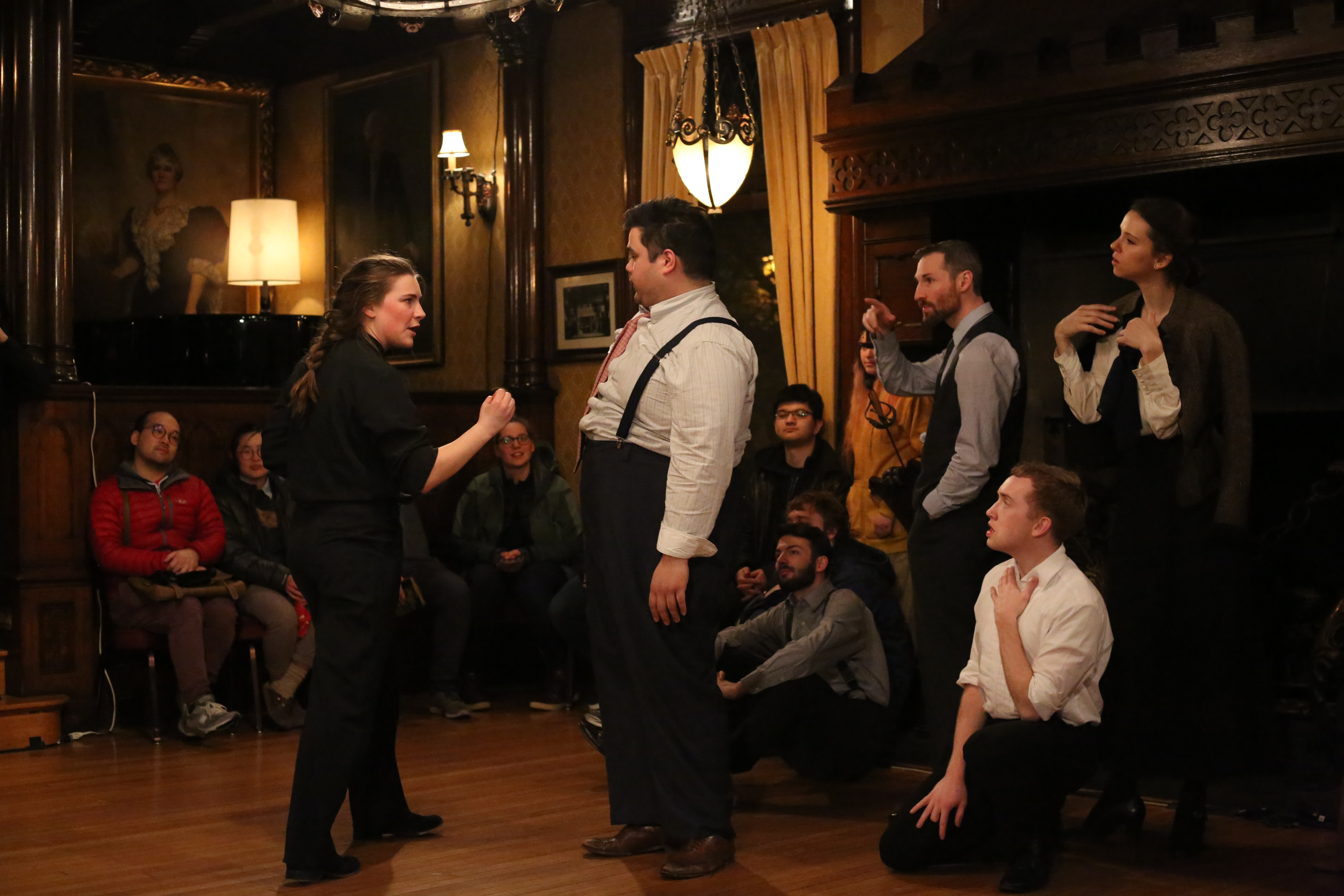
But the novelty of presenting Hamlet as a site-specific event turned out to be just one facet of this adventurous company’s innovative take.  Brooklyn-based director Julia Sears double cast Hamlet‘s major roles among a team of eleven actors, thus creating two simultaneous productions that unfolded in different rooms of the mansion.

The audience — limited to about 40 people for each performance — was correspondingly split in two and given a cast list designed as an invitation either to the wedding of Claudius and Gertrude or to the funeral of Hamlet Senior. In various key scenes, the two casts converged in the same space, so that, for example, we saw twin Hamlets confronting the same situation — as if these parallel universes had suddenly intersected.

At these face-offs, the double Hamlets and colleagues divvied up their lines or enacted them simultaneously. Sometimes the actors from the other cast were close enough to be audible, the slightly unsynchronized delivery intensifying a sense of  patterns being eerily repeated — like a familiar ghost story retold, with just enough of a sick twist to add a new frisson.

Hamlet2

Mario Orallo-Molinaro, Katherine Bicknell, and Kevin Lin; photo (c) Kyler Martin for The Horse in Motion

Virtuosity there was indeed, but a kind of virtuosity even more demanding than usual. For instance, Kevin Lin played Hamlet for the group to which I was assigned (the wedding party) during the second-to-last performance (28 April), homing in on the prince’s sense of desperate frustration to powerful effect. But in addition to this monumental assignment, he had to morph into Laertes for the “funeral” production and calibrate his interpretation to that of the other Hamlet, the commandingly eloquent Jocelyn Maher (who, in turn, was our Laertes).

Specific angles in the wedding cast — the intensity of the sexual bond between Claudius (Ben Phillips) and Gertrude (Tatiana Pavela) — made me curious about the parallel chemistry in the funeral cast’s scheming royal pair. Gender-blurring assignments also added a fascinating dimension to the experience. Along with the male-and-female Hamlets and Laerteses, both Hannah Ruwe and Nic Morden were double Ophelias (as well as Horatios). During the “mash-up” scenes, we saw both manifestations of Hamlet and Ophelia interacting with each other. Polonius, meanwhile, was played as a society matron by Laura Steele in both casts.

This may sound like a merely clever concept, but in performance it was riveting from start to finish, reinforcing what is at stake in Hamlet with unforgettable theatrical power. “Who’s there?” — the play’s first line, delivered urgently on a chilly, damp lawn next to the mansion — acquired fresh implications.
Hamlet3

l to r: Jocelyn Maher (Hamlet), Mario Orallo-Molinaro (Guildenstern), Ben Phillips (Francisco), Ian Bond (Claudius), Ophelia (Nic Morden), and Hannah Ruwe (Horatio); photo (c) Kyler Martin for The Horse in Motion

Jenn Oaster’s early-20th-century smart-set costumes, enhanced by Alex Potter’s period music sound design, evoked associations from the era when the Stimson-Green Mansion was built, of ghosts from its particular past. On one level, this suggested Hamlet’s tragedy playing out in a particular context of privilege, his madness presenting as fragmentation.

But Sears’s vision probed well beyond the psychological realism that has become the default setting of too much contemporary theater. I especially relished the surreal effects of the doubling, as well as the ironic humor of defamiliarizing such iconic scenes by means of another kind of familiarity — i.e., an imagined upper class family life in this setting. (Speaking of humor. Ian Bond’s cliché-free, inventive performance as the Gravedigger in the final act was itself worth the price of admission.)

Sears and her design team made imaginative use of the variety of spaces available on the premises. Instead of a fourth wall to break, the setting itself became a protagonist, offering new elements to explore with each gently orchestrated redirection of the audience to a different room: a raging fire in the hearth, a trip up creaking stairs for the genuinely intimate bedchamber scene, a spacious ballroom where the overwrought, speedy finale of death plays out after so much anticipation. (One quibble: the amplification device for the cloaked Hamlet’s Ghost — curiously, not credited in the program listing — distorted too many words in that crucial scene.)

I asked a friend who was also part of the wedding party for his impressions of this nontraditional performance setting. He told me that the experience of  “moving along with the cast, and in such close quarters, brought us closer to the play than we ordinarily might have been.”

I’ve never actually felt nervous before during Hamlet and Laertes’ final fencing match. This time, I was viscerally aware of the nuances of the fight choreography as the rapiers clashed inches away. The only drawback was that the logistics limited the audience size, so that local theater lovers who didn’t plan ahead missed out on this remarkable experience.

As the dead bodies, doubles included, lay strewn about, not even Fortinbras (the excellent Mario Orallo-Molinaro) could set things right. Sears’s final touch removed the precious sliver of optimism the Norwegian crown prince represents, making him another victim of the sad state of this world.

–Review (c) 2018 Thomas May. All rights reserved.

Filed under: Horse in Motion, review, Shakespeare

Shakespeare the Foreseer

jack-cade

Seattle Shakespeare Company is currently presenting a two-installment adaptation of the Henry VI trilogy, which they’ve titled Bring Down the House.

Directed by Rosa Joshi — whom I interviewed three years ago about her brilliant Richard II (also for Seattle Shakes) — it features an all-female cast and is deftly paced and riveting throughout.

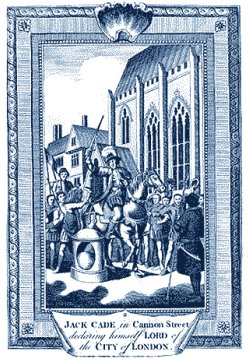
Along with Mari Nelson’s fiercely magnetic York and Sarah Harlett’s wickedly charismatic turn as a young, already restlessly scheming Richard III, I especially admired Peggy Gannon’s versatility in playing both Edward IV and the rabble-rouser Jack Cade, evoking a certain presidential blowhard in her portrayal of the latter.

Not that it requires any untoward exaggeration. Shakespeare seems to have anticipated the demagogic power that now so tragically holds sway:

Be it known unto thee by these                                                                                                 presence, even the presence of Lord Mortimer, that I
am the besom that must sweep the court clean of such
filth as thou art. Thou hast most traitorously
corrupted the youth of the realm in erecting a
grammar school; and whereas, before, our forefathers
had no other books but the score and the tally, thou
hast caused printing to be used, and, contrary to
the king, his crown and dignity, thou hast built a
paper-mill. It will be proved to thy face that thou
hast men about thee that usually talk of a noun and
a verb, and such abominable words as no Christian
ear can endure to hear. Thou hast appointed
justices of peace, to call poor men before them
about matters they were not able to answer.
Moreover, thou hast put them in prison; and because
they could not read, thou hast hanged them; when,
indeed, only for that cause they have been most
worthy to live. Thou dost ride in a foot-cloth, dost thou not?

History of Henry VI, Part II, Act IV, scene vii

Filed under: Shakespeare, Uncategorized

Richard III, Rock Star

I was very fortunate finally to have a chance to catch up with Thomas Ostermeier’s acclaimed production of Richard III the Schaubühne — not in Berlin, but at the Edinburgh International Festival.

Much has been made of Ostermeier’s highly original direction as a saturated, intensified portrait — a Machiavellian mirror — of the title anti-hero. That of course has been facilitated by the exciting, controversial translation/adaptation/condensation of the German text prepared by company dramaturg Marius von Mayenburg.

One of the most brilliantly effective choices — apparently a spontaneous decision arrived at during the course of rehearsal, according to Ostermeier — was to streamline the litany of climactic battles into a sequence of Richard fighting with himself, up to his inglorious demise.

This portrait approach was also made possible only through the weird, cultish charisma and electrifying stage presence of Lars Eidinger as a maniac-depressively embittered Richard. Not an “evil” character, according to Ostermeier, so much as one who makes the workings of power and its aggrandizement theatrically  transparent, naked.

“The play is not about evil as such,” says Ostermeier, “but about participation in power, the exclusion of an outsider and the manipulation of others’ antipathies. In this respect it does have significant political implications.” 

Eidinger’s matchless account requires intense physical acting, stamina, singing, and clownish, stand-up improv with the audience — the humor was particularly well-pointed, not a cop out (with a delightful exchange accusing a prematurely exiting patron of being rude when he claimed he was heading “to the toilet”).

But that’s not to shortchange the contributions of the rest of a stupendous ensemble cast. Percussionist Nils Ostendorf  contributed an excellent, live-wire score, which interpolated some fascinating touches (like an intensely repeated loop that segued in and out of Laurie Anderson’s “O Superman”).


Filed under: directors, Schaubühne, Shakespeare

Shakespeare Homage from Seattle Symphony

Mark PadmorePhoto: Marco Borggreve

Mark Padmore Photo: Marco Borggreve

The countdown to Shakespeare400 continues. Here’s my look ahead at this week’s Shakespeare-themed program from Seattle Symphony and Ludovic Morlot, with guest artist Mark Padmore:

If music be the food of love, centuries of composers have failed to surfeit the appetite of our collective passion for Shakespeare.

continue reading


Filed under: Seattle Symphony, Seattle Times, Shakespeare

Archive

Enter your email address to follow this blog and receive notifications of new posts by email.