MEMETERIA by Thomas May

Music & the Arts

Shakespeare at 450

468px-Shakespeare

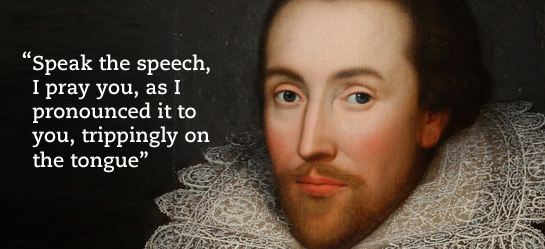
“Time … thou ceaseless lackey to eternity.” Today, by convention, the world celebrates Shakespeare’s birthday.

Here are some ways to pay tribute to the Bard:

–Take a look at a list of familiar phrases that may have been coined by Shakespeare. A sample:

A dish fit for the gods
A plague on both your houses
fair play
good riddance
salad days
love is blind
set your teeth on edge
up in arms

–Take a Shakespeare quiz

–As the Globe Theatre launches its ambitious Globe to Globe Hamlet initiative, enjoy this portfolio of 45 Hamlets selected by Michael Billington. Some of his choices: John Gielgud, Laurence Olivier, Richard O’Toole, Ralph Fiennes, Sarah Bernhardt.

–Listen to the Sonnets:

Filed under: Shakespeare

Stirring Up a Storm

Tempest

Quite happy to see Tom Adès take the Best Opera Grammy for The Tempest. I had the opportunity to write this essay for the Met when the production staged by Robert Lepage first appeared there:

When The Tempest opened at London’s Royal Opera House in February 2004, the anticipation couldn’t have been more intense. Composer Thomas Adès—only 32 at the time—had already been thrust into the international spotlight in the previous decade and found himself having to live up to recurrent comparisons with his similarly precocious compatriot and predecessor Benjamin Britten. Despite all this pressure, the overwhelming, almost unanimous response to Adès’s second opera seemed to confirm the parallels. “Only time will tell whether the first night of The Tempest in 2004 was a moment to set alongside the first night of Peter Grimes in 1945 in the history of British music,” wrote The Guardian the day after the occasion. “But it felt that way in the theatre.”

Time has proved that the initial verdicts weren’t idle hyperbole. The Tempest belongs to that rare group of contemporary operas whose critical acclaim is matched by the ultimate practical test of stage-worthiness. In fact, The Tempest—still less than a decade old—can already boast an astonishing track record of five different productions: the original Covent Garden staging (which was revived in 2007 and recorded for EMI’s award-winning CD), the American premiere at Santa Fe Opera in 2006, two separate productions in Germany, and now the opera’s premiere at the Met, which promises to be among the highlights of the new season.

Robert Lepage’s staging is a co-production of the Met, Opéra de Québec, and the Vienna Staatsoper and will also feature Adès (pronounced AH-diss) making his company debut as conductor. Reprising his performance as Prospero is baritone Simon Keenlyside, whose combined vocal and physical presence were widely admired as ideally suited to the role he created at the Royal Opera House.

The once-obligatory references to Britten became a kind of shorthand for English critics eager to spell out the high expectations pinned on Adès. In fact, he is an artist whose voice is unmistakably and audaciously original. Many gifted young composers demonstrate an eclectic, anxiety-free facility when it comes to claiming elements from the musical past for their own creative tool kit, but what was especially striking about Adès, while he was still just in his twenties, was the uncanny confidence with which he forged a rich, complex, allusive language with a coherence all its own.

Even more, before the millennium Adès had already found exciting ways to develop his flair for formal, abstract structures, vivid orchestration, and spirited detail while also demonstrating a compelling theatrical instinct. His range was apparent, whether in writing for a large Mahlerian orchestra (the symphonic Asyla, commissioned for the Berlin Philharmonic, for example) or in his first work for the stage, the chamber opera Powder Her Face (1995).

The latter, which used the scandalous story of an aristocrat’s fall from grace to ironically turn the mirror back on a tabloid-saturated culture, also revealed Adès’s extraordinary feel for portraying characters in music. With the far vaster canvas of The Tempest, he progressed to a mature mastery of his art, taming the often volatile energy found in his youthful scores into a sustained, emotionally gripping arc.

Shakespeare’s beloved final romance, remarks Adès, “is famously full of references to music, while the intangibility of some of its characters has always inspired music.” Purcell, Tchaikovsky, Sibelius, and Berio are just a few of the many composers who have fallen sway to its spell; even Mozart, near the end of his life, may have contemplated turning The Tempest into an opera. Yet instead of finding himself daunted by the weight of associations bound up with the source material—above all by the sheer power and poetry of Shakespeare’s language—Adès discovered a fresh approach to “translating” the Bard’s vision into opera.

The composer collaborated closely with librettist Meredith Oakes, an Australian-born playwright and poet whose talent for evoking traditional poetic patterns through “a very specific, archaistic style” felt particularly appropriate. Oakes distilled the original verse into pithy, condensed couplets that echo the play’s most famous passages in eminently singable phrases—instead of competing with them. Many of the couplets take the form of half-rhymes or slant-rhymes that acquire an extra charge by being ever so slightly off. The result, Adès says, “is a translation of Shakespeare into modern English, to be all the more faithful and concentrate the drama.”

Yet the three-act opera remains remarkably true to the arc of Shakespeare’s story and the spirit of his characters, while at the same time opening up the creative space necessary for Adès to add the unique perspective of his musical imagination. “I want it to be The Tempest. I want it to be Shakespeare and to bring that vision into the opera house as faithfully as possible,” the composer points out. “We actually started further away from the play than we ended up but found ourselves going back to Shakespeare’s structure much more.” But to achieve such fidelity—as opposed to a pale imitation—Adès and Oakes determined early on that they needed to swerve away from dogged, literal re-creation.

The most striking shift involves the opera’s conception of Prospero, the former Duke of Milan who, in the back story, has been usurped by his brother Antonio and shipwrecked on an island with his young daughter, Miranda. Prospero’s desire for vengeance is more pointed in the opera, as is his related assertion of control over the island’s indigenous creatures—Ariel and Caliban—and over Miranda’s emerging emotional autonomy as she falls in love with Ferdinand, his enemy’s son.

The libretto provided Adès with clearer “musical emotions” that motivate the dynamics of enslavement and liberation in the story as well as the transforming power of love and compassion. The real turning point, observes the composer, comes when Ariel tells Prospero that the suffering he has caused his enemies to endure would soften Ariel’s own heart if he were human. “And it’s the moment when Prospero realizes he’s gone too far and has to stop.”

Lepage, familiar to Met audiences for his stagings of Berlioz’s The Damnation of Faust and Wagner’s Ring cycle, praises the opera for capturing the “magic” of what is often considered the playwright’s final artistic testament. Not surprisingly for this wizard of theatrical illusion, the figure of Prospero has long fascinated Lepage, who has directed numerous productions of Shakespeare’s play. Each time he returns to it, he uncovers new insights. For his own concept of the opera, Lepage has expanded its aura of magic into a metaphor for artistic performance itself, envisioning Prospero as an 18th-century impresario of La Scala, the opera house in Milan, which he has recreated on the island of his banishment as a reminder of home.

“In those days, La Scala was a very magical place to set operas because it had all of the new state-of-the-art machinery,” Lepage explains. “The beach where everybody is marooned is actually a stage that’s been planted there and constructed by Prospero.” Lepage adds that each of the three acts presents a different perspective—from the stage itself, from the auditorium, and what goes on behind and off stage—to encompass this “opera-within-an-opera house.”

Members of his creative team will be making their Met debuts: Jasmine Catudal designed the sets, and the costumes are by Kym Barrett (known for her collaborations with Baz Luhrmann and her work on The Matrix films). The overall look will marry a sense of the island’s “native, aboriginal culture” with the Italian Baroque sensibility imported by the European interlopers.

Lepage’s mastery of both traditional stagecraft and its most up-to-date technological forms provides an ideal complement to the composer’s unique fusion of a classic play with a contemporary vision of opera. In his musical characterizations of the five leads, for example, Adès developed wonderfully effective alternatives to the vocal type casting that might have tempted a less-imaginative composer. While Ariel, a male character played by a soprano, sings in a stratospheric tessitura (frequently perching on Ds, Es, and Fs above high C, even reaching to G), “this isn’t a way of expressing high emotion and shouldn’t feel like the top of the singer’s range. That’s where she lives.”

Ariel is an elemental force of nature who—in another alteration of the original source—sings the final airborne phrase and becomes the wind again. Her island counterpart, the “monster” Caliban, is depicted not as a “lumpen, earthy brute” with a bass voice but is a lyrical tenor. “He’s often described in the play as being like an eel or a fish, and I suddenly thought he could be more like one of those exotic, wonderful voices from the East, with a weird elegance. And of course he is an aristocrat, not only in his own mind,” says Adès, who gives Caliban one of the most radiantly beautiful passages in the score: his aria reassuring the shipwrecked newcomers not to fear the island’s “noises.”

As for Prospero, the composer created a fully dimensional baritone role (with shades of Verdi’s and Wagner’s authoritarian father figures) who nevertheless defies the stereotype of the wise old sage. Adès was especially inspired by crafting the role for Keenlyside. “Simon’s a terrifically physical performer who projects youth. In a way, it’s that characterization, as much as the extraordinary voice, that was on my mind. I don’t think of Prospero as an old man. This is the only play of Shakespeare which observes the classical unities of happening in one place, in one day. When Prospero meditates on the evanescence of life, my feeling is actually it’s not that he does that every day and has been doing it for years and he’s an old bore. It’s that he’s just realizing it at that exact moment. That’s the first time he’s thought this.”

While Adès writes for the voice with great character, his score is also distinguished by its symphonic intricacy and architecture. This quality provides the opera with a richly satisfying cohesion and unity. Adès achieves this not through conventional leitmotif technique but by expertly manipulating his uniquely evocative harmonic language. He explains: “The music has its own internal logic of relationships; it doesn’t just do what it wants to do because the characters suddenly decide to go somewhere. It’s a tissue that’s woven in, so that everything is related in the music, and all the elements create a view of the world that’s whole, a sphere.”

(c) 2012 Thomas May – All rights reserved.

Filed under: Metropolitan Opera, new music, opera, Shakespeare

Mad for Shakespeare

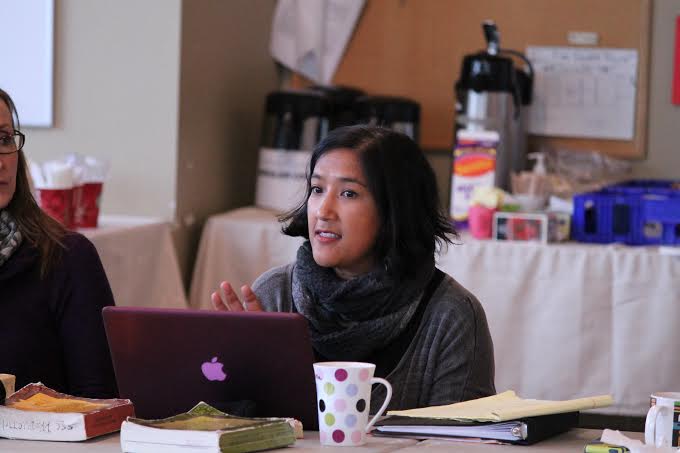
Rosa Joshi

Rosa Joshi

This is a fuller version of my profile of the Seattle-based director Rosa Joshi for Crosscut.com. Joshi and her team at Seattle Shakespeare Company have staged Richard II, a play that’s been in the spotlight thanks to the BBC’s Hollow Crown series but that — at least in the U.S. — remains a relative rarity.

“I don’t choose easy plays!” admits Rosa Joshi. She’s explaining her selection of Richard II as the vehicle for her directorial debut with Seattle Shakespeare Company.

The match between Joshi and Seattle Shakes is long overdue, given what she has brought to the Bard’s twist on “sad stories of the death of kings.” For my money, her Richard II ranks among the finest of the company’s recent productions, achieving a delicate balance of clarity and forceful poetic imagination.

“Shakespeare is my greatest love to direct,” says Joshi, who has been on the fine arts faculty at Seattle University since 2000.

“There are no small choices in Shakespeare. He makes you go to the extremities of emotion and experience, from the heights of joy to the depths of despair. That to me is infinitely challenging.”

Extreme situations frame Richard II, which traces the downfall of its titular king. Ill-suited to the throne, the impolitic Richard is forced to hand the crown over to his cousin-made-rival, Henry Bolingbroke, before being imprisoned and assassinated. His dramatic reversal of fortune has its counterpart in Henry’s equally dramatic ascent.

Richard (George Mount) surrenders his crown to Henry Bolingbroke (David Foubert); photo by John Ulman

Richard (George Mount) surrenders his crown to Henry Bolingbroke (David Foubert); photo by John Ulman

Over the past decade, Joshi has made a splash in Seattle with her all-women versions of Shakespeare. In 2006 she co-founded upstart crow, a local collective devoted to producing classic theater with exclusively female casts. Their inaugural production took on the Bard’s King John; their second effort followed in 2012 with the ultra-violent Titus Andronicus.

A central aim of upstart crow has been “to create opportunities for women to participate in the Western classical canon for which they share a passion – in a way they don’t get to do in more conventional arenas.”

“Any time you have one gender onstage it makes you look at gender differently,” Joshi says. “I’m not so much prescriptive about what it means, but think of it as an experiment in how the audience relates to the work. For some people, the gender simply goes away, and some people really notice it. There isn’t just one experience I’m trying to make the audience have.”

Joshi is well-aware of the seeming paradox that with the conventionally cast Richard II at Seattle Shakes, she’s chosen a play featuring a predominantly male cast (with just two actresses). In fact, she points out, upstart crow has also gravitated toward heavily male plays.

“With Richard, there is a way of looking at him as a character who has a certain female energy in a male world,” Joshi explains. As he loses the confidence of his subjects, Richard becomes increasingly marginalized. The actual women in the play, meanwhile, “are the only ones who hold on to family while the others are torn by loyalty to the state.”
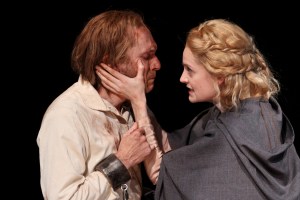
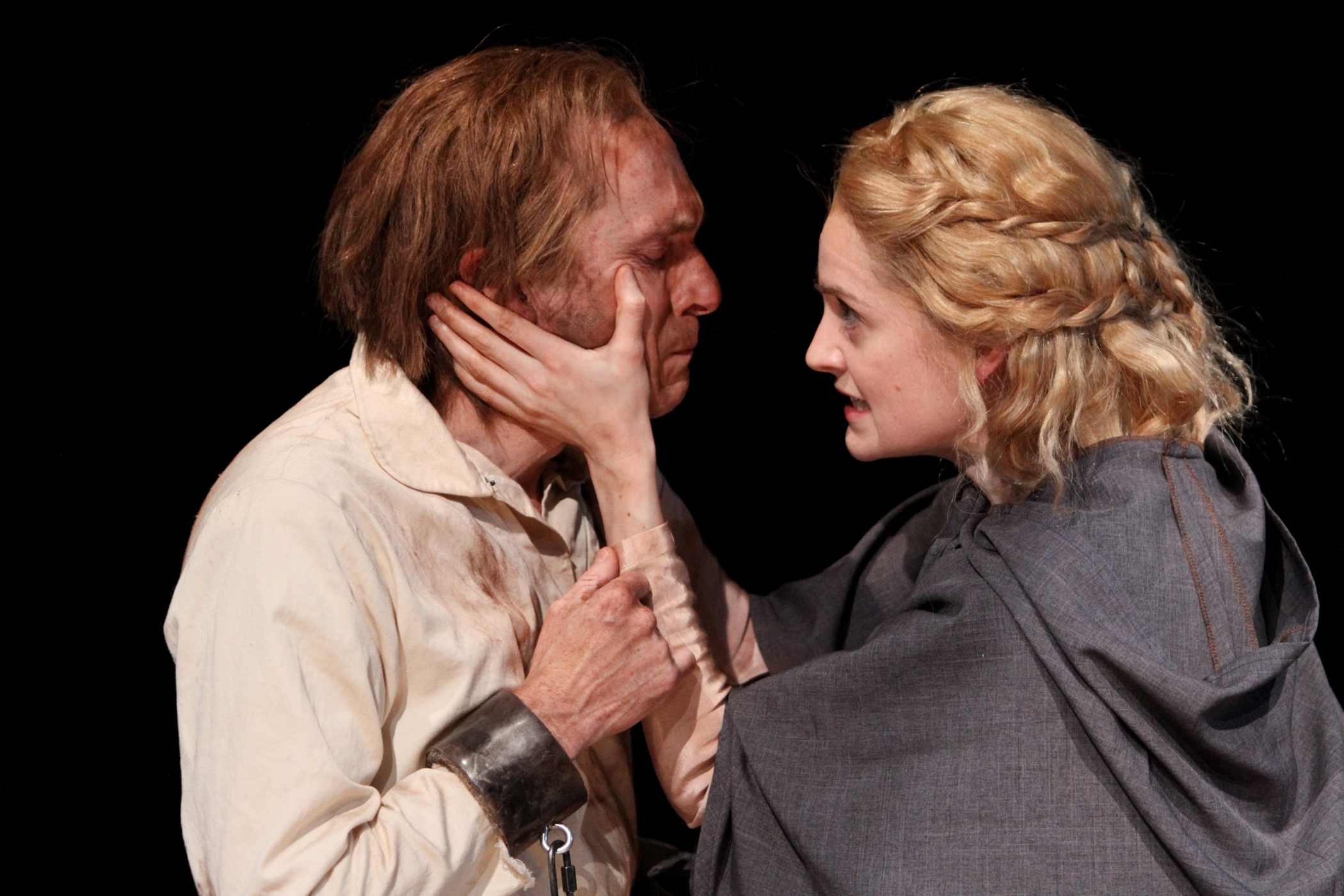
Richard (Geroge Mount) and his Queen (Brenda Joyner); photo by John Ulman

Richard (George Mount) and his Queen (Brenda Joyner); photo by John Ulman

In a similar vein, Joshi expresses puzzlement over another question she says is inevitably posed: “Why do you, as a woman of color, insist on doing this work by Dead White Males? Whenever I’m asked that, I point out that these plays are just as much my heritage, too.”

Joshi, who grew up in England and Kuwait, initially thought she was destined to become a doctor like her father. Still, she decided to keep her options open by studying in the United States and pursuing her love of theater on the side as a double major.

The turning point that made her decide to choose theater over medicine came when she was given the chance to direct during a semester abroad in London. Naturally, it was a thorny piece: Harold Pinter’s one-act “The Lover.”

After internships at the Williamstown Theatre Festival and Juilliard in New York, Joshi headed to Yale Drama School (during the Stanley Wojewodski era). Her classmates included Paul Giamatti, Liev Schreiber and the indie director Tom McCarthy. “I learned so much just from being around my peers,” she recalls.

Joshi relocated to Seattle during the 1990s, when the fringe theater scene was exploding. Legendary local director John Kazanjian of New City Theater, she says, became a key mentor. Kazanjian gave her the opportunity to produce her own shows — including her Seattle debut, a “Twelfth Night” staged on the steps of Capitol Hill’s Richard Hugo House.

“I think Seattle is a great place where emerging artists can sink their teeth into work. But it’s harder to sustain mid- and late-career artists.” Still, Joshi sees a positive development in the resurgence of adventurous theater in recent years from groups like New Century Theatre, azeotrope, Washington Ensemble Theatre, and Strawberry Workshop.

“A lot of these are companies started by artists who realize they need to self-produce: artists who have a shared mission and the expertise to produce their work, which is empowering. One of the things we try to promote here at SU to my students is the idea that they need to be nimble and able to do more than one thing.”

Joshi herself had taken that advice to heart during her early years in Seattle by self-producing. A stint as artistic director at the Northwest Asian American Theater got her involved in collaborations between Asian-American and Asian artists.

Since taking up her position at Seattle University, Joshi has guest directed at several Seattle theaters. She seems especially at home with Seattle Shakespeare, where she coaxes a poetically nuanced performance of the doomed Richard from George Mount, the company’s artistic director.
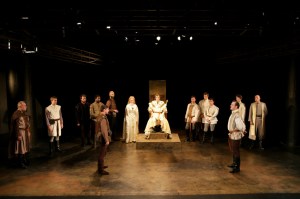
Cast of Richard II; photo by John Ullman

Cast of Richard II; photo by John Ulman

The complexity of Richard II, along with its confusing back story, poses daunting challenges for any director and cast. But Joshi and her actors bring a red-hot focus to what’s at stake for the two sides, and the story plays out with riveting dramatic rhythm.

It is Shakespeare’s ability to convey all of this through elaborately poetic language that particularly enthralls Joshi. Richard II is his only play written entirely in verse (even a gardener and his assistant carry on in lofty iambic pentameter).

“He’s able to use language to convey the inner workings of character and to externalize the souls and emotions of these characters,” Joshi explains. “At time we might feel the language is excessive: and that’s exactly the language we need in order to understand what’s going on with Richard.”

“I know lots of directors work from a very visual world, but I consider myself very text-driven.” Which hardly means Joshi’s work can’t be strongly visual — her production’s most indelible image reverses the moveable throne that dominates the minimalist set so that, in the prison scene, it becomes a looming gravestone — but she emphasizes that she wants such visual ideas to “emerge from the text. And what richer playground is there than Shakespeare, where the text delivers and encapsulates so much.”

Joshi is also intrigued by the ways in which Shakespeare blends the genres of history and tragedy in Richard II. And though it’s one of his less frequently staged plays, Richard II strikes a relevant chord because of the very modern crisis Richard faces, even within the play’s medieval setting.

Joshi points to Richard’s most self-reflective moments in the pivotal Pomfret Castle prison scene. “Take his lines: ‘but whate’er I be,/Nor I nor any man that but man is/With nothing shall be pleased, till he be eased/With being nothing.’ The density of meaning in that has always struck me as something that could be out of Samuel Beckett.”

“The existential journey that Richard goes through is something I think contemporary audiences can relate to in terms of how we define ourselves in the world. Richard has to grapple with who he is when he’s no longer king.”

“How does he cope with the absence of that identity? How does Henry edit his identity in order to become a leader? And how much are both shaped by who they are versus the people they have around them? Do we get the leaders we deserve?”

Richard in Pomfret prison; photo by John Ulman

Richard in Pomfret prison; photo by John Ulman

In fact, Richard II appears to have become a hot theatrical topic of late. Recent broadcasts by the BBC of The Hollow Crown series (the cycle of four history plays that begins with Richard II) has brought the melancholy Richard into the spotlight – as has a much-touted Royal Shakespeare Company production starring David Tennant as the deposed king, which was widely disseminated via HD cinemacast.

For Joshi, it’s no surprise that Richard II is suddenly brimming with contemporary relevance. “The history plays seem to come up more and more in part because we live in a politically cynical age. These are plays that focus on what people do for power and ambition. The first week of rehearsals, one of the news stories was of how Kim Jong-un had his uncle executed to consolidate his power.”

Yet in this case, Joshi has seen no need to “modernize” the setting in order to emphasize its relevance. “I’m always interested in the artificiality of theater. What does theater do that film doesn’t do?”

“We don’t compete with the kind of verisimilitude that you get in film because theater demands that the audience’s imagination be engaged to complete the experience. It is this pact we go into – audience and actors and designers – to create this world together through this act of imagination.”

(c) 2014 Thomas May. All rights reserved.

Filed under: directors, Shakespeare

Shakespeare’s Ruthless Dream

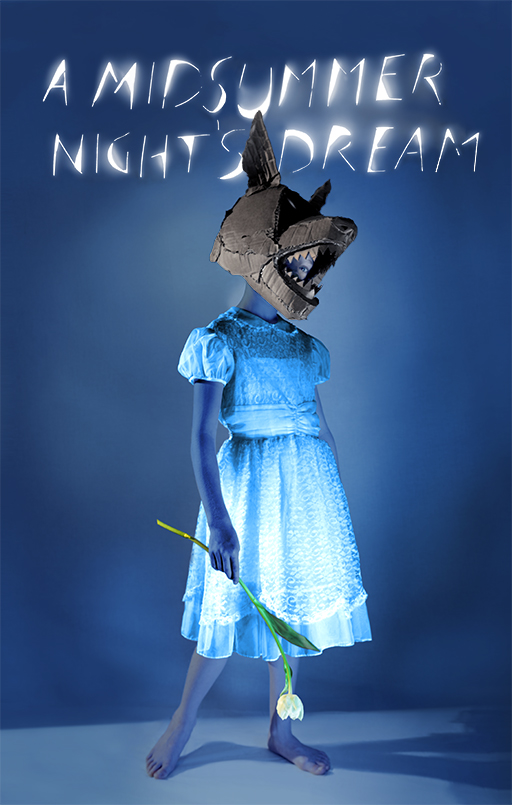
Midsummer

Reviewing Julie Taymor’s highly touted new production of A Midsummer Night’s Dream, Kate Havard floats some
provocative ideas about “the more unpleasant aspects at work” in a play that’s all too often taken for pretty fantasy and screwball identity mix-up.

Dream, writes Havard, “is actually a ruthless play: all four couplings marred with traces of compulsion, faithlessness, pettiness, and cruelty.”

According to Havard — a recent graduate of St. John’s College in Annapolis and a Tikvah fellow — Taymor emphasizes the forest “as a staging ground for the parts of the soul where reason rules not.”

The forest in “Midsummer” is not only the backdrop for chaos, it is full of spirits who egg on the passions, which helps to make us more aware of what must be tamed within us.

It is false to say that what the forest reveals in these Athenians is the true human nature, because reason is what makes us humans. But the unreasoning parts also tell us a lot.

To put it modernly, the forest is to Shakespeare what dreams are to Freud.

Havard draws out the implications of that analogy:

The symbolism isn’t subtle. Taymor’s taking the Frank Underwood approach to psychology: Everything is about sex except for sex, which is about power.

What Freud told us about our desires, the Greeks already knew: Dionysus and Aphrodite can only be contained and educated, not eradicated. They will always be there, just outside the city gates. And if you try and ignore them, it is at your peril.

In a recent interview in Smithsonian Magazine, Taymor describes what she thinks happens when Shakespeare shows these emotions getting “unleashed”:

I think that Shakespeare’s saying that’s how easily we can switch our passions. A little thing can do it. Whether it’s love juice, a psychedelic drug or somebody swishes by in a different way—that love is extremely fickle. I think a lot of this is about all different levels of love, just like “Titus [Andronicus]” is about every single aspect of violence.”

Filed under: Shakespeare

Shakespeare at Work


Just how “tailor-made” were Shakespeare’s plays for the particular actors in his company? In the TLS, Charles Nicholl reviews Shakespeare in Company by Bart Van Es. This new book “seeks to show that Shakespeare’s achievement as a writer was in crucial ways communal; that the contributions of his playhouse colleagues, indeed his whole immersion in the business and practice of the theatre, are woven into the fabric of his plays; and that in a broadly chronological framework one can see his literary skills evolving in response to certain changes in his working conditions.”

Van Es offers a corrective to the later Romantic image of the lone “lofty genius” — with interesting comparisons to be made along the way, incidentally, with the give-and-take of composers like Handel who wrote for particular performers and within a demanding commercial framework. According to Nicholl, Ven Es gives us a down-to-earth portrait of “a poet at work in the daily professional context of a busy and successful theatre company.”

Of special fascination is the influence of writing for the tragedian Richard Burbage and the comedian Robert Armin. The arrival of the latter to replace the previous “star comic” Will Kemp led to “a stylistic watershed in Shakespearean comedy.” Nicholl explains:

Kemp was an old-style “jigs and bawdry” man, whose typical Shakespearean parts were lovable bozos like Bottom and Dogberry; he may also have been the world’s first Falstaff. By contrast, the parts written for Armin during the first few years of the new century are the more complex, mercurial “fools”, whose wit is satirical and edgy yet tinged also with melancholy. The first role specially tailored for Armin was Touchstone in “As You Like It”….

Further Armin roles, in probable order of composition, are Feste in “Twelfth Night,” Thersites in “Troilus and Cressida,” Lavatch in “All’s Well” and the Fool in “Lear.” The last of these is a radical relocation of the truth-telling jester to the terrain of tragedy. Armin’s last identifiable Shakespearean role is Autolycus in “The Winter’s Tale.”

Filed under: book recs, Shakespeare

What Fire in the Ears: Much Ado c. 1953

Jennifer Lee Taylor as Beatrice and Matt Shimkus as Benedick; photo by John Ulman

Jennifer Lee Taylor as Beatrice and Matt Shimkus as Benedick; photo by John Ulman

Linguists like David Crystal are fond of pointing out that shifts in pronunciation over the centuries cause modern audiences to miss out on some of the key puns and subtexts in Shakespeare’s plays. The claim that “nothing” and “noting” were all but indistinguishable in Elizabethan English is a case in point. I don’t know who first observed that “Much Ado About Noting” might be a far apter title for Shakespeare’s perennially popular comedy of misalignments realigned, but it’s become a widespread idea by now.

Certainly the play’s momentum is driven by acts of noting, of hearing or seeing things that cause perceptions to be changed dramatically. Most of these eavesdroppings are intentionally stage-managed by other characters – for benevolent if somewhat mischievous purposes (Benedick and Beatrice being led to believe they are the object of each other’s affection) and for nefarious ones (the framing of Hero as unfaithful).

What I find most striking about Seattle Shakespeare’s current production of Much Ado About Nothing is how gullible the main characters prove to be. A good portion of the comedy in the Beatrice-Benedick stand-off arises from the exaggerated language both use to express their mutual disdain – with Beatrice scoring more stinging zingers in Jennifer Lee Taylor’s arch, glib-as-a-movie-starlet delivery. Yet it doesn’t take much trickery to soften them up and make the pair willing to thrust their necks “into a yoke” same as all the rest.

Justin Huertas as Balthasar, Jim Gall as Don Pedro, Jay Myers as Claudio, and Peter A. Jacobs as Leonato; photo by John Ulman.

Justin Huertas as Balthasar, Jim Gall as Don Pedro, Jay Myers as Claudio, and Peter A. Jacobs as Leonato; photo by John Ulman

More tellingly still, Claudio reverses his Prince Charming poses even more readily than he’d pressed his lightning-fast courtship of Hero. She, in turn, is just as content to have the hot-head back after he’s been compelled to “note” her fake funeral.

All this manipulation and puppet-like flexibility can make Much Ado seem pretty arbitrary. The fundamental problem Shakespeare’s comedy poses for the performers is that it nestles a potential tragedy at its core. The notions of love that the two main couples hold on to, imagining they represent the real thing, must be put to the test; they have to enter crisis mode before any genuine change can take place.

Merely “noting” appearances or trying to preempt disappointment is a passive stance, and it can’t substitute for experience. It’s one thing for this testing to take the form of obstacles – standard procedure in comedy – but to be presented as the nightmare which erupts at the play’s center is deeply unsettling.

Hero (Brenda Joyner) rejected; photo by John Ulman

Hero (Brenda Joyner) rejected; photo by John Ulman

Or…maybe that’s just making much ado about nothing after all. Maybe the play really should be enjoyed for its witty slant on romance and friendship triumphant, served up with abundant linguistic virtuosity (and a virtuosic reversal of all that when it comes to the malapropic snares in which Dogberry gets entangled). As directed by George Mount, artistic director of Seattle Shakes, this production doesn’t show much interest in digging beyond that, but it still adds up to a pleasurable performance for the most part.

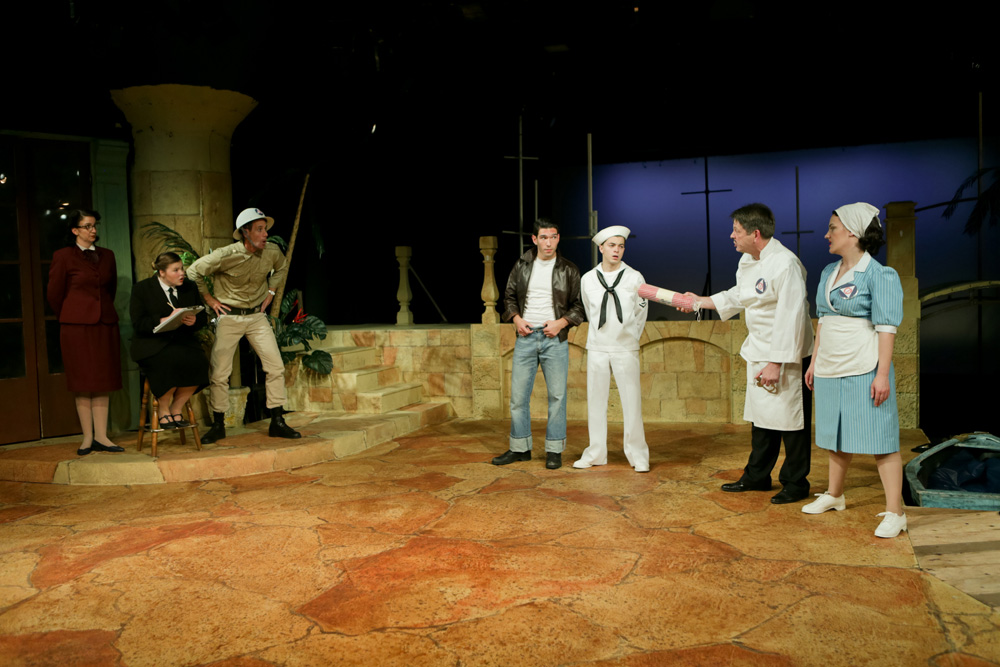
The production’s design elements are a particular attraction. They effectively translate the cheerful Mediterranean clime of Shakespeare’s Renaissance Messina to a tony seaside resort in 1953, with sailors coming home from the (presumably Korean) war, now ready to relax and get back to the pleasures of life. Craig B. Wollam’s elegantly evocative set, Roberta Russell’s sun-kissed lighting scheme, and the delightful period details of Doris Black’s costumes work together to reinforce this background.

Seattle Shakes is also embarking here on the first of two collaborations this season with Seattle Repertory Jazz Orchestra: Michael Brockman composed music for the songs Shakespeare embeds in the play. The jazz ensemble pre-recorded this incidental score. Justin Huertas (Balthasar) does double duty as the resort’s Sinatra-smooth entertainer and also sings a lovely threnody at the tomb of Hero before her “resurrection.”

Dogberry (David Quicksall) and crew; photo by  John Ulman

Dogberry (David Quicksall) and crew; photo by John Ulman

These elements so successfully evoke a concrete sense of place that it seems to encourage some of the cast to adopt a looser, more-relaxed style vis-a-vis Shakespeare’s language – as if to match the “realism” of the setting. Taylor’s Beatrice and Matt Shimkus as Benedick stand out not only for their engaging interactions, spinning off each other’s whip-snap repartee, but for their attention to the textures and rhythms of their words. And Peter A. Jacobs brings a suave edge to Leonato as the entitled party-giver while remaining authoritative in his speech.

As Hero and Claudio, on the other hand, Brenda Joyner and Jay Myers tend toward blandness, failing to voice the different registers of their language. Myers also remains too much the nice guy who’s been duped to give his final transformation its full effect. Especially flat is the one-note resentment displayed by Nick Rempel as the scheming villain Don John.

Noah Greene layers a Fonzie-ish attitude on the rascal-for-hire Borachio, who is the first in the play to set off its chain-reaction of conversations overheard. Most of these are staged, but he chances on Claudio’s spontaneous confession of his love for Hero. And by the play’s symmetry, it’s when Borachio is overheard by chance bragging about his nasty deed that the solution to the crisis is introduced. But before everything can be untangled, the night watch set up by Constable Dogberry (David Quicksall) – who do that bit of overhearing – restore the comic tone that’s so suddenly been sucked out of the play with Hero’s slander. This layer was, to my taste, the least successful, too reliant on extraneous gimmicks at the expense of the hilarity already there in the language.

When all is restored in the finale (the captured Don John notably awaiting his punishment offstage, to be dealt with later), this production infuses an infectious joie de vivre that makes this Much Ado about something after all.

Seattle Shakespeare Company’s production of Much Ado About Nothing, directed by George Mount, continues through November 17, 2013, at the Center Theatre at Seattle Center. Tickets online.

(c) 2013 Thomas May. All rights reserved.

Filed under: review, Shakespeare, theater

Suit the Accent to the Word

Shakespeare-OP

The British Library Board has released some online samples illustrating recent theories about the kind of pronunciation that would have been current in Shakespeare’s time. And it’s a far cry from the Very Serious Accent that sounds so at home among the aristos at Downton Abbey.

David Crystal, a British linguist who has also written about the social impact of texting, is a prominent expert in the field known as “original pronunciation.” OP is about putting the theory of how Shakespeare and his colleagues would have pronounced the Bard’s words into practice. You might think of it as a sort of linguistic equivalent to the historically informed performance practice movement familiar from early music. OP has been going strong for about a decade, starting with landmark productions of Romeo and Juliet and Troilus and Cressida at the Globe Theatre in London.

davidcrystal2
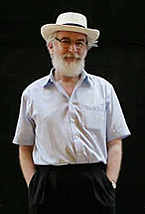
(David Crystal)

On his website devoted to information about the latest findings in OP, Crystal offers a handy summary of why it matters:

OP performance brings us as close as possible to how old texts would have sounded. It enables us to hear effects lost when old texts are read in a modern way. It avoids the modern social connotations that arise when we hear old texts read in a present-day accent.

For Shakespeare’s actual words:

–Rhymes that don’t work in modern English suddenly work.
–Puns missed in modern English become clear.
–New assonances and rhythms give lines a fresh impact.
–OP illustrates what is meant by speaking ‘trippingly upon the tongue’ (Hamlet).
–OP suggests new contrasts in speech style, such as between young and old, court and commoners, literate and illiterate.
–OP motivates fresh possibilities of character interpretation.

Crystal and his son, the actor Ben Crystal, give an introduction to the premises of OP:

Filed under: linguistics, performance, Shakespeare

Theater Obsessives and Super-Fans

Sleep No More

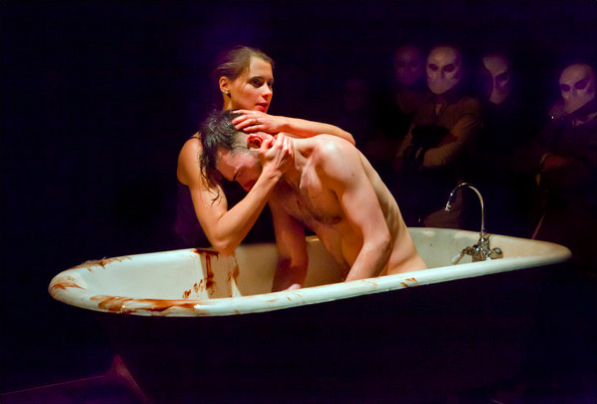
Sleep No More, a much-touted, site-specific, silently acted take on Macbeth by the British theater group Punchdrunk, has been running at the  McKittrick Hotel for several years. This imaginary “decadent luxury hotel” from the 1930s, which is said to have been condemned before it ever opened to the public, is in reality a set of adjoining warehouses in the Chelsea neighborhood of Manhattan.

With its audience members asked to don masks and invited to engage silently with the play’s characters while roaming about the eerie maze of fictional hotel rooms spread across five floors, the entire performative concept radically smashes down the fourth wall.

Tara Isabella Burton’s fascinating observations about her protracted experience with Sleep No More — and about the legendary super-fans who’ve become obsessed with reinhabiting this world in visit after visit — remind me of the dynamics of opera: of the immersive intensity that opera, allegedly the paragon of artistic “artificiality,” encourages:

Yet how real is real? For Sleep No More to succeed as a piece of theater, it must convince its audience — at least for the three hours of the show — that their interactions with Lady Macduff or Malcolm are true relationships, emotionally fraught on both sides. And yet to do so is to fuse fiction and reality in a manner that may feel uncomfortable, even dangerous, and on both sides (stalking on the part of besotted fans is not unheard of).

(Image: from Punchdrunk’s Sleep No More: Sara Krulwich for the NY Times)

Filed under: Shakespeare, theater

Archive

Enter your email address to follow this blog and receive notifications of new posts by email.