MEMETERIA by Thomas May

Music & the Arts

Fire, Water, Secrets, and Memory: Tan Dun Returns to Seattle Symphony

Tan Dun conducting Seattle Symphony, with harpist Xavier de Maistre; photo (c) James Holt / The Seattle Symphony. 

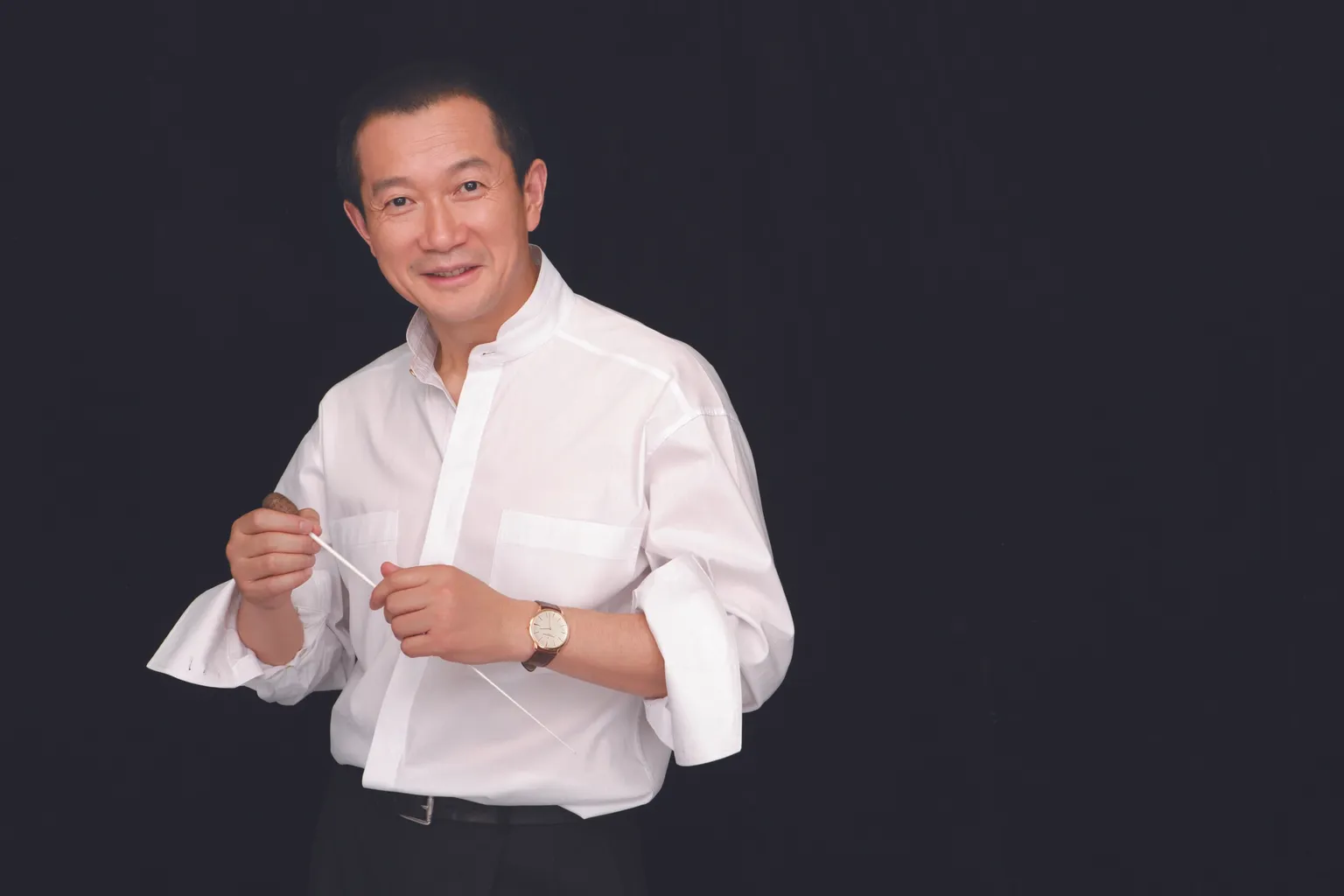
A concert built around the artistry of composer, conductor, and cultural connector Tan Dun offers no shortage of conceptual fascination. This week’s concerts mark his turn to the Seattle Symphony podium after a memorable debut here two and a half years ago, when he led his monumental Buddha Passion.

Raised in a remote village in China’s Hunan province and shaped equally by Western classical forms and ancient Chinese traditions, Tan – who since 1986 has been based in the US – brings a theatrical imagination and a deep sense of ritual to the concert stage. He framed last night’s program with a pair of short but intensely colorful works by two early 20th-century composers he admires, serving as explosive preludes to two large-scale pieces from his own catalog.

A vivid reading of Manuel de Falla’s Ritual Fire Dance, from his 1915 ballet El amor brujo, crackled with rhythmic energy and flared with instrumental color, setting one element against another as water came into protracted focus in the ensuing Concerto for Water Percussion and Orchestra, composed by Tan in 1998 and dedicated to Tōru Takemitsu. 

Tan draws out music’s ritual origins in intriguing ways. Percussionist Yuri Yamashita not only performed the solo part but dominated much of the piece with an almost shamanistic stage presence – from the way she mindfully released droplets from her fingers to the immersive sound world she conjured using bowls of wood or glass, as well as gongs dipped mesmerically into one of two large water bowls over which she presided. 

At some moments she even softly vocalized, as if engaged in a conjuring. Enhancing the theatrical experience were three video screens suspended above the orchestra –- one large at center and two smaller flanking it – which projected close-up footage of the bowls and the rippling water, inviting the audience into the tactile, elemental, organic world of the piece.

The orchestra functioned as a kind of elemental chorus, not so much a counterpart as a kaleidoscopic resonator. Specific voices occasionally emerged from the fabric – most memorably in a luminous duet between Yamashita and principal cellist Efe Baltacıgil, whose tone seemed to bloom out of the water’s surface. A long, improvisatory cadenza captivated with its focus on the physicality of sound.

Still, the Water Concerto’s meditative pacing and episodic structure began to feel diffuse over the span of the piece – though whether this observation reflects a Western bias about form or a real imbalance in proportions is a fair question. In any case, this was a welcome opportunity to hear the work in live performance. 

After intermission came a brisk, glittering account of Stravinsky’s Feu d’artifice (Fireworks), a four-minute burst of orchestral color dating from a little before the young Russian’s leap to international fame with The Firebird.

To this taste, the highlight of the program was Nu Shu: The Secret Songs of Women – a 13-part multimedia concerto that unfolded with greater emotional clarity and formal cohesion than the Water Concerto. Nu Shu originated as a commission for a harp concerto from the Philadelphia Orchestra but, inspired by Tan’s immersive research into a little-known linguistic and social tradition from his native Hunan Province, grew into a sui generis fusion of concerto, orchestral narrative, and ethnomusicological-sociological documentary.

The “secret songs” in question have to do with the vanishing Nüshu tradition — a secret, invented language once used by women in rural Hunan to communicate among themselves in calligraphy and through chanting and song. Tan painstakingly researched the small community of remaining Nüshu speakers, capturing their voices and stories in multiple videos. 

Nu Shu unfolds in 13 short video portraits created by the composer and his team – shown on the three screens above the stage – each anchored in the landscapes of the women’s daily lives and their stories of isolation and solidarity, which are shared from generation to generation.

For Tan, the harp represents “the most feminine of instruments,” writes Esteban Meneses in his excellent program note, and serves as “an intermediary between what the composer imagines as the future – the Western orchestra – and the past, represented by the microfilms.”

Xavier de Maistre was the eloquent soloist, playing a kind of bard who mediates these stories and showing remarkable dynamic and expressive range. Tan likewise assigns a crucial narrative role to the orchestra, which acted as a bridge translating memory into something shared and immediate.

Repeat performance on Friday, May 16, at 8 pm.

(c)2025 Thomas May

Filed under: review, Seattle Symphony, Tan Dun, , , ,

Tan Dun’s Buddha Passion

Composer Tan Dun (Courtesy of Tan Dun)

I wrote in advance about this week’s visit to Seattle Symphony by Tan Dun. Thursday night he conducted the Seattle Symphony, Seattle Symphony Chorale, Northwest Boychoir, and guest soloists in a moving performance of his Buddha Passion.

Here are excerpts from my review of the US premiere of Buddha Passion, performed by the Los Angeles Philharmonic under Gustavo Dudamel in 2019:

LOS ANGELES—A signature of Tan Dun’s most successful compositions is his gift for mixing putatively disparate elements into powerfully original amalgams. To make that happen means being able to take serious risks—and the premise behind Buddha Passion is nothing if not bold. The audience’s euphoric reaction at Walt Disney Concert Hall, where the Los Angeles Philharmonic and a cast of guest performers under Gustavo Dudamel gave the United States premiere on February 8, confirmed the tangible impact of Tan’s wildly imaginative gamble here.

Buddha Passion uses the rough outlines of the Christian Passion oratorio as a vehicle to explore the life and teachings of the Buddha. Tan drew inspiration specifically from the Mogao Caves outside the northwestern Chinese city of Dunhuang. These encompass over a millennium’s worth of murals and sculpture relating to Buddhism as well as artifacts that even contain evidence about the music of this period.

It’s fitting that Dunhuang was an ancient Silk Road outpost, since, on multiple levels, Buddha Passion stages a meeting place for diverse cultural phenomena: not only between the Passion format of the Christian West and Buddhism but between the Western orchestra/chorus and a Chinese-inflected soundscape, populist folk idioms and innovative “high art,” music, theater, and visual art. 

Tan’s Water Passion from 2000 responded directly to the Christian model, representing a millennial, global perspective on Bach’s St. Matthew Passion. In my view, Buddha Passion’s looser connection to the Passion idea—the composer also conceives of it as an opera—has resulted in a much more compelling work of art that transcends surface novelty and achieves a moving coherence on its own terms.

Over its two hours (including one intermission), Buddha Passion unfolds in six “acts,” each using a famous story associated with the Buddha himself or his teachings and sharing a core message of compassion, underscored by a recurrent chant motif. Tan distributes the voice of the Buddha among his various soloists and the chorus. In the first act, for example, the death of a bird leads Little Prince (sung by mezzo Huling Zhu) on his path to enlightenment. The stories share the clarity and directness of folk tales—such as the Deer of Nine Colors (soprano Sen Guo), a benevolent force who is killed by a man she has saved from drowning (tenor Kang Wang), or a contest of minds in the Zen tale of a woodcutter (bass-baritone Shenyang) whose wisdom awes the Master Monk. Yet from such simple elements and easily recognizable music gestures, Tan has constructed a monumental and richly complex work.

His instrumental resources blend the Western orchestra with an expanded percussion section including Tan’s hallmark “organic” sound sources from water and wood. In one scene, the fantan pipa virtuosa and dancer Chen Yining enchanted by setting the scene for a magnificent palace. 

Tan crafted his own libretto from original sources (a few bits in Sanskrit, the majority in Mandarin), and the LA Master Chorale as well as LA Children’s Chorus were also called on to incorporate Chinese techniques, including extensive glissandi.

Paradise seems never to be as conducive as the stumbling blocks to get there when it comes to inspiring art, and at moments I worried that Tan’s mellifluous, long-limbed melodies would become too syrupy. But context is everything here, and I found the sincerity of these gestures to be enhanced by the enormous variety of stimuli—not only musical—with which Buddha Passion teems, so that these moments served an emotional purpose similar to the directness of the narratives. 

The most powerful foil to potential sentimentality came in the indelible fifth act (“Heart Sutra”), which recounts the tragic meeting between a minstrel monk and Nina, a woman from the West who dies in his arms. With contributions by two indigenous artists taking center stage here—the Mongolian throat singer and Batubagen, also playing erhu, and the singer-actress Tan Weiwei—the intensity of this section made it stand apart as an opera-within-the-passion. Yet it was also brilliantly integrated into the narrative flow Tan had established. 

This passage also underscored the success of another facet of the composer’s fusion in this work: the ability to weave ancient, folk-based music and traditions into his unique language. Elsewhere in Buddha Passion we heard dense harmonic clusters radiating an Ivesian aura while, punctuating the finales of both parts (acts three and six), vibrant, tumultuous dithyrambs of rhythmic energy. This Buddha, when awakened, is not one to go gently into that good night. 

Filed under: review, Seattle Symphony, Tan Dun

Tan Dun Comes to Seattle

Composer Tan Dun (Courtesy of Tan Dun)

My Seattle Times story on Tan Dun and his upcoming appearances next week with Seattle Symphony:

A transformative encounter in cave temples inspired Tan Dun, who will conduct his epic Buddha Passion as part of a Seattle Symphony mini-festival of his works Nov. 3-13.

continue

Filed under: Seattle Symphony, Seattle Times, Tan Dun

Protected: Tan Dun’s Moving Buddha Passion Gets Its U.S. Premiere by LA Philharmonic

This content is password-protected. To view it, please enter the password below.

Filed under: Gustavo Dudamel, Los Angeles Philharmonic, Musical America, review, Tan Dun

Archive

Enter your email address to follow this blog and receive notifications of new posts by email.