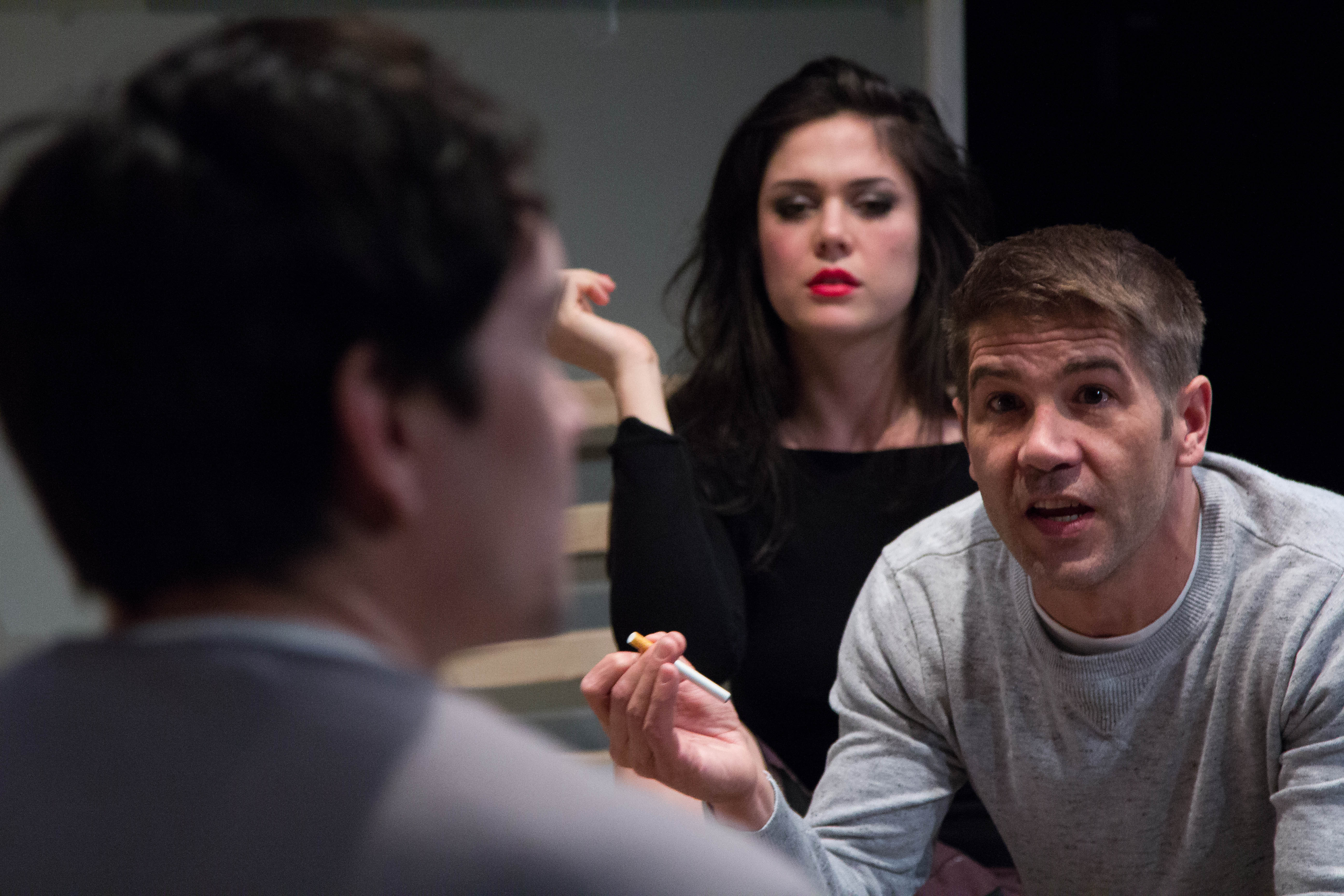
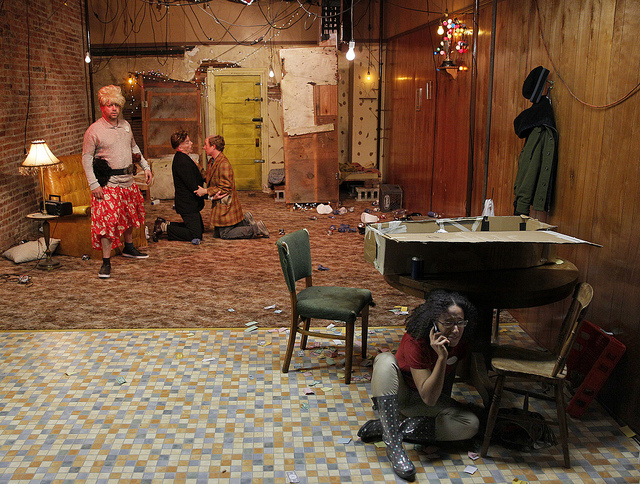
Richard Nguyen Sloniker, Tim Gouran and Mariel Neto in Red Light Winter; photo: Benito Vasquez
My recent profile of Seattle’s remarkable Azeotrope Theatre is up on Crosscut:
What makes people want to attend live theater? Sure, it’s an art that dates back to the origins of human culture, but why put up with the hassle when it’s become so easy to find entertainment from the comforts of home? Even the allure of films is no longer enough to guarantee the future of movie theaters.
But Azeotrope has a way of making you remember what’s so unique about theater in the first place. No amount of digitalized special effects can trump the raw, gritty emotional power or the gripping depictions of desperate characters who populate Azeotrope’s latest project.
Richard Nguyen Sloniker in Red Light Winter; photo: Sebastien Scanduzzi
Over the next month the company is presenting a double bill of plays in rotating repertory at the Eulalie Scandiuzzi Space, a tiny black box theater located downstairs at ACT. Both plays are less than a decade old: Adam Rapp’s Red Light Winter (2005), which was a Pulitzer finalist, and the Seattle premiere of the recent 25 Saints by Joshua Rollins (who will be on hand for post-play discussions on Nov. 2 and 3).
“When I when I first read Red Light Winter, it just kicked me in the balls,” says Richard Nguyen Sloniker, an actor, writer, teacher and co-founder of Azeotrope. “It hit me in a way I couldn’t quite grasp, and I had to try to parse out why.”
Rapp’s scenario is a bleak examination of the need for intimacy. It explores the consequences of a night two former college friends spend with a beautiful young prostitute in Amsterdam. “Sure, it’s not a very cheery play,” Sloniker explains, “but I identified with these lost, broken, human characters. A good play doesn’t necessarily have to give you a catharsis.”
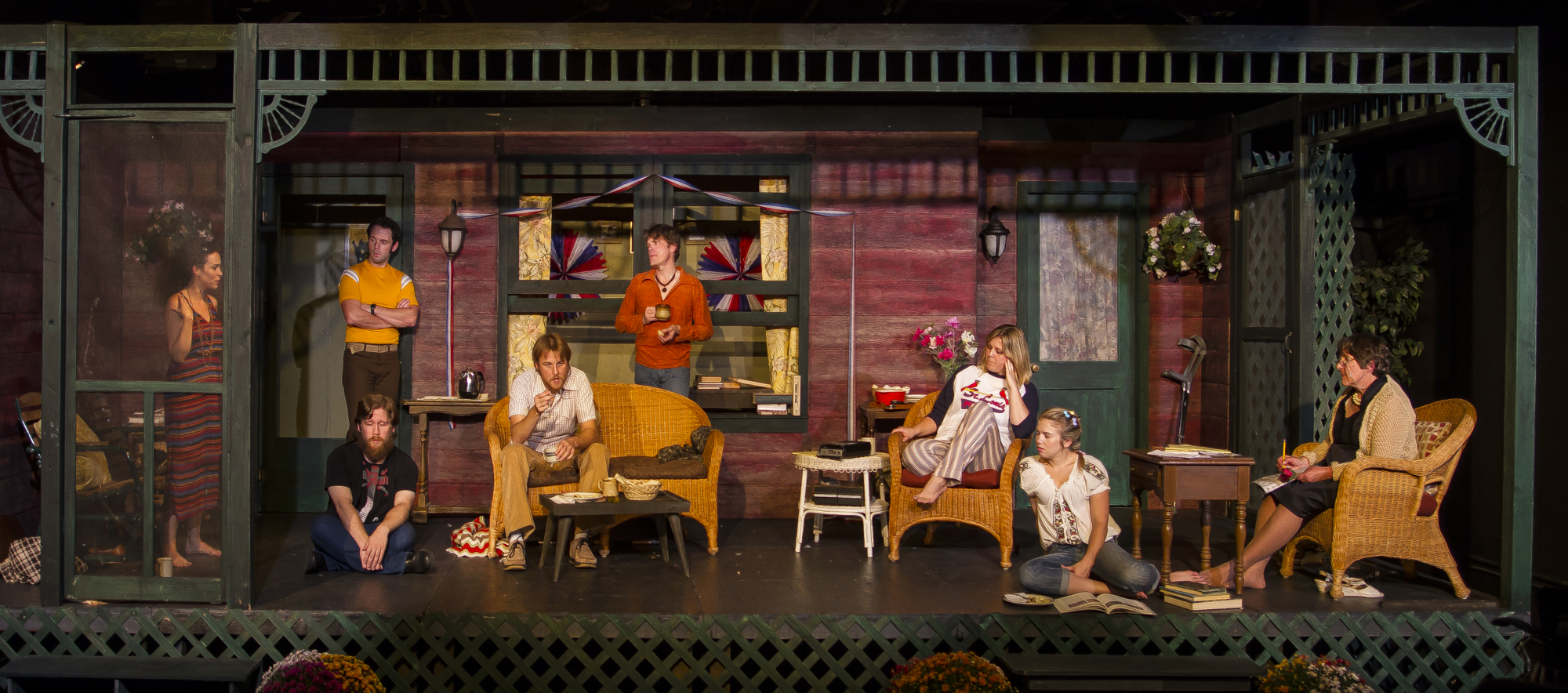
(left to right) Meg McLynn, Alex Garnett, Zach Sanders, Chris Shea, Tom Stewart, Megan Ahiers, Rachel Sedwick, and Mary Machala
When he was ready to realize his dream of launching a new theater company in Seattle, director, actor, and teacher Corey D. McDaniel chose a play that centers around rich and complex ensemble acting for their first outing. Theatre22‘s declared mission to serve as “a meeting ground” emphasizes the power of artistic collaboration. And the company’s inaugural production of Fifth of July unquestionably puts its values to the test.
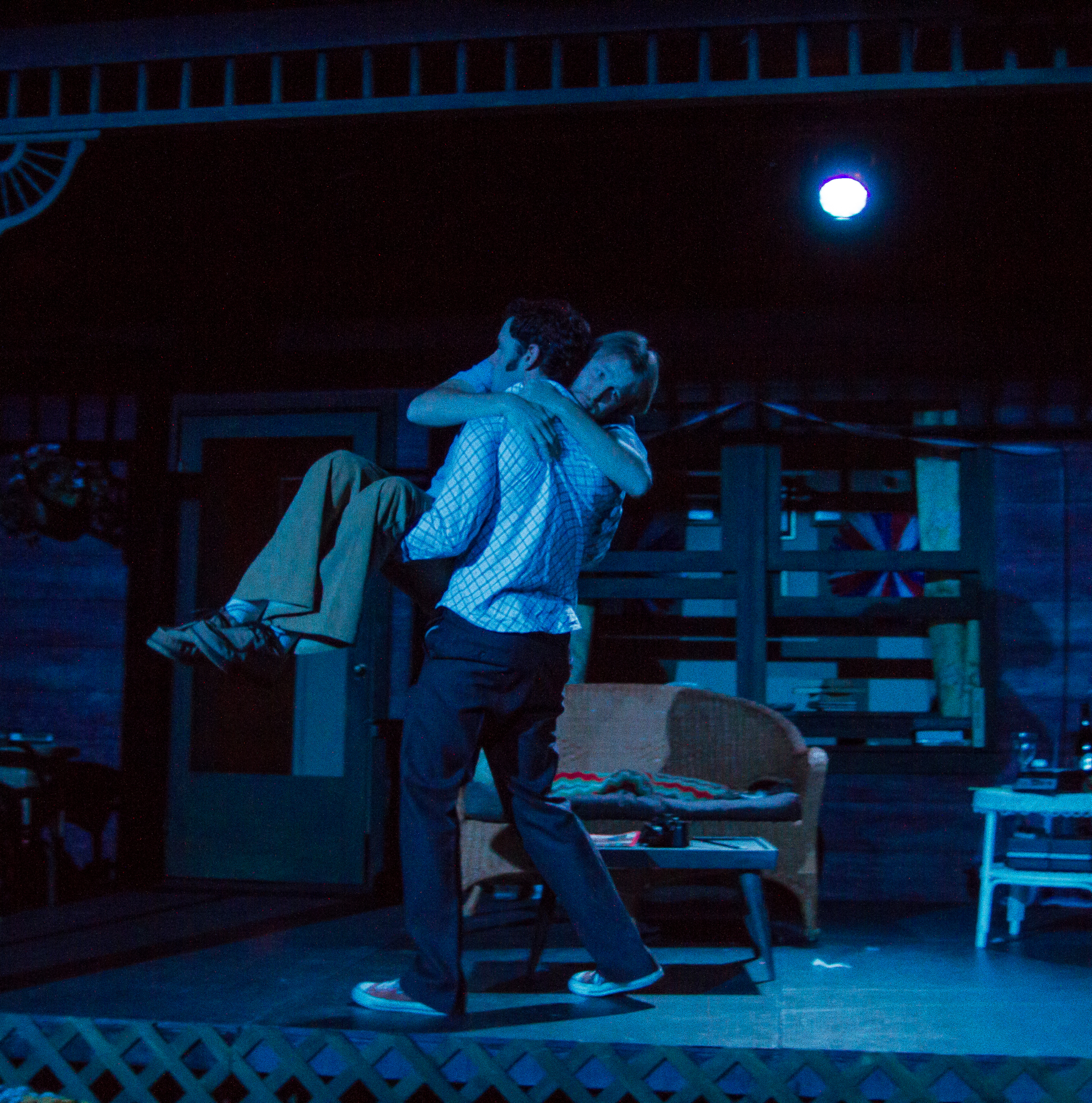
Lanford Wilson’s landmark play from 1978 is a richly textured meditation on the ties and tensions between a circle of highly individual characters coping with the emotional scars of disillusionment – and, in the case of Kenny Talley, a vet who lost his legs in Vietnam, the physical scars as well. Ken has taken temporary refuge in the now-rundown family homestead in rural Missouri which is his inheritance. Kenny’s lover Jed, a creative gardener, is painstakingly restoring the surrounding landscape, but the impulse toward stability Jed represents is countered by the events of a long Independence Day’s journey into night.
Chris Shea and Alex Garnett as Kenny and Jed
Among the holiday guests are Kenny’s sister June and her precocious teenage daughter, their Aunt Sally, and friends from their shared past as erstwhile radical students at Berkeley in the 1960s: the smooth-talking John Landis (who was sexually involved with brother and then sister) and his wealthy wife Gwen, whose big business trust fund didn’t prevent her from accessorizing trendy ’60s-style Marxism back in the day. Now, though, Gwen’s dreams have turned toward a career as a country singer, and her trusty guitarist Wes has accompanied her for the visit.
Borrowing a framework from Chekhov, Wilson establishes dramatic stakes that outwardly revolve around the proposed sale of the Talley home. John and Gwen hope to buy the farm to transform it into a commercial recording studio. But its metaphorical significance – the symbol of Ken’s unrealized potential and also of the past, of the collective memory whose meaning is up for grabs – intensifies the moral weight of the outcome. (Wilson, who died just two and a half years ago, went on to expand his drama of the Talleys into a trilogy, writing two more plays about the Talley family’s past, which take place in the 1940s.)
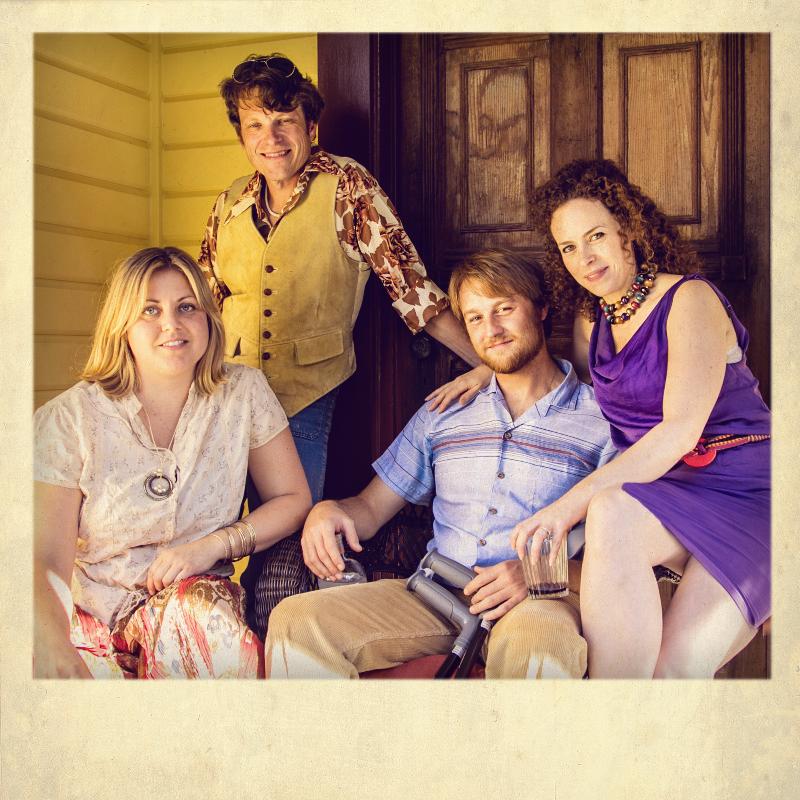
Fifth of July cast: Megan Ahiers, Tom Stewart, Chris Shea, and Meg McLynn; photo by Robert Falk
Director Julie Beckman is well attuned to the musical method of Wilson’s writing: like a tapestry of solo instrumentals emerging from the ensemble, different characters unexpectedly detach and come into the foreground to riff on a particular – not necessarily related – theme, only to gently recede while the focus turns elsewhere. A persistent challenge is making these transitions plausible and seamless: at times the production makes them feel too abrupt. There’s a lot of sensitive attention to detail in these monologues, and to their alluringly poetic blend of pathos and eccentric humor. The overall pacing, though, especially in the first act, has a tendency to slacken. As with Chekhov, finding the right tempo for Wilson is an extremely subtle undertaking.
Yet the connections and frustrations that are key to Fifth‘s momentum are vividly realized by the cast. Chris Shea, while tending toward a one-note approach to Kenny’s bitterly ironic tone, is genuinely moving in the final scene when – with beautiful symmetry – he is persuaded to stay by Gwen (a gloriously larger-than-life fuck-up in Meg McLynn’s portrayal). As his boyfriend Jed, Alex Garnett is the force that grounds Kenny, but he also underlines the significance of his rapport with Aunt Sally – and thus is the linchpin who holds this fragile family together. Megan Ahiers conveys sister June’s lingering insecurity; as her uber-curious daughter Shirley, Rachel Sedwick toggles between bratty tantrums and wise-beyond-her years remarks.
Aunt Shirley is meant to embody the contradictions that define the Talley family – or the braver exemplars of the clan – and the link to a past whose meaning has become painfully dubious. Mary Machala shows her as a dreamy eccentric, bruised in her own way and thus in league with her nephew Kenny. Tom Stewart emphasizes John’s sleazy swagger, but he comes off a tad too nice for the cutthroat competitor who has apparently shucked his Age of Aquarius idealism with no qualms. Zach Sanders has a few show-stealing moments as the space cadet Wes – including his famous monolog about the ill-fated Eskimo family.
The fine black box space of Fremont’s West of Lenin underscores the intimacy of this production and the details of Michael Mowery’s picture-frame unit set and Jordan Christianson’s spot-on costuming (complete with unironic bell-bottoms sported by John). Tim Moore’s sound focuses on the music – mostly a blast from the past – though I would’ve also welcomed some environmental sounds for a sense of place. Robert Falk’s lighting traces the first act’s woozy trailing off into memory as the national holiday fades into night, followed by the uneasy promise of the morning after.
It all makes for an impressive inaugural production. And Theatre22 has mapped out some ambitious plans for later in the season: in February comes a new musical titled The Hours of Life by Paul Lewis, based on Edgar Allen Poe, which will be directed by Corey McDaniel; and Terrence McNally’s The Lisbon Traviata is slated for this coming June, directed by Gerald B. Browning.
If you go: Fifth of July plays through October 26 at West of Lenin in Fremont. Tickets online
Corey McDaniel (producer) and Julie Beckman (director); photo by K. Lindsay
For its fall production, Seattle’s enterprising New Century Theatre has chosen Enda Walsh’s The Walworth Farce. Here’s my review for Crosscut:
Talk about a repetition compulsion: For the first half of The Walworth Farce, New Century Theatre’s latest adventure, a father and his two grown sons run through the lines of the play they reenact day after day – an absurd, antic ritual involving a mock procession with a cardboard coffin, constant prop swaps, dizzying identity changes and a hidden “fortune” of shredded Monopoly money.
In the confines of their squalid South London council flat, Dinny (Peter Crook) is the paterfamilias and dictatorial writer-director of the script he and his sons Sean (New Century Theatre artistic director Darragh Kennan) and Blake (Peter Dylan O’Connor) perform day after day. Dinny keeps his boys’ eyes on the prize, egging them on to compete for a chalice-like trophy that will go to that day’s “best actor.” But snafus inevitably occur, and the ritual has to be reorganized.
Dinny’s play is the thing that’s supposed to keep them all safe. It recounts the story, fable repeated until it’s taken as fact, of how this insular family unit was forced to abandon their idyllic home back in Cork. We also learn how Mother was killed in a bizarre accident involving a dead horse. They’ve been living as exiles ever since, surrounded by “savage” Londoners and holed up on the top floor of a grimy, stairless high-rise.
“What are we without our stories?” wonders Dinny by way of justifying the outrageous fiction he’s used to paint over what actually happened – and the real world kept at bay by a half-dozen deadbolts on the flat’s front door.
My recent interview with Alan Ayckbourn for Crosscut.com is up. Here’s a fuller version with some extra material that got cut in editing:
Since 1976, ACT Theatre has produced ten plays by Alan Ayckbourn – and that’s just a fraction of the 74-year-old English playwright’s catalogue. But this fall’s production of Sugar Daddies (2003) brings Seattle not only the honor of a North American premiere, but the presence of Sir Alan himself in his West Coast debut as a director. (He was knighted in 1997.)
Like most of his work, “Sugar Daddies” premiered at the Stephen Joseph Theatre in Scarborough (on the coast in North Yorkshire). Ayckbourn has maintained close ties there since early in his career, writing for its theatre-in-the-round configuration – a staging style he prefers. He stepped down as artistic director at the end of 2008 but lately appears to be busier than ever at the SJT with his projects as visiting director.
Ayckbourn’s breakthrough hit came with the London production in 1967 with Relatively Speaking, a fresh, hilariously constructed twist on the well-worn gag of lovers caught in a web of mistaken identity. (“The critics were shocked to see French windows instead of the kitchen sink – it seemed slightly reactionary,” he jokes.) Here already was the characteristic Ayckbournian touch, with its preoccupation with role playing and marital discontent. Some claim him to be one of “the world’s most-performed living playwrights,” though Ayckbourn’s own website points out “there is actually no plausible way to prove this statement.”
But what sets him apart is that his undeniably widespread – and sustained – popularity goes hand in hand with his untiring experimentation with theatricality and stagecraft.
And while he is usually thought of first and foremost as a comic master, Ayckbourn’s plays have become significantly more complex over time. Sugar Daddies in particular mingles satire and clever dialogue, taking a dark slant on a youth and beauty meets age and power scenario.
Emily Chisholm; photo by Nate Watters
Set in the contemporary London flat shared by half-sisters Sasha and Chloé, the play explores how they are affected when the younger, naïve Sasha is befriended by the elderly Val (old enough to be her grandfather). His extravagant gifts and nights out to the opera distract her from asking too much about Val’s sinister background – even when she’s warned by Ashley, their one-eyed neighbor and a former cop whose own past connection to Val is veiled in mystery. Ayckbourn’s absurd yet meticulously crafted symmetries resemble a cautionary retooling of Cinderella, where sudden shifts in fortune prove too good to be true.
I met up with Sir Alan during a break from rehearsal to talk about Sugar Daddies, his remarkable career and the future of theatre.
TM: How were you persuaded to come to Seattle – and what made you choose Sugar Daddies in particular to show audiences here the director side of your career?
AA: It has been brewing for some years. When [ACT artistic director] Kurt Beattie came over to visit me in England, he slid me a schematic of the Allen Theatre, which is not so far removed from our own theatre in the round in Scarborough. [The 404-seat Stephen Joseph Theatre.]
The ethos [of ACT] is very close to it. Both are interested in new writing, but are also very egalitarian – not like the old style, where the stage management were below stairs, the actors upstairs. And much more friendly. I’ve gotten asked dozens of times in England, “Why are you going to Seattle?” And I said, “Because they asked me!”
I chose “Sugar Daddies” as a play that hasn’t been done here and that I would like to revisit. From my knowledge of working in the States, it’s the sort of play American actors could embrace. Some of my plays are so English you’d spend most of the rehearsal period explaining the class system. We are doing [Sugar Daddies] as set in England, but nonetheless it’s fairly universal in its concerns.
TM: It’s probably a bit of a surprise to many who love your plays that you actually spend much more of your time on directing than writing. Yet somehow you’ve managed to remain a wildly popular and prolific writer (77 full-length plays and counting).
AA: I’ve had three careers in theatre: I started as an actor and then took, as I call it, the “poison chalice” of directing. Once you feel you’re in control as a director, it’s harder to go back to acting. The directing career developed quite independently from my writing career at first. Then the two almost inevitably merged, but quite later on.
The rehearsal room can be quite a hostile place … if the actors suspect you don’t know what you’re doing. It takes quite a lot of experience before you can confidently handle a whole room of actors – particularly because they are often rather eccentric and extraordinary individuals. I do spend more time in the rehearsal room than at my computer these days.
Over the last few years I’ve tended to direct a minimum of two plays a year, one of which is always a revival from my back catalogue. And I’ll use the revival as a pro forma for the new play. Last year I did a revival of Absurd Person Singular, and on the back of that I wrote a new six-handed play, Surprises [both plays call for 3 men and 3 women].
TM: In a sense, Sugar Daddies is about the art of theatre itself, the way we’re constantly playing roles, whether we are aware or want to or not.
AA: I was fascinated at the way we pretend, we select. It’s best summed up by when you’re very young and you meet a girl and the inevitable moment comes when you want to take her back to meet the parents. And then you’re thinking, “How am I going to look against the backdrop of my parents, who still look at me as 8 years old?” And she’s thinking the same thing: “My whole illusion of myself is going to be shattered.”
People like Sasha respond to other people she senses have an expectation of her. She in turn has an image of old people as being friendly. “Uncle” Val is trying to put a very dark past behind him, and Sasha presents him with an edited version of herself. It’s not a deliberately deceitful thing – though I think, in Uncle Val’s case, it may be. For most of us, it’s a presentation of ourselves, which we sense the other is expecting.
For example: as a director, actors don’t want to meet you socially if you’re rolling drunk. Not that they actually think you are infallible, but they like to assume a state of infallibility. If you go out of your way to encourage that, with a confident manner, it helps.
TM: So no drunk Tweeting once rehearsals have started! But what you describe sounds almost like the same dynamic you show Sasha experiencing. She’s looking for some kind of approval and validation from her Sugar Daddy Val.
AA: It touches on the old Faust legend of selling your soul to the devil. A lot of the play is set up so you’re asking, is she going to go down the path of eternal damnation with Uncle Val or is she going to find a way out? Fortunately, there is a turning point and a momentary glimpse of the monster. It’s not that Sasha doesn’t know about that [part of him], but she chooses not to know about it. The pleas of ignorance – we do a lot of that; it’s a considerable human characteristic.
TM: One recurring idea in critiques of Sugar Daddies is the issue of the play’s tonality. Critics have seemed confused by its mixture and want to have it both ways: a dark, confectionless, yet somehow entertaining play. For the ACT production, you’ve even decided to rewrite the final scene between Sasha and her half-sister Chloé.
AA: Rereading the play, I thought Sasha goes through this experience pretty well unscathed. She escapes with just a singe. I wanted those last few moments to show that there’s part of Uncle Val that’s been left with her. If you’ve supped with the devil, you’ve probably burnt your tongue.
John Patrick Lowrie as ex-cop Ashley; photo by LaRae Lobdell
Val is probably the most evil character I’ve written. For some reason all my evil characters seem to begin with V: Uncle Val, Vic [Man of the Moment], Vince [Way Upstream]. It’s a strange little motif. The man playing it in Scarborough said, “This must be the most evil man I’ve ever played.” He comes from that old-style East End gangster mode; he’s a capo, a don.
There is a sense that Sasha is refreshingly clear-eyed at the beginning, the “country mouse” who has come into the city, while Chloé is an exaggerated “town mouse” — probably one of those people in the media who are always competing furiously. But she has a sort of mistrust of human nature by the end – something you see in children growing up. Sasha’s not quite the girl she was at the beginning; there is a sort of ruthlessness about her.
TM: Among other modern playwrights, who would you single out as the great “bards” who will last?
AA: I’m a great admirer of David Hare and Alan Bennett. One of the writers that had the most profound effect on me, when I was directing other people’s plays, was Arthur Miller. The great thing about being a writer directing other people’s work is that as a director, you’re more or less compelled to take the play apart in order to put it together again with the actors. You see the mainspring here, the cogs there. Miller was a terrific craftsman and had a brain on him the size of Britain.
I was very lucky I grew up at the crossroads for English drama. So I absorbed a lot of the old-fashioned, well-made plays, and then came [John] Osborne and [Harold] Pinter, who was an enormous influence of me. I even acted in an early production of The Birthday Party, which he directed. He was an extraordinarily unique voice. So I’m influenced by the Chekhovs through to the Pinters really. I was blessed with a double upbringing.
TM: You’ve remained remarkably loyal to theatre as an art form, while so many of your colleagues – not to mention younger writers – have gone over to the commercial payoff of TV, Cable, film. What does the future of theatre look like to you?
AA: There’s a bright curve of new dramatists coming up in England. I do think, because of the non-encouragement of new writers, there’s a danger in our theatres now of [these writers] not addressing the challenges of theatre, but of trying to adapt television and film ideas. I used to sit at my desk and read 3 or 4 plays a week. My heart used to sink if there was a play with 26 scenes: Where’s the conciseness of theatre?
And there is a veering towards monologue, which is quite popular now — not just as a dictate of economics, but a preference of dramatists. When I was teaching, I used to try to point out all the colors of the theatre palette. My mentor Stephen Joseph told me, “Yeah, break the rules, but first of all you’ve got to know what they are!” So he sat me down and made me write a well-made play. At least I’d been through the process, and I’ve been breaking the rules ever since.
(Pam Nolte as Dolly Gallagher Levi in Taproot Theatre’s production of The Matchmaker; photo by Erik Stuhaug)
It’s surprisingly easy to mistakenly associate Thornton Wilder’s theater — or at least his most-famous plays — with feel-good, homespun, Norman Rockwell Americana. (Whether that represents a mistaken idea of Norman Rockwell is another question.) A similarly false impression clings to the widespread image of Aaron Copland, who even composed a score for the 1940 film of Our Town and later considered basing on opera on it — though the playwright declined, countering: “I write amusical plays.”
Of course The Matchmaker, a Broadway and West End hit in 1955 after it bombed in its earlier 1938 incarnation as The Merchant of Yonkers, did morph into the musical Hello, Dolly! in the following decade. But the brassy success of the latter — which, admittedly, I’ve never been able to fathom — only reinforced the notion that Wilder’s play is just another charming twist on the happy alliance between romance and the American Dream.
The new production of The Matchmaker currently on the boards at Seattle’s Taproot Theatre is certainly entertaining. But in director Scott Nolte’s version, it also welcomely embraces Wilder’s deft homage to a vanished, rawer era of American theater-making. For the most part, there’s no embarrassed smoothing-over of the popular farce — complete with its own character types — that was already a fossil when Wilder devised this valentine to it.
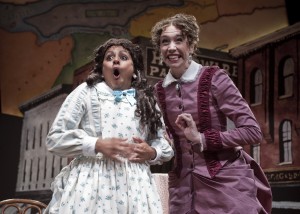
(Asha Stichter and Natalie Moe as Minnie Fay and Irene; photo by Erik Stuhaug)
Apart from an opening scene that drags, this Matchmaker is delightfully paced and benefits from a consistently focused ensemble energy. The renegade store clerk Cornelius Hackl (given an especially winning turn by Robert Hinds) and the scheming, ambitious milliner Irene Molloy (Natalie Anne Moe, channeling the moxie of Gretchen Mol’s Gillian on Boardwalk Empire) make their wide-eyed anticipation plausible when they remark: “The world is full of wonderful things!”
However “amusical” he may have thought his plays, Wilder’s build-up of the confrontations between the tyrannical merchant Horace Vandergelder and his underlings feels genuinely scherzo-like. Nolte makes room for the other concerns Wilder voices through the pleasure-seeking vehicle of his farcical plot.
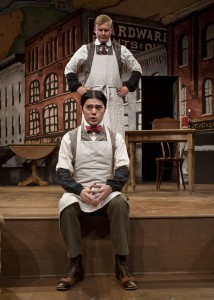
(Robert Hinds and Brad Walker as Cornelius and Barnaby; photo by Erik Stuhaug)
As these characters become entangled in mixed-up or feigned identities and search for mates and fortunes, they muse about the things that really matter to them. Against the backdrop of the Gilded Age and its class differences — effectively telegraphed by Sarah Burch Gordon’s delightful palette of costumes — Mrs. Dolly Gallagher Levi, the matchmaker in question (among other dubious pursuits), realizes it’s time to let go of memories of her late husband and “live among human beings” again: to be “a fool among fools” once more rather than “a fool alone.” Pam Nolte (Scott Nolte’s wife) animates her portrayal of the ever-confident Dolly with a well-calibrated hint of her disappointments.
Along with his humanist touches, Wilder works in a trenchant commentary on the greedy excess to which the drive for material success can lead. “The difference between a little money and an enormous amount of money is very slight, and that, also, can shatter the world,” observes Dolly, who espouses her own economic theory of “spread-it-around” capitalism. “Everybody thinks when he gets rich he’ll be a different kind of rich person from the rich people he sees around him,” Cornelius says. “Later on he finds out there’s only one kind of rich person. And he’s it.”
The point gets rather blunted in Robert Gallaher’s approach to Horace Vandergelder. Instead of the authoritarian, hard-as-nails “monster” who intimidates everyone, secure in his “half million,” Gallaher comes through as too domesticated, even mildly bemused by his sense of superiority.
(Robert Gallaher as Horace Vandergelder; photo by Erik Stuhaug)
Brad Walker, on the other hand, makes a memorable impression by playing up his character type as Barnaby Tucker, the naive sidekick to Cornelius in search of “an adventure” on their self-declared day off. So does Kim Morris in her hilarious depiction of the eccentric Miss Flora, the friend of Dolly and Horace’s late wife. During the denouement in her New York house (a surprise for anyone who knows only Hello, Dolly!), Wilder uses Miss Flora to parody treacly sentiments about “true love.”
Mark Lund’s simple sets (including a painted urban backdrop) and sound design transform the small stage area into 1880s New York with a bare minimum of suggestion. The real time change is conveyed through Wilder’s earthy language — spiced at times with clever, Oscar Wilde-like turns of phrase — and the actors’ demeanor, though, and it all plays out as less dated than you might expect.
The Matchmaker, which closes Taproot’s current season, plays through Oct 19 at 204 N. 85th St., Seattle; tickets at 206 781-9707 or online.
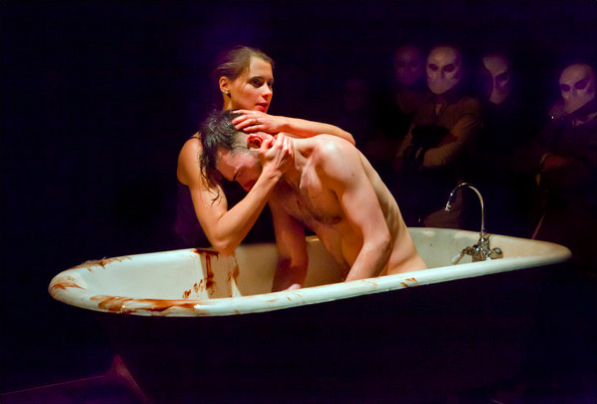
Sleep No More, a much-touted, site-specific, silently acted take on Macbeth by the British theater group Punchdrunk, has been running at the McKittrick Hotel for several years. This imaginary “decadent luxury hotel” from the 1930s, which is said to have been condemned before it ever opened to the public, is in reality a set of adjoining warehouses in the Chelsea neighborhood of Manhattan.
With its audience members asked to don masks and invited to engage silently with the play’s characters while roaming about the eerie maze of fictional hotel rooms spread across five floors, the entire performative concept radically smashes down the fourth wall.
Tara Isabella Burton’s fascinating observations about her protracted experience with Sleep No More — and about the legendary super-fans who’ve become obsessed with reinhabiting this world in visit after visit — remind me of the dynamics of opera: of the immersive intensity that opera, allegedly the paragon of artistic “artificiality,” encourages:
Yet how real is real? For Sleep No More to succeed as a piece of theater, it must convince its audience — at least for the three hours of the show — that their interactions with Lady Macduff or Malcolm are true relationships, emotionally fraught on both sides. And yet to do so is to fuse fiction and reality in a manner that may feel uncomfortable, even dangerous, and on both sides (stalking on the part of besotted fans is not unheard of).
(Image: from Punchdrunk’s Sleep No More: Sara Krulwich for the NY Times)
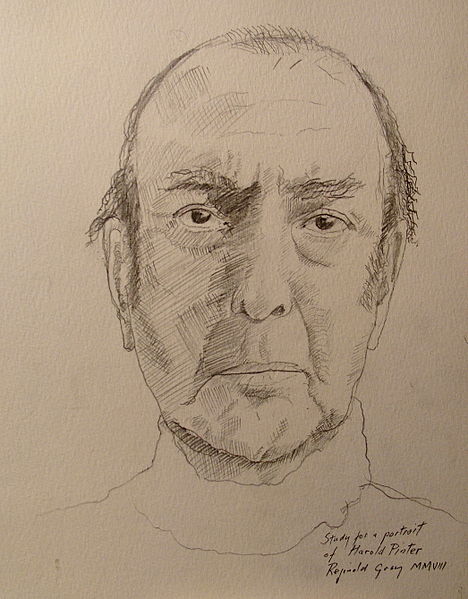
From the Paris Review archives, a fascinating interview with playwright Harold Pinter by Larry Bensky conducted in October 1966. “Good writing excites me, and makes life worth living,” says Pinter about his rapport with fellow writers. And he responds to a question about the influence of music on his writing:
I don’t know how music can influence writing; but it has been very important for me, both jazz and classical music. I feel a sense of music continually in writing, which is a different matter from having been influenced by it. Boulez and Webern are now composers I listen to a great deal.








 MEMETERIA by Thomas May