Violinist James Ehnes, Seattle Chamber Music Society’s artistic director, performs with colleagues during a SCMS Chamber Music in the Park concert. SCMS’ Summer Festival runs July 1-26 this year. (Jenna Poppe)
Tonight is the opening concert of the 2024 edition of the Seattle Chamber Music Society’s annual Summer Festival. I wrote a preview for The Seattle Times here:
Sure, the Seattle Chamber Music Society has a menu of the usual star composers — Beethoven, Brahms, Dvořák — for its Summer Festival running July 1-26. But this year, the festival is boasting an actual menu that will be designed onstage by Seattle star chefs. …
Here’s my review for Musical America of the American premiere of Kaija Saariaho’s final opera, Innocence, which was presented by San Francisco Opera this month:
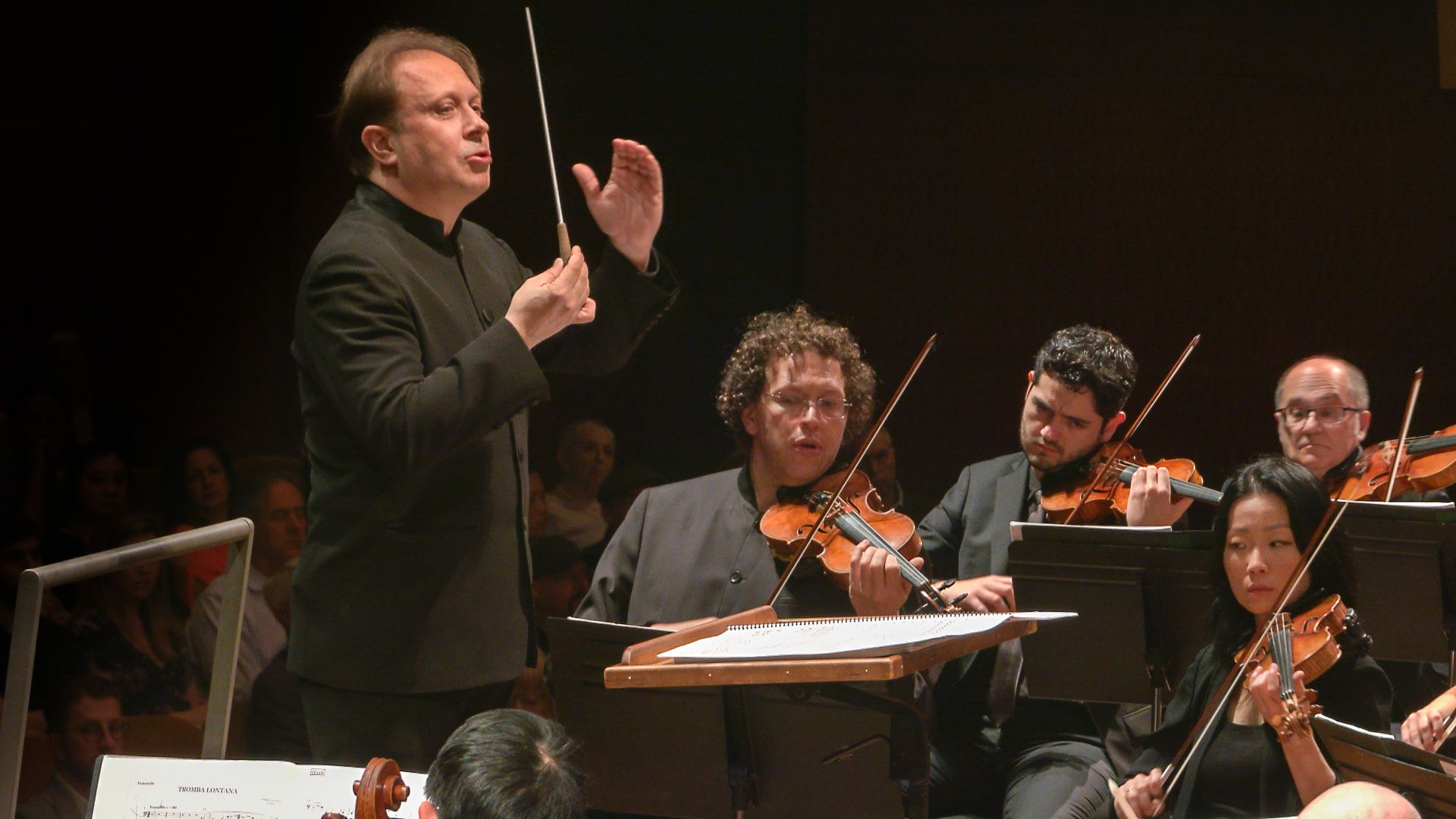
Ludovic Morlot conducting the Seattle Symphony; photo courtesy of the Seattle Symphony
For their second-to-last program of the season, the Seattle Symphony added John Adams’s early breakthrough Harmonium to its repertory with a breathtaking performance led by Conductor Emeritus Ludovic Morlot. During the 1970s, Adams had been building a reputation as an experimental composer doing his own thing in the Bay Area. He had become an advisor on contemporary music to the San Francisco Symphony’s then-music director Edo de Waart and received a commission to write a big choral-orchestral piece to help the orchestra celebrate its first season in Davies Hall, SFO’s new home across the street from the War Memorial Opera House. The premiere in April 1981 was a sensation that launched Adams on his path toward international stardom.
In his guise as a conductor, Adams has paid multiple visits to Seattle to lead the musicians in various of his own compositions and regards the SSO as “an excellent orchestra.” So it was especially satisfying to finally hear the collective forces of the SSO and its Chorale perform this pivotal work from more than four decades ago for the first time.
As it happened, I’d just come from hearing the original septet version of Adams’s 1978 piece Shaker Loops the week before at the Ojai Music Festival (performed by members of the visiting Mahler Chamber Orchestra, with fresh birdsong obbligato from the trees surrounding the outdoor Libbey Bowl). Adams had adopted the idioms of Minimalism in his distinctive, “impure” way in Shaker Loops and does something similar in Harmonium, but working for the first time with the much larger canvas of symphony orchestra and chorus. It was interesting to notice that some of the DNA of Shaker Loops is still present in varied form in Harmonium. At the same time, aspects of the signature language Adams would go on to develop (mostly orchestral, but in some respects choral as well) also appear in this score — certain timbral gestures from the tuned percussion, a shine that anticipates Grand Pianola Music (1982), or the stirring choral “pillars” found in the operas.
But the very fine performance led by Morlot kept me from falling into the trap of viewing a great artist’s early work merely contextually, as a launching pad toward future greatness. Harmonium proved completely compelling on its own terms, a splendidly structured choral triptych that conveys states of transcendence, serene contemplation, and unbridled joy.
Adams initially considered setting texts from the Wallace Stevens collection called Harmonium and then thought of writing for a wordless chorus, relying on their pure sounds, before he found a basis for what he imagined — “human voices — many of them — riding upon waves of rippling sound in John Donne’s “Negative Love” and two poems by Emily Dickinson: “Because I Could Not Stop for Death” and “Wild Nights.”
Morlot showed his sensitive understanding of Adams’s dramatic use of sudden harmonic modulations — at this stage in his career, the composer had been likening it to the process of “gating” in electronic music — and shaped the sense of progressive revelation via negation in the opening Donne section with a tenacious clarity.
The Chorale, excellently prepared by Joseph Crnko, encompassed an enormous sonic spectrum, from mystic whispers to ecstatic, Whitmanesque yawping that sent shockwaves crashing through Benaroya Hall. (Fittingly, the concert had begun with Tromba lontana, an “anti-fanfare” from 1986 in which the composer uses a pair of trumpets to sound an elegiac rather than military mood, calling to mind Whitman’s poem “The Mystic Trumpeter.”) Adams’s guiding image of surging waves of sound came to life most thrillingly in the final “section”Wild Nights” movement, a drastically contrasting juxtaposition with Dickinson’s death meditation preceding it.
Seattle Symphony Chorale plus part of the fabulous SSO brass section; photo courtesy of the Seattle Symphony
One of the most unforgettable moments in Harmonium is the seamless transition between the polar Dickinson poems, in which Adams builds up an irresistible, orgiastic flow of momentum. Beethoven’s Fifth Symphony, which occupied the second half of the program, happens to offer a plausible parallel in the musical “tunnel” that interlinks its last two movements.
Curiously, the program on which Harmonium was given its world premiere in San Francisco also involved a Beethoven pairing: in that case, with the Emperor Piano Concerto No. 5 — a work whose aura Adams confronted the next year in his wonderfully over-the-top Grand Pianola Music. On this occasion, Morlot — in his first reunion with the SSO since the sadly under-attended opening night of the season last September — approached the Beethoven with a clear sense of proportions and architecture. And with a bigger, more-rounded sound overall than in his Beethoven interpretations of several years ago, when he was music director.
Morlot held back from imposing an “interesting” perspective on the score, following Beethoven’s command of a single eighth-note rest between the first two statements, for example. He followed all of the repetitions — including, a bit surprisingly, even in the Scherzo. Still, the vision that emerged was more finale-centric, it seemed to me, with the terseness of the opening movement as a mere station on the way forward rather than an existential state. Despite brisk tempi, Morlot shaped the eccentrically long-spun melody of the Andante’s main theme with style and drew a magnificent dark sheen from the strings in particular, with bold strokes in the finale.
If aspects of the Scherzo felt understated, Morlot steered clear of the feeling of anti-climax that deflates so many renditions of the finale. The return of the ominous Scherzo music actually felt surprising, and the insistent paragraphs of C major brought to mind something of the French Revolutionary era music that was a clear inspiration for the young Beethoven.
Featuring countertenor Randall Scotting and tenor Jorge Navarro Colorado, comes the album Infinite Refrain, Music of Love’s Refugeoffers a focus on queer relationships and gay love in 17th-century Venice. They collaborate with the Academy of Ancient Music, led by conductor Laurence Cummings, to perform a program celebrating Venice as a place of unusual tolerance in the Baroque era. Infinite Refrain is framed as the journey of two men in love and tells its story through 17th-century music.
“Ironically, it was Venice’s decline as a trading powerhouse that led to its reputation as a Mecca for gay tourism,” writes Clive Paget in the excellent liner notes. “The annual Carnival, with its frenzy of sexual licence and promise of anonymity, had always drawn the crowds, but with the downturn in commercial revenue the authorities were increasingly inclined to turn a blind eye in exchange for a healthy injection of the 17th-century version of the pink pound. And so, something that had been swept under the carpet for over a century became something the Venetians could sell.”
“Onstage in the 1600s, people were playing different genders than they represented in their everyday life,” explains Scotting. “Men were wearing dresses, women were often in men’s suits, male castrati were singing in high voices… so many things were fluid about opera and music at this time.” Navarro Colorado adds: “Many of the duets on the album were also composed to be purposely ambiguous in terms of gender and allowing for queer interpretations so that whoever is listening will feel connected to their message of love.”
Alongside duets by Monteverdi and Cavalli are contemporary premieres of music by little-known composers Boretti, Melani, and Castrovillari, including an impassioned love duet for the mythic lovers Hercules and Theseus — “Se per tè lieto mi lice” (“To be happy for you is precious to me”). “This duet portrays two of the greatest heroes of Greek antiquity matter-of-factly proclaiming their love for each other and it is offered here just as Venetian audiences would have heard it in 1670,” says Scotting.
With Mitsuko Uchida as Music Director, this year’s Ojai Music Festival from 6-9 June promises an intriguing mix of Mozart piano concertos, early Modernist masterpieces (with a focus on Arnold Schoenberg), and pieces by contemporary composers who hold special significance for her. I had the privilege once again of writing the program notes, which are available here.
Visit OMF’s homepage for livestreams and replays of the concerts here.
Included in the latest issue of Strings magazine is my story on efforts by Trey Lee, Eldbjorg Hemsing, and John Luther Adams to address the climate crisis:
Nature sings in the work of countless composers in the Western classical tradition. The calls and flutterings of birds, spine-tingling thunder, falling raindrops: Vivaldi transformed a repertoire of found sounds from the natural world into some of the most memorable moments in The Four Seasons. …
My review for Gramophone of the new concert recording of John Adams’s Girls of the Golden West, which has been selected as an Editor’s Choice for June 2024:
The opera repertoire would be considerably diminished if composers had abandoned their ‘problem children’ at the first sign of trouble. John Adams confronted one of the biggest disappointments of his career when Girls of the Golden West was panned by a chorus of critics at its premiere in 2017….
My review of Yuja Wang’s recital at Benaroya Hall last Friday evening has been posted here:
It would be facile to suggest that the program Yuja Wang chose for her North American tour this spring was intended to display her astounding versatility – a versatility that is merely one manifestation of the artist’s virtuoso showmanship….
Gemma New with Seattle Symphony; photo (c) Ben VanHouten
A few weeks ago, Gemma New led the Seattle Symphony in an interestingly unusual program centered around Vaughan Williams’s Antarctic Symphony. The New Zealand-born conductor made an unexpected return visit this past week, when she agreed to take on another guest program in lieu of Elim Chan, who had been originally scheduled to make her debut with the orchestra but canceled owing to a family emergency.
New had just the week before stepped in for Marta Gardolińska at San Francisco Symphony — where, as in Seattle, she took on the program that had been announced, with no changes. That remarkable confirmation of New’s versatility and grace under pressure enhances her already impressive profile.
Thus New opened the first night of Seattle Symphony’s program (17 May) with a contemporary piece she had to learn under extra pressure: Unsuk Chin’s Subito con forza. The piece — so texture- and idea-rich that the term “concert opener” really doesn’t do it justice — was one of the many commissions around the (ill-fated) Beethoven anniversary year in 2020 for compositions reflecting in some way or other on the legacy of Beethoven.
Chin has described Beethoven as “the first consciously modern composer, in the sense that every piece asked for original solutions, even if this meant breaking through existing forms.” She adds: “What particularly appeals to me are the enormous contrasts: from volcanic eruptions to extreme serenity.” Subito con forza — meaning “suddenly, with power,” a phrase in the style of a Beethovenian musical indication such as “Allegro con brio” for the first movement of the Fifth Symphony — abounds in eruptions and contrasts. The opening gesture, for example, alludes to the Coriolan Overture and then explodes into a parallel but unfamiliar universe of chiming percussion and extended technique and quickly gutters into ghostly shiverings on the strings.
Seeming to explore untapped potential or multiple other directions Beethoven might have followed with his raw material, Chin’s approach differs in fascinating ways from Jörg Widmann’s Beethoven homage Con brio. New elicited a sense of the incandescent fire of Chin’s imagination, harnessed through the composer’s formidable orchestral technique.
It made for a wonderful companion piece to the second half of the program, the Symphony No. 1 by Beethoven himself. The audience was treated to an engrossingly fresh account that conjured a sense of the young composer bursting with ideas and the passion to stake his claim. New avoided the temptation to play up Beethoven as an eccentric flouting convention, which made his surprise moves in this work all the more effective, from the harmonic detour of the opening measures and the dam-rupturing energy of the extended coda in the first movement to the teasing, step-by-step presentation of the finale’s main theme.
The conductor’s style of sweeping, balletic gestures signaled the mellifluous, fully layered sound she elicited from the orchestra, with careful attention to dynamics and inner lines, but nothing over-polite or smoothed over. New was particularly sympathetic to the wit and humor of Beethoven’s First and — abetted by the Benaroya Hall acoustic — emphasized a somewhat brighter sonority overall, with Alexander White’s trumpet part always clearly discernible. She aligned the double basses in a curious configuration on stage left, divided into two subsections stretching to the wall. I couldn’t quite notice a difference in the sound, but I assume it supported a particular balance she was looking for. New left a vivid impression of having something to say with this familiar rep, and I’m eager to hear more Beethoven from her.
James Ehnes and Gemma New with Seattle Symphony; photo (c) Ben VanHouten
The program also offered an account of the Samuel Barber Violin Concerto featuring Jame Ehnes, one of the piece’s most eloquent advocates today. Any chance to hear Ehnes is to be cherished, but this performance struck me as particularly special, with the violinist adding a darker perspective to the work than I’ve heard before. The unwavering technique and consistently beautiful phrasing were there, but Ehnes touched on a more tragic than consoling aspect to Barber’s long-limbed lyricism.
Oboist Ben Hausmann — who also deserves kudos for his significant role in the Beethoven symphony — set the tone for the Andante with a solo of heartrending sincerity, while Ehnes countered with a melody of his own that seemed to have been generated in the moment. The Andante also allowed him to display the full richness of his 1715 “Marsick” Stradivari’s lower range. The frenzied virtuosity of the brief, perpetual-motion finale takes a drastically different turn from the preceding movements but felt like a necessary counterpart to so much lyrical effusion. New gave the orchestra a good deal of leeway, which, aside from a few issues of balance, encouraged an especially engaging rapport with the soloist.
Ehnes offered a substantial encore with his account of Eugène Ysaÿe’s single-movement Sonata No. 3 in D minor for solo violin, matching passion with flawless technique for this music clearly close to his heart.
Jake Heggie, composer of “Before It All Goes Dark,” a one-act opera based on the real-life story of an American veteran who learns he is heir to artworks looted by the Nazis. (James Niebuhr)
My Seattle Timespreview of Jake Heggie’s latest stagework, a one-act chamber opera commissioned by Music of Remembrance that will be premiered this Sunday 18 May:
Jake Heggie can never predict where he will find the topic for his next opera. But the American composer has an instinct for recognizing when he has alighted on a story that will send his imagination into overdrive. ..