MEMETERIA by Thomas May

Music & the Arts

Tippet Rise on Tour: August Festival 2021

Running August 19-22Tippet Rise on Tour: August Festival will premiere seven short classical performance films captured at unusual locations across the country: from a tractor barn in Colorado and Ensamble Studio’s Cyclopean House in Massachusetts to the Noguchi Museum in New York City.

The films feature cellist Arlen Hlusko; flutist Brandon Patrick George; pianists Michael Brown, Jenny Chen, and Anne-Marie McDermott; violinist Geneva Lewis; and the vocal ensemble The New Consort.

The festival is free to everyone. The films will stream each day at 8PM ET. Starting at 7:30PM ET this Thursday, August 19 is a live “backstage” gathering via Zoom that will include a discussion with Tippet Rise co-founders Cathy and Peter Halstead and Ensamble Studio’s Débora Mesa and Antón García Abril, the creators behind three monumental sculptures at Tippet Rise—the Domo, the Beartooth Portal, and the Inverted Portal.

Thursday’s location is Cyclopean House, the Brookline, Massachusetts, home and workplace of Débora and Antón, where violinist and rising star Geneva Lewis will perform an eclectic mix of works. Next up is New York and the Jerome Robbins Theater at the Baryshnikov Arts Center for a performance by Brandon Patrick George, flutist of Imani Winds.

Friday, August 20, brings a visit to one of the most tranquil and beautiful places in all of New York City—the Noguchi Museum—for a program of new works and poetry performed and read by cellist Arlen Hlusko, followed by a film featuring pianist Jenny Chen at the Blue Gallery in Manhattan.

Saturday, August 21 is set in a tractor barn nestled in Colorado’s Vail Valley at nearly 9,000 feet, where pianist Anne-Marie McDermott devotes her program to Schubert’s Piano Sonata in B-flat major.

The festival concludes in New York on Sunday, August 22 with two films: one beneath a church in Brooklyn at The Gymnasium-Gymnopedie, featuring the solo-voice ensemble The New Consort, and then again at the Blue Gallery for a performance by pianist Michael Brown, featuring a work of his own composition, Breakup Etude for Right Hand Alone, along with works by Chopin and Mendelssohn.

Full program details:

August Festival | Day One | August 19, 2021 | 6PM MDT
Geneva Lewis, violin
KAIJA SAARIAHO: Nocturne
HEINRICH IGNATZ BIBER: Passacaglia
EUGÈNE YSAŸE: Sonata No. 5 in G Major for solo violin, Op. 27
Filmed at Cyclopean House, Brookline, Massachusetts
Jean Coleman, filmmaker; Noriko Okabe, audio engineer. Duration:

Brandon Patrick George, flute
JOHANN SEBASTIAN BACH: Partita in A Minor for solo flute, BWV 1013
TŌRU TAKEMITSU: Air
DAVID LANG: Thorn
Filmed at Jerome Robbins Theater at Baryshnikov Arts Center, New York
Tristan Cook, filmmaker; George Wellington, audio engineer. Duration: 21’

August Festival | Day Two | August 20, 2021 | 6PM MDT
Arlen Hlusko, cello
JOHN CONAHAN: Philly ‘hood Flashes
NICHOLAS YANDELL: Restless/Release
MICHELLE ROSS: Haiku
DAVID JAEGER: The Blue Trees Rise Again (1. Landscape, 2. Evening, 3. Conjure You)
SETH COLE: Mi’Mahalah L’Mahol (From Sickness to Dancing)
Filmed at The Isamu Noguchi Foundation and Garden Museum, Long Island City, New York
Jean Coleman, filmmaker; Noriko Okabe, audio engineer. Duration: 20’

Jenny Chen, piano
FRANZ LISZT: Three Concert Études, S. 144, Étude No. 3 Un Sospiro
FRÉDÉRIC CHOPIN: Barcarolle in F-sharp Major, Op. 60
FRANZ LISZT: Hungarian Rhapsody No. 10, in E Major, S.244/10
Filmed at Blue Gallery, New York, New York
Xuan, filmmaker; Noriko Okabe, audio engineer. Duration: 25’

August Festival | Day Three | August 21, 2021 | 6PM MDT
Anne-Marie McDermott, piano
FRANZ SCHUBERT: Piano Sonata in B-flat Major, D. 960
Filmed at Tractor Barn, Edwards, Colorado
Tristan Cook, filmmaker; Jim Ruberto, audio engineer. Duration: 45’

August Festival | Day Four | August 22, 2021 | 6PM MDT
The New Consort, vocal ensemble (Madeline Apple Healey, Rhianna Cockrell, Clifton Massey,
Nathan Hodgson, Brian Mummert)
CARLO GESUALDO: “Moro, lasso, almio duolo”
CLAUDIO MONTEVERDI: “Zefiro torna e’l bel tempo rimena”
TED HEARNE: Ripple
SAMIH CHOUKEIR, arranged by Shireen Abu Khader: Lau Rahal Sawti
Filmed at Gymnopedie, Brooklyn, NY
Jean Coleman, filmmaker, Noriko Okabe, audio engineer. Duration: 30’

Michael Brown, piano
MAURICE RAVEL: Jeux d’eau
MICHAEL BROWN: Breakup Etude for Right Hand Alone (2020)
FREDERIC CHOPIN: Impromptu in F-sharp Major, Op. 36
ALEXANDER SCRIABIN: Poème in F-sharp Major, Op. 32, No. 1
FELIX MENDELSSOHN: Rondo Capriccioso, Op. 14
Filmed at Blue Gallery, New York, New York
Xuan, filmmaker; Noriko Okabe, audio engineer. Durati

Filed under: music news, Tippet Rise

Music on the Strait: Opening Weekend, Part 2 (at Concerts in the Barn)

The Barn entrance; photo credit J. Gustavo Elias

For the first time since it began in 2018, Music on the Strait (MOTS) is partnering this summer with Concerts in the Barn to present a third performance for each of the festival’s two weekends. Scheduled for Sundays in Quilcene (about an hour southeast of Port Angeles), these concerts repeat one of the Friday/Saturday programs and are available to the public on a free/pay-what-you-can basis (prior registration required).

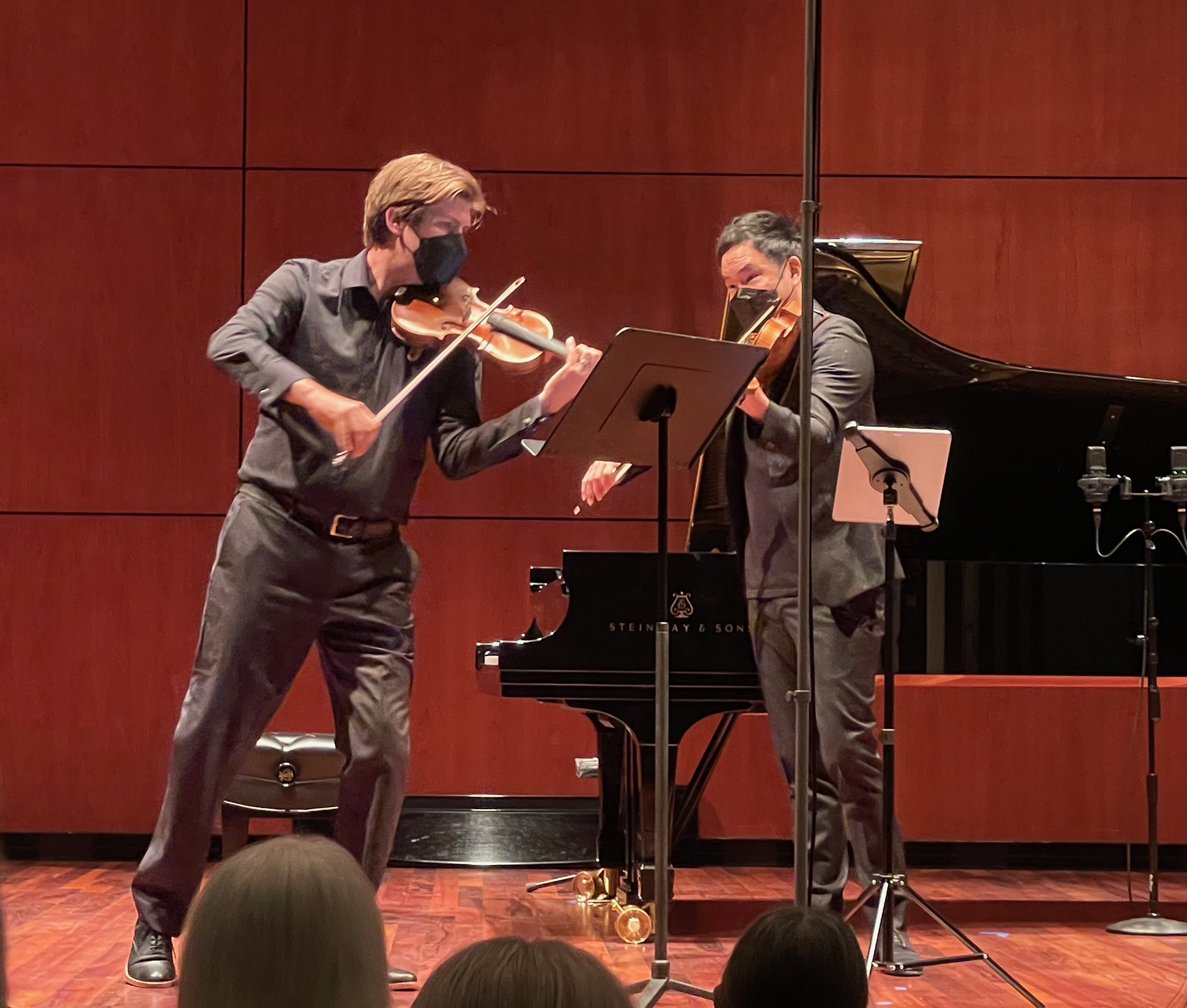
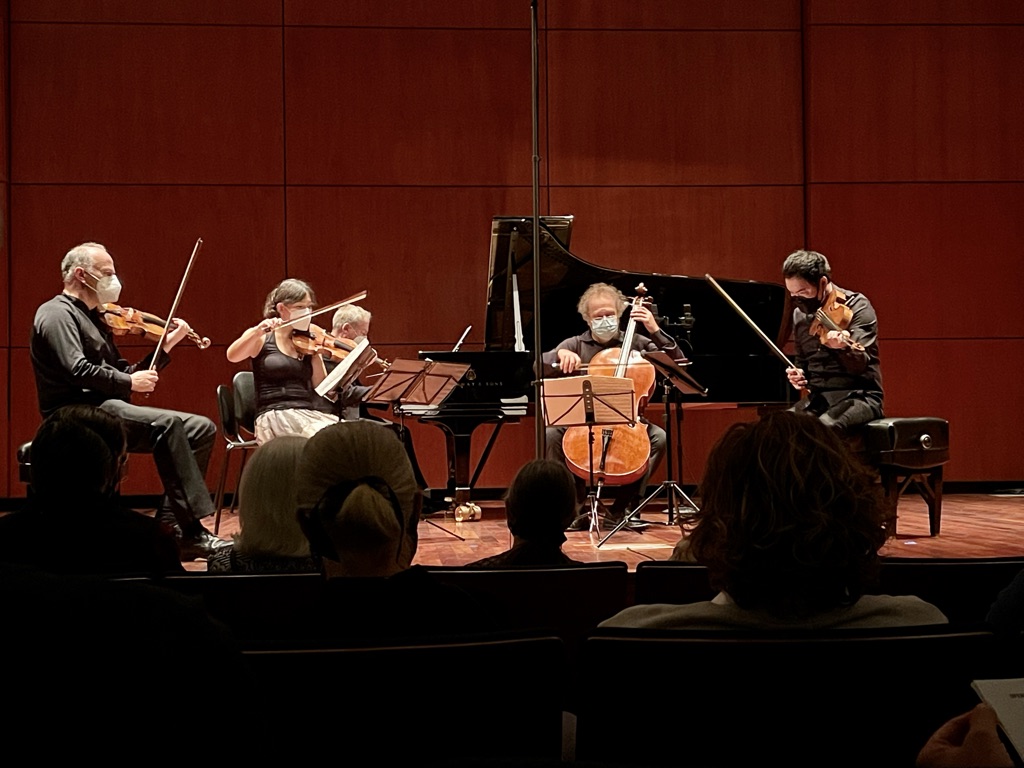
Determined to have the full experience of MOTS both at its Port Angeles venue (Peninsula College’s Maier Hall) and at the Barn, my partner and I caught the Takács Quartet on Sunday afternoon in its repeat of Friday’s opening program. Connected with the Concerts in the Barn series is a moving story of its own involving reconciliation with the descendants of the Japanese American family who had owned the land before they were forced into internment camps in the Second World War. Alan Iglitzin, the legendary violist who founded the Port Townsend-based Olympic Music Festival and cofounded the Philadelphia Quartet, established the series in 1984 in an abandoned dairy barn at Trillium Woods Farm near Quilcene (venue pictured above and just below).

With the Takács, MOTS’s co-founder, the Grammy Award-winning violist Richard O’Neill, was able to present what he has been up to most recently as the newest member of that revered ensemble. He offered some prefatory comments recalling his epiphany in this very space, as a youngster spellbound in the audience on July 3, 1993, when he heard a performance of the Death and the Maiden Quartet and realized he wanted to spend his life making music like this. O’Neill gave a touching tribute to Iglitzin (who remains active as he heads into his 90s), pointing out how his efforts have left a lasting imprint.

Inside the Barn; photo credit J. Gustavo Elias

We found a comfortable spot atop a hay bale for the first half and tried out the loft in back for the second; the acoustics were consistently warm, natural, direct. As far as could be ascertained, this was the first time the Takács Quartet was performing in an actual barn (though O’Neill and violinist Harumi Rhodes had individually appeared in the same space before). The relaxed setting, with audience reclining on the grass outside and listening via speakers, was inversely proportional to the intensity of involvement in the music-making (for the Takács and audience alike).

The program presented three hefty staples of the repertoire, in the process tracing a branch of the Viennese Classical tradition and an early modern offshoot. Melancholy and subdued serenity took the lead at the start of Haydn’s F minor Quartet from the genre-defining Op. 20 set of 1772.

Edward Dusinberre’s exquisite descants in the slow movement had the flexibility of first-rate jazz, blooming across the basic lilt of the siciliana, while ensemble ebb-and-pull at a breakneck pace imbued the double-fugue finale with thrilling emotion. From this kind of realization, it became understandable how Beethoven would later mine such potential from what must have seemed, to contemporaries, the hopelessly antiquated constraints of string counterpoint.

Gears were immediately shifted for Ravel’s sole essay in the genre, the early Quartet in F major from 1903, both modeled on and knowingly independent of Debussy’s contribution from a decade before. O’Neill’s rich, demonstrative viola personality — amply on display as Ravel’s writing ventures ever further into timbral experiment — was but one strand of a winningly characterful account. At one moment of mysterious tremoli, a dulcet breeze wafted through the open barn doors and across the space, a perfectly timed accompaniment.

Time and again, as in András Fejér’s superbly articulated solo work in the cello-centered variation of the second movement of the Schubert, the Takács demonstrated their winning secret of accommodating strikingly individual voices while maintaining coherence and unity of purpose as an ensemble. This is, in large part, the result of the sort of close listening that allowed such an impressive display of dynamic range and control in the Assez vif, as well as such infinite tenderness amid the tempo changes of Ravel’s slow movement.

An intriguingly balletic quality enriched the final movement. Dance of a far more dreadful vividness was the driving force in the last two movements of Schubert’s Death and the Maiden from 1824, to which the concert’s second half was devoted.

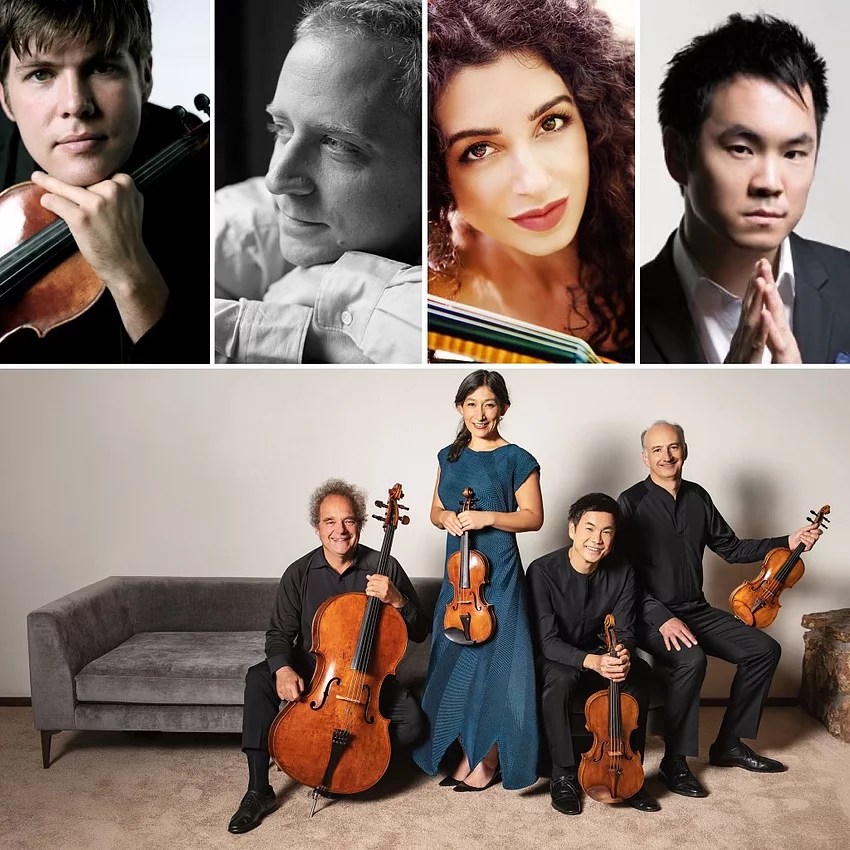
Takács Quartet (Edward Dusinberre, Harumi Rhodes, Richard O’Neill, and András Fejér) ; photo credit J. Gustavo Elias

But the Takács set the stage with a surprising take on the opening movement: here, they almost downplayed the obvious drama and emphasized melodic consolation instead, clinging to Schubert’s Siren-like phrases as if to a life raft. As the afternoon sun stole through a crack in the wood above the players, a gleam briefly lit up the body of Fejér’s cello during the variation movement from which Schubert’s Quartet got its nickname; later, the whispered violin-and-viola reprise of the theme was as chilling as a prolonged death rattle.

The final tarantella kept looping back in terrifyingly relentless repetitions, a nightmare Groundhog Day with no escape in the Takács’ feverish, sweat-soaked rendition.

There is one more weekend to experience the 2021 Music on the Strait Festival; both programs feature Jeremy Denk, James Garlick, Ani Aznavoorian, and Richard O’Neill. Friday’s concert (20 August) is titled A Belated Beethoven Celebration; on Saturday (21 August), the Barn-Burning Brahms finale presents music by Jessie Montgomery, Paul Hindemith, and Johannes Brahms, which will be repeated Sunday (22 August) at 2pm as part of the Concerts in the Barn series in Quilcene.

–Review (c) 2021 Thomas May — All rights reserved

Filed under: chamber music, Music on the Strait, review

Music on the Strait: Opening Weekend, Part 1

James Garlick and Richard O’Neill; image credit: J. Gustavo Elias

In 2018, local sons James Garlick and Richard O’Neill together founded Music on the Strait (MOTS) in partnership with the Port Angeles Symphony, as a summer chamber festival in Port Angeles. The aim is to make chamber music performed by artists of international caliber accessible to residents of the Olympic Peninsula. This marvel-filled region on the “other side” of Puget Sound — paradise for nature lovers — is surprisingly close to Seattle but vastly distant in ethos and even climate. Though only 80-something miles away, Port Angeles requires a substantial day trip from the Emerald City (via either a ferry ride or a longer detour by land).

The prolonged, silent fermata caused by the pandemic intruded after just two years of building up momentum (though Music on the Strait was able to produce two live-stream programs over the past year). Even so, MOTS pulled off an inspired and inspiring opening weekend with a return to live performance at Maier Hall on the main campus of Peninsula College located in Port Angeles. It’s a small, warm, intimate space ideal for chamber music and seemed to be pulsating with anticipation as the audience gathered on Saturday night for the second program of this opening weekend (the first I was able to catch). MOTS required vaccination cards as well as masks, and patrons effortlessly complied.

Garlick is a violinist who hails from Port Angeles itself but is currently based in Minneapolis, while the violist O’Neill, a native of nearby Sequim, has long been a regular presence at the Seattle Chamber Music Society festivals. Earlier this year, O’Neill joined the storied Takács Quartet and won his first Grammy Award for Best Classical Instrumental solo (for his recording of Christopher Theofanides’s Viola Concerto).

image credit: J. Gustavo Elias

The two MOTS cofounders and artistic directors started off the program with a duo for their respective instruments by the Norwegian composer, conductor, and violinist Johan Halvorsen — or rather, Halvorsen’s late-Romantic elaboration on the Sarabande from Handel’s D minor Harpsichord Suite. The harmonic sequence is mighty reminiscent of the ear-wiggy La Folia craze that took Europe by storm centuries ago — hence the nickname “Handel’s Folia” — but Halvorsen’s treatment engraves the music with a tremendously “non-HIP” solemnity that requires its own historically informed practice, so distant has this Victorian era aesthetic become. It was intriguing to hear (and see) Garlick and O’Neill exchange and fuse their notably different playing styles and gestural languages.

Jeremy Denk; image credit: J. Gustavo Elias

Jeremy Denk has close ties to MOTS — he was a featured artist in the inaugural season — and he is cast in a central role in the 2021 edition as well. Though his mask made him appear slightly surreal in the heat of the moment (especially given his fondness for turning from the Steinway to glance at the audience or, later, his fellow musicians), the pianist’s gregarious, stimulating, and entertaining artistic personality was fully on display. Denk prefaced his account of J.S. Bach’s G major Partita No. 5, BWV 829, by describing it as the work of a “wicked, smiling, rambunctious rapscallion” who delighted in confounding the church elders with wild modulations and far-roaming fantasies. And that was just how he played the Partita, emphasizing every moment of wit and invention with a willful, winning eccentricity. It seemed very much of our time, of a desperate need to accentuate how music matters, even at its most playful. Amid all the frolicking, the Sarabande had a directness that was deeply touching.

Denk approached the final Gigue as if it were a study for late Beethoven (admittedly, easier to do with Bach-on-piano). Similarly, he found in Thomas “Blind Tom” Wiggins’s The Battle of Manassas a provocatively avant-garde take on program music and a fascination for sound collage and cluster chords decades ahead of Charles Ives. The piece also calls for spoken (shouted) “tags” from the pianist, with Denk briefly pulling down his mask to announce such events as the approach of the Southern Army in this extraordinary evocation of the 1861 victory of Confederate forces in the First Battle of Bull Run — a musical equivalent of the once-popular panorama paintings that were 19th-century precursors to film.

The Battle of Manassas was part of a set that included Samuel Coleridge-Taylor’s transcription of They Will Not Lend Me a Child (Op. 59, no. 4), played with spacious grandeur and an affectionately meditative account of Scott Joplin’s 1907 Heliotrope Bouquet (cowritten with Louis Chauvin), culminating in one of the North American Ballads by the late Frederic Rzewski. Denk chose Winnsboro Cotton Mill Blues, inspired by a folk song connected to the labor struggle of textile workers at a South Carolina plant in the 1930s. Rzewski’s grinding, machine-like ostinati suggested a provocative counterpart to the “Blind Tom” Wiggins piece — in both cases, Denk thundered relentlessly from the lower depths, using the keyboard to transport us inside the action. But the victory in Rzewski’s mini-epic is intensely rewarding: the emergence of song, of humanity, that hoists itself above brutal, indifferent implacability.

Takács Quartet (Edward Dusinberre, Harumi Rhodes, Richard O’Neill, and András Fejér); image credit: J. Gustavo Elias

Denk joined with the Takács Quartet — another clear win for this edition of MOTS — in a deep dive into Robert Schumann’s Piano Quintet, Op. 44 (which the Takács has recorded with Marc-André Hamelin). They reveled in the enormous diversity of this pathbreaking score’s emotional terrain, at times stretching the flexibility of its language to a near-breaking point. The opening movement, with its outsize exuberance, plummeted into gloom in the funeral march that ensues and which they rendered with a powerfully effective slow burn — seemingly encapsulating the composer’s polar extremes. It’s become a challenge not to read a subtext of our recent collective suffering into these familiar musical journeys — in this case, the nervous pauses and pent-up tensions of the march seemed especially telling. The Scherzo, effusive and ebullient, helped light the way back toward a hope that took root in the finale’s polyphonic splendor, brightening into plausible joy.

–(c)2021 Thomas May — All rights reserved

Filed under: chamber music, Music on the Strait, review

Music on the Strait

MOTSphotos.jpeg

Over at beautiful Port Angeles on the Olympic Peninsula, Music on the Strait opens tonight at 7pm PST with a program of Haydn, Ravel, and Schubert performed by the Takács Quartet. There will also be a free or pay-what-you-can livestream.

On Saturday, Jeremy Denk joins the Takács in Schumann’s Piano Quintet; the program also includes music by Johan Halvorsen plus solo piano works to be announced.

Music on the Strait

Filed under: Uncategorized

Lucerne Festival Launching Tonight: Crazy Times

This evening in Lucerne (at 6.30 pm local time), the 2021 Summer Festival begins with Riccardo Chailly leading the Lucerne Festival Orchestra in a program of Mozart and Schubert. The concert is being streamed on arte.

The summer’s theme, quite aptly for these times, is “Crazy” — the German word verrückt having especially rich connotations that extend from mental imbalance to the dislocations and ruptures that seed a paradigm shift.

more on the Summer Festival

Filed under: Lucerne Festival, music news

Where Ancient Peaks Embrace Old Friends, Music Adds Its Wonder

Donald Runnicles conducted the Grand Teton Music Festival Orchestra in Britten’s ‘Four Sea Interludes,’ Elgar’s ‘Enigma Variations,’ and Carl Vine’s ‘Five Hallucinations’ for trombone and orchestra. (Photo by J. Gustavo Elias)

My report on the 60th-anniversary Grand Teton Music Festival currently under way:

JACKSON HOLE, Wyo. — Even when obscured by smoke drifting in from distant wildfires, the Grand Tetons’ towering peaks command awe. The tallest cluster, which dominates the promotional posters for this summer’s Grand Teton Music Festival, has been dubbed “the Cathedral Group.”

continue

Filed under: festivals, Grand Teton Music Festival, review

Paul Lansky’s Angles

I review Paul Lansky’s latest release in the August issue of Gramophone:

After more than three decades as a computer music pioneer, Paul Lansky made a dramatic change of tack and began composing exclusively for acoustic instruments. This release is Vol 17 in the extensive series from the Bridge label …

continue

Filed under: CD review, Gramophone

A “Guest” Visit from Donald Runnicles at Grand Teton Music Festival

Image (c) J. Gustavo Elias: Sir Donald Runnicles with the Grand Teton Music Festival Orchestra

Gemma New was originally scheduled to make her Grand Teton Music Festival debut conducting this week’s full orchestral program. But when she had to cancel at the last minute, GTMF’s music director Sir Donald Runnicles stepped in to save the day, adding two more concerts to those for which he is already responsible during this 60th-anniversary season.

My full report is forthcoming elsewhere, but in the meantime, even though the remaining performance tonight at 8pm is sold out, you might have luck by getting on the Festival’s waitlist (see here for ticket info and contacts).

The warm bond Runnicles enjoys with the Festival musicians was gloriously evident, moving to behold and experience. He led the orchestra in an account of the Four Sea Interludes from Benjamin Britten’s Peter Grimes — with such a fierce intensity that the entire opera seemed distilled into this purely instrumental music of transition and commentary.

Also on the menu was another Runnicles specialty, Edward Elgar’s Variations on an Original Theme, Op. 36 (aka the Enigma Variations). No matter how often he has conducted this repertoire staple, how often the musicians have delivered it as part of their respective subscription seasons back with their home orchestras, there was no sign of jaded habit, no room for “been-there-done-that” mediocrity.

The loving attention to every detail in Elgar’s score clearly pulled the Walk Festival Hall audience breathlessly in, reaffirming confidence — sorely needed confidence after the long deprivation — in music’s power to transform. (Incidentally, you can get another potent dose of Runnicles’s affinity for Elgar in an account of the Symphony No. 1 with the Berliner Philharmoniker from 2011, available in the Digital Concert Hall.)

The Britten and Elgar framed the evening’s contemporary work, Five Hallucinations for Trombone and Orchestra by the Australian composer Carl Vine. The work was commissioned for GTMF Orchestra’s principal trombonist (and fellow Australian) Michael Mulcahy and premiered in Chicago in 2016. It makes a solid addition to a rare repertoire, taking for its inspiration case studies described by Oliver Sacks.

Vine describes his starting point: “Hallucinations are fascinating phenomena – instantaneous random inventions of our brains overlaid on the sensation of common reality and indistinguishable from it…. Sufferers of brain damage or a range of neurological disorders regularly hallucinate. Others without mental illness but under great stress or fatigue can also hallucinate, as of course can those who use psychotropic drugs. It is this bridge between the real world and some of the surprising ways in which our brains interpret the mundane reality around us that I find endlessly fascinating.”

Filed under: Donald Runnicles, Grand Teton Music Festival, Uncategorized

Hitting the Sweet Spot: Third Coast Percussion at Grand Teton Music Festival

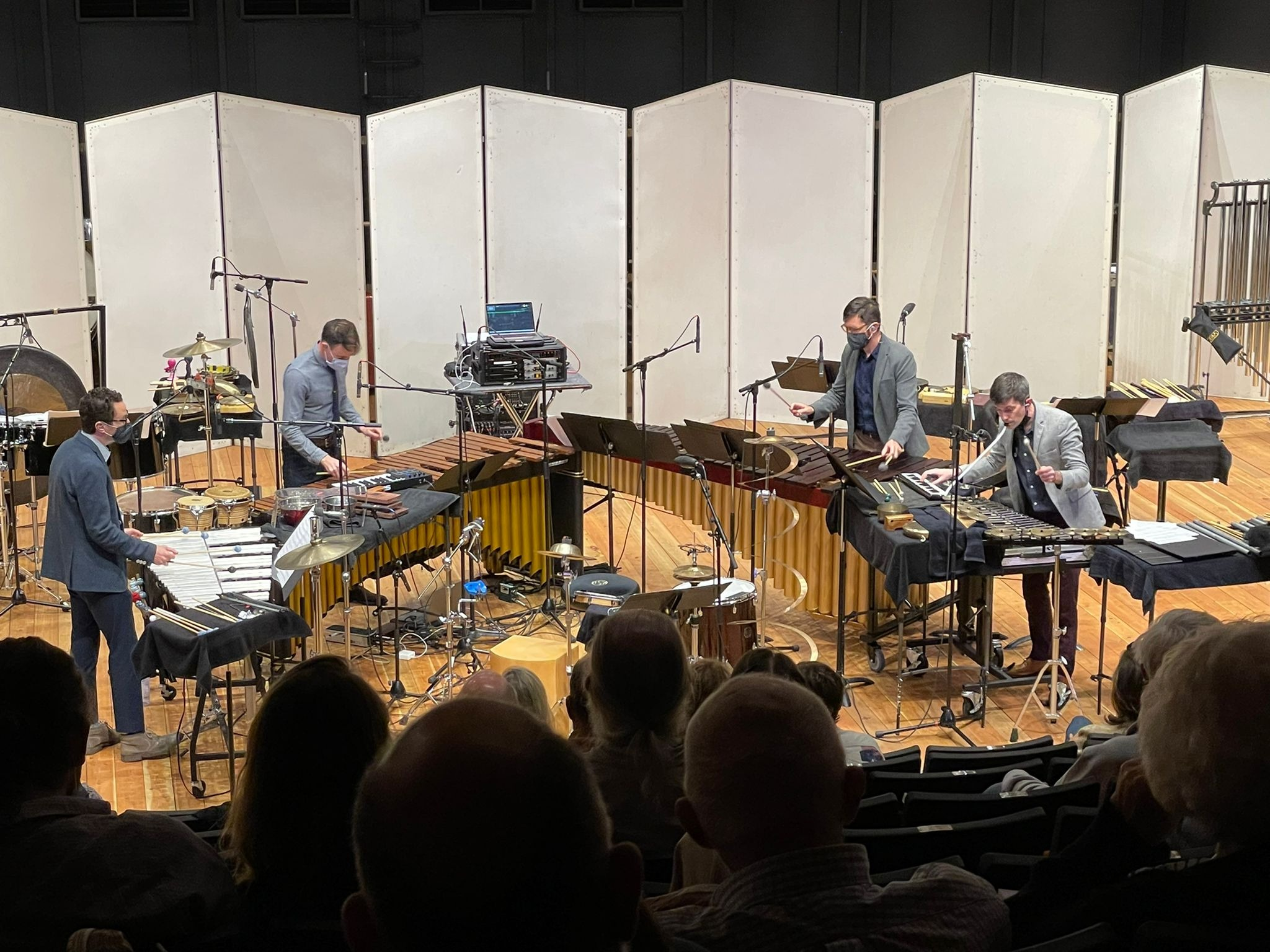
Photo (c) Jorge Gustavo de Araujo Elias Third Coast Percussion: David Skidmore, Robert Dillon, Peter Martin, and Sean Connors

Week 4 of the Grand Teton Music Festival continued with an enthusiastically received performance by Chicago-based Third Coast Percussion making their Festival debut. Presented without intermission, the concert unfolded with unflagging energy as each member of the quartet — David Skidmore, Robert Dillon, Peter Martin, and Sean Connors — took turns introducing the selections.

The entire program consisted of living composers — indeed, composers with whom Third Coast has collaborated. Their style of music making overall synthesizes a kind of surgical precision with frenetic spontaneity — and that intriguing blend is mirrored by their exciting visual performance, a virtuoso choreography that is functional and at the same time abstractly alluring.

These are artists who make music by hitting things, their bodies acting, reacting, incorporating the sounds they produce. At times the performance resembled a wild physics experiment trying to calibrate new sources of energy. Expressivity as energy, in different shapes and contours, certainly characterized their renditions of Clarice Assad’s The Hero, one of the 12 “archetypes” from their most recent album of the same name. Likewise for the extensive, four-movement Percussion Quartet by Danny Elfman, which contained some of the unexpected-but-just-right harmonic progressions familiar from his signature film scores.

Metamorphoses, the name of one of Third Coast’s ongoing projects, is also the title of some of Philip Glass’s best-known pieces (from his 1989 Solo Piano album). The ensemble’s arrangement of Metamorphosis 1 for percussion quartet, created in consultation with Glass, reminded me of the composer’s Baroque affinities with its chaconne-like eternal recurrence. Especially intriguing in this transcription — despite an obbligato solo for melodica that seemed to dissipate some of the piece’s haunting solemnity — were the carefully prepared shifts in dynamic shading.

A good part of the aesthetic interest in this concert involved connecting the vast armamentarium of instruments — tuned and untuned, made of metal or wood, acoustic or digitally manipulated — with the specific sounds produced. Devonté Hynes’s Fields, which originated as a commission from Hubbard Street Dance and choreographer Emma Portner, made a striking, joyful impression; the album garnered several nominations in the 2021 Grammy Awards. Also known as Blood Orange, Hynes (a British multi-instrumentalist, singer, songwriter, and record producer as well as composer) made his “classical” debut with this Third Coast Percussion collaboration.

The program ended with a long, suite-like offering of pieces by Jlin (Jerrilynn Patton), an electronic musician and producer from Gary, Indiana. These came from a seven-movement project titled Perspective — debuting here ahead of the postponed Carnegie Hall premiere — and showcased a feverishly inventive imagination. Jlin’s music juxtaposes a universe of samples and sound colors worthy of Stravinsky, exploding with complex rhythmic counterpoint and exuberant variety. In her own words, Jlin’s compositions are “clean, precise, and unpredictable.”

–(c)2021 Thomas May – All rights reserved

Filed under: Grand Teton Music Festival, Third Coast Percussion

A Homecoming for the Grand Teton Music Festival

Photo (c) Jorge Gustavo de Araujo Elias. Pictured: Elisabeth Remy Johnson, harp; Mercedes Smith, flute; Zach Boeding, oboe; Marci Gurnow, clarinet; Madeline Sharp, viola

It’s only my first time in these parts, but already I can understand the deep, magnetic sense of connection that draws people back here again and again. Upon passing through the elk antler arch at Jackson Hole Airport (the only U.S. airport located within a national park, incidentally), I soon began to feel the charm of a place that hasn’t been flattened out by plastic predictability. Even with lingering smoke from the latest Western fires imposing a thin pall, the capacity for this landscape to inspire awe was undimmed.

With its marriage of valley and dramatic, looming scarps, it’s obvious how the Jackson Hole area beckoned as an ideal spot to make music. The Grand Teton Music Festival opened on 2 July, following the all-too-familiar hiatus, and is now into Week 4 of a seven-week season — which also marks the Festival’s 60th anniversary.

Last night I began with the first of the week’s offerings, a chamber music evening at Walk Hall, GTMF’s home performance space. It was decently attended, taking into account the reduced-capacity seating plan and a sudden shift in mask policy. (Just last night, in the wake of the new CDC announcement, the official recommendation switched to suggesting that vaccinated and unvaccinated people both wear masks indoors.)

Part of a series curated — and engagingly introduced by — Adelle Eslinger Runnicles, the concert presented a flavorful sampling of periods and instrumental formations, starting with a transcription by Phil Brink for low brass of J.S. Bach’s D minor Chaconne from the Partita No. 2 for solo violin (Michael Mulcahy, trombone; Jared Rodin, trombone; Craig Mulcahy, trombone; Jay Evans, trombone; JáTtik Clark, tuba). The Baroque fondness for transcription aside, Bach’s masterpiece sounded of a different era — not Romantic exactly, but funereal, ritualistic, the opening to new vistas in the later variations remarkably fluid and gentle.

Unmistakably Romantic phrasing beguiled in Saint-Saëns’s Fantaisie for Violin and Harp, Op. 124, featuring
Eunice Keem on violin and Elisabeth Remy Johnson on harp. Exquisitely balanced and fully engaged in playing off each other, the duo cast a spell throughout this late-period piece’s range of moods.

Johnson also performed in Kimberly Osberg’s Just Another Climb,* joined by colleagues Mercedes Smith on flute, Zach Boeding on oboe, Marci Gurnow on clarinet, and Madeline Sharp on viola. If the Saint-Saëns suggested a leisured dreamscape, Just Another Climb packed the punch of an involving musical short story, its impact belying the brevity of the piece’s duration (about four minutes) — and making this a real highlight of the evening.

The young, Portland, Oregon-based Osberg, who was present in the audience, was inspired by the feat of the first “manless” ascent of the Grand Teton made in 1939 by Margaret Bedell, Anne Sharples, Margaret Smith Craighead, and Mary Whittemore — upon which achievement Craighead remarked: ” Craighead wrote: “This may have been of importance to the record of events, but to us it was just another climb.”

This first performance before a live audience emphasized Osberg’s colorfully individualistic writing for each component of the ensemble. The result was an assuredly paced musical storytelling that found freshness in a diatonic idiom, using evocative gestures to hint at but not dictate a plausible narrative. I’m eager to learn more about this composer and hear what she can accomplish with a longer form.

The program’s brass theme sets the stage for the main new work on this week’s orchestral concert,  Five Hallucinations for Trombone and Orchestra by Carl Vines. It returned in John Stevens’s Triangles for horn (Josh Phillips), trombone (Jay Evans), and tuba (JáTtik Clark), a piece from 1978 that (not always convincingly) juggles with jazz vernacular.

Concluding the program was a rendition of Beethoven’s C minor String Trio from the Op. 9 set by violinist Louise Morrison, violist Chiara Kingsley Dieguez, and cellist Thomas Carpenter that reveled in the tension between the first movement’s ominous energies and the halcyon release of the Adagio. The long time away from live performance could be sensed in some issues of balance and phrasing, but the richness of this score — Beethoven declared these trios among his finest compositions of the period — came through, most notably in the spidery enigma of the concluding measures.

–(c) 2021 Thomas May All rights reserved

*

Filed under: Grand Teton Music Festival, music news

Archive

Enter your email address to follow this blog and receive notifications of new posts by email.