There was a lot of excitement in the air at the opening of San Francisco Opera’s new production of Fidelio, which had been delayed for a year for obvious reasons. Here’s my review for Musical America:
Byron Schenkman & Friends launch their ninth season on Sunday, 17 October, with the program Joy and Sorrow Across the Waters. It promises to be a fascinating program, presenting traditional music and stories of the Coast Salish People alongside 17th-century European Baroque music for violin and harpsichord from Spain, Italy, Germany, and the Netherlands. The performers include Native American flutist Paul Chiyokten Wagner, Ingrid Matthews, and Byron Schenkman.
The beloved Seattle-based pianist Judith Cohen will be joined Jill Timmons, Terry Spiller, and Dean Williamson for an intriguing edition of the Governor’s Chamber Music Series on Sunday, 10 September, at 3pm at the Meydenbauer Center in Bellevue, WA. Titled Two Pianos, 40 Fingers, the eight-hands program includes music by Liszt, Debussy, Ravel, Piazzolla, and more.
This week’s concerts — which were originally scheduled to introduce Francisco Coll’s violin concerto for Patricia Kopatchinskaja — are instead presenting the PNW premiere of Fandango by the Mexican composer Arturo Márquez, written for Anne Akiko Meyers (shown in the video above performing the premiere of Adam Schoenberg’s Orchard in Fog with the San Diego Symphony and Sameer Patel).
Meyers premiered Fandango to acclaim in August at the Hollywood Bowl, with Gustavo Dudamel leading the Los Angeles Philharmonic. The Seattle Symphony, led by guest conductor Giancarlo Guerrero, is performing the concerto again on Saturday at 8.00pm PST, along with Rachmaninoff’s SymphonicDances and Rossini’s Overture to Semiramide.
SSO is also making the stream of Thursday’s performance available to watch until 14 October here (Fandango starts at 18:15).
“The Fandango is known worldwide as a popular Spanish dance and specifically, as one of the fundamental parts (Palos) of flamenco. Since its appearance around the 18th century, various composers such as S. de Murcia, D. Scarlatti, L. Bocherini, Padre Soler, W. A. Mozart, among others, have included Fandango in concert music. What little is known in the world is that immediately upon its appearance in Spain, the Fandango moves to the Americas where it acquires a personality according to the land that adopts and cultivates it. Today, we can still find it in countries such as Ecuador, Colombia and Mexico, in the latter and specifically in the state of Veracruz and in the Huasteca area, part of 7 states in eastern Mexico, the Fandango acquires a tinge different from the Spanish genre; for centuries, it has been a special festival for musicians, singers, poets and dancers. Everyone gathers around a wooden platform to stamp their feet, sing and improvise tenth-line stanza of the occasion. It should be noted that Fandango and Huapango have similar meanings in our country.
In 2018 I received an email from violinist Anne Akiko Meyers, a wonderful musician, where she proposed to me the possibility of writing a work for violin and orchestra that had to do with Mexican music. The proposal interested and fascinated me from that very moment, not only because of Maestra Meyers emotional aesthetic proposal but also because of my admiration for her musicality, virtuosity and, above all, for her courage in proposing a concert so out of the ordinary. I had already tried, unsuccessfully, to compose a violin concerto some 20 years earlier with ideas that were based on the Mexican Fandango. I had known this music since I was a child, listening to it in the cinema, on the radio and listening to my father, a mariachi violinist, (Arturo Márquez Sr.) interpret huastecos and mariachi music. Also since the 90’s I have been present admiring the Fandango in various parts of Mexico. I would like to mention that the violin was my first instrument when I was 14 years old (1965), curiously, I studied it in La Puente California in Los Angeles County where fortunately this work will be premiered with the wonderful Los Angeles Philharmonic under the direction of my admired Gustavo Dudamel. Beautiful coincidence as I have no doubt that Fandango was danced in California in the 18th and 19th centuries.
Fandango for violin and orchestra is formally a concerto in three movements:
Folia Tropical
Plegaria (Prayer) (Chaconne)
Fandanguito
The first movement, Folia Tropical, has the form of the sonata or traditional classical concert: Introduction, exposition with its two themes, bridge, development and recapitulation. The introduction and the two themes share the same motif in a totally different way. Emotionally, the introduction is a call to the remote history of the Fandango; the first theme and the bridge, this one totally rhythmic, are based on the Caribbean “Clave” and the second is eminently expressive, almost like a romantic bolero. Folias are ancient dances that come from Portugal and Spain. However, also the root and meaning of this word takes us to the French word “Folie”: madness.
The second movement: Plegaria pays tribute to the huapango mariachi together with the Spanish Fandango, both in its rhythmic and emotional parts. It should be noted that one of the Palos del Flamenco Andaluz is precisely a Malagueña and Mexico also has a huapango honoring Malaga. I do not use traditional themes but there is a healthy attempt to unite both worlds; that is why this movement is the fruit of an imaginary marriage between the Huapango-Mariachi and Pablo Sarasate, Manuel de Falla and Issac Albeniz, three of my beloved and admired Spanish composers. It is also a freely treated chaconne. Perhaps few people know that the Chaconne as well as the Zarabanda were two dances forbidden by the Spanish Inquisition in the late 16th and early 17th centuries, long before they became part of European baroque music. Moreover, the first writings on these dances place them in colonial Mexico of these centuries.
The third movement “Fandanguito” is a tribute to the famous Fandangito Huasteco. The music of this region is composed of violin, jarana huasteca (small rhythm guitar) and huapanguera (low guitar with 5 orders of strings) and of course accompanies the singing of their sones and the improvisation sung or recited. The Huasteco violin is one of the instruments with the most virtuosity in all of America. It has certain features similar to baroque music but with great rhythmic vitality and a rich original variety in bow strokes. Every Huasteco violinist must have a personal version of this son, if he wants to have and maintain prestige. This third movement is a totally free elaboration of the Huasteco Fandanguito, but it maintains many of its rhythmic characteristics. It demands a great virtuosity from the soloist, and it is the music that I have kept in my heart for decades.
I think that for every composer it is a real challenge to compose new works from old forms, especially when this repertoire is part of the fundamental structure of classical music. On the other hand, composing in this 2020 pandemic was not easy due to the huge human suffering. Undoubtedly my experience with this work during this period has been intense and highly emotional but, I have to mention that I have preserved my seven capital principles: Tonality, modality, melody, rhythm, imaginary folk tradition, harmony and orchestral color.”
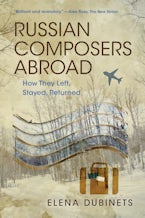
The much-anticipated new book by the eminent musicologist and artistic programming genius Elena Dubinets has just been published: Russian Composers Abroad: How They Left, Stayed, Returned. I had the honor of contributing one of the cover blurbs for this study of a century of Russian émigré composers (especially from the 1970s on) and diasporic identities.
As Vice President of Artistic Planning and Creative Projects for Seattle Symphony, Elena Dubinets not only played a decisive role in shaping that institution — its international profile grew significantly under her tenure — but left a mark the American orchestral field generally.
To Seattle’s loss, Dubinets left the SSO just before the pandemic and has only recently embarked on a new path as Artistic Director of the London Philharmonic. The LPO is going through an exciting period of transition as it returns to live performances under its new Chief Conductor, Edward Gardner.
Heartiest congratulations to an artist I have admired for many years. James Ehnes was named Artist of the Year at Gramophone’s recent annual awards ceremony. Charlotte Gardner writes eloquently of the violinist’s extraordinary recent accomplishments in a complete Beethoven sonata set as well as his pandemic project recording the Bach and Ysaÿe solo violin works: “Ehnes’s warm, golden sound is as much a constantly changing story of articulation and timbre as ever, but sounding even more emotionally up close and personal than ever before…”
It’s deeply gratifying to see such a deserving artist receive this distinction. Here’s the playlist Gramophone has put together in conjunction with this award:
BUCHAREST, Romania — Romania has a long record of defying the catastrophes history has served up, so it certainly would not allow the pandemic to derail the George Enescu International Festival, devoted to its premier musical native son, which ended on Sunday. At stake was not only the 25th edition of this country’s largest cultural event, but also the renewal of a global artistic exchange that this still-marginalized part of Europe considers essential to its development…
Composer Carlisle Floyd, widely viewed as a founding father of American opera, died Thursday at age 95 in Tallahassee, Fla. His death was announced by his publisher, Boosey & Hawkes, which did not share the cause of his death.
I’m a big fan of A Public Space’s online book club. Recently, APS began hosting an encore club to reread War and Peace with Yiyun Li, author of Tolstoy Together: 85 Days of War and Peace.
For reference, here are some quick links:
All of Yiyun Li’s daily posts are here; perspectives on the issue of translation, historical context, Tolstoy as a stage director, etc., here and here.
From A Public Space:
#TolstoyTogether | September 15 – December 8 An Online Book Club—Free and Open to All
The Schedule. We will read together daily for 85 days. A gentle schedule: 12-15 pages a day, around 30 minutes, that can provide an anchor this fall, when transitions bring hope, thrill, and sometimes uncertainty. Find the reading schedule here.
How It Works. The book club is free and open to all. Every morning, Yiyun Li shares notes on the day’s reading on A Public Space’s Twitter and Instagram accounts (@apublicspace) with the hashtag #TolstoyTogether. Readers share their thoughts and responses, and ask questions using #TolstoyTogether.
The recently concluded BBC Proms concerts are available online. Here’s a guest review of the 2021 edition of the Proms by Tom Luce:
BBC PROMENADE CONCERTS 2021: REVIVAL OF PUBLIC MUSIC-MAKING DURING THE PANDEMIC
Last year, in compliance with pandemic restrictions, the BBC had to limit both the number and accessibility of its annual Promenade Concert Festival concerts. There were fine and interesting concerts as usual in London’s huge Albert Hall. They were all broadcast but had no public audiences present.
This year, with great skill and imagination, the BBC has achieved a full program which complies with pandemic public health precautions. The Albert Hall stage was enlarged so that orchestral members could social distance from each other and the audience, and the public were admitted after showing proof of double vaccination or negative Covid tests. So nearly a year and a half after the near closure of public music-making, it has been revived.
The 46 concert programs had great diversity in content and performers. The classical composers and their modern successors were fully represented, but there was also a lot of non-European music and popular and folk-based items. How many festival programs have included not only Bach’s St. Matthew Passion and Wagner’s Tristan und Isolde, along with the usual Beethoven, Brahms, Mozart, Stravinsky, etc., but also music by Florence Price and Gity Razaz, n accordionist playing a Piazzolla tango, an evening devoted to a jazz saxophonist and composer, and another to the Golden Age of Broadway?
International travel restrictions meant that nearly all performing groups were based in the UK. As well as the BBC’s own and other regular British orchestras, a fine concert was provided by the Chineke! orchestra, and a chamber group consisting largely of members of the Kanneh-Mason family (cellist Sheku having memorably played Tchaikovsky’s Rococo Variations with the Seattle Symphony three years ago), which delivered a charming performance of Saint-Saëns’s Carnival of the Animals.
All of the concerts remain internationally available on BBC Sounds until mid-October. It’s hard to pick those most worthwhile to hear out of such a fine collection. My own preferences include a wonderful St. MatthewPassion performance by the Baroque-style Arcangelo group under their founder and director Johnathan Cohen, who with excellent soloists delivered both the dramatic crowd interventions and the intimate and reflective arias and recitatives with equal effectiveness (9 September); a magnificently played and conducted Tristan und Isolde from the Glyndebourne Festival (3 September); John Eliot Gardiner’s Monteverdi team in a Bach cantata and a stunningly energetic performance of Handel’s DixitDominus (1 September); Simon Rattle and the London Symphony in a Stravinsky program (22 August); a fine delivery of Mahler’s Fifth Symphony by an orchestra of pandemic-impoverished freelance musicians specially brought together by the BBC (8 September); the Chineke! Orhcestra’s fine evening with rarely performed but very welcome music by Florence Price, Samuel Taylor Coleridge Taylor, and Felo Sowande, as well as a Vivaldi concerto (24 August); and a superb rendering of Mozart’s last three symphonies by the Scottish Chamber Orchestra (1 August).
In accordance with British tradition, the first and last nights were national events. I have elsewhere described the first night’s programming as very suitable to pandemic circumstances. A remarkable feature of the last night was a beautiful choral arrangement of Samuel Barber’s Adagio for Strings. Arranging the words from the Agnus Dei (“Grant them rest……….Grant us peace”) to this celebrated expression of grief was a wonderful addition to a public concert occurring on 9/11, 20 years after the tragic events in the USA — a commemoration subtly conveyed by Hall ushers gently lifting the Stars and Stripes as it was sung.
All of the concerts I observed were attended by thousands in the Albert Hall, who responded very strongly, and these performances were no doubt heard by millions via radio. To experience such a public revival of real concerts and the profound effect of music on society has reminded me of two historic observations on music’s importance:
-Plato’s comment: “Music is a moral law. It gives soul to the universe and wings to the mind, flight to the imagination, and charm to sadness and gaiety to life and to everything”.
-”Musica: Laetitia comes medecina dolorum” (“Music: pleasure’s companion: grief’s remedy”), the inscription on the virginal in Vermeer’s painting The Music Lesson.



 MEMETERIA by Thomas May